Pawel Krolas, Janne Heilala (2023). Life cycle opportunity based on implementation of Quality Management Systems. In: Human Aspects of Advanced Manufacturing. AHFE Open Access, vol. 80, pp. 57–66. https://doi.org/10.54941/ahfe1003508
Mico and macro environment creates opportunities and threats for the organization. Enterprise identifies the opportunities to take advantage for the business either intentionally or unintentionally. Organization which focused on taking advantage from the opportunities increase the chance of taking advantage of them. Opportunity is understood as a favorable situation for the subject of action. The ability to use the opportunity creates a framework for establishing cooperation between the company and the client. `The article presents a theoretical and practical approach to the opportunity. The theoretical part presents the idea of the opportunity, meaning and its importance for the organization. The paper presents life cycle opportunity which creates framework for establishing cooperation between supplier and a client. The practical part shows a case study based on the development and implementation of a Quality Management Systems in a selected organization. The work done for the organization has been assessed by the external certification body. Implementation of Quality Management Systems enabled to establishment a long-term cooperation based on annual action that should be taken according to the selected elements of ISO systems.
Enterprises taking specific actions are guided by the possibility of achieving benefits through the optimal use of resources and skills that can significantly reduce the risk and increase achieving particular objectives. The environment in which the company operates creates opportunities and threats. Oppor- tunities are related to the ability to capture favorable conditions to take a new, often risky action that will allow to gain a competitive advantage in the long term. Opportunities occur in a wide range of events surrounding the enterprise and are usually unstructured in the initial phase. Capturing and using them depends on the individual skills of the entrepreneur, as well as the acceptance of the associated risk (Królas, 2019).
Opportunities occurring in the company’s environment create a certain life cycle. Opportunities with a short life cycle require decisions to be taken in the short term, without detailed identification and risk assessment. In the case of a long life cycle, the time to make a decision and carry out a risk analysis
related to the use of an opportunity is longer than in the case of a short cycle. Also, the number of companies potentially interested in taking advantage of the opportunity is increasing (Królas, Włodarkiewicz-Klimek, 2015a).
Life cycle opportunity creates the conditions to establish the cooperation between supplier and client. Such kind of the cooperation could be single or cycle. Single cooperation gives the possibility just to gain a profit and look for another client. Cycle cooperation requires resources and competence to meet client expectations. The use of single opportunity creates the possibili- ties to establish long term cooperation between the organizations based on cycle action that should be done according the specific subject. Every next opportunity could deliver the values to the supplier:
The same as the first opportunity,
Bigger value then the first opportunity,
Lower values then the first opportunity.
Regardless of the value delivered, further cooperation creates “win-win” situations both to the supplier and to the clients. Supplier is able to get more or less precise portfolio of the orders from the client in specific time period. The client gets good quality of product or service that the supplier is able to deliver.
OPPORTUNITY AND ITS MEANING The phenomenon of opportunity is of interest to various scientific disci- plines from microeconomics through strategic management or the resource theory (Hunter, 2013). Opportunities can be both objective and subjective. It depends from organizations perceptions. In the subject of the literature there is different understanding of the opportunity definition. Hang, Garn- sey and Ruan (2013) presents the point of view, that opportunities are discovered as well as created by enterprises. Alvarez and Barney (2007) things that opportunities exist regardless of the actions and perceptions of the company. Ardichvili et al. (2003) suggest that opportunities can be identified to some extent, but they are essentially developed in the course of the organization’s deliberate activities and not found by acci- dent. The occurrence of an opportunity may be the result of intentional actions of the enterprise or may be related to the element of surprise (Shane, 2000). Kirzner (1997) believes that opportunities can be disclosed without deliberate searches because enterprises have the necessary readi- ness and resources to seize them. Organizations can create a situation by acting, combining various resources, making changes without much invo- lvement in the process of looking for opportunities (Peiris I. et al., 2013). Krupski (2008) notes that opportunities appear, last for a while, and then disappear.
Trzcielinski (2011) understands by opportunity a situation that favors the subject of action in achieving the intended goal or desired effect, which exists in the surroundings of this subject or is a postulated state of the fea- tures of this environment. Opportunity constitutes a set of positive events in the environment that can be used by the company (in order to gain
Life Cycle Opportunity Based on Implementation of Quality Management Systems 59
benefits) thanks to the ability of configuring the necessary resources (Krolas, Włodarkiewicz-Klimek, 2015b).
Regardless of how the opportunity is perceived, the factors that determines its use is the time needed to configure the necessary resources. Due to the duration, opportunities are limited and create a certain life cycle.
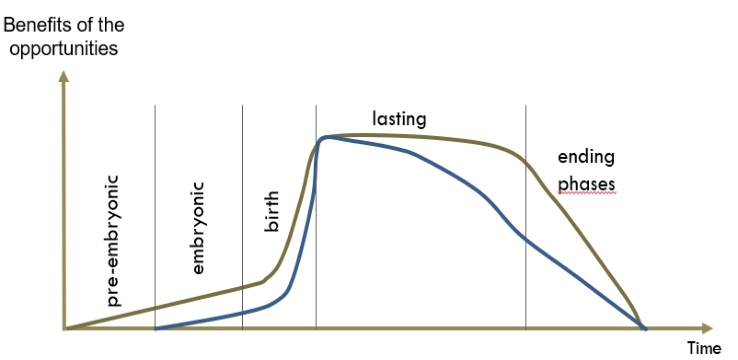
LIFE CYCLE OPPORTUNITY The life cycle of the opportunity itself is related to the industry and the envi- ronment in which the company operates. The life cycle of an opportunity depends on the certainty of the favorable situation and its duration – Figure 1.
Life cycle opportunity consist from particulate phases (Trzcielinski, 2011):
pre-embryonic - in this phase future events arise, often with a very long- time horizon, which may be beneficial for the enterprise,
embryonic - this phase concerns the occurrence of events that could be the basis for the emergence of other situations considered as a interesting for the organizations,
birth - occurring events cause the occurrence of a favorable situation. The situation may be complete, understood as an opportunity or incomplete. It this case it could be a chance for the enterprise,
lasting - the duration of an opportunity may be related to many factors beyond the enterprise’s control,
decline - this phase may occur in the case of a lack of available resources, a change in the factor determining the opportunity.
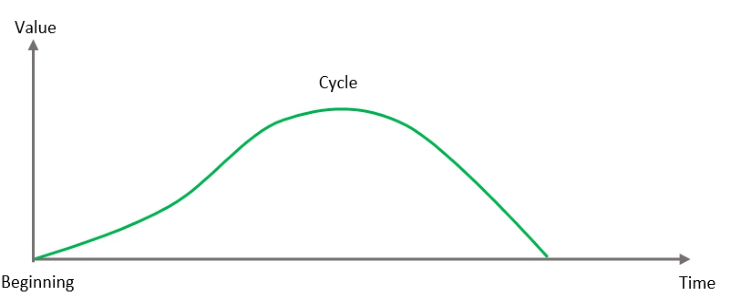
Taking advantage from the life cycle create beginning of the cooperation between supplier and a client. Such kind of the partnership has got particular beginning and end – Figure 2.
Figure 2 presented cooperation between supplier and customer. On one side there is a value for the supplier understand as getting new client or returning client, building the position on the market, generate a profit to
Figure 1: Life cycle opportunity (source: Trzcielinski, 2011, pp. 60).
60 Krolas and Heilala
Figure 2: Cooperation between supplier and customer (sources: based on own study).
the organization. At the very beginning of the cooperation there is rather low value which increase in the middle and decrease in the end of the cooperation. There could be also other workload related to the project which is implemen- ted. It depends from individual venture. On the other side there is life time of the cooperation. It depends from the scope of the cooperation and also availability of resources needed to be used during the cooperations.
The area of the cooperation between supplier and customer depends from the sector of the industry. In the Quality Management Systems there are 3 basic units cooperating with each other:
Client – the unit where the Quality Management System is introduced,
Advisor company – organization that implement the QMS in client organization,
Certification body – organization that issues a certificate of compliance with particular requirements.
Over the years, the number of certificates and also specific quality mana- gement systems has changed.
QUALITY MANAGEMENT SYSTEMS The beginnings of 1990 took place the first implementations of the ISO’s qua- lity management system (QMS) in polish organizations. Mainly, the large, production organizations decided to work according to the ISO standards. Thanks to it the enterprises were able to improved processes, objective orien- tations, competence of the people and establish cycle action required by ISO specifications (Królas, 2020). In the year 2000 and later also medium and a small organization started to introduce ISO systems; not only ISO 9001 but also Environmental Management Systems – ISO 14001 and Occupational Health and Safety Management Systems - PN-N-18001 (actual ISO 45001). The numbers of the certificates received by polish organizations through the last years changed Table 1.
The most popular standard in Poland is Quality Management System ISO 9001:2015. Very often one of the conditions to get public tender is to possess
Life Cycle Opportunity Based on Implementation of Quality Management Systems 61
Table 1. Number of certificates in Poland between 2017–2021 (source: own study based on www.iso.org).
Table available in the original PDF paper.
ISO 2017 2018 2019 2020 2021 2021/2020 % 11846 11 294 11460 10219 10512 +2 % Quality Management System ISO 9001:2015
2885 2921 3466 2748 2831 +3 %
Environmental Management Systems ISO 14001:2015
705 700 652 710 876 +23 %
Information Security Management System ISO 27001:2017
- 83 257 1141 1646 +44 %
Occupational Health and Safety Management Systems ISO 45001:2018
173 139 141 178 250 +40 %
Energy Management System ISO 50001:2018
ISO 9001 standard by the organization. The number of the certificates issued by certification bodies in 2021 was 10512. Taking into the consideration year 2021 and 2020 it is possible to notice very slow increase 2 %. The tendency through last 5 years estimated between 10 000 and 12 000 issued certificates.
Quite similar situation is dealing with Environmental Management Systems – ISO 14001. There is 3 % increase year to year (2021/2020) of issued certificates. The value oscillated between 2885 up to 3466 issued certificates in the time period 2017-2021.
Information Security Management System ISO 27001:2017 has got incre- ase 23 % from 2021 and 2020. Although the number of the certificates is not so large as in ISO 9001 or ISO 14001 it is possible to notice increase tendency. The organizations are taking into the consideration importance of safety dealing with software and hardware in business activity.
The situation of the Occupational Health and Safety Management Systems ISO 45001:2018 and Energy Management System ISO 50001:2018 is quite similar. The standard was published in 2018. The organization had 3 years to introduce new version on the standard. Thanks to it year by year the numbers of certificates rise achieving 40 % with compering 2021 and 2020.
Presented Table 1 based on certificate issued by certification bodies. There is a lot of organization that introduce different kind of ISO standards, mainte- nance the requirement of ISO. Because of the high cost some of organizations do not join certification body audits.
Due to the certification requirement’s Quality Management Systems chara- cterised by cycle action that must be taken at least one a year to maintain the certificate. Such activities include: audits and management reviews. These actions could be done by the organization or by external advisor unit. In both cases needed competence are required. In small and medium business more often are used external advisor company. Large organization could pro- vide needed found to secure the required competencies to the people dealing
62 Krolas and Heilala
with QMS standards. Thanks to it, large organization could do action by themselves dealing with cycle action in QMS.
CASE STUDY The research was conducted in advisor company – SIMPTEST Poznan1 which implemented Quality Management Systems (QMS) in Alpha organization. The specialization of Alpha2 based on installation, service and maintenance of wind turbines as well as the repair of blades. Over the years organization Alpha performed all over the world engaged in projects in whole Europe, Africa and Asia where installed more than 1.000 wind turbines.
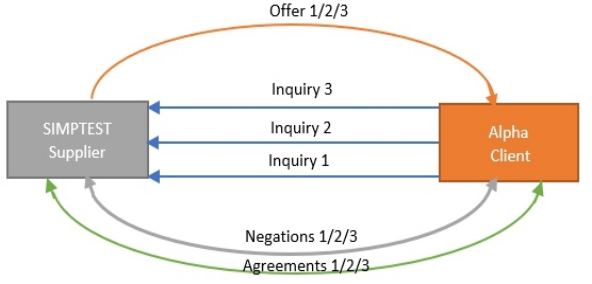
The aim of research was to present implementation of Quality Manage- ment Systems which was made by SIMPTEST Poznan in Alpha organization as an element of life cycle opportunity Figure 3.
Figure 3: Cooperation between the companies (source: own study).
The research took please between 2020 and 2022. During this time advisor company introduce Quality Management Systems – ISO 9001, ISO 14001, ISO 45001 in Alpha organization.
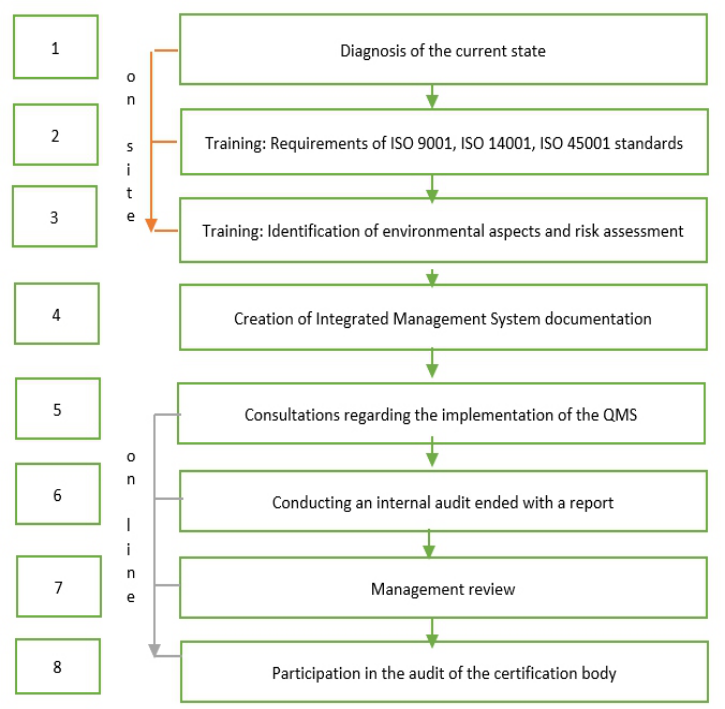
One of the authors of the publication was Project manager of the develo- pment and implementation of QMS in Alpha organization– Figure 4.
The implementation consisted from several phases:
Diagnosis of the current state (1) - the first phase based on analysis of present state. The advisor company got familiar with the scope of the enterprise Alpha activity: strategy, organizational structure, processes, procedures, instructions. The interview was done in headquarter of Alpha organization with the representative of management board and chosen managers and specialists. The last part of this phase was to create a report 1SIMPTEST Poznan is an advisor company with 40 years’ experience on polish market. The main activity of the company is implementation, training, auditing and management reviewing of Quality Management Systems (QMS) of: ISO 9001, ISO 14001, ISO 45001, ISO 27001 and others. SIMPTEST Poznan have done about 350 QMS implementations on small, medium and large organization. 2The author of the publication was not authorized to publish the name of the organization presented in the case study. For the purposes of this article, the organization was named of the Greek alphabet – Alpha.
Life Cycle Opportunity Based on Implementation of Quality Management Systems 63
Figure 4: Phases of development and implementation of quality management systems (source: own study).
which was showing the degree of fulfillment of the requirements regarding the ISO 9001, ISO 14001, ISO 45001 standards.
Training: Requirements of ISO 9001, ISO 14001, ISO 45001 standards (2) – during this phase the representative of advisor company did training course in which the requirements of the standards were discussed.
Training: Identification of environmental aspects and risk assessment (3) – the second training included identification and assessment of envi- ronmental aspects joint with risk assessment. Representatives of Alpha’s management took part in two trainings.
Both the diagnosis stage and the training stage (2 and 3) were carried out stationary, as the pandemic situation still allowed on it.
The training courses was done in headquarter of Alpha organization. The representative of Alpha organization took participation in training courses.
Creation of Integrated Management System documentation (4) – on this phase the needed documents were prepared: Quality manual, Procedures
64 Krolas and Heilala
and Instructions. The creation of the documentation was prepared in head quarter on advisor company.
Consultations regarding the implementation of the QMS (5) – based on the submitted documents, the required records from individual processes were defined and consulted.
Conducting an internal audit ended with a report (6) – during the audit the degree of compliance with the requirements of the standards in que- stions was determined. The report included strengths, potentials and non-conformities for which a non-conformities cards were issued and corrective actions were taken.
Management review (7) – the management review covered areas characte- ristic of the standards in question in terms of: quality, environment and health and safety.
Participation in the audit of the certification body (8) – during the audit of the external certification body, representatives of the consulting company supported Alpha.
The audit of the certification body was successful. The company obtained a certificate of compliance with these standards.
Because of the COVID-19 restriction the phases 5–8 took place on-line.
In 2021 and 2022 Alpha company repeated the query – Figure 3. The scope of query was dealing with conducting an audit and management review. Based on it, advisor company prepared on offer. In negotiation process the condition of order were clarified. Thanks to it advisor company and Alpha company sign an agreement (2021 year and 2022 year).
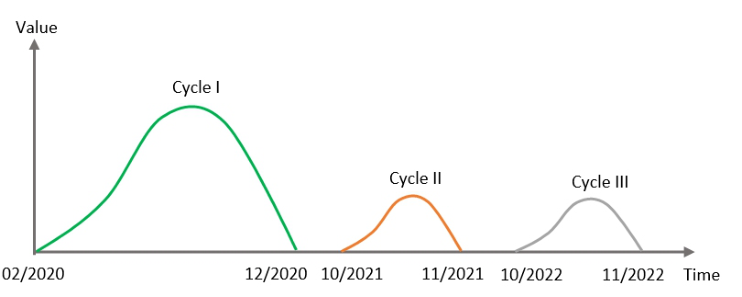
The life cycle and use of the opportunity based on presented case study consisted from three cycles – Figure 5.
Life cycle opportunity based on – Figure 5 consists of:
Cycle I – the life cycle and the use of opportunity begun when advisor company got an inquiry to development and implementation of Qua- lity Management Systems based on ISO 9001, ISO 14001, ISO 45001 from Alpha organization. Based on experience, knowledge of the market
Figure 5: Life cycle opportunity based on implementation and review of QMS (sources: own study).
Life Cycle Opportunity Based on Implementation of Quality Management Systems 65
situation and intuition the offer was prepared. Due to the other competi- tion offer, the negations took place. Based on it the agreement was sign. The scope of work was presented on Figure 4. The cooperation last from 02/2020 up to 12.2020.
Cycle II and III - the supervision audit and management review took place in October / November 2021 and October / November 2022. The time was established for one month before external audit of certificate body. The advisor company got the inquiry. Based on knowledge of the client orga- nization and market situation the offer was prepared. Before the signing the agreement, the negation took place. The life cycle and the use of the opportunity waste two months. The scope of work included two stages: audit and management review.
Based on establish relations, advisor and also Alpha company things about further cooperation in the next time period. Such kind approach could be understood as win-win situation.
SUMMARY Opportunity is a situation conducive to the subject of action in achieving the intended goal. The development of the opportunity and the way it is used by the organization depends on the sources of its creation, resources owned by the organization and the time of availability of the opportunity (Królas, Włodarkiewicz-Klimek, 2015a).
Taking advantage from the opportunity gives the possibilities to establish beginnings of the cooperation between supplier and client. Depends on the way of the relations and its attractiveness such kind of the cooperation could be single or cycle one.
Based on the example of implementations of QMS the life cycle opportu- nity was presented.
The implementations of QMS could have different phases depends of the need of the organization. Based on case study there was presented the imple- mentations of QMS that consists from 7 phases: diagnosis of the current state, two trainings courses, creation of integrated management system documen- tation, consultations regarding the implementation of the QMS, conducting an internal audit, management review and participation in the audit of the certification body. Thanks to establish cooperations the advisor company (supplier) was able to create new cooperations dealing with QMS with the Alpha organization (client). Also, the perspective on further cooperations is optimistic.
Presented approach could be inspiration for other sector of the industry how to establish business cooperation based on life cycle opportunity.
REFERENCES
Alvarez S., A., Barney J., B., (2007), Discovery and Creation: Alternative Theories of Entrepreneurial Ac-tion, Strategic Entrepreneurship Journal, Vol. 1, Nos. 1–2, pp. 11–26.
66 Krolas and Heilala
Ardichvili A., Cardozo R., Ray S., (2003), A theory of entrepreneurial opportunity identification and development, Journal of Business Venturing 18, pp. 105–123. Hunter M., (2013), Typologies and sources of entrepreneurial opportunity, Econo-
mics, Management, and Financial Markets Volume 8(3). pp. 58–59. Hang C., Garnsey E., Ruan Y., (2013), Opportunity Discovery and Creation in Disruptive Innovation, Centre for Technology Management Working Paper Series, Institute for Manufacturing, at the University of Cambridge Engineering Department No: 2013/03, pp. 5–6. International Organization for Standardization – www.iso.org ISO 9001:2015, Quality Management Systems – Requirements. ISO 14001:2015 - Environmental Management Systems - Requirements with guida-
nce for use. ISO 27001:2017 - Information technology. Security techniques. Information security management systems. Requirements. ISO 45001:2018 - Occupational Health and Safety Management Systems. Require-
ments with guidance for use. ISO 50001:2018 - Energy Management Systems — Requirements with guidance for use. Kirzner I., M., (1997), “Entrepreneurial Discovery and the Competitive Market Pro-
cess: An Austrian Ap-proach”, Journal of Economic Literature, Vol. 35, No. 1. pp. 60–85. Królas, P. (2020). Human Aspect and Risk in Quality Management Systems. In: Stefan Trzcielinski and Waldemar Karwowski (eds) Advances in The Ergonomics in Manufacturing: Managing the Enterprise of the Future. AHFE (2020) Inter- national Conference. AHFE Open Access, vol. 12. AHFE International, USA, http://doi.org/10.54941/ahfe100433. Królas P., (2019), Identyfikacja ryzyka zwia˛zanego z krótkim cyklem ˙zycia okazji –
studium przypadku. Zeszyty Naukowe Politechniki Pozna´nskiej “Organizacja i Zarza˛dzanie”, Wyd. 80, pp. 140. Królas P., Włodarkiewicz-Klimek H., 2015a, Okazja a ryzko we współczesnym przedsie˛biorstwie, w: Kształtowanie zwinno´sci przedsie˛biorstw: monografia / red. Stefan Trzcieli´nski, Taduesz Zaborowski (WIZ) - Pozna´n - Gorzów Wlkp., Polska: IBEN, 2015, pp. 95; 103. Królas P., Włodarkiewicz-Klimek H., 2015b, Okazje - ´zródła, rodzaje i ryzyko, w:
Kształtowanie zwinno´sci przedsie˛biorstw: monografia / red. Stefan Trzcieli´nski, Taduesz Zaborowski (WIZ) - Pozna´n - Gorzów Wlkp., Polska : IBEN, 2015, pp. 106. Krupski R., (red.) (2008), Elastyczno´s´c organizacji, Wydawnictwo Uniwersytetu Ekonomicznego we Wrocławiu. s. 49; pp. 49–50. Peiris I, Akoorie M., Sinha P., (2013), Conceptualizing the Process of Opportunity
Identyfication in Inter-natioanl Entrepreneuship Research, South Asian Journal of Management, Jul-Sep 2013, Vol. 20 Issus 3. Shane S., (2000), “Prior Knowledge and the Discovery of Entrepreneurial Opportunities”, Organization science. Vol. 11, pp. 448–469. Trzcieli´nski S. (2011), Zwinne przedsie˛biorstwo, Pozna´n, Wydawnictwo Politechniki
Pozna´nskiej. s. 43–57.
LISTED IN THE AHFE DIGITAL BOOKSTORE CATALOGUE
Explore the complete digital volume
Human Aspects of Advanced Manufacturing
Read this individual research paper free through the original publisher, or explore the full digital proceedings book.
ISBN 978-1-958651-56-8
Explore this ISBN in the AHFE Bookstore ↗Listed in the July 2026 bookstore catalogue; search by ISBN to confirm current availability · Digital book purchase optional