Thomas Menkhoff, Gopalakrishnan Surianarayanan (2023). How Singapore’s Manufacturing Small and Medium Size Enterprises Embrace Industry 4.0. In: Human Aspects of Advanced Manufacturing. AHFE Open Access, vol. 80, pp. 138–148. https://doi.org/10.54941/ahfe1003516
Industry 4.0 adoption is expected to profoundly impact the entire spectrum of industries, especially in manufacturing. By using a confluence of automation, data, and digitalisation, Industry 4.0 aims to radically transform how organisations operate presently while increasing productivity, enhancing flexibility, reducing costs, and improving efficiency. More companies are strategically embracing Industry 4.0 approaches to leverage opportunities arising from newly connected computers and increasingly autonomous automation systems (e.g., robotics), equipped with intelligent machine learning algorithms that control the robotics without much human input. In these 'smart' factories, cyber-physical systems (i.e., independently operating systems that self-optimize and communicate with each other, and ultimately optimize production) monitor the physical manufacturing processes and play an increasingly important role in terms of decision-making. Industry 4.0 signifies three mutually interconnected factors, namely digitisation and integration of any technical-economic networks, digitisation of products and services, and new market models. At the core of this new smart manufacturing paradigm is the Internet of Things that drives the conversion of traditional factories into a 'smart' manufacturing environment called "Industry 4.0", resulting in an increasingly intelligent, connected, and autonomous factory with dynamic capabilities. Smart manufacturing technologies include big data processing, machine learning, advanced robotics, cloud computing, sensors technology, additive manufacturing, and augmented reality. By using predictive big data analytics, deep learning, or sentiment/image analysis, business leaders can identify patterns and trends in vast reams of big data. It allows them to make 'smarter' decisions (e.g., about the loss of customers or the necessary service inspection of equipment) and potentially to become more competitive in real-time. Based on case study research on small manufacturing firms in Singapore, we explore how local SMEs adopt Industry 4.0 solutions. We shed light on the drivers and barriers of Industry 4.0 adoption to better understand current business dynamics, potential human issues, focus areas, and initiatives to smoothen this implementation. The study is part of a wider Industry 4.0 study of key specialists and decision-makers across Government agencies, Institutes of Higher Learnings, suppliers of Industry 4.0 technology, business associations, etc. Technology push by the Government with robust funding and training support, skilled labour shortages including imported labour dependence, productivity issues and the pressure to innovate business models due to increased competition are propelling SMEs to adopt Industry 4.0. Some challenges include high investment costs, ROI concerns as well as capability and mindset issues. The paper contributes to the minimal Asian management literature about Industry 4.0 matters in Asian SMEs.
More companies are strategically embracing so-called Industry 4.0 appro- aches to leverage opportunities arising from newly connected computers and increasingly autonomous automation systems (e.g., robotics), equipped with intelligent machine learning algorithms that control the robotics with- out much human input. In these ‘smart’ factories, cyber-physical systems (i.e., independently operating systems that self-optimize and communicate with each other, and ultimately optimize production) monitor the physical manufacturing processes and play an increasingly important role in terms of decision-making.
Industry 4.0 signifies three mutually interconnected factors (Zezulka et al., 2016), namely digitisation and integration of any technical-economic netw- orks, digitisation of products and services, and new market models. At the core of this new smart manufacturing paradigm (McKewen nd) is the Internet of Things that drives the conversion of traditional factories into a ‘smart’ manufacturing environment called “Industry 4.0” (Kagermann et al., 2013), resulting in an increasingly intelligent, connected, and autonomous
How Singapore’s Manufacturing Small and Medium Enterprises Embrace Industry 4.0 139
factory with outstanding dynamic capabilities (Teece, 2010; Eisenhardt & Martin, 2000). Smart manufacturing technologies include big data proces- sing, machine learning, advanced robotics, cloud computing, sensors techno- logy, additive manufacturing, and augmented reality. By using predictive big data analytics, deep learning, or sentiment/image analysis, business leaders can identify patterns and trends in vast reams of big data. It allows them to make ‘smarter’ decisions (e.g., about the loss of customers or the necessary service inspection of equipment) and potentially to become more competitive in real-time.
DEVELOPING HUMAN SYSTEMS INTEGRATION TOOLS TO SUPPORT SYSTEMS DESIGN2. RESEARCH VISION, RATIONALE AND QUESTIONS Conceptual Framework: Sustaining Singapore’s Competitiveness in Manufacturing and Technology Innovation Through Industry 4.0
Characteristic features of an Industry 4.0 system (Marr, 2016; Schwab, 2016) include interoperability (machines, devices, sensors, and people that connect and communicate with one another), information transparency (the systems create a virtual copy of the physical world through sensor data to contex- tualize information), technical assistance (both the ability of the systems to support humans in making decisions and solving problems and the ability to assist humans with tasks that are too difficult or unsafe for humans) and decentralized decision-making (the ability of cyber-physical systems to make simple decisions on their own and become as autonomous as possible).
Industry 4.0 initiatives are finding increased interest across Southeast Asian economies (ASEAN) over the last few years, with most governments taking active measures to push towards this implementation. ASEAN aspi- res to be the world’s 4th largest economic block by 2050, and Industry 4.0 is a critical element of this growth vision across the region. Most countries, including Singapore, have created a road map with a vision for Industry 4.0. However, there is arguably limited adoption despite all the initiatives and support extended by the various Governments.
The manufacturing sector is critical for Singapore’s economy as it makes up about 21% of Singapore’s GDP, accounting for 14% of its workforce. Due to the lack of research data on the firms’ receptiveness towards advanced Industry 4.0 technologies, it is critical to examine the impact of automa- tion, digitization, and web-based production systems on the business models of local manufacturers in terms of successful ‘production optimization’, greater ‘product customization,’ ‘predictive’ maintenance and ‘visionary’ investments into automation solutions. According to the Singapore Busi- ness Federation, about 60% of local small and medium-sized enterprises have not made significant technological changes. Possible reasons include resistance to change, lack of technological knowledge and resources, and insufficient leadership foresight. Many local firms are still operating in ‘the Industrial 2.0/3.0’ era rather than embracing opportunities arising from smart ‘Industry 4.0’ technologies. In smart factories, cyber-physical systems (i.e., independently operating systems that self-optimize and communicate
140 Surianarayanan and Menkhoff
with each other) monitor the physical manufacturing processes and play an increasingly important role in decision-making. At the core of this new smart manufacturing, the paradigm is IoT, resulting in an increasingly intelligent, connected, and autonomous factory with excellent dynamic capabilities.
Singapore has an adequate level of understanding of the need to migrate to Industry 4.0, and the benefits of implementing such advanced manufactu- ring solutions has generated much excitement. However, unlike Germany or the United States, the pace of adoption has been muted beyond a few early adopters.
In 2015, the Agency for Science, Technology, and Research (A*STAR) star- ted a Future of Manufacturing (FoM) Initiative in close consultation with the Ministry of Trade and Industry (MTI), the Economic Development Board (EDB), and SPRING Singapore under the Government’s Research, Innovation & Enterprise 2020 plan. The deliberations involved extensive engagement with industry and trade associations. The initiative’s goal is to sustain Sin- gapore’s competitiveness in manufacturing and technology innovation. It is a location of choice for developing, test-bedding, and deploying adva- nced breaking-ground technologies in the manufacturing sector. “The three key thrusts of A*STAR’s FoM Initiative are the public-private partnership platforms of Tech Access, Tech Depot, and Model Factories, which aim to drive technology innovation, knowledge transfer and adoption across the manufacturing industry (A*STAR Science and Engineering Research Council (SERC).”
In 2017, Singapore’s Economic Development Board (EDB) launched a Smart Industry Readiness Index (Siri) to help firms measure their progress and to understand implementation gaps. Technology, Process, and Organi- sation were the three building blocks of Industry 4.0 identified by EDB. The Model Factory at A*Star’s Advanced Remanufacturing and Technology Cen- tre and the Operation and Technology Roadmap (OTR) launch enables firms to realise their transformation on this smart manufacturing journey (Launch of A*STAR’s Model Factory@ARTC, n.d.).
Conceptual Framework: Purpose of Research and Research Question There are limited Singapore studies to understand the driving forces and bar- riers in adopting and implementing Industry 4.0. Most studies focus on the technology aspects and provide limited understanding from SMEs’ holistic business model viewpoint. The paper attempts to address this significant knowledge gap and contribute to the minimal Asian management literature about the smart manufacturing technology research gap’s impact on under- standing the experts across the ecosystem. We believe that this approach will help us better understand current business dynamics, potential issues, focus areas, and developments related to the pace of adopting advanced manufacturing approaches within Singapore’s manufacturing sector to help catapult Singapore’s manufacturers to the next level. The core research que- stion addressed in the paper is: How do Singapore’s manufacturing Small and Medium Enterprises embrace Industry 4.0 to enhance their business models?
How Singapore’s Manufacturing Small and Medium Enterprises Embrace Industry 4.0 141
RESEARCH VISION, RATIONALE AND QUESTIONS
Method
Our study adopted a dual-phase approach to developing a model that can cla- rify factors influencing the readiness of SMEs for the adoption of Industry 4.0. The first phase involved expert semi-structured interviews (via Zoom) with eight key decision-makers and heads across Government agencies, Insti- tutes of Higher Learnings (IHLs), suppliers/providers of technology, business associations and the local SME sector. A structured questionnaire was devised based on the current body of knowledge in Industry 4.0.
The objective of the expert interviews was to dive deeper into the issues involved to develop a comprehensive understanding of the challenges faced by SMEs in Singapore. The qualitative approach allows the interviewees to express themselves freely while providing us with the option to seek additio- nal inputs and quality guidance. “Qualitative research is conducted through intense and prolonged contact with a ‘field’ or life situation” (Miles & Huberman, 1984; Gioia et al., 2013). Interviews were recorded with the participants’ permission and then transcribed verbatim using transcription software, followed by an analysis of emerging themes using software (Nvivo). Based on a literature review and the expert interviews, we eventually arrived at several factors or categories (see Table 1 below) impacting Industry 4.0 adoption in SMEs.
Qualitative data analysis techniques comprise three different procedures: data reduction (e.g., discarding irrelevant data in transcripts), data display (e.g., specific graphical formats derived from the data), and drawing conclu- sions based on field notes and emerging themes. In line with the criteria of qualitative research, we clustered respondents’ transcribed statements into common (raw data) themes and grouped them into so-called first-order the- mes. Units with different meanings and general dimensions were established
Table 1. Factors impacting Industry 4.0 adoption in SMEs.
Table available in the original PDF paper.
# Factors 1 Capability and Competency 2 Collaboration – Internal and External 3 Culture of Company 4 Business Model Innovation 5 Skilled Labour Shortage and Dependencies 6 Mindset and Resistance to Change 7 Productivity and Efficiency 8 Return on Investment and Capital Costs 9 Government Subsidies, Incentives and Support 10 Talent Shortage 11 Technological Push by the Government 12 Top Management Support 13 Turnkey Solution Providers 14 Uniform Standards 15 Strategy and Implementation Roadmap
142 Surianarayanan and Menkhoff
based on second-order themes (Eisenhardt & Graebner, 2007). Table 1 sum- marizes the key outcomes of this step as far as the expert interviews are concerned.
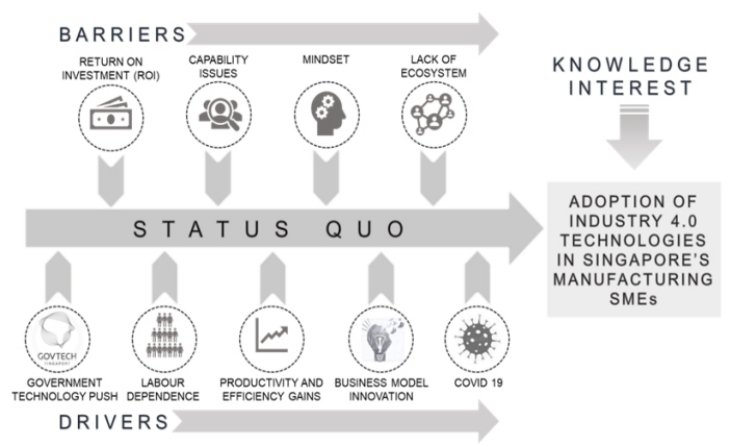
EXPERT INTERVIEW FINDINGS The expert interviews helped to identify five key drivers and four main barriers with regards to the adoption and implementation of Industry 4.0 approaches as illustrated in Figure 1.
Key drivers include technological push and incentives by the Government, skilled labour shortages, productivity and efficiency gains, the pressure to innovate business models due to increased competition, and the impact of Covid-19. Barriers in adoption revolve around return-on-investment issues, capability constraints, lack of ecosystem, and mindset factors. All experts agreed that Industry 4.0 was well recognised across the manufacturing SMEs in Singapore due to the top-down kind of initiatives embarked upon by the Government in Singapore and well supported by the agencies supporting this initiative.
“This is because Singapore has identified Industry 4.0 as an important skill and an important capability to improve productivity and to keep manufacturing content as a percentage of GDP existing in Singapore, and of course there has been a lot of downward pressure on that over the last few years” (Interviewee 2).
The expert views varied in terms of readiness to adopt and implement Industry 4.0 and SMEs’ capabilities. They ranged between 5 to 7 on a scale of 0 to 10 (0 = very low - 10 = very high) to measure SME’s readiness and
Figure 1: Drivers and barriers of Industry 4.0 adoption and implementation.
How Singapore’s Manufacturing Small and Medium Enterprises Embrace Industry 4.0 143
capabilities to adopt and implement Industry 4.0 initiatives. The size and sector in which the SME operated played a crucial role in adopting Industry 4.0. It was unanimously felt that larger SMEs (USD 100 million and above) were very well-positioned to embrace Industry 4.0. In contrast, medium-sized SMEs (USD 10 – 100 million) were now more willing to embrace, especially on the back of Covid-19 bottlenecks and issues. Smaller SMEs below USD 10 million did not recognise Industry 4.0 benefits and were not on board due to various constraints with investment and operation scale as a hindrance. We observed that specific sectors such as hi-tech manufacturing, electronics, semiconductors, medical equipment, etc. were very well positioned to benefit from Industry 4.0 initiatives and SMEs in these sectors.
“The writing is on the wall with COVID coming in. I think Industry 4.0 will get an impetus in terms of people wanting to adopt/upgrade or maybe at least have the interest because traditional construction companies would not have changed their model” (Interviewee 5).
SME CASE STUDY: ‘EMPEROR TECHNOLOGIES’ Emperor Technologies (founded in 1988) is a Singaporean medtech manufa- cturing and solutions firm, dedicated to the design of medical products which produces devices and lab equipment. The company has expanded into end-to- end solutions like surgical, patient care and diagnostic devices by harnessing their engineering design capabilities. There is a large number of loyal and dedicated staff who have been with the company for over 30 years. More than a quarter of them are enterprising research scientists and engineers. The company’s founder and CEO has identified med-tech as a growth sector, He leveraged on Emperor’s strengths as a former contract manufacturer of medi- cal technologies and morphed into a complete solutions provider based on a co-design, collaborative approach towards its partners.
Being a Visionary Emperor’s conference rooms and the offices of the CEO are adorned with models of cars, vintage models of telephones, custom-designed items, inclu- ding card holders, wallets etc., a resounding testament to the CEO’s passion for engineering and his astute business acumen. The restlessness to constan- tly innovate, develop and/or improve on a product idea by revamping the design and by creating an alternative approach are hallmarks of the markers laid down by the CEO to ensure that his firm constantly collaborates and co-creates designs and solutions. This approach has consistently aided Empe- ror to build partnerships globally with established firms and many of their leading partners, to keep innovating and remain ahead of the curve. The com- pany has been strongly riding on their engineering design capabilities to also cross-apply knowledge and expertise gained across various products. Empe- ror’s value propositions are high mix and low volume product options for customers, engineering design capabilities including co-design options. The firm is a reliable partner for leading global brands.
144 Surianarayanan and Menkhoff
Overcoming Challenges Emperor realised soon after their inception that a facility to prototype their ideas would be critical while also understanding the longer gestation periods in the industry with medical devices needing stringent testing and certifica- tion requirements. The company got itself ISO-14385 certified for quality compliance to enable it to design and manufacture medical devices. This provided another opportunity for Emperor to work with other local SMEs to ride on their expertise to manage certifications like CE and regulatory appro- vals, since they were very versatile with the approach needed (including the complicated paperwork formalities critical for such requirements).
To sharpen Emperor’s competitive edge, top management developed a stra- tegy to create new product solutions by tapping into available resources. The CEO entered into a partnership with the Agency for Science, Technology and Research (A*Star) through the agency’s research institute – the Singa- pore Institute of Manufacturing Technology (SIMTech) to research and build production solutions.
Digital Factory During a business mission to Germany in 2016, Emperor’s founder and CEO witnessed first-hand Industry 4.0 initiatives implemented by German compa- nies, and he was so impressed that upon his return, he stressed upon his team the benefits of getting Industry 4.0 established in Emperor:
“I came back from the business mission to Germany and told my team, that I want Industry 4.0 implemented yesterday … At that point in time, the Singapore market predominantly comprised of overseas technology vendors of Industry 4.0 solutions, who were also very expensive. I wan- ted a local vendor who would understand my needs and also to be able to supply it …” (the CEO).
The identification of the right partner to embark on the Industry 4.0 initi- ative in 2016 was a challenge since the technologies were very new then, and Singapore was flooded with several new providers. The background work to find an appropriate digital solution suitable for Emperor was critical as not every Industry 4.0 solution was suitable or easily adaptable. Eventually, Emperor tapped into the existing partnership with SIMTech on Industry 4.0. Since they already had some familiarity in understanding the process, it was easier for them to custom-design solutions which could be easily integra- ted into Emperor’s approach. As SIMTech was familiar with the grants and financial assistance schemes, it was beneficial for Emperor to seek their assi- stance which helped to identify sources of financial support for technological upgrading efforts and to manage the necessary paperwork.
“Industry 4.0 is essentially about collection of the relevant data and information in a factory by using sensors, RFIDs etc. to make it a closed- loop system that allows us to have real-time information about our operations” (the CEO).
How Singapore’s Manufacturing Small and Medium Enterprises Embrace Industry 4.0 145
The CEO realised the urgent need for data-driven decisions to be able to improve the firm’s efficiency, productivity and to keep labour costs down, while improving the output and reducing the unit costs of products to remain competitive. It has led to process improvements by reducing the cycle time or frequency while optimising the set-up time. With their A*Star partnership, Emperor could tap into the agency’s Model Factory initiative designed to improve productivity by keeping costs lower through technological advance- ments in 3 major areas – operations management, equipment effectiveness and inspection.
Financial support provided by Government agencies like Enterprise Singa- pore allowed Emperor to identify and gradually adopt 4 modular solutions, specifically tailored to their needs devised by A*Star. It helped Emperor to improve operations efficiency by working with 2 planners (against 4 planners previously) and to speed up planning lead-time from 2 weeks to 3 working days while doing away with the 3rd shift completely. Overall, the availability of data enabled an operational efficiency enhancement of 70 % with better machine utilisation, e.g., it increased the ability to determine spare capacity. In terms of inspection, the software enabled supervisors to verify any quality matters whether on-site or on a remote basis. It allowed immediate deci- sion making and helped to save a lot of manual entry procedures. Overall, the initiative supported the firm’s lean manufacturing approach, including the real-time tracking of raw material shortages and the management of Just-In-Time (JIT) inventory supplies.
Emperor has 1800 employees across 8 factory locations. The digital factory approach has resulted in real-time visibility. All factories are Industry 4.0 compliant and inter-connected, allowing for flexibility across all locations to manufacture the various products. Singapore’s excellent free trade arran- gements and location allows Emperor to strategically position itself while leveraging on its factories across Asia, as the firm continues to expand and foray into new markets.
Talent Management Emperor has many loyal staff members who have spent over 30 years with the company. From the beginning, the need to retain their rich experience while re-skilling them in line with Industry 4.0 initiatives was regarded as important by management to ensure a successful transformation. The CEO personally ensured that the right communication was sent to all employees by annou- ncing that no retrenchments would be made, while making full disclosure of the company’s plans to re-train and re-deploy staff if the situation would demand. The CEO values his employees as critical key resources, to the extent that he claims to be expendable himself but not the long-term committed staff who manage his production lines and business. About a dozen staff members were sent to the SIMTech facilities in 2017 to familiarize themselves with the modular solutions being implemented and to take part in an on-the-site training programme to observe the technological changes. This was followed by another 2 staff who underwent the Workforce Skills Qualification (WSQ) course to understand the microfluidics manufacturing process. To fulfil its
146 Surianarayanan and Menkhoff
long-term needs for talent, Emperor has initiated partnerships for internsh- ips with local polytechnics, the Institute of Technical Education (ITE) and the Singapore University of Technology. The company offers internships to meet future manpower needs.
Partnerships – A Collaborative Recipe for Success Right from Emperor’s inception, the founder believed that relationships and partnerships were the only way for an aspiring SME to build and transform the business. This was evident in the form of associations formed with techno- logy providers like SIMTech or Institutes of Higher Learnings (IHLs) as well as partnerships with key customers. During the Covid-19 pandemic, the com- pany became one of the first local SMEs to produce face shields and masks, and it took Emperor less than 1 week to tackle the challenge presented to them and to deliver the expected outcome. The company got also involved in Covid-19 reagent and digital PCR kits due to its immense experience with Ebola test kits.
The Roadmap Ahead Emperor has been one of the earliest adopters of Industry 4.0 initiatives in Singapore, which has allowed it to make rapid strides in smart manufactu- ring. Year-on-year revenue growth is healthy. Management is expecting to double revenues in the near future and continues to invest into research and development (R&D) to stay ahead of the competition curve with further increases expected in the years ahead to grow earnings. The company is active in claiming medical device-related patents on a yearly basis in line with the need to strive in the R & D space to further grow the business. The company is now actively engaging with SIMTech to co-develop wearables like activity trackers. The race of innovation can be won with partners and collaborators according to the CEO, and it seems that Emperor is poised for a fascinating period ahead under his able leadership.
CONCLUSION
This paper is part of efforts to examine the readiness of Singapore-based SMEs in the manufacturing sector to implement Industry 4.0 solutions. SMEs are well advised to adopt a clear strategy and create a roadmap to align their organisation and entire workforce with Industry 4.0 goals. SMEs need to closely network with educational institutions, industry partners and the Government agencies (e.g., SIMTech) to create strong ecosystem linkages for mutual benefits. While the Industry 4.0 transformation has significant top-down leadership support in Singapore, SME bosses and employees must buy-in into the challenging transformation process with clear support and actionable guidance to ensure that the adoption initiative succeeds. SMEs are increasingly getting convinced of the benefits of investing into digitali- sation and automation. Digitalisation, analytics, and automation will be in significant demand, and firms providing a right work environment with a progressive mindset will reap the rewards in the times ahead. Singapore can play a critical role in ASEAN by leading Industry 4.0 initiatives like advanced
How Singapore’s Manufacturing Small and Medium Enterprises Embrace Industry 4.0 147
manufacturing, innovation, and digital activities across the entire value chain. Industry 4.0 can have a positive impact on the business models (Girotra & Netessine, 2014; Taran et al., 2019; Osterwalder et al., 2020) of local SMEs provided the implementation by a proactive (Bateman & Crant, 1993) SME owner-manager such as Emperor Technologies’ boss creates and captures new value in form of data-driven process, production, shipment, inspection and planning improvements on the basis of a compelling value proposition and collaborative value network.
REFERENCES
Bateman, T. S. and Crant, J. M. (1993) The proactive component of organizational behavior: A measure and correlates. Journal of Organizational Behavior 14(2), pp. 103–118. doi: 10.1002/job.4030140202. Belton, K. B. et al. (2019) Who Will Set the Rules for Smart Factories? Issues in
Science & Technology 35(3), pp. 70–76. Eisenhardt, K. M. and Graebner, M. E. (2007) Theory Building from Cases: Opportunities and Challenges. Academy of Management Journal 50(1), pp. 25–32. Eisenhardt, K. M., & Martin, J. A. (2000) Dynamic capabilities: what are they? Stra-
tegic Management Journal, 21(10-11), 1105–1121. https://doi.org/10.1002/1097- 0266(200010/11)21:10/11<1105:: AID-SMJ133>3.0. CO;2-E Gioia, D. A. et al. (2013) Seeking Qualitative Rigor in Inductive Research: Notes on the Gioia Methodology. Organizational Research Methods 16(1), pp. 15–31. doi: 10.1177/1094428112452151. Girotra, K. and Netessine, S. (2014) Four Paths to Business Model Innovation.
Harvard Business Review (July–August 2014) 1 July. Available at: https://hbr. org/2014/07/four-paths-to-business-model-innovation [Accessed: 29 September 2020]. Kagermann, H., Wahlster, W. and Helbig, J. (2013) Recommendations for implementing the Strategic Initiative Industrie 4.0 – Final Report of the Industrie 4.0 Working Group. Communication Promoters Group of the Industry-Science Research Alliance, acatech, Frankfurt am Main. Availa- ble at: https://www.din.de/blob/76902/e8cac883f42bf28536e7e8165993f1fd/re commendations-for-implementing-industry-4-0-data.pdf. Launch of A*STAR’s Model Factory @ ARTC. [no date]. Available at: https://www.astar.edu.sg/News-and-Events/a-star-news/news/publicity-highlights/ launch-of-a- star-s-model-factory–artc [Accessed: 26 September 2020]. Marr, B (2016) What Everyone Must Know About Industry 4.0. Available
at: https://www.forbes.com/sites/bernardmarr/2016/06/20/what-everyone-must- know-about-industry-4-0/#66508a40795f [Accessed: 26 September 2020]. McKewen, E. [no date] What is Smart Manufacturing? (Part 1A). Available at: https: //www.cmtc.com/blog/what-is-smart-manufacturing-part-1a-of-6 [Accessed: 26 September 2020]. Miles, M. B., & Huberman, A. M. (1984) Drawing Valid Meaning from Qualitative
Data: Toward a Shared Craft. Educational Researcher, 13(5), 20–30. https://doi. org/10.3102/0013189X013005020. [no date]. Müller, J. M. 2019 Assessing the barriers to Industry 4.0 implementation from a workers’ perspective. IFAC-PapersOnLine 52(13), pp. 2189–2194. doi: doi.org/10.1016/j.ifacol.2019.11.530.
148 Surianarayanan and Menkhoff
Osterwalder, A., Pigneur, Y. and Clark, T. (2010) Business Model Generation: A Handbook for Visionaries, Game Changers, and Challengers. Strategyzer series. Hoboken, NJ. John Wiley & Sons. Schwab, K. (2016) The Fourth Industrial Revolution: what it means and how to
respond. Available at: https://www.weforum.org/agenda/2016/01/the-fourth-ind ustrial-revolution-what-it-means-and-how-to-respond/ [Accessed: 26 September 2020]. Singapore’s companies take leap into advanced manufacturing. [no date]. Available at: https://www.edb.gov.sg/en/news-and-events/insights/manufacturing/facto ry-forward-advanced-manufacturing-takes-root-in-singapore.html [Accessed: 26 September 2020]. Taran, Y., Goduscheit, R. C. and Boer, H. (2019) Business Model Innovation – A
Gamble or a Manageable Process? Journal of Business Models 7(5), pp. 90–107. Teece, D. J. (2010) Technological Innovation and the Theory of the Firm: The Role of Enterprise-Level Knowledge, Complementarities, and (Dynamic) Capabilities, in: Handbook of the Economics of Innovation. Zezulka, F. et al. (2016) Industry 4.0 – An Introduction in the pheno- menon. IFAC-PapersOnLine 49(25), pp. 8–12. doi: https://doi.org/10.1016/ j.ifacol.2016.12.002.
LISTED IN THE AHFE DIGITAL BOOKSTORE CATALOGUE
Explore the complete digital volume
Human Aspects of Advanced Manufacturing
Read this individual research paper free through the original publisher, or explore the full digital proceedings book.
ISBN 978-1-958651-56-8
Explore this ISBN in the AHFE Bookstore ↗Listed in the July 2026 bookstore catalogue; search by ISBN to confirm current availability · Digital book purchase optional