Marisa Schirmer, Florens Burgert, Christina Mayer, Susanne Mütze Niewöhner (2023). Developing intelligent technologies to support employees in manufacturing planning: applying a scenario planning method to consider future of work. In: Human Aspects of Advanced Manufacturing. AHFE Open Access, vol. 80, pp. 126–137. https://doi.org/10.54941/ahfe1003515
The environment of industrial enterprises is characterized not only by increasing volatility and uncertainty, but also by growing complexity and ambiguity (Ködding and Dumitrescu, 2022; Wonsak et al., 2021). For manufacturing process planning and CAM systems in use (CAM: Computer Aided Manufacturing), new requirements arise as a result of growing complexity and individualization of components, tools, and machines (Suhl and Isenberg, 2019; Jayasekara et al., 2019). In order to overcome these requirements, CAx system providers and researchers are currently developing approaches in technology-driven projects on how conventional support systems can be further developed, e.g., by integrating artificial intelligence (AI) (cf. Dripke et al., 2017). In technology development projects, however, the classic fields of work organization as well as other dimensions at the enterprise and individual level should be taken into account in addition to technology (Mütze-Niewöhner et al., 2022). In order to remain competitive, future developments must be considered by enterprises and systematically addressed in their strategic decisions (Ködding and Dumitrescu, 2022; Fink et al., 2005).This paper presents the application of scenario planning in the context of a technology-driven innovation project. Aim of this project with the acronym CAM2030 is to create a new generation of CAM systems by integrating innovative technologies, such as AI, evolutionary algorithms, and cloud computing in order to enable employees to perform manufacturing process planning for the production of complex products quickly, efficiently, and adeptly (cf. Burgert et al., 2022). To anticipate future developments of the work of CAM users, the scenario planning method by Fink and Siebe (2016) was used. Scenarios take into account that the future of work is open and uncertain, but will take place within a limited range of development possibilities (Burmeister et al., 2019). The intention within CAM2030 was to ensure that estimations of future support needs of CAM users are considered in the technology development activities. Since the scenario planning was tested for the first time in the context of the technology-driven project, the focus of this paper is on the application and discussion of the method. First, it provides a brief introduction to the applied scenario planning method according to Fink and Siebe (2016). Second, the procedure is described and methodological findings are discussed, e.g., to what extent the concept helped to successively guide the participants through scenario planning process. Challenges included, e.g., the involvement of multiple stakeholders, time demands on all participants, and enabling participants to focus on the open and uncertain development of CAM planning work within the technology-driven project. Third, as an outlook, it is reflected to what extent the applied method may support a future strategic decision-making process.
The environment of industrial enterprises is characterized not only by increasing volatility and uncertainty, but also by growing complexity and ambiguity (Ködding and Dumitrescu, 2022; Wonsak et al., 2021). For manufacturing process planning and CAM systems in use (CAM: Computer Aided Manufacturing), new requirements arise as a result of growing complexity and individualization of components, tools, and machines (Suhl and Isenberg, 2019; Jayasekara et al., 2019). To overcome these requirements, CAx system providers and researchers are currently developing approaches in technology-driven projects on how conventional support systems can be further developed, e.g., by integrating artificial intelligence (AI) (cf. Dripke et al., 2017). In technology development projects, however,
Developing Intelligent Technologies to Support Employees in Manufacturing Planning 127
the classic fields of work organization as well as other dimensions at the enterprise and individual level should be taken into account in addition to technology (Mütze-Niewöhner et al., 2022).
In order to remain competitive, future developments must be considered by enterprises and systematically addressed in their strategic decisions (Ködding and Dumitrescu, 2022; Fink et al., 2005). To deal with uncertainty associated with future, foresight methods are often used for strategic decision-making in enterprises (Meyerowitz et al., 2018; Lew et al., 2018). In distinction to other futures research approaches, such as predictions and forecasts, scenario planning supports the systematic creation of various possible combinations of future states, so-called scenarios, on the basis of a strictly future- oriented perspective (Fink and Siebe, 2016; Sardesai et al., 2021). The scenario planning method became well-known in the 1970s to support the identification of future developments incorporating uncertainties in complex environments as a basis for strategic decisions (Fink et al., 2005). Since then, the interest in the method has grown in academia, public, and private sectors as well as policy (Sardesai et al., 2021), and various approaches have been developed (see e.g. Bradfield et al., 2005; Burmeister et al., 2019; Ködding and Dumitrescu, 2022; Kosow and Gaßner, 2008 for overviews). However, scientific publications on the application of scenario planning in a production context only consider partial steps of the method or do not describe the implementation of the associated workshops in detail (e.g. Von der Gracht and Stillings, 2012; Wonsak et al., 2021).
The paper presents the application of scenario planning in the context of a technology-driven innovation project. Aim of this project with the acronym CAM2030 is to create a new generation of CAM systems by integrating innovative technologies, such as AI, evolutionary algorithms, and cloud computing in order to enable employees to perform manufacturing process planning for the production of complex products quickly, efficiently, and adeptly (cf. Burgert et al., 2022a). The scenario planning method was used to anticipate future developments of the work of CAM users. The intention was to ensure that estimations of future support needs of CAM users are considered in the technology development activities.
Since the scenario planning was tested for the first time in the context of the technology-driven project, the focus of this paper is on the application and discussion of the method. First, it provides a brief introduction to the applied scenario planning method according to Fink and Siebe (2016). Second, the procedure is described and the methodological findings are discussed. Third, it is reflected to what extent the scenario planning method can form a basis for future strategic decisions in an entrepreneurial context.
METHOD
Scenarios take into account that the future of work is open and uncertain, but will take place within a limited range of development possibilities (Burmeister et al., 2019). Therefore, scenarios are well-founded descriptions of future states that show alternative future development possibilities (Burmeister et al., 2019).
The scenario planning method proposed by Fink and Siebe (2016) includes four phases. As preparation, the scenario field is defined whose possible future states the scenarios are to describe (e.g. enterprise, technology etc.). Related to this, the target group, the purpose of the scenario planning, the depth of content, and the future horizon are determined. In the first phase, the scenario field analysis, influence factors are collected that adequately characterize the scenario field. Factors with a strong influence are selected as key factors. For each key factor, possible future developments, so-called projections, are compiled in the scenario prognostics (phase 2). In the third phase, the scenario development, scenarios are built as a consistent combination of these projections. Highly consistent bundles are grouped using a cluster analysis. In the last phase, the scenarios are evaluated and interpreted. This includes determining the consequences that are associated with a scenario for the design field.
According to Fink and Siebe (2016), scenario planning is traditionally conducted as a series of mostly one-day workshops with detailed work periods between the workshops or as a compact one-day conference. The workshops can be carried out physically, physically supported by virtual platforms, or only virtually. As the method requires a deep knowledge and understanding of the scenario field (Graessler et al., 2017), it is crucial to bring together the right people in the scenario team and motivate them to contribute their knowledge about the future (Fink and Siebe, 2016). The scenario team should be heterogeneous, e.g., cross-functional for integrating different perspectives (Fink and Siebe, 2016). The high time effort required as well as the high complexity of scenario planning methods are seen as challenges in the application (Mietzner and Reger, 2005; Graessler et al., 2017).
APPLICATION Based on the scenario planning method according to Fink and Siebe (2016), a workshop concept was conceived with the aim of developing, designing, and evaluating scenarios for the future of work in CAM planning including directly related activities such as workpiece design and prototype manufacturing (cf. Burgert et al., 2022b) in 15 years. For each phase of the scenario planning method, individual forms of elaboration were conceptualized. Due to the Covid-19 pandemic, the video communication platform Zoom® was used to enable virtual workshops. Four workshops were conducted, complemented by self-work periods between the workshops. Participants throughout the scenario planning process included CAM users, CAM developers, CAM providers, and researchers from different organizations. Their expertise covered various fields such as computer science with focus on artificial intelligence and evolutionary algorithms, mechanical engineering, and human-centered work design.
During a virtual kick-off meeting (workshop 1), the concept as well as the planned procedure were presented. The aim of the kick-off was to introduce the participants to the scenario planning method and to sensitize them to the benefits of the results in the context of the project
Developing Intelligent Technologies to Support Employees in Manufacturing Planning 129
(e.g. derivation of qualification requirements) and beyond the project (e.g. insights for the strategic alignment of the enterprises and for future research projects). Furthermore, questions were clarified and the time availability of the participants as well as the intended implementation of the method were coordinated. Since scenario planning is a complex, time-intensive method, the participants of the kick-off asked to rather hold fewer long workshop sessions and instead proceed in smaller working steps.
To document the entire scenario process, a board was created on the visual collaboration platform Miro®. Therefore, the board was the basis for all workshops and contained the results of every scenario planning phase. Further, participants who were unable to attend a workshop were subsequently informed about the progress, so they could continue participating at the same level of knowledge.
Phase 1 (scenario field analysis): Following the recommendation by Fink and Siebe (2016), the goal of the first phase was to identify 15 to 20 key factors with the greatest impact on the scenario field. The factor collection was conducted within two self-work periods. In self-work period 1, the participants received a text document with instructions and an example of how to collect influencing factors. By means of the shell model of human- centered work design in enterprises according to Mütze-Niewöhner et al. (2022) and given impulse questions, the participants collected and briefly described influencing factors for future developments of work in CAM planning on the supra-enterprise level, on the enterprise level, and on the individual level of the employee with work tasks and work conditions (including human-computer interaction). The selected shell model served to pre-structure the relevant levels of work design and to enable the development of holistic scenarios. Since its known from studies that in many cases people limit their thinking with mental frames due to so-called narrow framing (cf. Spetzler et al., 2016), a predefined structure supports a more targeted search for influencing factors. The collected factors were consolidated within a new text document and afterwards their relevance was evaluated by the participants in self-work period 2 using a five-point Likert scale. Fourteen final key factors with the highest relevance formed the basis for the second phase.
Phase 2 (scenario prognostics): Originally, a single workshop was planned for this phase. However, as the time availability of the participants prevented a common date, two 90-minutes workshops (workshops 2 and 3) with the same concept were conducted to define the main uncertainties of the respective key factors and elaborate possible projections. Each group received half of the key factors with the associated short descriptions and discussed them under guidance of the moderators along three questions following Fink and Siebe (2016):
Which main uncertainty is relevant for the key factor considered?
Are there other uncertainties that should be looked at?
How can the main uncertainty be described?
The results were recorded on the Miro® board and subsequently used for the joint elaboration of the projections. Originally, it was planned that the
participants would write down possible projections using virtual sticky notes before the results would be discussed in plenary. Since the discussion of the main uncertainties beforehand lasted longer than planned, the collection and discussion of the projections had to take place directly in plenary. As soon as the participants were able to agree on the final projections for the main uncertainties, they were documented on sticky notes. At the end of the second phase, two to four projections for each key factor were determined based on the discussion of the main uncertainties.
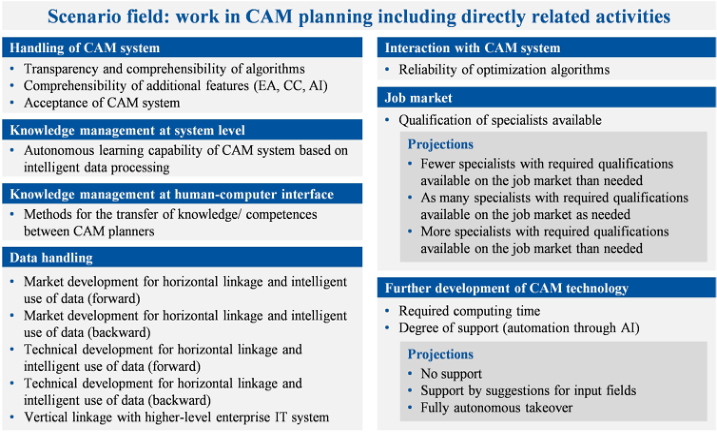
Figure 1 shows the fourteen key factors, arranged by categories, and exemplary projections. The key factors and their projections were used to form scenarios in the following phase.
Phase 3 (scenario development): Deviating from the procedure according to Fink and Siebe (2016), the projections were already evaluated by the participants in a third self-work period and those that were assessed as inconceivable were not considered further for the scenario development. Thereby, the number of projections could be initially reduced in order to lower the complexity of scenario development. However, the loss of information resulting from this restriction had to be accepted for the further development of scenarios. Subsequently, a consistency matrix was used internally to check the extent to which the further considered projections of two key factors in each case can occur simultaneously within a scenario. In deviation from Fink and Siebe (2016), the consistency was assessed at the key factor level in order to reduce the complexity of this step. This consistency matrix was checked and supplemented by individual expert assessments from the project consortium. Taking into account the probabilities of occurrence and the consistency matrix, 51 raw scenarios were created internally. These were aggregated into respective homogeneous but mutually heterogeneous
Figure 1: Key factors and exemplary projections.
Developing Intelligent Technologies to Support Employees in Manufacturing Planning 131
clusters. For this purpose, a hierarchical clustering with the Euclidean distance measure and the average linkage method (cf. Herzhoff, 2004) was carried out using the statistical software IBM® SPSS® Statistics. The result were six scenario clusters.
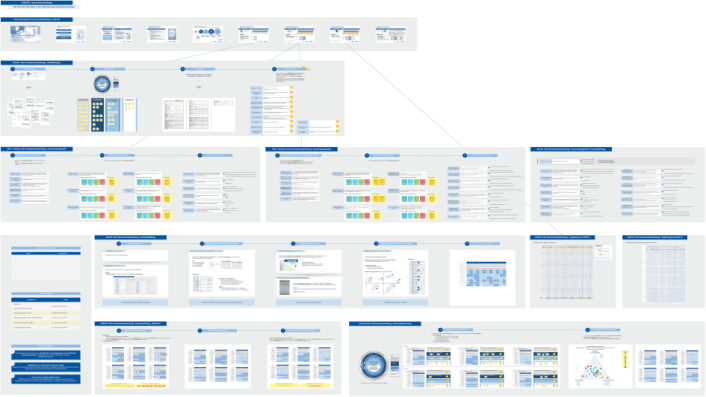
Phase 4 (scenario evaluation): In order to interpret the six developed scenario clusters, a fourth workshop (with a duration of 180 minutes) was conducted in the CAM2030 project. After reflecting on the clusters formed, they were evaluated by the participants in terms of what implications they might have for future work in CAM planning. The different levels of the shell model of human-centered work design (Mütze-Niewöhner et al., 2022; see above) were again used as a structure for collecting possible implications of the scenario clusters. For this step, the participants worked in groups in Zoom® breakout sessions before the results were discussed in plenary. In addition, the participants assessed and discussed the extent to which the future work in CAM planning could tend toward flexibility/adaptability, human justice, or economic efficiency as a result of the respective cluster under consideration. Figure 2 gives an impression of the shared Miro® board at the end of this phase.
Figure 2: Scenario planning results on the visual collaboration platform Miro®.
DISCUSSION
In the following, both the application of the method and its suitability as support for strategic decisions in enterprises are discussed.
Lessons Learned From the Application The application of the scenario planning method in the context of production planning allows different findings:
First, challenges arose that included, e.g., the involvement of the different stakeholders in the scenario planning, time demands on all participants due to the complex method, and enabling participants to focus on the open and uncertain development of CAM planning work within a technology-driven project. A kick-off meeting was conducted to address these challenges. This meeting allowed the participants to get to know the method in advance, to clarify basic questions, and to be prepared for the individual phases. It created a common level of knowledge among all participants, which facilitated the implementation of the scenario planning and, e.g., saved time in the subsequent workshops that would otherwise have had to be scheduled for questions regarding the general methodical procedure. A kick-off is recommended due to the complexity of the method. The use of the method as combination of workshops and self-work periods allowed the participants a higher temporal flexibility and had the advantage that the results of the self-work periods could not be influenced by other participants. In general, participants can benefit from such asynchronous phases and materials, but they also bring the risk of unrealistic expectations on the project partner (Becerra et al., 2021). In our context, the self-work periods were well received. Apart from the time flexibility, this could also be due to the common interest in working together in the project context and the given pre-structuring by the shell model according to Mütze-Niewöhner et al. (2022). The latter proved particularly useful in the aim of creating holistic scenarios for the future development of work in CAM planning, in order to direct the participants’ focus on the various aspects of work while taking all relevant levels into account.
Second, with the adaption of the prepared workshop series concept after the kick-off, a combination of different survey procedures was necessary. Although the required documents for the self-work periods were complemented by explanations and examples, the use of different procedures can nevertheless raise questions among the participants. In order to receive answers to their queries, written or verbal contact attempts should have been made. Since no queries arose during the self-work periods, it is unclear whether the effort to get answers was too high or the detailed explanations and examples were sufficient enough for understanding the tasks.
Third, conducting the workshops virtually enables a higher flexibility for organizers and participants, e.g., through saved travel times. Kurniawan et al. (2022) do not see any differences in the results of a scenario planning method between virtual workshops and physical meetings. Fink and Siebe (2016) have already considered the possibility of scenario planning in virtual workshops. The use of Zoom® provided the ability to record the workshops eliminating the need for handwritten minutes. This allowed the participants to focus entirely on developing results. To counteract the lack of personal contact (e.g. Becerra et al., 2021) and to convey a feeling of active participation, it is recommended to ask the participants for activated cameras (Zimmermann et al., 2021).
Fourth, a remote concept allows the integration of digital tools such as Miro® (Becerra et al., 2021). The use of a Miro® board enabled an overarching organization of the results of all self-work periods as well as
Developing Intelligent Technologies to Support Employees in Manufacturing Planning 133
workshops, and supported the interrelationships among the four phases of scenario planning. At any time, it was possible to look back at the previous joint results and at the results of the other group, such as in phase 2. The board also allowed participants to enter in later phases without having comprehension problems or lack of information. Becerra et al. (2021) also describe the collaboration of participants, communication, and the exchange among participants through the use of Miro® which can be confirmed in the given context. Another advantage is that the content and results are available digitally and can therefore be used again at any time (Becerra et al., 2021).
Fifth, a scenario team with different disciplinary backgrounds supports the development of holistic scenarios, recommended by Fink and Siebe (2016). However, because the method was applied in several workshops and self- work periods, the participants were not always the same. Thus, in some phases one or another perspective on the results was missing. Short bilateral meetings with individual participants could counteract this. Nevertheless, it would be advisable to invite multiple participants for each discipline and thus to integrate the relevant perspectives in each phase. For participants in virtual workshops, getting to know each other and working together can be challenging (e.g. Becerra et al., 2021). Due to the project context, the participants already knew each other as well as the collaboration in virtual meetings (cf. Rußkamp et al., 2022).
Sixth, as the limited time availability of the participants resulted in different groups of participants for the self-work periods and workshops, e.g., important findings may not have been included because the key factors were divided between the two groups in the second phase. To reduce complexity and effort for participants, forming the scenario clusters, e.g., was done internally. Involving the project consortium in the creation of the clusters rather than just discussing them might have resulted in different clusters. If scenario planning will be used again in this context, more generous planning and communication of the time scope of each phase would be recommended.
Support for Strategic Decision-Making Processes Since the scenario planning method helps to deal with uncertainty by identifying possible developments, it is assumed that it will enable an alignment of the corporate strategy with the environment (Vecchiato, 2012) and therefore better strategic decisions (Meyerowitz et al., 2018).
Regarding the future of work in CAM planning, CAM system providers could, e.g., consider the desired degree of system automation in their strategic positioning. The integration of further CAx systems could also be part of a strategic decision. Enterprises using CAM systems could take the expected degree of support for CAM planners into account when selecting the system.
A decision-making process and thus the quality of a decision can be assessed in an entrepreneurial context based on the decision quality approach by Spetzler et al. (2016). According to this approach, a decision has a high quality if six quality criteria are taken into account in the decision-making process. In the following, it is reflected to what extent the applied scenario
planning method can be used as a basis for future strategic decision-making by increasing its quality with reference to the six quality criteria.
First, the quality criterion appropriate frame concerns the decision-making framework. This framework defines purpose and scope of the decision as well as the perspectives to be considered. In scenario planning, a wide range of potential developments in the environment of the future work in CAM planning were collected. In addition, different perspectives could be taken into account as the scenario team consisted of participants with diverse professional backgrounds. Ramírez et al. (2017), e.g., state that effective scenarios emerge as soon as diverse perspectives and viewpoints are included within the application. The scenarios elaborated show all conceivable developments, but strategic decisions are only made for those whose probability of occurrence is considered realistic. Although the scenarios provide information on the environmental developments to be taken into account in the decision-making process, these are only part of the information required for strategic decision-making.
Second, clear values and objectives should be determined to evaluate the success of the decision at the end of the decision-making process (clear values and tradeoffs). The aim of scenario planning was to map future and plausible development options within the environment of work in CAM planning. Since this aim is not necessarily congruent with corporate objectives underlying a specific decision, this criterion cannot be taken into account further by scenario planning method.
Third, the options for actions considered should be creative (creative alternatives). Particularly in enterprises, it may be the case that no alternative options are sought, but only the acceptance or rejection of a proposal is discussed. As a result, suitable solutions can be overlooked. Scenarios lead to a closer examination of various development options of the corporate environment. In this way, different possibilities for strategic orientation are opened up in order to formulate potential courses of action in response.
Fourth, appropriate information and sources are necessary for a fundamental understanding of possible decision outcomes (relevant and reliable information). The scenario planning method can be seen as one of many sources for future decisions. The scenarios developed within the four-phase structure and with the participation of various disciplines may be considered a reliable part of the decision-making process.
Fifth, by means of a comprehensible argumentation, it must be possible to convey why the chosen option for action is the best alternative for the decision situation considered (sound reasoning). The scenarios compiled do not represent the options for action for future decisions, but a decision is ultimately made and communicated on the basis of other aspects. However, the transparency and the procedure of the method enable to derive how options for action were prepared with the help of the scenarios.
Sixth, there should be a willingness for realization of the decision made (commitment to action). In enterprises, problems usually arise because the decision-makers are often not the ones who are supposed to take care of the implementation of the decision. Involving employees in the decision- making process increases their identification with the solution and thus their
Developing Intelligent Technologies to Support Employees in Manufacturing Planning 135
willingness to realize it (cf. Zink et al., 2015). The participatory approach within the method can increase the acceptance for the results of the scenario planning. However, the commitment to a future decision may only be supported by the scenario planning process if the composition of the scenario team corresponds to the composition of the decision team. Furthermore, other factors within the decision-making process and additional sources may influence commitment.
CONCLUSION
The application of the scenario planning method in the CAM2030 project worked well and generated the desired results. The main challenges were the methodological and content-related complexity, the composition of the scenario team as well as the temporal intensity. In order to meet these challenges, the kick-off meeting, among other things, proved to be useful. Reflecting on the methodological approach using the decision quality criteria according to Spetzler et al. (2016) shows that scenario planning can basically be used as part of the preparation of a strategic decision. Through an interdisciplinary team and a holistic view of work in CAM planning by using the shell model according to Mütze-Niewöhner et al. (2022), scenario planning method is considered successful. In particular, this method supported the integration of human and organizational factors into a technology-driven project.
ACKNOWLEDGMENT
The research and development project CAM2030 is funded by the German Federal Ministry of Education and Research (BMBF) within the “Innovations for Tomorrow’s Production, Services, and Work” program (funding number: 02J19B081) and implemented by the Project Management Agency Karlsruhe (PTKA). The authors are responsible for the content of this publication. The authors would like to express their gratitude for this support.
REFERENCES
Becerra, Z. M., Fereydooni, N., Kun, A. L., McKerral, A., Riener, A., Walker, B. N., and Wintersberger, P. (2021) ‘Interactive Workshops in a Pandemic: The Real Benefits of Virtual Spaces’, IEEE Pervasive Computing, 20(1), pp. 35–39. Available at: https://doi.org/10.1109/mprv.2020.3044072. Bradfield, R., Wright, G., Burt, G., Cairns, G., and Van Der Heijden, K. (2005)
‘The origins and evolution of scenario techniques in long range business planning’, Futures, 37(8), pp. 795–812. Available at: https://doi.org/10.1016/j.fu tures.2005.01.003. Burgert, F. L., Schirmer, M., Harlacher, M., Nitsch, V., and Mütze-Niewöhner, S. (2022a) ‘Analyse der Arbeit von CAM-Planenden als Grundlage für die Entwicklung intelligenter Unterstützungssysteme für die Prozessplanung’, in Gesellschaft für Arbeitswissenschaft e. V. (ed.) Technologie und Bildung in hybriden Arbeitswelten: 68. Kongress der Gesellschaft für Arbeitswissenschaft. Sankt Augustin: GfA-Press, B. 10.3. Available at: https://doi.org/10.18154/RW TH-2022-02442.
Burgert, F. L., Schirmer, M., Harlacher, M., and Mütze-Niewöhner, S. (2022b) Partizipative Erhebung und Modellierung eines CAM-Planungsprozesses für die Fertigung komplexer Bauteile unter Anwendung der K3-Notation. Aachen: Institut für Arbeitswissenschaft der RWTH Aachen University. Burmeister, K., Fink, A., Mayer, C., Schiel, A., and Schulz-Montag, B. (2019)
Szenario-Report: KI-basierte Arbeitswelten 2030. Available at: https://doi.org/10. 24406/publica-fhg-299898. Dripke, C., Höhr, S., Csiszar, A., and Verl, A. (2017) ‘A Concept for the Application of Reinforcement Learning in the Optimization of CAM-Generated Tool Paths’, Machine Learning for Cyber Physical Systems, pp. 1–8. Available at: https://doi.org/10.1007/978-3-662-53806-7_1. Fink, A., Marr, B., Siebe, A., and Kuhle, J. P. (2005) ‘The future scorecard: combining external and internal scenarios to create strategic foresight’, Management Decision, 43(3), pp. 360–381. Available at: https://doi. org/10.1108/00251740510589751. Fink, A. and Siebe, A. (2016) Szenario-Management: Von strategischem Vorausdenken zu zukunftsrobusten Entscheidungen. Frankfurt am Main: Campus Verlag. Graessler, I., Scholle, P., and Pottebaum, J. (2017) ‘Integrated process and data
model for applying scenario-technique in requirements engineering’, DS 87– 3 Proceedings of the 21st International Conference on Engineering Design (ICED17) Vol. 3: Product, Services and Systems Design, Vancouver, Canada, pp. 261–270. Herzhoff, M. (2005) Szenario-Technik in der chemischen Industrie. Available at: https://depositonce.tu-berlin.de/handle/11303/1167. Jayasekara, D., Pawar, K., and Ratchev, S. (2019) ‘A Framework to Assess Readiness
of Firms for Cloud Manufacturing’, 2019 IEEE International Conference on Engineering, Technology and Innovation (ICE/ITMC) [Preprint]. Available at: ht tps://doi.org/10.1109/ice.2019.8792648. Ködding, P. and Dumitrescu, R. (2022) ‘Szenario-Technik mit digitalen Technologien’, Digitalisierung souverän gestalten II: Handlungsspielräume in digitalen Wertschöpfungsnetzwerken, pp. 120–135. Available at: https://doi.org/10.1007/978-3-662-64408-9_10. Kosow, H. and Gaßner, R. (2008) Methoden der Zukunfts- und Szenarioanalyse: Überblick, Bewertung und Auswahlkriterien. Berlin: Institut für Zukunftsstudien und Technologiebewertung. Kurniawan, J. H., Apergi, M., Eicke, L., Goldthau, A., Lazurko, A., Nordemann, E.,
Schuch, E., Sharma, A., Siddhantakar, N., Veit, K., and Weko, S. (2022) ‘Towards participatory cross-impact balance analysis: Leveraging morphological analysis for data collection in energy transition scenario workshops’, Energy Research & Social Science, 93, 102815. Available at: https://doi.org/10.1016/j.erss.2022. 102815. Lew, C., Meyerowitz, D., and Svensson, G. (2018) ‘Formal and informal scenarioplanning in strategic decision-making: an assessment of corporate reasoning’, Journal of Business & Industrial Marketing, 34(2), pp. 439–450. Available at: https://doi.org/10.1108/jbim-03-2018-0096. Meyerowitz, D., Lew, C., and Svensson, G. (2018) ‘Scenario-planning in strategic
decision-making: requirements, benefits and inhibitors’, Foresight, 20(6), pp. 602–621. Available at: https://doi.org/10.1108/fs-04-2018-0036. Mietzner, D. and Reger, G. (2005) ‘Advantages and disadvantages of scenario approaches for strategic foresight’, International Journal of Technology
Developing Intelligent Technologies to Support Employees in Manufacturing Planning 137
Intelligence and Planning, 1(2), pp. 220–239. Available at: https://doi.org/10. 1504/ijtip.2005.006516. Mütze-Niewöhner, S., Mayer, C., Harlacher, M., Steireif, N., and Nitsch, V. (2022) ‘Work 4.0: Human-Centered Work Design in the Digital Age’, Handbook Industry 4.0: Law, Technology, Society, pp. 985–1019. Available at: https://doi.org/10. 1007/978-3-662-64448-5_52. Ramírez, R., Churchhouse, S., Palermo, A., and Hoffmann, J. (2017) ‘Using scenario
planning to reshape strategy’, MIT Sloan Management Review, 58(4). Rußkamp, N., Digmayer, C., Jakobs, E. M., Burgert, F., Schirmer, M., and Mütze-Niewöhner, S. (2022) ‘New ways to design next-generation CAM systems. An integrated approach of co-creation and process modeling’, Human Aspects of Advanced Manufacturing, 66, pp. 1–12. Available at: http://doi.org/10.54941/ahfe1002682. Sardesai, S., Stute, M., and Kamphues, J. (2021) ‘A Methodology for Future Scenario
Planning’, Lecture Notes in Management and Industrial Engineering, pp. 35–59. Available at: https://doi.org/10.1007/978-3-030-63505-3_2. Spetzler, C., Winter, H., and Meyer, J. (2016) Decision Quality: Value Creation from Better Business Decisions. Hoboken, NJ: John Wiley & Sons. Suhl, L. and Isenberg, F. (2019) ‘Production Optimizer: Mehrteiliges Konzept
zur Planung der Fertigung’, Intelligente Arbeitsvorbereitung auf Basis virtueller Werkzeugmaschinen, pp. 121–149. Available at: https://doi.org/10.1007/978-3- 662-58020-2_5. Vecchiato, R. (2012) ‘Environmental uncertainty, foresight and strategic decision making: An integrated study’, Technological Forecasting & Social Change, 79(3), pp. 436–447. Available at: https://doi.org/10.1016/j.techfore.2011.07.010. Von der Gracht, H. A. and Stillings, C. (2013) ‘An innovation-focused scenario
process – A case from the materials producing industry’, Technological Forecasting & Social Change, 80(4), pp. 599–610. Available at: https://doi.org/ 10.1016/j.techfore.2012.05.009. Wonsak, I., Bauer, H., Sippl, F., and Reinhart, G. (2021) ‘A scenario-based approach for translating strategic perspectives into input variables for production planning and control’, Procedia CIRP, 104, pp. 429–434. Available at: https://doi.org/10. 1016/j.procir.2021.11.072. Zimmermann, N., Pluchinotta, I., Salvia, G., Touchie, M., Stopps, H., Hamilton,
I., Kesik, T., Dianati, K., and Chen, T. (2021) ‘Moving online: reflections from conducting system dynamics workshops in virtual settings’, System Dynamics Review, 37(1), pp. 59–71. Available at: https://doi.org/10.1002/sdr.1667. Zink, K. J., Kötter, W., Longmuß, J., and Thul, M. J. (2015) Veränderungsprozesse erfolgreich gestalten. Berlin: Springer Vieweg.
LISTED IN THE AHFE DIGITAL BOOKSTORE CATALOGUE
Explore the complete digital volume
Human Aspects of Advanced Manufacturing
Read this individual research paper free through the original publisher, or explore the full digital proceedings book.
ISBN 978-1-958651-56-8
Explore this ISBN in the AHFE Bookstore ↗Listed in the July 2026 bookstore catalogue; search by ISBN to confirm current availability · Digital book purchase optional