Qichao Zhao, Qian Zhou, Qingju Wang, Ying Gao, Ping Wu (2023). Prediction of purchase decision-making on digital live streaming Interface on MT: A comparative research of multi-modal Human-Machine Interaction. In: Ergonomics In Design. AHFE Open Access, vol. 77, pp. 787–797. https://doi.org/10.54941/ahfe1003439
In the emerging live-stream shopping, evaluating and establishing the best interface design for live streaming platform to improve user experience and effect transactions is essential. Nevertheless, traditional methods such as subjective interviews and task-observation have limitations to assess the neural mechanisms involved in this process. This study sought to apply neuroscience methods in analyzing and evaluate 3 different live streaming APP’s Human-machine Interaction with users and further use Support vector machine (SVM) classifiers based on different combination of users’ electrodermal activity, electroencephalogram and eye movement to predict users’ purchase decision. To this end, 35 participants were required to complete 4 shopping tasks on 3 live streaming APP respectably, and their multi-dimensional subjective and objective data were collected and analyzed. The results showed that the tonic SC was significantly smallest in the A APP than other two APP, and the B APP had smallest fixation frequency, implying that B App might need less effort in interaction with users and obtained more positive user experience. Moreover,the fusion of eye movements, EDA and EEG data could fairly improve the performance of design decision making classification. Then, it is possible that applying multi-modal physiological data synchronization would be an effective approach to assess live streaming platform and further improve the integration quality, or develop advanced tailor-made product recommendation system.
Recently, with the advent of 5G technology, a new form of marketing mode— living streaming has received wide attention (Deng, Benckendorff, & Wang, 2022). Live streaming platforms enable streamers to promote themselves, showing the characteristics of products and communicating real time. It could stimulate consumption through online celebrity effect or other marke- ting methods (J. Chen & Liao, 2022). Compared with traditional marketing
models, which include commodity marketing and service marketing, live stre- aming marketing can better improve customer’s purchasing experience (Lin, Yao, & Chen, 2021). To follow the trend of the live stream E-Comerce, diverse live stream platforms are designed for users to enjoy this type of online shopping.
In the form of sales with live streaming as the carrier, users focus on the live streaming’s content, while the interface of the live streaming platform is the direct medium of information transfer and exchange between people and pro- ducts (Patel, Das, Chatterjee, & Shukla, 2020). The interaction between live streaming platform and users increasingly varied (Barney, Hancock, Esmark Jones, Kazandjian, & Collier, 2022). The key point of interaction is to know the details of the product and send the bullet screen through the interface and click the purchase icon in the interface to place an order. Therefore, the function of interaction with the anchor in the interface directly affects the user’s perception and emotion, such as purchase motivation, pleasure and presence. For example, some live streaming platforms use a lot of transparent dialog boxes and suspended air bubbles to avoid blocking anchors and com- modities, making the shopping channel more accessible, which helps users to convenient shopping. While, others unappropriated interaction would have a negative impact on user’s shopping experience, such as the fast bullet screen scrolling in a high-traffic broadcast room, the messy complicated swiping gifts and “like” clicking. Most studies of shopping APP investigate the con- struction concept of interactive interface (Barney et al., 2022), and few focus on the assessment of the user experience of living streaming APP interface.
To understanding the different interfaces design’s impact on the unspoken response of consumers to the live streaming, neuromarketing approach provi- des an effective tool for identifying consumer’s user experience and purchase decision-making (Rawnaque et al., 2020). The Electroencephalogram (EEG) results suggested that good user experience and willing to pay responses are associated with positive trends in frontal alpha asymmetry (FAA) (T. Z. Ram- søy, M. Skov, M. K. Christensen, & C. Stahlhut, 2018). The Differential entropy (DE) and Shannon entropy are also commonly used EEG features in consumer preference (Zeng, Lin, Xiao, Wang, & Zhou, 2021). Basically, higher entropy indicates more complex pr chaotic systems, thus, more unex- pected experience and less predictability (Phung, Tran, Ma, Nguyen, & Pham, 2014). In addition to the EEG brain-signal recording techniques, other phy- siological signals, namely electrodermal activity (EDA) and eye tracking (ET) measurements, to collect user’s physiological responses to stimuli. EDA has a tonic and phasic component called skin conductance level (SCLs, tonic SC) and skin conductance response (SCRs, phasic SC). EDA is a correlate of sympathetic nervous system activity, which has also been shown to cor- relate with physiological arousal (Pizzie & Kraemer, 2021). ET not only provides a visual understanding of user’s attention, but also the pupil size, blink frequence and other eye movement signals are widely used as an indica- tion of the user’s emotion or workload (Lim, Mountstephens, & Teo, 2020). Therefore, with the combination of EEG, EDA, ET, through advanced spe- ctral analysis and machine learning algorithms, neurophysiological signals can now provide an almost accurate view of how living streaming platform
Prediction of Purchase Decision-Making on Digital Live Streaming Interface on MT 789
interface design impact user experience during shopping decisions and their purchase decision.
This study had two research objectives. First, we evaluated user experience of 3 different live streaming APPs interactive interface with the combination of EEG, ET, EDA and subjective questionnaire. Second, we try to predict the relation between purchase decision-making results and user’s multi-mode data synchronization during the interaction of live streaming.
METHODOLOGY
Participants Thirty-three subjects (19 males) participated in the experiment, aged 23–38 (mean = 31, SD = 5.58). Participants were also required not to have expe- riences of any live streaming APP shopping before. They were also required not to use any psychiatric drugs in the last 6 months. All participants gave informed consent before the experiment and received a gift at the end of the experiment.
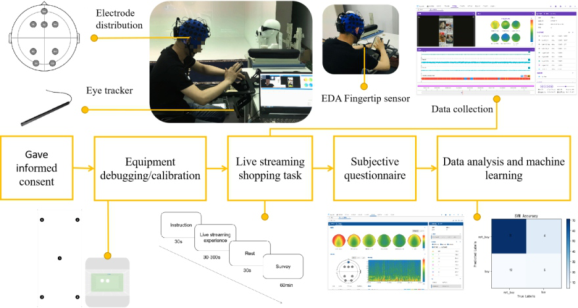
Procedure Three live streaming APPs (A, B, C) were used in the present study. All partici- pants were required to finish 4 kinds of shopping tasks in each live streaming platform. Total 3 blocks consist of 12 trials, and the order of each block was balanced using a Latin Square. First, at the beginning of each block, partici- pants were required to close eyes and rest for 5 minutes to collect their basic physiological baseline value. Then the participants could browse the plat- form freely in 1 minute to get familiar with the platforms. When participants finishing shopping, a subjective questionnaire was asked to rate the given aspects with Likert 5 subscale according to participants’ experience using the live streaming APP. The flow of each trial was shown in Figure 1.
Figure 1: Experiment process.
Data Recording and Processing This experiment was carried in a laboratory of Beijing Human Factors Engi- neering Technology Research Institute, where a Mobile Device Stand (Kingfar International Inc. China) was installed, compatible with a smartphone (Rong- yao 30, 2388*1080) and Tobii Pro Fusion eye tracker (Tobii technology, 250Hz sampling rate, 0.3
accuracy, 0.2
precision). EEG was collected from the scalp using an 8-electrod Mobile semi-dry EEG system (Bitbrain, 0.01 Hz high-pass filter with a notch filter at 50 Hz, 256 Hz sampling rate), at positions Fpz, F3, F4, Fz, P3, P4, O1, O2. The EEG eletrodes impedance were kept below 5K. The average of the channels was calculated as re-reference of biosignals. The EEG data were processed using ErgoLAB V3.0 (Kingfar) and Python 2020a. In order to denoise signals such as eye movement and EMG artifacts, the independent component analysis has been performed. From the artifact-free EEG, the power spectral density (PSD) of the recorded EEG data has been calculated using the wavelet transform.
EDA was collected from index fingers of left hand using Fingertip sensor (Kingfar). The EDA data were filtered with a cut-off frequency of 0.3 Hz and with Butterworth filter of 10 Hz using the ErgoLAB V3.0 (Kingfar). Then, the obtained continuous signal was detrended to eliminate the potential trend- related effects.
Data Analysis Two participants’ data were incompletely recorded and thirty-one valid data were used for analysis in the next section. PSD, FAA, DE, and Shannon entropy of EEG data were applied and compared in this study. According to five frequency bands: alpha (8–13 Hz); beta (14–30 Hz); delta (1–3 Hz); theta (4–7 Hz); the traditional PSD features was computed. The FAA index was calculated as the difference between right-hemispheric data minus left-hemispheric data with the following formula (Coan & Allen, 2004):
ln(F4 alpha power)- ln(F3 alpha power) Shannon entropy is defined as:
Equation reproduced from the original PDF.
Where pi is the probability of occurrence of the signal. And the DE feature is defined as follows, !
Z ∞
1 √
1 √
h(X) =
dx
2σ 2 log
2π2
−∞
2πσ 2 exp (x −µ)2
2πσ 2 exp (x −µ)2
= 1 2 log(2πeσ 2) Where X submits the Gauss distribution N(µ, σ 2), x is a variable and π, and e are constant.
The eye state indices such as the pupil diameter, blink, fixation, saccade and Tonic SC were extracted using ErgoLAB V3.0 software. Then ANOVA with repeated measures analysis was analyzed using on JASP.
Prediction of Purchase Decision-Making on Digital Live Streaming Interface on MT 791
Finally, to investigate how accurately the multi-mode data predict the inci- dence of decision-making. All trials marked as “Not_buy” and “Buy” among all subjects have been extracted separately and, in this way, two catego- ries as “Not_buy” and “Buy” have been constructed. For constructing the feature vector for EEG data, EDA, eye tracking of each trial, the relative power (normalized to the power in whole frequency range) for different brain waves (δ, θ, α and β) and the DE, and Shannon entropy for all 8 channels, FAA have been calculated. In this paper, the authors classified the dataset based on Support Vector Machine (SVM) with a Radial Basis Function ker- nel. Furthermore, to evaluate the impact of features grouped by the sensor used to acquire them, 3 combinations of features were considered: EEG-only features, ET-only features, and finally EEG, ET, and EDA features.
RESULTS
Subjective Questionnaire Results (1) Learnability. Repeated variance test found that there were significant differences in user’s subjective learnability experience of the three live streaming APPs (F(2, 62) = 4.765, p = 0.012). Further post test found that user’s learnability for type B APP was significantly higher than that for type C APP (t = 3.043, p = 0.010). (2) Fluency. Repeated variance test found that there was little difference in the subjective experience of fluency of the three APPs (F(2, 62) = 0.308, p = 0.736). (3) Pleasure. Repeated variance test found that there were significant dif- ferences in user’s subjective pleasurable sexual experience for the three live streaming APPs (F(2, 62) = 9.277, p < 0.001). Further post test found that user’s pleasurable experience for type B APP was significantly higher than that for type C APP (t = 4.084, p < 0.001). (4) Satisfaction. Repeated variance test found that user’s subjective pleasu- rable sexual experience of the three live streaming APPs had significant differences (F(2, 62) = 3.078, p = 0.053). Further post-test found that user’s satisfaction with type B APP was slightly higher than that with type C APP.
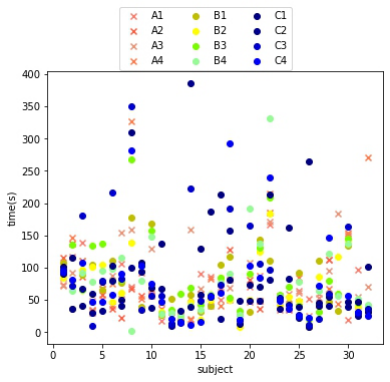
Behavioral Results The user’s reaction time in each decision was showed in Figure 2. The beh- avior of not arriving at the order submission page within 180 seconds was regarded as the user did not have purchase intention, which was marked as 1. The behavior of arriving at the order submission page within 180 seconds was regarded as the user had purchase intention and marked as 0. Chi-Squared Analysis showed that the difference of user’s purchase decision was signifi- cant (χ2(2) = 8.002, p = 0.018). Participants spent more time on type C APP for buying decision.
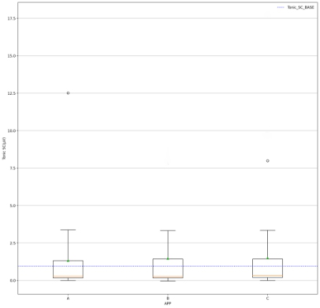
EDA Result A Repeated measure ANOV for EDA data was performed with respect to the 3 conditions (using A APP, B APP and C APP). As shown in Figure 3, there
Figure 2: The users’ reaction time in each decision.Figure 3: The users’ tonic SC when using 3 APPs.
was a significant effect of APP with a significant increase in EDA (F(2, 248) = 3.122, p = 0.046), asC APP had greatest tonic SC.
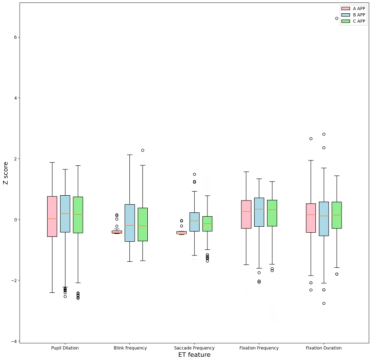
Eye-Tracking (ET) Results The impact of APP living stream on the eye-tracking features including pupil dilation(mm), blink frequency(N/min), saccade frequency(N/min), fixa- tion frequency (N/min), fixation duration(s) were statistically assessed using Repeated ANOV measure. Aside from pupil dilation, fixation duration, all the other features were significantly impacted by living streaming APP. Speci- fically, A APP had lowest blink frequency, and B APP had lowest fixation frequency, and C APP had highest saccade frequency (blink frequency: F (2, 248) = 55.453, p < 0.01, fixation frequency: F(2, 248) = 3.668, p < 0.027, saccade frequency : F(2, 248) = 100.571, p < 0.01).
Prediction of Purchase Decision-Making on Digital Live Streaming Interface on MT 793
Figure 4: The users’ ET features when using 3 Apps.
EEG Results Repeated ANOVA analysis showed that the type of APP had no significant impact on the EEG features. And the results were shown in Table 1.
Classification Results Signals from EDA, eye movements and EEG were fused at between the deci- sion level and the feature lever. After Z-score Normalization of the data and feature selection using Kendall correlation analysis, the SVM results could be show in the Confusion Matrix of different groups. And from Table 2, the test classification accuracy of the fusion data group was above 70%, while the accuracy of ET features only group were around the random level of 50%.
Table 1. The repeated ANOVA of EEG features.
Table available in the original PDF paper.
Indices F value df p delta 0.402 (2,62) 0.671 theta 0.747 (2,62) 0.478 alpha 0.923 (2,62) 0.403 beta 3.078 (2,62) 0.053 FAA 0.757 (2,62) 0.47 Shannon entropy 2.012 (2,62) 0.143 DE entropy 0.409 (2,62) 0.666
Table 2. The classification accuracies (%) of the data.
Table available in the original PDF paper.
Fusion data EEG data ET data EDA data Train accuracy 0.8867 0.750000 0.50000 0.8045 Test accuracy 0.7934 0.684782 0.48913 0.7367
DISCUSSION
The two main objectives of this study were: (1) to estimate the different live streaming platforms’ impact on user’s purchasing experiences; (2) and further predicting user’s purchase decision based on physiological data. To achieve these objectives, we designed a live streaming shopping experiment, requiring subjects to complete 4 shopping tasks s on 3 live streaming APP respecta- bly. User’s multi-dimensional subjective and objective data were collected and analyzed.
The subjective results have enabled us to confirm that B live streaming App had the most positive user experience than other two platforms, and C live streaming App received least learnability and pleasure acknowled- gment. Meanwhile, the tonic SC was significantly highest in C APP than other two APP. In Ward and Marsden’s experiment, users’ galvanic skin response was higher in a poor-designed web browser than in a well-designed web browser (Ward & Marsden, 2003). Also, Ying Li’s research showed that low- experience user who entered simple text input phrase had a lower galvanic skin response than those who entered complex text input phrases (Li, You, You, & Ji, 2019). The interface design of C App might cause some difficulties for uses during the shopping tasks.
Combined with the ET results, fixation metric are generally related to user’s visual processing and metal workload, the longer duration of fixa- tion or the smaller number of fixations could be related to user’s increasing resource demand (Albert, Jeelani, Han, & Azevedo, 2018). Blink freque- ncy and saccadic frequency are also associated with user’s fatigue and task demands (Yamada & Kobayashi, 2018). B APP had smallest fixation freque- ncy, implying that B App might need less effort in cognition and interaction, and leading to a more pleasurable user experience. The interface of A and C APP might increase user’s cognitive load to process.
Though the differences in EEG data were not significant among 3 living streaming APPs, a more negative FAA score was obtained in B APP, refle- cting higher right PFC alpha activity. While combined with the subjective results and behavioural results which users had the best opinion and made most affirmative purchase decision in B APP, the EEG results appeared incon- sistent with classical interpretation of the FAA (Aggarwal, 2021). However, alternative evidence on the FAA are also emerging. The approach motivation with greater right frontal-cortical asymmetry was explained in Gable’s review (Gable, Neal, & Threadgill, 2018). Ramsøy also found the prefrontal asym- metry in the alpha band was not related to consumer’s final choice (Thomas Z. Ramsøy, Martin Skov, Maiken K. Christensen, & Carsten Stahlhut, 2018). And Di Gruttola’s results suggested only when a commercial script provi- ded an andqueate information for cumumers to a more well-planed purhcase decision-making, the FAA would correaltes to the motivation and preference (Di Gruttola et al., 2020). Accordingly, the live streaming features such as perceived scarcity, immersion, and other marketing strategies would increase consumer’s impulsive purchase behavior (B. Chen, Wang, Rasool, & Wang, 2022) and might made the FAA’s positive relation with favorableness to the platforms missing in current study.
Prediction of Purchase Decision-Making on Digital Live Streaming Interface on MT 795
Another important finding of our study was that combined data inclu- ding EEG data, ET data and EDA data reached the highest accurancy to predict user’s purchase decision in live streaming platform. Compared to single modal data, the multimodal data can significant enhance the prediction of consumer purchase decision making behaviour. It showed the promising advantages that exploiting FAA feature, shannon entropy feature, PE entropy feature from EEG, pupil dilation, blink frequence, saccade frequence, fixation frequence, fixation duration from eye tracking, and tonic SC from EDA to create a classifier to predict users purchase behaviour.
This research revealed that applying advanced neuromarketing method and multimodal data to evaluate living streaming platform’s user experie- nce and predict purchse decision making behavior were feasible. However, some of the limitations of this work should be considered in future study. Firstly, this study only focuses on the EEG oscillatory activity during shop- ping on live streaming platform, while the Event-Related Potentials, such as N2 related to the cognitive control, P3 related to attentional processes, could provide more cues about economic decision-making process (Alí Diez & Marco-Pallarés, 2021). Another limitation to address would be the need to analysis area of of interest of of eye movement on live streaming plat- form interface, then user’s dynamic changing pattern of attention could be illustrated (Karmarkar, Carroll, Burke, & Hijikata, 2021). Moreover, the number of trials of different APP shop tasks could increase and expand the train dataset to improve the performance of classification of machine learning (Hakim et al., 2021).
CONCLUSION
With increasing live streaming marketing, the influence of user experience and user’s purchase decision-making process of live streaming APP cannot be neglected. The current study measured 3 different live streaming APPs using EEG, ET, EDA data combined with subjective evaluation and decision- making behavior, and found B APP had the most positive user experience and less difficulty in interaction. Meanwhile, our results proved that live strea- ming platform user’s purchase decision are predictable according to multi- dimensional physiological responses. Future research can exploit the classier based on features extracted from electrodermal activity, electroencephalo- gram and eye movement for user’s purchase decision making behavior to improve live streaming interface design or develop recommendation engines and other advanced systems.
ACKNOWLEDGMENT
This study was supported by the “Scientific Research Support” project pro- vided by Kingfar International Inc. Thanks for the research technical and ErgoLAB V3.0 Man-Machine-Environment Testing Cloud Platform related scientific research equipment support of Kingfar project team.
REFERENCES
Aggarwal, M. (2021). Attitude-based entropy function and applications in decisionmaking. Engineering Applications of Artificial Intelligence, 104, 104290. doi: ht tps://doi.org/10.1016/j.engappai.2021.104290. Albert, A., Jeelani, I., Han, K., & Azevedo, R. (2018). Are Visual Search Patterns
Predictive of Hazard Recognition Performance? Empirical Investigation Using Eye-Tracking Technology. Journal of Construction Engineering and Management, 145. doi: 10.1061/(ASCE) CO.1943–7862.0001589. Alí Diez, Í., & Marco-Pallarés, J. (2021). Neurophysiological correlates of purchase decision-making. Biological Psychology, 161, 108060. doi: https://doi.org/10. 1016/j.biopsycho.2021.108060. Barney, C., Hancock, T., Esmark Jones, C. L., Kazandjian, B., & Collier, J. E. (2022).
Ideally human-ish: How anthropomorphized do you have to be in shopper-facing retail technology? Journal of Retailing, 98(4), 685–705. doi: https://doi.org/10. 1016/j.jretai.2022.04.001. Chen, B., Wang, L., Rasool, H., & Wang, J. (2022). Research on the Impact of Marketing Strategy on Consumers’ Impulsive Purchase Behavior in Livestreaming E-commerce. Front Psychol, 13, 905531. doi: 10.3389/fpsyg.2022.905531. Chen, J., & Liao, J. (2022). Antecedents of Viewers’ Live Streaming Watch-
ing: A Perspective of Social Presence Theory. Front Psychol, 13, 839629. doi: 10.3389/fpsyg.2022.839629. Coan, J. A., & Allen, J. J. B. (2004). Frontal EEG asymmetry as a moderator and mediator of emotion. Biological Psychology, 67(1), 7–50. doi: https://doi.org/10. 1016/j.biopsycho.2004.03.002. Deng, Z., Benckendorff, P., & Wang, J. (2022). From interaction to relationship:
Rethinking parasocial phenomena in travel live streaming. Tourism Management, 93, 104583. doi: https://doi.org/10.1016/j.tourman.2022.104583. Di Gruttola, F., Malizia, A. P., D’Arcangelo, S., Lattanzi, N., Ricciardi, E., & Orfei, M. D. (2020). The Relation Between Consumers’ Frontal Alpha Asymmetry, Attitude, and Investment Decision. Front Neurosci, 14, 577978. doi: 10.3389/fnins.2020.577978. Gable, P. A., Neal, L. B., & Threadgill, A. H. (2018). Regulatory behavior and frontal
activity: Considering the role of revised-BIS in relative right frontal asymmetry. Psychophysiology, 55(1). doi: 10.1111/psyp.12910. Hakim, A., Klorfeld, S., Sela, T., Friedman, D., Shabat-Simon, M., & Levy, D. J.
(2021). Machines learn neuromarketing: Improving preference prediction from self-reports using multiple EEG measures and machine learning. International Journal of Research in Marketing, 38(3), 770–791. doi: https://doi.org/10.1016/ j.ijresmar.2020.10.005. Karmarkar, U. R., Carroll, A. L., Burke, M., & Hijikata, S. (2021). Category Congruence of Display-Only Products Influences Attention and Purchase Decisions. Front Neurosci, 15, 610060. doi: 10.3389/fnins.2021.610060. Li, Y., You, F., You, X., & Ji, M. (2019). Smartphone text input: Effects of experience
and phrase complexity on user performance, physiological reaction, and perceived usability. Applied Ergonomics, 80, 200–208. doi: https://doi.org/10.1016/j.apergo .2019.05.019. Lim, J. Z., Mountstephens, J., & Teo, J. (2020). Emotion Recognition Using Eye- Tracking: Taxonomy, Review and Current Challenges. Sensors (Basel), 20(8). doi: 10.3390/s20082384.
Prediction of Purchase Decision-Making on Digital Live Streaming Interface on MT 797
Lin, Y., Yao, D., & Chen, X. (2021). Happiness Begets Money: Emotion and Engagement in Live Streaming. Journal of Marketing Research, 58(3), 417–438. doi: 10.1177/00222437211002477. Patel, V., Das, K., Chatterjee, R., & Shukla, Y. (2020). Does the interface quality of
mobile shopping apps affect purchase intention? An empirical study. Australasian Marketing Journal (AMJ), 28(4), 300–309. doi: https://doi.org/10.1016/j.ausmj. 2020.08.004. Phung, D. Q., Tran, D. T., Ma, W., Nguyen, P., & Pham, T. (2014). Using Shannon Entropy as EEG Signal Feature for Fast Person Identification. Paper presented at the The European Symposium on Artificial Neural Networks. Pizzie, R. G., & Kraemer, D. J. M. (2021). The Association Between Emotion Regu-
lation, Physiological Arousal, and Performance in Math Anxiety. Front Psychol, 12, 639448. doi: 10.3389/fpsyg.2021.639448. Ramsøy, T. Z., Skov, M., Christensen, M. K., & Stahlhut, C. (2018). Frontal Brain Asymmetry and Willingness to Pay. Frontiers in Neuroscience, 12. 138. doi: 10.3389/fnins.2018.00138. Rawnaque, F. S., Rahman, K. M., Anwar, S. F., Vaidyanathan, R., Chau, T.,
Sarker, F., & Mamun, K. A. A. (2020). Technological advancements and opportunities in Neuromarketing: a systematic review. Brain Inform, 7(1), 10. doi: 10.1186/s40708-020-00109-x. Singh, G., Chanel, C. P. C., & Roy, R. N. (2021). Mental Workload Estimation Based on Physiological Features for Pilot-UAV Teaming Applications. Front Hum Neurosci, 15, 692878. doi: 10.3389/fnhum.2021.692878. Ward, R. D., & Marsden, P. H. (2003). Physiological responses to different WEB
page designs. International Journal of Human-Computer Studies, 59(1), 199–212. doi: https://doi.org/10.1016/S1071-5819(03)00019-3. Yamada, Y., & Kobayashi, M. (2018). Detecting mental fatigue from eye-tracking data gathered while watching video: Evaluation in younger and older adults. Arti- ficial Intelligence in Medicine, 91, 39–48. doi: https://doi.org/10.1016/j.artmed .2018.06.005. Zeng, L., Lin, M., Xiao, K., Wang, J., & Zhou, H. (2021). Like/Dislike Prediction for
Sport Shoes With Electroencephalography: An Application of Neuromarketing. Front Hum Neurosci, 15, 793952. doi: 10.3389/fnhum.2021.793952.
LISTED IN THE AHFE DIGITAL BOOKSTORE CATALOGUE
Explore the complete digital volume
Ergonomics In Design
Read this individual research paper free through the original publisher, or explore the full digital proceedings book.
ISBN 978-1-958651-53-7
Explore this ISBN in the AHFE Bookstore ↗Listed in the July 2026 bookstore catalogue; search by ISBN to confirm current availability · Digital book purchase optional