Zehong Wei, Xuelian Zheng, Jie Wang, Yuanyuan Ren, Qingju Wang (2023). Evaluation of nonlinear regional stability performance of passenger cars. In: Ergonomics In Design. AHFE Open Access, vol. 77, pp. 563–572. https://doi.org/10.54941/ahfe1003416
With the development of automobile technology and the improvement of road facilities, the driving performance and driving environment of vehicles have been improved, and the speed of vehicles has accelerated. This also brings hidden dangers to vehicle safety. When the vehicle is driving under complex working conditions such as ice and snow roads or strong crosswind, the vehicle tends to be in a nonlinear area, and the vehicle is prone to instability due to drivers’ insufficient driving experience and incorrect operation, resulting in traffic accidents and casualties and property losses. However, in the current evaluation system for passenger car safety, the performance of the linear region of the vehicle is mainly evaluated by limiting the maximum vehicle speed or lateral acceleration, and the stability of the nonlinear region of the passenger car is not comprehensively evaluated. This paper proposes a comprehensive evaluation index for passenger car safety based on stability and nonlinearity. The slowly increasing steer test under different speeds and different road conditions is conducted through the joint simulation of CarSim and MATLAB/Simulink, and the vehicle state can transition from the linear region to the nonlinear region under this test scenario, so the validity of the comprehensive evaluation index of passenger car safety proposed in this paper can be verified. The test results show that the index can quantitatively evaluate the safety of passenger cars under different test scenarios.
Passenger car safety is often evaluated by handling stability. Vehicle hand- ling stability not only affects the driving experience of the driver, but also guarantees the safety of vehicles at high speed. Therefore, vehicle handling stability testing has become a necessary test item in the process of vehicle development and has received wide attention from industry and academia. The research on vehicle handling stability can be traced back to the 1930s and can be divided into open-loop and closed-loop tests in terms of test forms; subjective evaluation, objective evaluation, and comprehensive evaluation in terms of evaluation methods (Bai et al. 2012; Lin, 2018; Zhong, 2019; Liu, 2021). So far, the steady static circular test (Gao, 2014), step steering test
(Yang et al. 2016), fish hook test (Sun, 2021), double lane change test (Chen and Guo, 2015), pylon course slalom test (Liu, 2017) and other tests have been proposed one after another. Objective evaluation indexes such as degree of understeer, steering sensitivity, maximum lateral acceleration, and yaw damping (Wang, 2012) and subjective evaluation means such as question- naire (Wang, 2020) were constructed, and the correlation between subjective and objective evaluations was analyzed (Chen, 2016). At present, vehicle handling stability testing is often limited to a single test condition, failing to conduct a comprehensive analysis of the adaptability of evaluation indica- tors under different vehicle speeds, different road adhesion conditions and other working conditions. The evaluation index construction mainly focuses on evaluating the vehicle stability, describing the vehicle stability degree with qualitative or quantitative indicators, ignoring the nonlinear characteristics of the vehicle tends to destabilization process. Therefore, a comprehensive evaluation of vehicle stability and nonlinearity is expected to help the vehi- cle stability control system sense the destabilization trend in advance, correct the vehicle attitude in time, and avoid the vehicle losing the ability to be controlled as much as possible.
In summary, this paper intends to propose a comprehensive evaluation method for passenger car safety based on vehicle stability and nonlinearity. The slowly increasing steer test is chosen as validation experiment, in which the vehicle state can transit from the linear region to the nonlinear region, and by changing speed and road adhesion coefficient, the nonlinear state of the vehicle under different test conditions can be stimulated, and the ada- ptability of the comprehensive evaluation index to the test condition can be effectively evaluated. In the evaluation session, a comprehensive evaluation index is proposed considering the stability and nonlinearity of the vehicle state, characterizing the stability of the vehicle by the distance of the actual state from the safety boundary of the state, and characterizing the nonlinea- rity of the vehicle by the deviation between the actual state and the desired state of the vehicle, both of which are integrated as the comprehensive evalua- tion index of the vehicle. Finally, the validity of the comprehensive evaluation index proposed in this paper is verified by the joint simulation of CarSim and MATLAB/Simulink. On the one hand, this index can help to enrich the eva- luation content of the handling stability in vehicle development, and on the other hand, it can provide the theoretical basis for the decision-making and control of autonomous vehicles.
EXPERIMENTAL DESIGN In order to promote the vehicle to reach the stability limit and enter into nonlinear state, the slowly increasing steer test is used as the validation expe- riment. The basic procedure of the validation test is as follows: the vehicle speed maintains constant. The steering wheel angle is incremented by 2deg/s, and the radius of curvature of the vehicle trajectory decreases as the stee- ring angle increases. The vehicle state transits from the linear region to the nonlinear region, and finally the vehicle trajectory ends up in a spiral shape.
Evaluation of Nonlinear Regional Stability Performance of Passenger Cars 565
Table 1. Verification of comprehensive index under different road adhesion conditions.
Table available in the original PDF paper.
Road friction coefficient Velocity Stop conditions 0.85 80km/h The simulation time reaches 25s 0.6 80km/h 0.4 80km/h 0.2 80km/h
Table 2. Verification of comprehensive index under different velocity.
Table available in the original PDF paper.
Road friction coefficient Velocity Stop conditions 0.2 100km/h The simulation time reaches 25s 0.2 80km/h 0.2 60km/h 0.2 40km/h
Table 3. Vehicle dynamics parameters table.
Table available in the original PDF paper.
Parameter name Numerical value Vehicle mass(kg) 1860 Moment of inertia (kg·m2) 3438.5 Distance from centroid to front axle (m) 1.25 Distance from centroid to rear axle (m) 1.7 Centroid height (m) 0.72
On this basis, considering that the vehicle speed and road adhesion con- ditions have a great influence on the vehicle stability and nonlinearity. To effectively stimulate the vehicle nonlinearity and further enrich the test con- tent, slowly increasing steer tests are conducted under different vehicle speeds and different road adhesion conditions. The specific test settings are shown in Table 1 and Table 2.
In order to verify the performance of the proposed comprehensive evalu- ation index for passenger car safety, the Carsim and Simulink are used for joint simulation and the passenger car parameters in Table 3 are used.
COMPREHENSIVE EVALUATION INDEX OF PASSENGER CARS In this paper, we will evaluate the stability of the nonlinear region of passen- ger cars from these two aspects. In terms of vehicle stability characterization, considering the constraint of ground attachment on the vehicle state, this paper constructs a stability index to characterize the stability of the vehicle. In terms of nonlinear degree characterization, considering that the vehicle tends to deviate from the expected driving state when vehicle tends to be unstable, this paper constructs a nonlinear index based on the deviation between the actual state and the expected state of the vehicle to characterize the degree of nonlinearity.
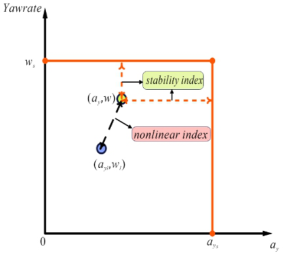
Based on this, the key parameters required for the construction of the characterization index are shown in Figure 1. Where ay is the actual lateral
Figure 1: Construction of comprehensive evaluation index.
acceleration, and w is the actual yaw rate, which can be measured by sensors or estimated (Xu, 2007; Bai, 2011; Chen, 2008). ays is the safety boundary value of lateral acceleration, andws is the safety boundary value of yaw rate. ayl is the expected lateral acceleration and wl is the expected yaw rate, which can be generated by driving data calibration or electronic stability controller such as ESP (Yu, 2017).
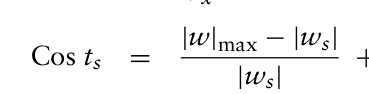
Vehicle is limited by the ground adhesion, and the yaw rate of the car should not be too large when driving at high speed, otherwise the vehicle is prone to dangerous behaviours such as sideslip. In this paper, the stability boundary of yaw rate and lateral acceleration are based on the road adhesion conditions (Hu, 2021), as shown in equation (1). The stability of the vehicle is characterized by calculating the maximum absolute value of the deviation between the actual state of the vehicle and the stability boundary under dif- ferent conditions of the slowly increasing steer test, and each deviation term is normalized by the value of the stability boundary. The stability index is constructed as shown in equation (2). When the actual state of the vehicle is within the safe boundary value, the stability index is negative. As the vehicle state tends to the safety boundary, the tires tend to saturate and the stability index tends to 0. When the vehicle state is beyond the safety boundary range, the stability index is positive and the vehicle is prone to instability.
Equation reproduced from the original PDF.
max −
ay
ays
Equation reproduced from the original PDF.
|ws| +
ays
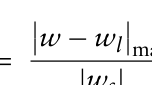
(3) When the vehicle is in good road conditions, the handling response will be more in line with driving expectations, but as the driving environment deteri- orates, the tires tend to saturate and the degree of vehicle nonlinearity spikes. The response of yaw rate and lateral acceleration in the vehicle steering test can reflect the change of vehicle nonlinearity. In this paper, the vehicle nonli- near characteristics are characterized by the absolute maximum value of the deviation between the actual yaw rate and lateral acceleration of the vehicle
Evaluation of Nonlinear Regional Stability Performance of Passenger Cars 567
and the expected driving state value under different test conditions of the slo- wly increasing steer test, and the deviation term is normalized by the stable boundary value, which constitutes the nonlinear index as shown in equa- tion (3). When the actual state of the vehicle is close to the expected value of driving, the nonlinear index tends to 0. As the nonlinearity of the vehicle increases, the value of the nonlinear index increases to a positive value.
ay −ayl
Equation reproduced from the original PDF.
max ays
(4) The vehicle comprehensive evaluation index is a combination of stability index and nonlinear index, as shown in equation (4). The weight can be changed with the change of road attachment conditions. The side slip and other risk is not easy to occur on high adhesion road. The weight of nonli- near index in the comprehensive evaluation is higher on high road adhesion road, emphasizing the vehicle response state in line with driving expectati- ons to avoid excessive response deviation leading to collision. The tires are easily saturated on low adhesion roads, and the vehicle is easily destabilized due to excessive driver tension or improper operation, so the stability index has a higher weight in the comprehensive evaluation process. When the com- prehensive evaluation index is negative, it means that the nonlinearity of the vehicle is low, the nonlinear index tends to be close to 0, the actual state of the vehicle is far from the safety boundary value, and the stability of the vehicle is stronger. When the comprehensive evaluation index is positive, the vehicle nonlinearity degree is significant, and the actual state of the vehicle is close to or beyond the safety boundary value. At this time the wheels tend to saturate, and the vehicle is easy to destabilize.
Equation reproduced from the original PDF.
RESULTS AND DISCUSSION
In terms of risk and repeatability, this paper uses simulation means to build a simulation environment through CarSim and Simulink, and conducts slo- wly increasing steer tests under different speeds and different road adhesion conditions to verify the comprehensive vehicle evaluation method proposed in this paper.
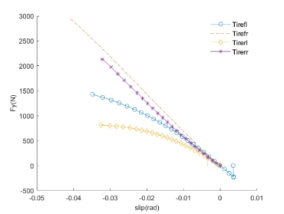
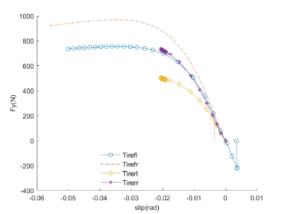
The results of the slowly increasing steer test under different road adhesion conditions are shown in Figure 2. As the road adhesion coefficient decreases, the wheels are more likely to reach the saturation state, so the degree of vehicle nonlinearity increases, and the deviation of the actual vehicle state from the desired state gradually increases. When the road adhesion coefficient is 0.4 and 0.2, the vehicle state value deviates more, and the nonlinearity is more obvious. The vehicle state is more biased to the safety boundary value, and the stability decreases.
The vehicle comprehensive evaluation index values under different road adhesion are shown in Table 3. It is not difficult to find that the index can effectively characterize the vehicle stability state differences under different road adhesion conditions. When road adhesion coefficient is 0.85 and 0.6,
a) Yaw rate deviation b) Lateral acceleration deviation
c) Yaw rate on high adhesion road VS safety boundary
d) Lateral acceleration on high adhesion road VS safety boundary
e) Yaw rate on low adhesion road VS safety boundary
f) Lateral acceleration on low adhesion road VS safety boundary
g) Tire characteristics on high adhesion road(0.85)
h) Tire characteristics on low adhesion road(0.2)
Figure 2: Vehicle nonlinearity and stability characteristics under different road adhe- sion conditions.
the vehicle comprehensive evaluation index is negative. With the road adhe- sion coefficient reducing, its value tends to 0. When road adhesion coefficient is 0.2 and 0.4, the tire show saturation state, and its corresponding vehicle
Evaluation of Nonlinear Regional Stability Performance of Passenger Cars 569
Table 4. Comprehensive stability index under different road adhesion conditions.
stability comprehensive evaluation index is positive. Meanwhile the vehicle nonlinear degree is significant, and the vehicle has seriously deviated from the expected state of driving. At this time, it is easy to cause the vehicle to collide with other vehicles in the process of obstacle avoidance due to understeering. In summary, under different road adhesion coefficient vehi- cle comprehensive evaluation index can effectively characterize the vehicle stability and nonlinearity degree.
The results of the slowly increasing steer test at different speeds are shown in Figure 3. As the vehicle speed decreases, the yaw rate deviation and lateral acceleration deviation decrease significantly, and the degree of vehicle nonli- nearity is alleviated. When the vehicle speed decreases to 40km/h, the vehicle stability is improved. The wheels show significant saturation characteristics at high speed, and the vehicle nonlinearity is obvious, while the vehicle state is close to the safety boundary value. The vehicle is easy to lose control, and the driving risk is greatly increased.
It is not difficult to find that the index can effectively characterize the dif- ference of vehicle stability state under different speed conditions. As shown in table 4, when the vehicle speed is 100km/h, 80km/h and 60km/h, the vehicle comprehensive evaluation index is positive, and the vehicle nonli- near characteristics are significant, and the value tends to 0 as the vehicle speed decreases. The comprehensive evaluation index transit to negative value when the speed decrease to 40km/h, and the degree of vehicle non- linearity is improved more obviously. Therefore, it is an effective measure to reduce risk by decreasing speed appropriately when driving on the low adhesion road. In summary, the comprehensive vehicle evaluation index can effectively characterize the vehicle stability and nonlinearity at different speeds.
a) Yaw rate deviation b) Lateral acceleration deviation
c) Yaw rate on highspeed VS safety boundary
d) Lateral acceleration on high speed VS safety boundary
e) Yaw rate on low speed VS safety boundary
f) Lateral acceleration on low speed VS safety boundary
g) Tire characteristics on high speed(100km/h)
h) Tire characteristics on low speed(40km/h)
Figure 3: Vehicle nonlinearity and stability characteristics under different velocities.
CONCLUSION
In this paper, a feasible comprehensive evaluation method of vehicle stability and nonlinearity is proposed for passenger cars, including two aspects of test
Evaluation of Nonlinear Regional Stability Performance of Passenger Cars 571
design and evaluation index construction. The slowly increasing steer test is determined as the validation experiment, and the experimental conditions are extended to different vehicle speeds and different road adhesion conditions in order to effectively stimulate the vehicle nonlinearity. A comprehensive vehi- cle evaluation index consisting of stability index and nonlinearity index was constructed by considering the vehicle stability and nonlinearity degree. The adaptability of the comprehensive evaluation indexes to the changes of the test conditions is explored. Considering the risk and repeatability, the simu- lation means is selected to verify the validity of the vehicle comprehensive evaluation index. The simulation verification results show that, as the road adhesion coefficient decreases, the vehicle comprehensive evaluation index gradually changes from negative to positive values, while the vehicle stabi- lity decreases and the vehicle nonlinearity increases. At this time, reducing the vehicle speed is an effective measure. When the road adhesion coeffici- ent is 0.2, the vehicle speed can be reduced to 40km/h to a certain extent to alleviate the vehicle instability trend, and the vehicle comprehensive eva- luation index to return to negative values by decreasing speed. So that the comprehensive evaluation method proposed in this paper can not only effe- ctively evaluate the difference of vehicle performance in linear and nonlinear regions, but also can quantitatively distinguish the difference of vehicle per- formance under different test conditions, and has certain robustness to both vehicle speed and road adhesion conditions. The evaluation method is expe- cted to enrich the content of vehicle handling stability evaluation, and it can also empower the autonomous driving decision and control algorithm, and provide the theoretical basis for planning the corresponding safety measures for different working conditions. The weight of stability indicators and the weight of nonlinear indicators in the current comprehensive evaluation inde- xes are determined empirically, and the weight of relevant indicators should change adaptively due to the changing test scenarios in the actual driving of vehicles, so in the future research, the introduction of fuzzy algorithms is con- sidered to realize the adaptive adjustment of comprehensive evaluation index weight values with the test scenarios.
REFERENCES
Bai Haiying, Wang Xiuying, Zhang Yunhui. (2011). Research on Soft Measurement Method of Vehicle Lateral Acceleration, Automobile Technology Volume 2011 No. 10. Bai Yan, Jia Xin, Zong Changfu, Guan Xin. (2012). Review of Objective Vehicle
Handling Evaluation, Science Technology and Engineering Volume 12 No. 6. Chen Xiaoyi. (2008). Study on the Methods of Vehicle Yaw Rate Estimation, Auto Sci-Tech Volume 2008 No. 1. Chen Huanming, Guo Konghui. (2015). Simulation of the Effects of Tire Performa-
nce on Vehicle Handling Stability, Automotive Engineering Volume 37 No. 5. Chen Juanjuan. (2016). Study on the correlation between subjective and objective evaluation for handling and stability of passenger vehicles. Master. Chang’an University. Gao Hongbo. (2014). Research on Directional Stability and Control Strategy of
Tractor-semitrailer Steering and Braking. PhD. Jilin University.
Hu Wangli. (2021). Research on Control Strategy of Vehicle ESP System Based on Road Adhesion Coefficient. Master. Chang’an University. Liu Dan, Wang Shengchang, Chen Juanjuan, Yang Zezhong. (2017). Correlation
between Subject and Objective Evaluation Data of Vehicle Handling Stability Based on Snake Test, Transport Energy Conservation & Environmental Protection Volume 13 No. 4. Lin Wengan. (2018). Comprehensive Evaluation System Research on Handling Stability of LCV. Master. Tsinghua University. Liu Bowei. (2021). Study on Objective Evaluation Method of Vehicle Handling and
Stability. Master. Chongqing Jiaotong University. Sun Ming, Cui Xiaochuan, Dai Qin. (2021). Study on NCAP fish hook test methods in the United States, Beijing Automotive Engineering Volume 2021 No. 3. Wang Changqing. (2012). Study on Objective Evaluation Index System of on-center
Handling for Passenger Car. Master. Jilin University. Wang Jiawei. (2020). The quantification of subjective evaluation in the development of chassis handling and stability. Master. Jilin University. Xu Tifan, Gao Xiaojie. (2007). A review of the development status of vehicle
longitudinal speed estimation algorithms, Shanghai Auto Volume 2007 No. 6. Yang E-chuan, Wang Teng, Zhang Yong, Deng Guohong, Ou Jian. (2016). Simulation Analysis and Optimization of Vehicle Transient Response Characteristics under Steering Angle Input, Journal of Southwest University Volume 38 No. 6. Yu Fan, Lin Yi. (2017). Automobile System Dynamics. 2nd. Beijing: China Machine
Press. Zhong Fan. (2019). Study on Subjective and Objective Evaluation Consistency of Vehicle Handling Stability. Master. Hunan University.
LISTED IN THE AHFE DIGITAL BOOKSTORE CATALOGUE
Explore the complete digital volume
Ergonomics In Design
Read this individual research paper free through the original publisher, or explore the full digital proceedings book.
ISBN 978-1-958651-53-7
Explore this ISBN in the AHFE Bookstore ↗Listed in the July 2026 bookstore catalogue; search by ISBN to confirm current availability · Digital book purchase optional