Fahad Khan, Seemal Asif, Phil Webb (2023). Communication components for Human Intention Prediction – A Survey. In: Human Aspects of Advanced Manufacturing. AHFE Open Access, vol. 80, pp. 9–19. https://doi.org/10.54941/ahfe1003504
In this review we address the communication components for human intention prediction for Human-robot collaboration (HRC). The HRC is the approach in which human and robot(s) work towards achieving the same goal. The interaction can be both levels physical and cognitive. The traditional settings of the HRC system provides fixed robot program based on waypoints or gestures. It is difficult to predefine the instructions of the situation in complex and variable environment. The understanding of human intention on dynamic basis is crucial for the success of such systems. The core character of co-existence of human and the robot is to understand the dynamic scenes of human intentions. To understand the human intention there is need to understand the components of intention communication. This paper provides comprehensive overview about the understanding the intention as communication components and modelling those components by using machine learning technology in HRC. Multiple ways of communicating intention are possible by using speech, action, gesture, haptic, physiological signals, etc. The article details various approaches to understand the human intention communication aspect particularly in the Human Robot Collaboration setting.
Collaborative industrial robots have been extensively used in intelligent manufacturing systems. Human-robot collaboration (HRC) refers to the interaction between human workers and robots in a shared workspace. It involves the use of robots to assist human workers in performing tasks, with the goal of improving efficiency, productivity, and safety. In HRC systems, robots and human workers work together as a team, with the robot provi- ding capabilities such as increased endurance, precision, and speed, while the human worker provides capabilities such as adaptability, creativity, and deci- sion making. (Bauer, Wollherr and Buss, 2008; Liu et al., 2022) Humans and robot work in a same shared manufacturing space and safety is an essential requirement for such a HRC system. Safety standards are of type A basic safety, type B generic safety and type C machine safety; type B has B1 and B2 for specific safety and safety aspect of safeguarding respectively.
Humans has interpretation capabilities where they rely on a combina- tion of visual, auditory, and other sensory cues to understand and interpret
intentions and actions of other co-workers. In this review, we aim to under- stand and discuss research in human intention prediction domain and provide insights into the use of machine learning technology to achieve this. The section 1 and 2 provide the fundamental background on HRC and Inten- tion Prediction. Human intention prediction and human motion prediction has fine line, there has been significant amount of research done in later area whereas for human intention prediction, research carried is limited to specific tasks and environments. This specific task could be gesture, speech, haptic or other forms of communication in a particular environment, which will be discussed in the section 3. The multiplicity of framework and approaches unveils the lack of the unified framework for human intention prediction and need for generalised model which could be adopted and used across various systems. Human workers intention must be interpreted, and human must be assisted for an efficient HRC system (Semeraro, Griffiths and Cangelosi, 2023). The section 3 also reviews previous work around human intention prediction. The section 4 creates broader discussion and summarises overall findings followed by scope of further work. It also reviews various HRC task accomplished using different modes of communications such as gesture, spe- ech, haptic and so on. Section 5 and highlights implementation of machine learning technology in HRC.
HUMAN-ROBOT COLLABORATION In the field of HRC systems, the term refers to a situation where robots and human workers interact and cooperate with each other to achieve common goals. The collaboration can take place in a variety of forms, such as:
Physical interaction: where robots and humans physically work together to complete a task.
Cognitive interaction: where robots assist humans in tasks that require cognitive processes.
Shared control: where humans and robots collaborate to make decisions and complete tasks.
Collaborative decision-making: where humans and robots work together to solve problems and make decisions.
Human-guided robotic tasks: where robots complete tasks under the guidance of a human operator.
Human-robot handover: where robots take over tasks from human workers and vice versa.
Overall, HRC systems aim to enhance the efficiency, safety, and flexibility of manufacturing and other industries.
Human Intention Prediction Human intention prediction in HRC refers to the ability of a robot to antici- pate and understand the goals, plans, and actions of a human. This is critical for ensuring safe and effective collaboration between the human and robot, as it allows the robot to make informed decisions and take appropriate actions.
Communication Components for Human Intention Prediction – A Survey 11
The prediction of human intention can be achieved through various techni- ques such as machine learning, computer vision, and probabilistic models. It is a crucial aspect of human-robot interaction and is an active area of research in both robotics and artificial intelligence.
Human intention prediction and human motion prediction are related but distinct concepts in the field of HRC. Human motion prediction refers to the ability of a system to predict the movement of a human based on past observa- tions, such as tracking human body movements, or predicting the trajectory of a human worker’s arm, or the timing of when a worker is likely to move to a different location (Liu and Wang, 2017). This information can be used to improve the efficiency and safety of the collaboration, for example by allow- ing the robot to anticipate and avoid collisions with the human worker or to optimize the robot’s motion in order to avoid interfering with human motion. Human motion prediction can be achieved by using various techniques such as computer vision, motion capture, and sensor-based tracking (Liu et al., 2022). Human intention prediction, on the other hand, refers to the ability of a system to infer the goals, desires or objectives of a human, it enables the robot to anticipate and respond to the actions of the human worker in real-time. One of the key advantages of human intention prediction is that it enables the robot to anticipate the human worker’s next action, and to take appro- priate action to assist the human worker. This could include predicting what task the human worker is about to perform, or what object the worker is likely to pick up next. This information can be used to improve the effecti- veness of the collaboration, for example by allowing the robot to assist the human worker with a task, or by allowing the robot to take over a task that the human worker is unable to complete. Human intention prediction can be achieved by using various techniques such as machine learning, Bayesian models, and probabilistic reasoning. By understanding the human worker’s intentions, the robot can adapt its own actions to support the human wor- ker, leading to improved performance, increased efficiency, and improved safety. Another advantage is that human intention prediction can be used to improve the safety of the HRC system (Liu and Wang, 2017). By anticipating the human worker’s actions, the robot can take action to prevent collisions or other safety hazards. Both of these predictions serve different purposes, require different kinds of information and models. In further sections we will explore more about them.
Humans use facial expressions, body language, and tone of voice to infer the intentions of others. They also use their own experiences, background knowledge, and social context to interpret the intentions of others and adapt efficiently to coordinate the interaction. The intention can be understood when end-goal is predefined, for this robot should perform coordinated movements of all body parts, thus making their goals and actions “legible” to humans (Duarte et al., 2018).
Communicating Intention in HRC In Human-Robot Collaboration (HRC) systems, effective communication of intention between the human and robot participants is critical for safe,
efficient, and effective collaboration. There are several ways that intention can be communicated in HRC, including:
Direct instruction: Humans can communicate their intention to the robot through direct verbal or gestural commands.
Context-aware interaction: Robots can infer human intention based on the context in which the collaboration takes place.
Natural language processing: Humans can communicate their inten- tion using natural language, which the robot can interpret using NLP techniques.
Predictive models: Robots can use predictive models to anticipate human intention based on past behavioural patterns.
Eye-gaze tracking: Robots can track human eye movements to infer intention, such as where a human is looking to guide the robot’s attention.
Body language: Humans can communicate their intention through body language, such as gestures, posture, and facial expressions.
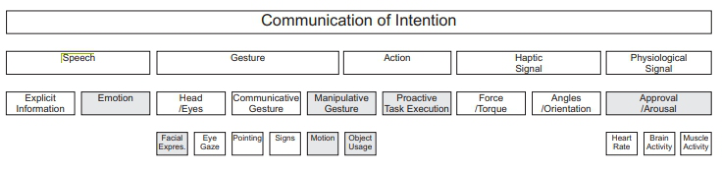
Effective communication of intention is crucial for ensuring that the colla- boration between the human and robot participants is seamless and efficient. By utilizing a combination of these methods, HRC systems can effecti- vely communicate intention and facilitate collaboration between humans and robots. Figure 1 illustrates the main components for Human Intention communication which are further discussed in the following paragraphs.
Speech is one form of communication; it can be explicit or implicit. The proposed a system (Matignon, Karami and Mouaddib, 2010) for a verbal and non-verbal robot companion that collaborates with a human partner to achieve a common mission. The robot’s objective is to infer the human’s pre- ferences upon the tasks of the mission, so it can collaborate with the human by taking on the human’s non-favourite tasks. To do this, they develop a uni- fied model that allows the robot to switch between verbal and non-verbal interactions. The robot can adjust its plan in case of sudden changes in the human’s preferences, and the proposed model helps it decide which tasks to perform to effectively satisfy the human’s preferences. Intention estimation can be achieved with speech as seen in model by (Wang et al., 2018) where voice instruction is given to a robot, language is processed using google spe- ech recognition system and extracts human intention (Deuerlein et al., 2021; Matignon, Karami and Mouaddib, n.d.; Wang et al., n.d.).
Figure 1: Ways of communicating intentions (Bauer, Wollherr and Buss, 2008).
Communication Components for Human Intention Prediction – A Survey 13
Gesture based intention communication can be witnessed in many studies, most of the motion prediction-based models falls under action-based inten- tion communication, such a proposed model is a method to recognize human body movements, in real-time setting with statistical methods and aiming to provide robot with action prediction capabilities. Inspired from speech reco- gnition, they trained a statistical gesture model to recognize those physical gestures in real time. This allowed to anticipate intention of other workers while interactions partners are still performing assigned tasks. There are seve- ral other studies where gesture based HRC system has been incorporated in various forms (Saponaro, Salvi and Bernardino, 2013).
Haptic perceptions can ensure efficient, ergonomic, safe, and dexterous interactions between humans and robots, intelligent interactive control model (Li and Zhu, 2022) uses haptic e-skin to sense applied contact position and contact force, converts these forces to generalized forces to convey human control intentions to robots. Robot arm can be manipulated by touching e-skin and demonstrates hand-by-hand teaching, HRC takes place as user teaches a robot to pick up an object, carry it and place in a box. In another study, human actions are recognised from data coming from wearable skin, awareness signals or vibrotactile signals from robot informs human about received data. An approach uses haptic feedback devices to notify human worker about robot’s intention in the form of robot’s current status and its planned trajectory (Grushko et al., 2021).
Physiological signals refer to the measurement and analysis of biological signals such as heart rate, skin conductance, muscle activity, respiration, and other such signals detects emotions, level of workers engagement in task and stress levels which helps to understand the physiological state (men- tal state) in HRC. These signals provide ability to infer worker’s affective state like electrocardiography (ECG), electrodermal activity (EDA), electroe- ncephalography (EEG), photoplethysmography (PPG), and pupillometry via quantitative approximations. Human intentions are difficult to detect in sha- red manufacturing where these signals serve as communication and when incorporated brings numerous advantages like enhances safety, performance, natural experience and creates meaningful experiences. The authors detailed how EEG signal can be integrated to detect human movement intentions and apply them to safety systems (Buerkle, Lohse and Ferreira, 2019; Gervasi et al., 2022; Kothig et al., 2021a). In a study, (Guo et al., 2019)designed five various emotions for small huma- noid robot (Alpha 2) and used EEG and pupillometry signals to analyse how user react to these emotional expressions to verify intended response. Corri- gan et al. used EDA to develop an adaptive signal to detect user’s engagement during their interaction with robot NAO (Corrigan et al., 2014; Kothig et al., 2021b).
Machine Learning Approaches for Human Intention Prediction in Human Robot Collaboration Machine Learning is a field of artificial intelligence derived from compu- ter science, which uses algorithms, statistical models, learning techniques to
train the systems and to identify and categorize data that they haven’t come across. It helps to create autonomous and intelligent systems by predicting about human behaviour, speech, gestures, physiological signals, and other data (Semeraro, Griffiths and Cangelosi, 2023).
A model (Matignon, Karami and Mouaddib, 2010) uses an epistemic par- tially observable Markov decision process (POMDP) for disambiguating the human’s preferences and an intuitive HRC for inferring human’s intentions based on observed human actions. In another study, authors have performed study to predict human intention to interact with robot using visual infor- mation like facial expression and body language, (Thang et al., 2019) system of multiple object detection is used along with Single-Shot-Multibox dete- ction (face detection), deep neural network (facial expression recognition). Long short-term memory (LSTM) network is used to predict human inten- tion. This was experimented with mobile robot and is very limited to social interaction, similar approach can be implemented in manufacturing robots (Truong, Ye and Ngo, 2019).
The stiffness estimation and intention detection method for HRC using CNN technique where human arm endpoint stiffness was estimated by muscle activation level and via tracking the human arm configurations whe- reas human intention was estimated via sEMG signal and neural network model. Force sensors were embedded in a feedback loop to adapt intelligen- tly, this setup was verified on Baxter robot platform (Chen, Jiang and Yang, 2020). Using dynamic model of human limb, LSTM - the supervised learning model to predict human intention along with an assistant motion con- troller to accomplish collaborative task. The reinforcement learning, fuzzy Q-learning algorithm is used to generate minimum jerk trajectory. Robot Franka Emika with 7 dof and joint torque sensors is used for this setup (Lu, Hu and Pan, 2020). Another LSTM model, (Yan et al., 2019) where relati- onship of skeleton-based information of human motion provides a possible solution for the robot to recognize human intention. It has high accuracy and low error and implemented on UR5; task is to assemble different pieces together.
A behaviour interactive learning framework in multi-agent setting as Mar- kov decision process, where user is in concurrent and collaborative task realization. A reinforcement model for Relational Action Process (RAP) is applied for a human assembling a box, it classifies users based on their expe- riences and different abilities and assists them accordingly. Rethink Robotics Baxter is used in setup and experiments (Munzer, Toussaint and Lopes, 2018). Another study (Vinanzi, Cangelosi and Goerick, 2020), cognitive robotic having cognitive architecture to detect intention of a human using probabi- listic and unsupervised learning model. The main highlight from this study is that it explores social understanding and cognitive significance of inten- tion reading. They introduced new clustering algorithm which is multi-level and multi-modal. Sawyer robot was used and demonstrated that adoption of multiple social cues leading to goal disambiguation.
Communication Components for Human Intention Prediction – A Survey 15
Table 1. Features extracted from papers related to human intention communication.
Table available in the original PDF paper.
Human Intention Communication
Author Machine Learning Model
Speech Gesture Action Haptic Signal Physiological Signal CNN (SL) X X
(Chen, Jiang and Yang, 2020) (Lu, Hu and Pan, 2020) LSTM (SL) X X
RAP (RL) X
Q-Learning (UL) (Munzer, Toussaint and Lopes, 2018) X (Vinanzi, Cangelosi and Goerick, 2020) Bayes Clustering (UL)
(Wang et al., 2018) ELM (RL) X X X X X (Yan et al., 2019) LSTM (SL) X X (Zhou and Wachs, 2019) TTSNet (SL) X X (Liu et al., 2022) EHMM (EL) X
Table 1 provides an overview of machine learning models used in studies on human intention communication. It shows the specific models emplo- yed by each author and the communication components they considered, including speech, gesture, action, haptic, and physiological signals. Nota- bly, gesture emerges as the most frequently considered component across the studies. The ELM algorithm encompasses all communication types. Whereas, the LSTM model is employed in two studies, specifically focusing on gesture and action signals (Wang et al., 2018; Yan et al., 2019; Lu, et al., 2020).
A study by authors, (Wang et al., 2018), developed effective teaching lear- ning prediction model which is based on extreme learning machine (ELM) for a Staubli TX2-60 robot which can learn multi-modal human hand-over demonstrations online and also it can predict human hand over intentions while assisting during HRC.
In this approach, a cognitive model known as the Turn-Taking Spiking Neural Network (TTSNet) based on neuron firing patterns is observed in SNN is capable of performing turn-taking predictions about a human’s inten- tions. Its application is seen in medical field as robotic assistant nurse which predicts doctor’s turn-taking intentions while doctor is performing a surgery (Zhou and Wachs, 2019).
Generative Adversarial Networks (GANs) are a deep learning technique used for predicting human intention in HRC. GANs have a generator & discriminator working together to generate synthetic data resembling human behaviour. Trained on human behaviour data, the generator predicts human intention & the discriminator evaluates the realism of these predictions. The process continues until the generator produces realistic human intention sam- ples. The generator can then be used to predict human intention in real-time hence improving HRC.
GANs have been proposed for human intention prediction in HRC in vari- ous research studies. For example, in a study (R. Xu et al. 2018), a GAN was
used to predict human arm motion in a HRC task. The authors trained a GAN on a dataset of human arm motion and used it to generate synthetic samples of human intention, which were then used to guide the motion of a robotic arm. The results showed that the GAN-based approach was effective in predicting human arm motion, leading to improved performance in the HRC task.
In another study (Z. Wang et al., 2020), a GAN was used to predict the future location of a human in a multi-agent interaction scenario. The authors trained a GAN on a dataset of human motion and used it to generate synthetic samples of human intention, which were then used to make predictions about the future location of the human. The results showed that the GAN-based approach was effective in predicting the future location of the human, leading to improved performance in the multi-agent interaction scenario.
These studies demonstrate the potential of GANs for human intention pre- diction in HRC. However, much work still needs to be done to further develop and validate GANs for this application.
DISCUSSION AND CONCLUSION Human motion prediction is an important aspect of HRC. The objective of human motion prediction is to enable robots to anticipate and respond to the actions and intentions of humans. This can be achieved by using various mediums such as gesture recognition, action recognition, haptic feedback, and physiological signals. The use of machine learning algorithms can help to achieve high accuracy in human motion prediction, but it is not enough to ensure safe interaction (Guo et al., 2019; Kothig et al., 2021b).
In order to guarantee safety in HRC, it is essential to consider and model the safety parameters. This is especially important in situations where robots are performing tasks that could potentially cause harm to humans, such as in the example of a robot carrying out a welding task in a shared working space. In these situations, it is important to ensure that the robot is aware of the necessary precautions to take while carrying out the task. For instance, the robot should be equipped with safety sensors to detect the presence of a human, and it should have the capability to stop its motion if a human is detected in the vicinity.
Moreover, the robot should be designed to minimize the risk of injury by having appropriate safety mechanisms in place. For example, the end effector of the robot, such as a welding tool, should be designed in such a way that it minimizes the risk of injury to humans. Additionally, the robot should be programmed to follow safety protocols and guidelines, such as ensuring that the welding tool is not pointed directly at the human, and that it does not move in an unpredictable manner.
The safety and HRC cannot solely rely on the collaborative robot and human intention prediction and these measures are not enough to ensure safe interaction. It is essential to consider and model the safety parameters, and to ensure that the robot is equipped with appropriate safety mechanisms, in order to guarantee safety in HRC (Guo et al., 2019; Kothig et al., 2021b; Villani et al., 2018; Zacharaki et al., 2020).
Communication Components for Human Intention Prediction – A Survey 17
The review provided focus on various communication components of human intentions, including speech, gestures, actions, haptic signals, and physiological measures. Machine learning methods for learning human intentions based on these components for safer HRC are also covered.
In conclusion, human intention prediction is a crucial aspect of HRC, as it allows for safe and effective interaction between humans and robots. Accu- rate intention prediction can lead to improved task performance, increased efficiency, and overall improved HRC. However, the prediction of human intention is a challenging task due to the complexities and variability of human behaviour. Despite this, significant progress has been made in the field, and it is an active area of research that holds promise for advancing the capabilities of HRC in the future.
ACKNOWLEDGMENT
This work was supported by EPSRC under Grant EP/V062158/1.
REFERENCES
Bauer, A., Wollherr, D. and Buss, M. (2008) ‘Human-robot collaboration: A survey’, International Journal of Humanoid Robotics, 5(1), pp. 47–66. Buerkle, A., Lohse, N. and Ferreira, P. (2019) ‘Towards symbiotic human-robot col-
laboration: human movement intention recognition with an EEG’, UK-RAS19 Conference: ‘Embedded Intelligence: Enabling and Supporting RAS Technologies’ Proceedings, 2 Loughborough University, pp. 52–55 Chen, X., Jiang, Y. and Yang, C. (2020) ‘Stiffness Estimation and Intention Detection for Human-Robot Collaboration’, Proceedings of the 15th IEEE Conference on Industrial Electronics and Applications, ICIEA 2020, Institute of Electrical and Electronics Engineers Inc., pp. 1802–1807. Corrigan, L. J., Basedow, C., Küster, D., Kappas, A., Peters, C. and Castellano, G.
(2014) ‘Mixing implicit and explicit probes: Finding a ground truth for engage- ment in social human-robot interactions’, ACM/IEEE International Conference on Human-Robot Interaction, IEEE Computer Society, pp. 140–141. Deuerlein, C., Langer, M., Seßner, J., Heß, P. and Franke, J. (2021) ‘Human-robotinteraction using cloud-based speech recognition systems’, Procedia CIRP, 97 Elsevier, pp. 130–135. Duarte, N. F., Rakovic, M., Tasevski, J., Coco, M. I., Billard, A. and Santos-Victor,
J. (2018) ‘Action Anticipation: Reading the Intentions of Humans and Robots’, IEEE Robotics and Automation Letters, 3(4) Institute of Electrical and Electronics Engineers Inc., pp. 4132–4139. Gervasi, R., Khurshid Aliev, ·, Luca Mastrogiacomo, · and Franceschini, F. (2022) ‘User Experience and Physiological Response in Human-Robot Collaboration: A Preliminary Investigation’, Journal of Intelligent & Robotic Systems 2022 106:2, 106(2) Springer, pp. 1–30. Grushko, S., Vysocký, A., Ošˇcádal, P., Vocetka, M., Novák, P. and Bobovský,
Z. (2021) ‘Improved Mutual Understanding for Human-Robot Collaboration: Combining Human-Aware Motion Planning with Haptic Feedback Devices for Communicating Planned Trajectory’, Sensors 2021, Vol. 21, Page 3673, 21(11) Multidisciplinary Digital Publishing Institute, p. 3673.
Guo, F., Li, M., Qu, Q. and Duffy, V. G. (2019) ‘The Effect of a Humanoid Robot’s Emotional Behaviors on Users’ Emotional Respon- ses: Evidence from Pupillometry and Electroencephalography Measures’, https://doi.org/10.1080/10447318.2019.1587938, 35(20) Taylor & Francis, pp. 1947–1959. Kothig, A., Munoz, J., Akgun, S. A., Aroyo, A. M. and Dautenhahn, K. (2021a) ‘Connecting humans and robots using physiological signals - Closing-the-loop in HRI’, 2021 30th IEEE International Conference on Robot and Human Interactive Communication, RO-MAN 2021, Institute of Electrical and Electronics Engineers Inc., pp. 735–742. Kothig, A., Munoz, J., Akgun, S. A., Aroyo, A. M. and Dautenhahn, K. (2021b)
‘Connecting humans and robots using physiological signals - Closing-the-loop in HRI’, 2021 30th IEEE International Conference on Robot and Human Interactive Communication, RO-MAN 2021, Institute of Electrical and Electronics Engineers Inc., pp. 735–742. Li, G. and Zhu, R. (2022) ‘Intelligent Interactive Control via Haptic E-skin for Human–Robot Interaction and Collaboration’, Advanced Intelligent Systems, 4(11) John Wiley & Sons, Ltd, p. 2200101. Liu, H. and Wang, L. (2017) ‘Human motion prediction for human-robot collabora-
tion’, Journal of Manufacturing Systems, 44 Elsevier, pp. 287–294. Liu, T., Lyu, E., Wang, J. and Meng, M. Q. H. (2022) ‘Unified Intention Inference and Learning for Human-Robot Cooperative Assembly’, IEEE Transactions on Automation Science and Engineering, 19(3) Institute of Electrical and Electronics Engineers Inc., pp. 2256–2266. Lu, W., Hu, Z. and Pan, J. (2020) ‘Human-Robot Collaboration using Variable
Admittance Control and Human Intention Prediction’, IEEE International Con- ference on Automation Science and Engineering, 2020-August IEEE Computer Society, pp. 1116–1121. Matignon, L., Karami, A.-B. and Mouaddib, A.-I. (n.d.) ‘A Model for Verbal and Non-Verbal Human-Robot Collaboration*’ Munzer, T., Toussaint, M. and Lopes, M. (2018) ‘Efficient behavior learning in
human–robot collaboration’, Autonomous Robots, 42(5) Springer New York LLC, pp. 1103–1115. Papanastasiou, S., Kousi, N., Karagiannis, P., Gkournelos, C., Papavasileiou, A., Dimoulas, K., Baris, K., Koukas, S., Michalos, G. and Makris, S. (2019) ‘Tow- ards seamless human robot collaboration: integrating multimodal interaction’, International Journal of Advanced Manufacturing Technology, 105(9) Springer, pp. 3881–3897. R. Xu, Q. Wei, Y. Liu, and D. Li, “Predicting human arm motion for human-robot
collaboration using generative adversarial networks,” Journal of Human-Robot Interaction, vol. 7, no. 4, pp. 63–76, 2018. Saponaro, G., Salvi, G. and Bernardino, A. (2013) ‘Robot anticipation of human intentions through continuous gesture recognition’, Proceedings of the 2013 Inter- national Conference on Collaboration Technologies and Systems, CTS 2013, pp. 218–225. Semeraro, F., Griffiths, A. and Cangelosi, A. (2023) ‘Human–robot collaboration
and machine learning: A systematic review of recent research’, Robotics and Computer-Integrated Manufacturing, 79 Pergamon, p. 102432. Thang, D. N., Nguyen, L. A., Dung, P. T., Khoa, T. D., Son, N. H., Hiep, N. T., van Nguyen, P., Truong, V. D., Toan, D. H., Hung, N. M., Ngo, T. D. and Tru- ong, X. T. (2019) ‘Deep Learning-based Multiple Objects Detection and Tracking
Communication Components for Human Intention Prediction – A Survey 19
System for Socially Aware Mobile Robot Navigation Framework’, NICS 2018 - Proceedings of 2018 5th NAFOSTED Conference on Information and Computer Science, Institute of Electrical and Electronics Engineers Inc., pp. 436–441. Truong, X. T., Ye, Q. and Ngo, T. D. (n.d.) Social interactive intention prediction and categorization. Villani, V., Pini, F., Leali, F. and Secchi, C. (2018) ‘Survey on human–robot col-
laboration in industrial settings: Safety, intuitive interfaces and applications’, Mechatronics, 55 Pergamon, pp. 248–266. Vinanzi, S., Cangelosi, A. and Goerick, C. (2020) ‘The Role of Social Cues for Goal Disambiguation in Human-Robot Cooperation’, 29th IEEE International Conference on Robot and Human Interactive Communication, RO-MAN 2020, Institute of Electrical and Electronics Engineers Inc., pp. 971–977. Wang, W., Li, R., Chen, Y. and Jia, Y. (2018) ‘Human Intention Prediction in Human-
Robot Collaborative Tasks’, ACM/IEEE International Conference on Human- Robot Interaction, 3 IEEE Computer Society, pp. 279–280. Wang, W., Li, R., Chen, Y., Jia, Y. and Jai, Y. (n.d.) ‘Human Intention Prediction in Human-Robot Collaborative Tasks’, 3 ACM. Yan, L., Gao, X., Zhang, X. and Chang, S. (2019) ‘Human-robot collaboration by
intention recognition using deep LSTM neural network’, Proceedings of the 8th International Conference on Fluid Power and Mechatronics, FPM 2019, Institute of Electrical and Electronics Engineers Inc., pp. 1390–1396. Z. Wang, Z. Li, Z. Li, and Y. Zhang, “Generative adversarial networks for multiagent future location prediction in human-robot collaboration,” International Journal of Robotics Research, vol. 39, no. 5, pp. 501–516, 2020. Zacharaki, A., Kostavelis, I., Gasteratos, A. and Dokas, I. (2020) ‘Safety bounds in
human robot interaction: A survey’, Safety Science, 127 Elsevier, p. 104667. Zhou, T. and Wachs, J. P. (2019) ‘Spiking Neural Networks for early prediction in human–robot collaboration’, International Journal of Robotics Research, 38(14) SAGE Publications Inc., pp. 1619–1643.
LISTED IN THE AHFE DIGITAL BOOKSTORE CATALOGUE
Explore the complete digital volume
Human Aspects of Advanced Manufacturing
Read this individual research paper free through the original publisher, or explore the full digital proceedings book.
ISBN 978-1-958651-56-8
Explore this ISBN in the AHFE Bookstore ↗Listed in the July 2026 bookstore catalogue; search by ISBN to confirm current availability · Digital book purchase optional