Busra Yetkin, Berna Ulutas (2024). Application of Digital Human Modelling and Factorial Experiments for Workstation Optimization. In: Human Factors and Simulation. AHFE Open Access, vol. 139, pp. 8–15. https://doi.org/10.54941/ahfe1005019
Human-Robot Collaboration (HRC) empower manufacturing workstations by enabling ergonomic and safe working conditions for humans. To design successful HRC, operational and ergonomics aspects must be considered. In this paper, a new methodology is developed to identify factors that can impact physical workload of workers’ performance in a HRC environment. The proposed approach is based on Digital Human Modelling (DHM) and Factorial Design of Experiments. DHM enables to design and evaluate a large number of design configurations with respect to multiple performance measures. However, most of modelling tools focus on graphical aspects and fail to analyze the effect of interactions among different design parameters that play a significant role in the design of workstations. Factorial Experiments addresses these gaps by generating a set of alternative design configurations in a systematic manner. In this study, a HRC workstation design is simulated in JACK software. A set of controllable design parameters (input factors) that may influence the ergonomic risks are defined as number of cobots, task complexity, human's anthropometric characteristics (height and weight) and product features (weight and dimensions). Each factor has two levels as high and low. To reduce the number of runs fractional factorial design algorithm is applied and 32 experiments are generated by using different configurations of factors’ levels. Multi-objective optimization technique applied for five different performance measures that are characterized as cumulative compression, cumulative low back moment exposure on L4/L5, energy expenditure rate, RULA score and cycle time. Main and interaction effects of input factors on performance measures are discussed. The proposed methodology shows the advantages of combining DHM tools, and statistical design approaches such as Factorial Experiments.
The concept of Human-Robot Collaboration (HRC) where humans and cobots work together brings challenging problems of how such systems should be designed and managed. When designing a HRC environment, it is essential to make the most of the ergonomic and economic benefits offered by cobots. Reducing or totally removing repetitive movements and/or heavy
Application of Digital Human Modelling and Factorial Experiments 9
lifting tasks are considered as the most important benefits for humans in a HRC system. In order to achieve this benefit, many issues such as inte- gration, scheduling, identifying skills of each agent and task assignment must carefully be considered. A multidisciplinary approach is required to understand worker interaction with cobots in repetitive industrial settings. Digital Human Modelling (DHM) enables to build and investigate work- stations considering a number of design configurations based on multiple performance measures. However, most of the studies design a little set of configurations and select one of them with no optimization process. In this case, it is probable that there is a better solution. Ben Gal and Buckhin (2002) proposed a methodology to deal with this limitation. The authors combined virtual manufacturing, and design of experiments (DOE) to generate a set of alternative design configurations in a systematic manner, and obtained the best configuration in terms of ergonomics and economic measures. They considered height, length, and depth of the workstation as design factors. Rio Vilas et al. (2012) presented a framework for manufacturing worksta- tion design using DHM, combining ergonomic and operational considera- tions and demonstrated in two case studies that how DHM can be profitably used. The authors applied DOE to assess and generate different combina- tions of the design parameters such as workstation materials’ height and angle levels.
A literature review is conducted to investigate the studies for HRC apply- ing DHM. Based on the current accessible literature, it can be stated that there is a limited number of studies related to simulation and optimization for HRC in the digital manufacturing environment. Castro et al. (2017) tested an industrial case to show how IPS IMMA simulation software can assist in the design of human-robot collaborative workstations. Ore et al. (2016) combined the performance measures from the DHM together with multi-objective optimization techniques to design the optimal workstation that includes human and industrial robot collaboration. The authors used height and angle metrics of the workstation as input factors and investi- gated the trade-off between the cycle time and the rapid upper limb assess- ment (RULA) ergonomic measure. Although these studies address workplace design optimization considering physical design attributes like heights and angles, critical production simulations were performed with only one or a few human models and other important factors in a work environment were not taken into account. This means not all potential people in a work environ- ment are represented and task or product related parameters are disregarded so far.
This study introduces a new framework for a HRC workstation design including set of parameters that may influence the physical ergonomic risks based on factorial experiment using a DHM simulation (JACK 9.0). The methodology presented in this study enables multi-objective optimization to minimize a numerous ergonomic risk and maximize productivity. A case study of external gear pump assembly is designed for demonstration purposes and to assess the method’s validity.
10 Yetkin and Ulutas
METHOD
The proposed methodology aims to identify the factors that may influence the physical ergonomic risks and cycle time in a HRC workstation and at what level of these factors, workplace design can be optimized. To demonstrate the methodology, an external gear pump assembly workstation is modelled in JACK software. Fractional factorial design algorithm is applied and 32 experiments are generated by using different configurations of factors’ levels. To obtain the optimal workstation design, multi-objective optimization tech- nique is applied for different performance measures that are characterized as ergonomic and economical.
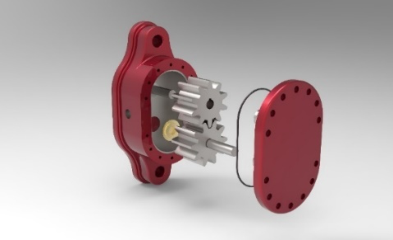
Case Study An assembly workstation is designed for external gear pump that has appli- cations in several industries such as, automotive, ship, oil, and chemistry as shown in Figure 1. The entities needed such as conveyors/shelves/tools for station design are used from JACK software library. UR3 and UR5 models of Universal Robots are imported to the JACK software for assembly process as possible resources for the required tasks.
Figure 1: External gear pump.
The main operations defined for the product in concern are as follows:
Bushes, pins, and gears are picked from the shelves and assembled to the house,
The seal is inserted into the groove on the housing,
The cover housing is closed over the housing,
Bolts are inserted into the holes in the housing,
All bolts are tightened.
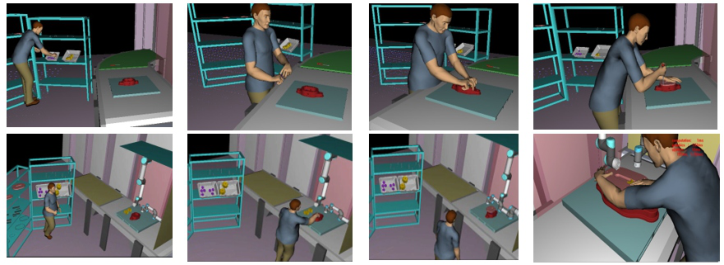
As illustrated in Figure 2, these tasks can be executed by a human worker or collaboratively with cobots. The first row of the figure represents the workstation along with the anthropometry of manikins where a human worker completes the tasks. The second row of the figure correspond to HRC where two cobots are utilized along with the human worker.
Application of Digital Human Modelling and Factorial Experiments 11
Figure 2: The designed workstation without and with cobots.
Design of Experiments Simulations can be performed in JACK software in real time. The results can be generated for one cycle, cumulatively daily for the desired duration, or based on the desired number of repetitions that are obtained cumulatively for that period. In this study, the simulations are run for 8 hours of a working day and cumulative results are obtained. Five performance measures/responses that are readily available in the software are chosen. Cumulative compres- sion on L4/L5 (MegaNewton-second) and Cumulative moment exposure (MegaNewton-meter-seconds) enables to identify the impact of task demands that are performed during the entire work shift. Metabolic energy expendi- ture (kcal/minute) calculates the number of kilocalories required for each task performed within the simulation, by considering the demands of posture and effort. The risk of upper limb disorder potentials for the exposed workers during a manual task can be assessed by RULA. Through predetermined time analysis tool in JACK software, Cycle time can be obtained for a simulation that predicts the time required to perform a job by subdividing a task into a set of motions which have been assigned times based on the methods-time measurement (MTM-1) system.
A set of controllable design parameters (input factors) that may influence the physical ergonomic risks are defined as number of collaborative robots, task complexity, human’s anthropometric characteristics (height and weight) and product features (weight and dimensions). Two levels are considered as high and low for the input factors as shown in Table 1. To cover all repre- sentative workers, a percentile approach has been used when defining the manikins. The goal is that the biggest male (95th percentile) and the smallest female (5th percentile) should be able to do the task. For this, Korean anthro- pometric database, available in JACK library, is used to create human models according to height and weight measurements.
The gear pumps have various applications and can be designed in a wide range of sizes and weights. Therefore, product related features are con- sidered as another factor that can impact the worker’s physical ergonomic load.
12 Yetkin and Ulutas
Table 1. The selected ranges of the input factors.
Table available in the original PDF paper.
Input Factor Level 1 Level 2 Height 149.1 180.5 Weight 45 87 Number of cobots 0 2 Dimensions of the parts (cm) 20×15×10 50×30×25 Weight of the parts (kg) 2 8 Task complexity Low High
To investigate impact of HRC, cobots have been positioned at the work- station and two levels for this factor is considered. Level 0 correspond to the case where all tasks are executed by human and no cobot is utilized. Level 2 is the case where two cobots are collaborate with human at the same station. Cobots can successfully perform point-to-point movements, apply force/torque, and grasp simple objects. However, complex coordinated movements, precise grasps, or in-hand manipulation require more complex perception and control and are not suitable with current levels of robot decision-making/skills. It is more appropriate to assign such complex tasks to people who can achieve high performance with less planning effort (Lamon et al., 2019). Considering this task-resource compatibility two different level of tasks are designed in JACK software. Low task complexity defines the tasks that can be handled by simple movements like pick and place. In contrast, if task complexity is high, tasks require fixing/aligning and rotating with two hands movements.
To generate a solution space of design configurations, a 26 and 1/2 frac- tional factorial experiment with 32 different configurations are identified by the factor ranges and neglecting higher order response models. Each config- uration is manually programmed in JACK software. This takes a significant time especially when a series of complex actions must occur together.
RESULTS
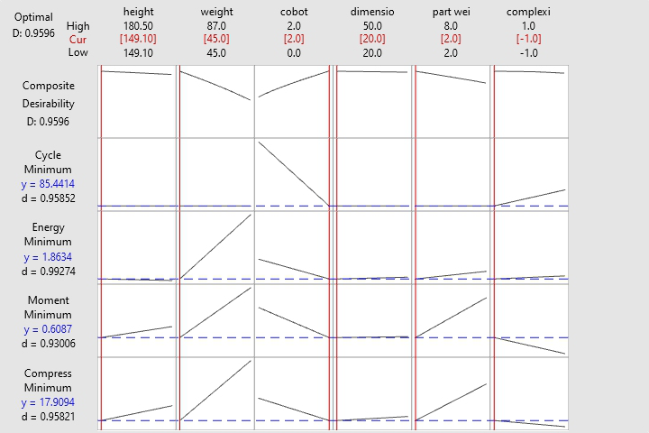
In this section, simulation results of 32 different solutions are analyzed for the each response separately and simultaneously using the desirability function approach that is applied for multi-optimization in Minitab Software. Desir- ability method finds conditions that provide the “most desirable” response values (Figueiredo et al., 2014). The response optimizer is run to minimize all ergonomic measures and cycle time, assuming each response has equal impor- tance and weight relative to the others. The mulit-optimization results is given in Figure 3. This graph shows the effect of each factor on the responses and composite desirability. The current factor settings are representted by verti- cal red lines and the numbers in red at the top of the columns. Individual and composite desirability assess how well a configuration of factors reaches the goals defined for the responses. While individual desirability (d) evalu- ates how the settings optimize a single response, composite desirability (D) evaluates how the settings optimize all responses simultaneously.
Application of Digital Human Modelling and Factorial Experiments 13
When all responses are optimized separately, individual desirability func- tions are obtained as 1. The composite desirability optimization (D) is obtained as 0.9596, and since this value was very close to 1, all responses could be optimized at a good rate. This value interprets that there is some trade-off from each response in multiple response optimization.
Figure 3: Individual and composite desirability levels.
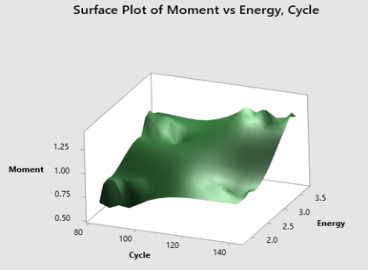
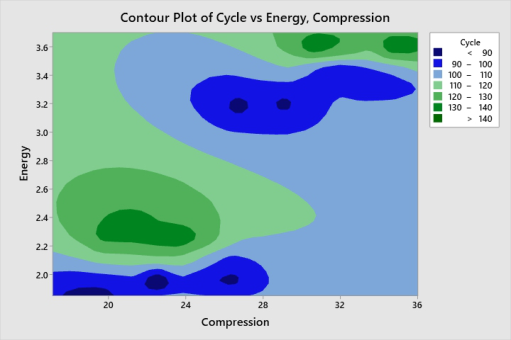
Figure 3 also shows which factors affect each response. Cycle time is most affected by the number of cobots and then by the task complexity. As the number of cobots increased, cycle time decreased significantly. This is a con- sistent result since cobots take over some of the tasks in the station. If task complexity increases, cycle time increases too. This is because in a com- plex task there will be more movement and alignment tasks take more time. This variation range can be seen in surface and contour plots as shown in Figure 4 and Figure 5. When only cycle time is minimized, the response gives 83 seconds and the worst solution for the cycle time was at 141.8 seconds.
Figure 4: Surface plot of moment vs energy, cycle time.
14 Yetkin and Ulutas
Energy expenditure increased when body weight is heavier, and it is impacted by cobot usage as well. Energy expenditure gives the best response when a 45 kg human deployed in the simulation. It varies from 1850 to 3700 (kcal/min) for different simulations as can be seen in Figure 5.
Figure 5: Contour plot of cycle time vs energy, compression.
It can be seen that the factors affecting the cumulative compression and cumulative moment are identical. The strength of the relationship between two measures is examined with Pearson correlation analysis. The correlation coefficient which is 0.942 confirms the strong positive relationship between the two measures. All the input factors impacted these two responses, it is observed that body anthropometry, cobot number, product and task features can change physical ergonomic loads on human.
CONCLUSION
In this case study, the contribution of cobots to worker’s ergonomic load and cycle time were assessed. Also, the effect of other factors was consid- ered to improve the HRC working environment. The proposed approach was based on Factorial Experiments and had utilized DHM for simulations to enable multi-objective optimization. Energy expenditure, cumulative low back moment, cumulative compression on L4/L5, and cycle time were defined as one objective representing the ergonomics. The assembly workstation was tested based on 32 configurations as to highest productivity and lowest possible ergonomics measures.
This study exemplifies the benefits of combining digital modelling tools with statistical design approaches to get better understanding of configu- rations and analysis of the results through an experimental set up. This methodology can be applied to different workstation configurations and combined with different performance measures. Economic considerations for cobot applications can be integrated into the methodology. Motion capture technologies can be used to generate simulations more efficient in DHM.
Application of Digital Human Modelling and Factorial Experiments 15
ACKNOWLEDGMENT
The software used in this study was supported by the Eskisehir Osmangazi University Scientific Research Program (BAP#FDK-2022-2519).
REFERENCES
Ben-Gal, I. and Bukchin J. (2002). The Ergonomic Design Of Workstations Using Virtual Manufacturing and Response Surface Methodology, IIE Transactions Volume 34, No. 4. del Rio Vilas, D., Longo F. and Monteil, N. R. (2013). A General Framework For
The Manufacturing Workstation Design Optimization: A Combined Ergonomic and Operational Approach, SIMULATION Volume 89, No. 3. Lamon, E., De Franco, A., Peternel, L., and Ajoudani, A. (2019). A Capability- Aware Role Allocation Approach to Industrial Assembly Tasks. IEEE Robotics and Automation Letters Volume 4, No. 4. Ore, F., Vemula B. R., Hanson, L. and Wiktorsson, M. (2016). Human–Industrial
Robot Collaboration: Application of Simulation Software for Workstation Opti- mization, Procedia CIRP, 44. Ruiz Castro, P., Mahdavian, N., Brolin, E., Högberg, D. and Hanson, L. (2017).
IPS IMMA for Designing Human-Robot Collaboration Workstations. In 5th International Digital Human Modeling Symposium, Bonn/Germany, June 26–28.
LISTED IN THE AHFE DIGITAL BOOKSTORE CATALOGUE
Explore the complete digital volume
Human Factors and Simulation
Read this individual research paper free through the original publisher, or explore the full digital proceedings book.
ISBN 978-1-964867-15-1
Explore this ISBN in the AHFE Bookstore ↗Listed in the July 2026 bookstore catalogue; search by ISBN to confirm current availability · Digital book purchase optional