Manuela Vargas Gonzalez, Maria Pia Cavatorta, Valerio Cibrario, Lidia Ghibaudo, Ludovico Rossi (2024). A comprehensive digital twin for assessing feasibility and ergonomics of high-tension cable assembly operations. In: Accessibility, Assistive Technology and Digital Environments. AHFE Open Access, vol. 121, pp. 222–229. https://doi.org/10.54941/ahfe1004631
The focus of this study is on a comprehensive digital twin illustrating the assembly of a high-tension cable in an electric vehicle. This involves the integration of two software programs, IPS Cable Simulation and IPS IMMA (Intelligently Moving Manikin in Assembly), to simulate the cable assembly and analyze ergonomic factors. The study uses the vehicle geometry and task sequence of Stellantis on a hypothetical use case of an extreme assembly line with the vehicle raised and the operator performing the activity underbody. The simulation of the cable assembly analyses extension-compression and torsion behaviors, ensuring compliance with acceptable limits. Anthropometric variations among operators are considered using IPS IMMA's module to create a family of manikins representing the global Stellantis workforce. Ergonomic analysis with the EAWS tool identifies risk factors for operators of different anthropometries. Additionally, a comparison is made on task time between the MTM-UAS methodology and IPS simulation's biomechanically modelled time. Results indicate a successful integration of IPS Cable Simulation and IPS IMMA, creating a digital twin that accurately simulates the operator's task with the high-voltage cable. The study emphasizes the importance of biomechanical models in understanding issues related to reachability, incongruous postures, and their impact on task time, contrasting with predetermined time approaches. In the current landscape of electrified vehicles, where there is a noticeable increase in the dimension and number of the cables, and of autonomous vehicles, where packaging challenges arise from redundancy requirements and the growing reliance on virtual verification, comprehensive and realistic dynamic simulations will become increasingly vital.
future (International Energy Agency, 2023). The increased electrification in electric vehicles translates to a greater quantity of cables, which are longer and larger in diameter. This amplifies the importance and criticality of cable assembly activities in the manufacturing process. Moreover, the current focus on autonomous driving technology has become a strategic area for many companies, experiencing significant growth. This emphasis has resulted in the development of advanced and reliable self-driving systems. To enhance safety standards, the redundancy concept is implemented in the electrifica- tion of the car. This entails the incorporation of a backup system that ensures the transmission of data and proper functioning in the event of a serious system failure. Consequently, vehicles equipped with autonomous driving capabilities require the duplication of wiring, which impacts on the over- all wiring mountability within the vehicle. In addition, electrification and autonomous driving imply extended virtual validation, due to the standards and ISO requirements.
Digital Twins (DT) are virtual models that replicate real world processes, products, or services. The use of DT is widely used within many industries due to their capability to simulate every aspect of a given process, product, or service. This enables the early identification and resolution of critical issues during the design phase, contributing to more efficient and effective develop- ment processes (Attaran & Celik, 2023; Sharma et al., 2022). Additionally, this technology facilitates the assessment of optimization possibilities and the exploration of “What-if” scenarios.
Nevertheless, there are instances, such as ergonomics, in which assessments are often conducted on physical prototypes at the very end of the design process where significant changes to the processes, products, or services are costly and time consuming (Geiger et al., 2020). This is where the utiliza- tion of Digital Human Modelling (DHM) software becomes valuable, as it facilitates the generation of DT for a given process or service where humans are involved. This capability enhances the efficiency of the design process, enabling more effective development procedures.
Creating a realistic simulation for the assembly of cables by humans has become a challenging task. The conventional method of simulating cables as rigid bodies neglects their inherent properties. This approach fails to capture the difficulties involved in assembling flexible cables and does not adequately represent the challenges an operator may face, including the necessity for specific motions and postures during the assembly process.
The present paper illustrates a comprehensive digital twin that repro- duces the assembly operation of the high-tension cable on the vehicle floor of a Stellantis battery electric vehicle. This study is a hypothetical use case of an extreme case of line conception in which the assembly task is per- formed entirely underbody. The paper illustrates the integrated use of two software tools to establish a dynamic and realistic simulation and provide a comprehensive understanding of the work scenario. The simulation allows performing a detailed evaluation of the cable assembly process, an assessment of the ergonomic risk factors for different anthropometries using EAWS and a time analysis of the different subtasks to be performed by the worker.
MATERIALS AND METHODS
Designing realistic simulations poses a significant challenge when developing a DT to represent a product or process, especially when human interactions are involved, during the initial stages of the design process (Geiger et al., 2020). Consequently, it is crucial to use an appropriate DHM tool that ensures an accurate representation of the target population and the actual scenario.
The simulation tools used are IPS IMMA (Intelligently Moving Manikin in Assembly) and IPS Cable Simulation, which are integrated within the same environment. This integration facilitates the execution of assembly simu- lations that involve human interactions with flexible elements, offering a comprehensive platform for studying and optimizing such scenarios. IPS IMMA is endowed with an anthropometric model that facilitates the gen- eration of manikins, ensuring they accurately represent the anthropometric diversity within the target population (Brolin et al., 2011). Furthermore, it has the capability to generate task simulations where the manikin adopts highly ergonomic postures while keeping to specified constraints, such as grasping or viewing requirements. On the other hand, IPS Cable Simulation allows users to automatically simulate a physically correct flexible routing, and measure and visualize contact, collision, stress, and strains, during the entire motion. Moreover, it provides an automatic optimization with respect to the length and fixation points of the cable (flexstructures GmbH, 2023).
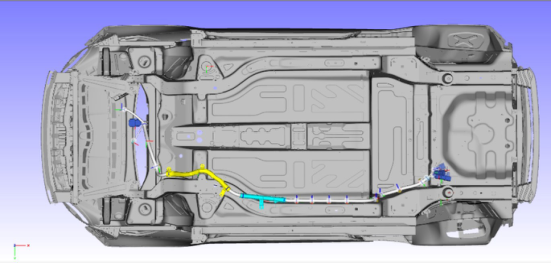
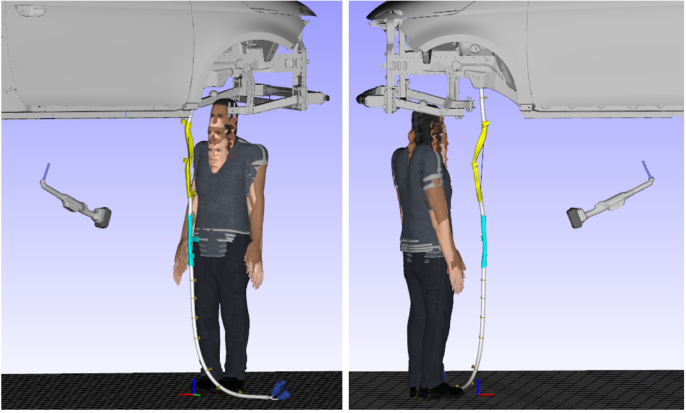
The use case is the assembly operation of the high-tension cable on the vehicle floor of a Stellantis battery electric vehicle (see Figure 1). The work- station geometry presented here is not representative of the current working conditions and the line layout at Stellantis, in which the car is rotated to optimize the posture engaged by the operator. This study is a hypothetical use case of an extreme case of line conception where the assembly operation of the high-tension cable on the vehicle floor is performed with the vehicle raised. In this scenario, the worker performs the tasks while standing, system- atically allocating the cable and its components onto the underbody starting from the front of the vehicle. The simulation starts with the cable suspended freely, ready for the assembly activity. This state follows a prior connection by another worker to the front of the vehicle (see Figure 2).
Figure 1: Cable assembled in the car underbody.
A Comprehensive Digital Twin 225
As a first step, a detailed simulation analysis of the cable assembly process was performed. Using IPS Cable Simulation, it became feasible to generate a virtual representation of a cable with the properties of an actual high- tension cable, thereby accurately simulating its real-world behavior. Given the assembly’s inherent characteristics, the operator must manipulate the cable to adapt to the geometry of the vehicle floor while satisfying specific geometric constraints.
Subsequently, two tests were conducted, the extension-compression and torsion behaviors of the cable to ensure that these characteristics fall within acceptable limits. The first test assesses the absence of failures in fixation points and the minimum required overlength necessary for the worker to reach connectors and fixation points. The second test evaluates absence of local damages that could make the flexible component unserviceable for ensuring structural integrity. Cable analysis helped to identify the postures that the operator will need to assume during the task, thus enabling a more realistic understanding and reproduction of the physical requirements of the work activity.
As second step, a simulation of the assembly process was conducted to assess the ergonomic risk factors and analyze the time involved in the dif- ferent sub-tasks. A family of manikins was developed to represent Stellantis workforce in different geographical regions around the world by combining different anthropometric databases. This ensures a comprehensive evaluation that considers the varied anthropometric characteristics within the work- force. The Stellantis family of manikins is composed of three male and three female manikins whose statures are shown in Table 1. The initial position of the family of manikins is facing the suspended cable (see Figure 2).
Table 1. Stature of the family of manikins used to run the simulation.
Table available in the original PDF paper.
Male Female Small Medium Big Small Medium Big
Stature [mm] 1690 1760 1810 1550 1660 1740
Once the simulation with the family of manikins was completed, the ergonomic assessment was performed through the EAWS tool (version 1.3.6), which is implemented within the IPS IMMA. This assessment helped identi- fying the exposure to risk factors for operators of different anthropometries when performing the assembly activity. The EAWS section used to evaluate the activity is the posture section.
The MTM methodology follows a standardized basic movement to cal- culate time, independent of the task specifics, and which does not take into account the conditions of the assembly process that dictate how the activity should be executed. These specific conditions may introduce complexities to individual sub-tasks, potentially affecting the time required by the operator to complete them. A comparison was made between the task time calculated with the predetermined MTM-UAS methodology and the individual activity
time of the task given by the IPS simulation, which is based on a biomechan- ical model that considers the manikin behavior according to the assembly conditions.
Figure 2: Initial position of the family of manikins in the hypothetical use case of raised car.
RESULTS AND DISCUSSION
A comprehensive dynamic simulation of the cable assembly process was conducted using IPS Cable Simulation. In both extension-compression and torsion behavior tests, the results indicated that, after multiple manipula- tions required for the assembly, the cable reached the specified thresholds. Specifically, in the extension-compression test, the observed values were con- sistently below 5 mm, while for torsion behaviors, the cable’s performance exceeded acceptable standards.
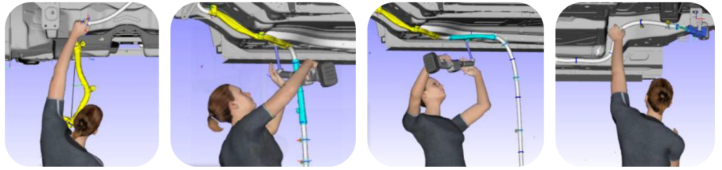
Once the cable assessment was completed, the full work cycle of the high-tension cable assembly was simulated in the hypothetical underbody workstation by integrating IPS IMMA with the simulation done previously with IPS Cable Simulation (see Figure 3).
Figure 3: Simulation of the high-tension cable assembly underbody.
A Comprehensive Digital Twin 227
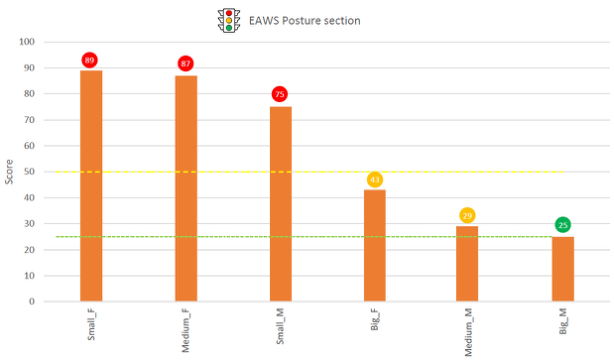
The ergonomic risk of the workstation was evaluated using the posture section of EAWS (see Figure 4). As anticipated, given the nature of the hypo- thetical activity where workers were required to work with their predominant hand above shoulder level, the EAWS score reflects the ergonomic risk for each of the members of the family of manikins. The diverse anthropometric characteristics within the simulated family of manikins reveal distinct risk lev- els. Those with a stature equal to or less than 1690mm face a high ergonomic risk, implying that either the activity needs modification or individuals below this stature should not be assigned to this workstation. On the contrary, the big female and medium male manikins show a moderate risk, which is still not recommended and indicate the necessity for modifications. Only the big male manikin obtains a low-risk score; however, it is essential to note that this score is at the upper limit of the lower risk range, implying potential pro- gression to medium risk over extended shifts. Adjustments may be needed even for the low-risk scenario to ensure sustained safety and comfort for the operator.
Regarding the time analysis, the comparison between the time given by the standardized MTM methodology and the time calculated using IPS IMMA reveals disparities in the activities of the task. IPS IMMA is a DHM soft- ware based on a biomechanical model that considers the anthropometry of the manikin and the intricacies of the task to calculate activity time. This approach provides insights into the biomechanical time required, taking into account factors such as reachability, visibility, and postural considerations. Given the specific nature of the use case, where operators are required to work with their predominant hand above shoulder level, the results indicate a necessity for longer times due to postural risks and variations in anthro- pometric dimensions. The standardized MTM methodology works well in scenarios without critical postural considerations, but it exhibits less flexibil- ity in accommodating factors such as posture, visibility, and reach criticalities. Furthermore, the analysis demonstrates that the operator’s anthropometry has an impact on task completion times.
Figure 4: EAWS posture score for the family of manikins for the hypothetical use case of raised car.
The observed differences between the standardized MTM methodology and biomechanical time highlight the need for further exploration in future research. Understanding these variations is crucial for refining time analy- sis methodologies, particularly in scenarios with postural complexities and diverse anthropometric characteristics of the operators.
CONCLUSION
The paper has illustrated a comprehensive digital twin that reproduces the assembly operation of the high-tension cable on the vehicle floor of a Stel- lantis battery electric vehicle in a hypothetical scenario of raised car. The dynamic simulation is able to take into account the characteristics of the cable, which may significantly influence how the assembly activity is per- formed by directly affecting the postures and behavior of the manikin. The consideration of cable properties adds a crucial layer of realism to the simula- tion, allowing for a more accurate representation of how the cable assembly task is performed and how the operator interacts with dynamic elements of the process.
In addition, this study shows that the biomechanical model integrated within IPS IMMA may help in understanding issues of poor reachability and need for incongruous postures and how these issues reflect on the time that is necessary to perform the task, unlike the predetermined time approach where time codes are assigned regardless of the biomechanical workload required by the task.
The development of this use case takes into account new trends and technologies in the automotive industry (electric vehicles and autonomous driving), which helps to optimize the approaches used to simulate real-world scenarios and, in turn, the simulation software. The integrated use of IPS IMMA and IPS Cable Simulation made it possible to develop a more real- istic simulation, thanks also to the continued support of fleXstructures in optimizing the simulation in light of the results obtained.
ACKNOWLEDGMENT
The authors acknowledge the work carried out by the graduate student Hélène Correale within her master’s thesis in Automotive Engineering at Politecnico di Torino in collaboration with Stellantis and fleXstructures Italia S.r.l.
REFERENCES
Attaran, M., & Celik, B. G. (2023). Digital Twin: Benefits, use cases, challenges, and opportunities. Decision Analytics Journal, 6. https://doi.org/10.1016/j.dajour .2023.100165 Brolin, E., Hanson, L., Högberg, D., Rhen, I.-M., Bertilsson, E., Hanson, L.,
Högberg, D., & Rhén, I. M. (2011). Creation of the IMMA manikin with consid- eration of anthropometric diversity. 21st International Conference on Production Research. https://www.researchgate.net/publication/247778095 Flexstructures GmbH. (2023). IPS Cable Simulation. Flexstructures GmbH Kaiserslautern. https://flexstructures.com/products/ips-cable-simulation/
A Comprehensive Digital Twin 229
Geiger, A., Brandenburg, E., & Stark, R. (2020). Natural virtual reality user interface to define assembly sequences for digital human models. Applied System Innovation, 3(1), 1–16. https://doi.org/10.3390/asi3010015 International Energy Agency. (2023). Global EV Outlook 2023: Catching up with
climate ambitions. www.iea.org Sharma, A., Kosasih, E., Zhang, J., Brintrup, A., & Calinescu, A. (2022). Digital Twins: State of the art theory and practice, challenges, and open research ques- tions. In Journal of Industrial Information Integration (Vol. 30). Elsevier B. V. https://doi.org/10.1016/j.jii.2022.100383
LISTED IN THE AHFE DIGITAL BOOKSTORE CATALOGUE
Explore the complete digital volume
Accessibility, Assistive Technology and Digital Environments
Read this individual research paper free through the original publisher, or explore the full digital proceedings book.
ISBN 978-1-958651-97-1
Explore this ISBN in the AHFE Bookstore ↗Listed in the July 2026 bookstore catalogue; search by ISBN to confirm current availability · Digital book purchase optional