Kaiqiao Zheng, Jing Luo (2024). A human-computer interaction design solution for women's home nodule detection devices. In: Accessibility, Assistive Technology and Digital Environments. AHFE Open Access, vol. 121, pp. 130–140. https://doi.org/10.54941/ahfe1004621
Women exhibit a higher susceptibility to nodules compared to men, attributed to factors such as genetics, physiology, and the dual pressures of managing both home and work. A nodule, defined as a diseased mass in human tissue or organs with a diameter of less than 3 cm, necessitates thorough follow-up testing for early detection and cancer treatment. Notably, breast and thyroid nodules, predominantly located in superficial tissues, can be initially screened through palpation. Breast and thyroid cancers, the most prevalent solid malignant tumors among women, continue to show an increasing incidence, posing a significant threat to women's physical and mental well-being. Despite this, recent studies indicate that only a minority of women can afford the time and financial resources for regular medical checkups, primarily due to economic pressures and the apprehension and fear associated with healthcare .Experts recommend regular monthly self-examinations for women as a proactive measure to reduce the risk of cancer, improve treatment outcomes, and enhance personal health awareness. Commonly employed methods to assist women in refining their self-examination skills and overall experience include graphic awareness education, simulators, and mobile apps. However, due to the often small or deeply hidden nature of nodules, tactile detection by touch can be challenging for the average individual. Some experts are exploring detection technologies and home-based devices, such as wearable devices integrated with bras [9]. Yet, as the home health detection devices, a human-centered approach is essential, necessitating careful consideration of human-computer interaction design to optimize the user experience.Following user research and analysis, this study has developed a compact home nodule detection device to facilitate early detection. In consideration of ergonomics and users' familiarity with smart products, the self-test device is designed to be compact and easy to operate, catering to non-professional healthcare users in a home setting. Paired with a mobile app, the device offers testing guidance, feedback on results, and additional features such as symptom recording, reminders, and health education. This comprehensive approach enhances the device's functionality and user-friendliness. In comparison to previous auxiliary detection methods, this device provides a more comfortable human-computer interaction experience, significantly boosting users' willingness and confidence in self-testing. Overall, this solution addresses current challenges in nodule self-inspection,encouraging people to pay more attention to their health status.Main research contents:1.Establishing Design Foundations: conduct competitive analysis and user research to define the product design framework.2.Integrating Human Factors: utilize human factors engineering analysis to shape the product's appearance and style. Develop a design prototype based on these considerations.3.User Review: engage users in the evaluation of the design prototype to validate design feasibility.Main research methods:1.Competitive Product Analysis: conduct a thorough analysis of existing nodule detection products in the market, identifying strengths and weaknesses. Summarize findings to guide the design process of this study.2.Semi-Structured Interviews: engage in semi-structured interviews with users to explore the timing, specific scenarios, and preferences related to self-tests. Understand user demands regarding product appearance, functions, and interactions.3.Usability Testing: implement usability testing by inviting users to assess the accessibility, comfort, reliability, functional integrity, and overall satisfaction of the product. Use feedback to refine and enhance the product design in the future.
The identification of nodules serves as an early symptom for numerous seri- ous diseases, making it a vital aspect of healthcare. Particularly in women, the predisposition to nodules is higher than in men, attributed to factors such as genetics, physiological structure, and the compounded stress of home and work (Tran and Davies, 2023). A nodule, typically defined as a diseased mass in human tissue or an organ measuring less than 3 centimeters in diam- eter, holds significant importance. Breast and thyroid nodules, commonly situated in superficial tissues, can be initially screened through palpation. Despite breast and thyroid cancers being the most prevalent solid malig- nancies among women, with an increasing incidence (Bolf et al., 2019; Jin et al., 2022), recent findings indicate that a significant number of women neglect regular medical visits. This neglect can be attributed to time con- straints, financial pressures, and apprehensions related to worry and fear (Goldenberg et al., 2008). The failure to undergo regular medical checkups in hospitals poses potential risks to women’s health.
The recommendation that women engage in regular self-health checkups has been put forth to mitigate the risk of cancer, enhance treatment out- comes, and foster personal health awareness (Kutlu and Bicer, 2017). To facilitate women in acquiring self-examination skills, common educational approaches involve graphic awareness (Tuna et al., 2014), simulator-based training (OGBENE et al., 2023), or the use of mobile apps to guide the self- examination process (Karadeniz Küçük and ¸Sener, 2021). However, nodules are often small or deeply concealed, and examination results can be easily influenced by individual subjective experiences. The presence of nodules is challenging for an ordinary person to perceive through touch without expe- rience. Therefore, the future of nodule self-examination is expected to pivot towards the use of assistive devices as a more objective and accurate method of detection.
In recent years, there has been a trend towards miniaturization in medi- cal devices, driven by user demands for convenience and sustainable health testing. Concurrently, the advent of artificial intelligence (AI) has ushered in transformative changes for home medical devices. AI, through automatic processing and analysis of substantial health data, enables patients to gain profound insights into their health and receive personalized health advice. AI technology has also eased the workload for doctors.For example, the AI breast screening device AIBUS incorporates a robotic arm for standardized breast sweeps and intelligent labeling of lesions based on image algorithms (Yan et al., 2023); a nodule recognition system for thyroid ultrasound images developed by Wenjun Yao et al. (2023) effectively reduces physicians’ read- ing time.These technological advancements provide a new opportunity for the home use of nodule identification and diagnosis.
While functionality is crucial for a home health testing device, it is essen- tial to recognize that users of such devices are typically non-professionals who may not be well-versed in the technical principles of the device. Hence, the ease of use and user experience play a pivotal role. This underscores the importance of human-computer interaction (HCI) design.HCI design involves optimizing the interaction between the device and the user, encom- passing aspects such as device appearance, button layout, screen display, etc. (Yuan and Ren, 2023). Effective HCI design aligns the device with human usage habits and psychological expectations, thereby reducing the learning curve and operational complexity. Ultimately, this contributes to an enhanced user experience and increased user satisfaction.
Moreover, it is imperative to consider the specific needs of the female population. Women’s physiological characteristics, particularly their unique “three periods” (menstruation, pregnancy, and lactation), impose heightened requirements for comfort, ease of use, and privacy when it comes to health testing equipment.
Given the aforementioned background and challenges, this study centers on the human-computer interaction design of home nodule detection devices for women. The approach involves a comprehensive review of relevant lit- erature and the current market landscape, with a focus on understanding the human-computer interaction aspects of existing breast or thyroid self- examination tools from the perspective of women. Subsequently, through
132 Zheng and Luo
in-depth interviews, research, and analysis of the target users, we extract design requirements and formulate the ultimate design solution. Finally, we invite volunteers to conduct usability evaluations to inform future iterations and upgrades of the product.
METHODS
Literature Review
The analysis of literature and market research led to the summarization of human-computer interaction methods employed by current nodule self- testing methods and commercially available self-testing products (Table 1). The non-invasive detection methods can be categorized into three major groups based on the human-computer interaction of the device.
Table 1. Current nodule detection products.
Table available in the original PDF paper.
Code Schematic Working principle HCI methods Advantage A1 Computer vision recognition and speech recognition Real time guidance and feedback, users will not miss detection Guide users to self check through audio-visual feedback
A2 ultrasound technologies
Wearable and physically guided sensor positioning
No imaging artifacts caused by poor positioning or lack of contact Support continuous detection
Wearable automatic detection
A3 Microwave imaging technology
Low cost and portable
Handheld automatic detection
A4 optical tactile-elasticity imaging
low cost
A5 Red light transmission
Handheld and self judgment
A6 Capture cellular thermal energy mutations
Wearable and feedback results through the APP
Support continuous detection
The first category involves a self-inspection guidance system leveraging computer vision technology. This method entails the computer vision sys- tem recognizing the detection area, tracking the user’s hand movements, and assessing the palpation level. Users control the entire system through a voice recognition system (Billones et al., 2015).
A Human-Computer Interaction Design Solution 133
The second category consists of wearable devices utilizing technologies such as ultrasound imaging (Du et al., 2023), microwave imaging (Elsheakh et al., 2023), cellular thermal monitoring, and others. Sensors are placed on the bra, allowing users to complete the detection of breast nodules by wear- ing the device for a designated period. Real-time monitoring of the breast is achieved through prolonged device usage.
The third category includes handheld devices, exemplified by the handheld detector based on optical tactile elastography. This technology is applicable for breast nodule and thyroid nodule monitoring, offering advantages such as non-invasiveness, real-time monitoring, portability, and ease of operation (Cho et al., 2023).
User Research In order to better understand users’ self-examination behaviors and their preferences and demands for the appearance, functions, and interactions of self-examination devices, we recruited six female users with self-examination experiences and six female users without self-examination experiences through online social platforms to conduct semi-structured interviews.
Table 2. Participant characteristics.
Table available in the original PDF paper.
Nodule detection method Self examination frequency
Code Age Ever had Breast or thyroid disease P1 24 NO Self-examination Once a week P2 22 YES Self-examination Once a week P3 30 NO Self-examination Non scheduled P4 26 YES Self-examination and echography Once a month P5 24 YES Self-examination and echography Once a month P6 23 NO Self-examination Non scheduled P7 23 NO Physical examination Never P8 25 NO Physical examination Never P9 24 NO Physical examination Never P10 22 NO Physical examination Never P11 33 NO Physical examination Never P12 28 NO Physical examination Never
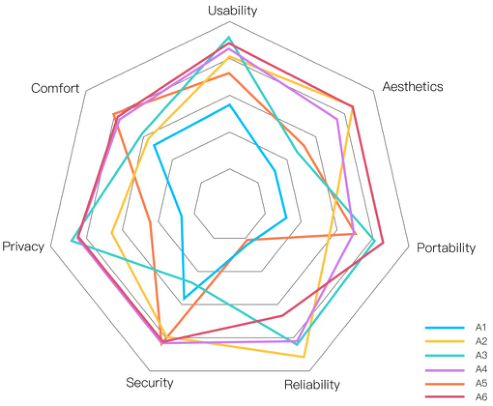
Before formally beginning the interviews, we had participants complete an advance questionnaire. The questionnaire included: (a) basic information about the individual; (b) the participants’ experience of self-checking; and (c) graphic descriptions of the six self-checking devices and the corresponding five-point scales in Table 1. After understanding the basic working principles and usage of the six devices, participants rated them on seven dimensions,
134 Zheng and Luo
including ratings on the ease of use, comfort, and privacy of the devices. The scoring results are shown in Figure 1.
Then, in-depth interviews were conducted with the users in conjunction with the results of the advance questionnaire, which consisted of four parts: (a) participants’ overall evaluation and opinion of the existing equipment; (b) participants’ evaluation of the device’s functionality; (c) participants’ evalu- ation of the device’s exterior design; and (d) participants’ additional insights and suggestions for the relevant device. The interview process lasted approxi- mately 20 minutes and was audio-recorded throughout with the participants’ consent. The audio files were transcribed and organized textually after the interviews.
Figure 1: Results of participant ratings of current nodule self-examination devices.
RESULT
When confronted with a self-inspection device utilizing a visual system, exem- plified by A1, all 12 participants voiced apprehensions regarding potential privacy breaches. The heightened concern stemmed from prevalent incidents of surreptitious photography and the unauthorized disclosure of privacy information from electronic devices in recent years.Therefore women are strongly wary of products with cameras. Two interviewees also mentioned that when they used their cell phones in the bathroom, they would avoid the camera catching them or they would take objects to cover the camera (P1, P7).
While wearables received generally high ratings from participants for ease of use and reliability, there were notable reservations expressed regarding comfort. Some interviewees were concerned about whether the sensors could be perfectly hidden in clothing in summer when clothing is thin (P4). Addi- tionally, worries were raised about the impact of sweating on the accuracy of test results and the cleanliness of devices, particularly those with multiple
A Human-Computer Interaction Design Solution 135
sensor-linking wires like A3 (P7, P8). Although using these devices at home avoids the above issues, many respondents indicated that they would not wear a bra when they got home from work or when they went to bed, and they would not want to wear the device while they slept, as this may affect sleep comfort. In addition, respondents with child bearing experience (P11) indicated that a woman’s breasts may get enlarged during breastfeeding, and she was concerned that the wearable devices would not accommodate her postnatal figure.
For the handheld device, participants indicated that it would have a wider scope of application, as it could detect nodules in multiple parts of the body, and could also be used with family members to increase the utilization rate of the device (P5). However, there is a slight lack of information interaction, and the “device + app” mode commonly used in modern smart devices can be used to realize quick feedback and recording of testing information.
In addition, a number of participants expressed the hope that the test results could be fed back instantly without the need to wait for a long time. Participant P5 mentioned that waiting for the test results at the hospital made her feel very anxious. Regarding the appearance design of the testing device, participants did not have a clear design style preference for the time being, and indicated that they paid more attention to the functionality and practicality of the product than the appearance.
DESIGN Design Requirement
Based on the above research results, we summarized the following design requirements and categorized them according to the three dimensions of basic functions, device appearance and human-computer interaction, as shown in Table 3. These design requirements aim to meet the needs and expectations of users for nodal self-inspection devices from multiple dimensions.
Table 3. Design requirement.
Table available in the original PDF paper.
Design requirement Illustrate Design dimension Function Multi site detection Suitable for testing multiple body parts Privacy Protection No camera Intelligent diagnosis Intelligent analysis of test results
Appearance Simplicity Avoid excessive decoration Softer Avoids sharp edges and is easy to hold and use Human- machine interaction Instant feedback Instructs users in real time and provides feedback at the end of the operation Explanation of test results Provide AI doctors to answer questions Nodule knowledge education
Increased user awareness and understanding of nodules Easy handling Avoid complex buttons and actions Health Tracking Regularly remind users to test and generate quarterly reports
136 Zheng and Luo
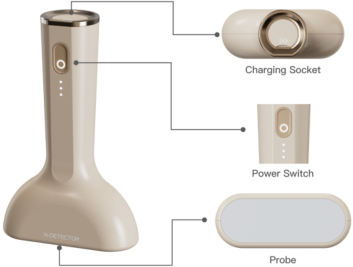
Design Description The ultrasound technology is widely available and is used in the detection of breast and thyroid nodules, so this design is based on ultrasound detection technology. In addition, in order to adapt to a wider range of body sizes and detection sites, a handheld design was finally adopted. The design of the device is shown in Figure 2. The appearance of the device is designed to be simple and rounded. The color palette chosen is a warm light curry, thoughtfully selected to harmonize with traditional household equipment. This not only aligns with existing home aesthetics but also swiftly establishes an emotional connection with the user. The warm and comfortable feel aims to create a positive user experience.
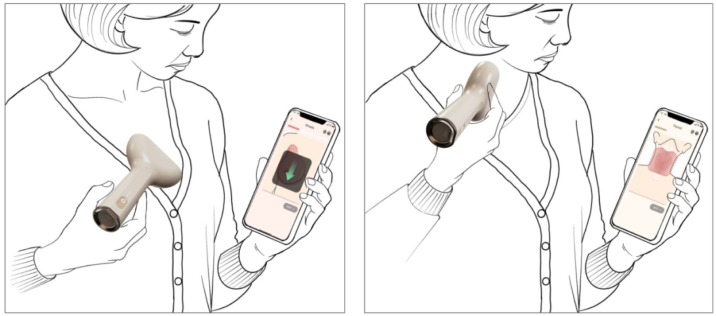
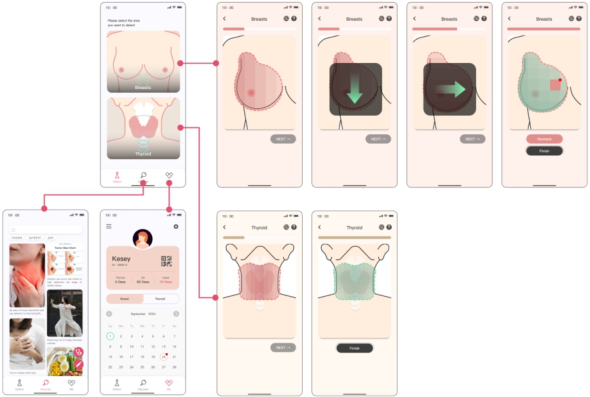
To make the operation of the device easy and to reduce button misop- eration, there is only one switch on the device. After the user turns on the switch, the user selects the part of the body to be detected on the mobile app and follows the tips to move the scanner for scanning, shown in Figure 3. In addition, to ensure the accuracy of the scan, the system will ask users to enter their chest and neck measurements when they first use the device. Then, the app will carefully divide the area to be inspected into several zones and guide the user to scan horizontally and vertically in all directions.
Figure 2: Description of the structure of the nodule detection equipment.Figure 3: Schematic diagram of device use.
A Human-Computer Interaction Design Solution 137
In order to avoid users worrying about camera shots, we have added a no-camera logo to the interactive interface of the detection function. At the end of the scan, abnormal conditions will be marked in the detection page. The system also analyzes the health of the individual (physiological/pregnan- cy/breastfeeding) and the previous test results and provides health advice. Users can also choose to re-test the area if they disagree with the scan results, or select an AI doctor for consultation. In addition, in order to provide users with a better understanding of how to prevent and eliminate nodules, we have set up a discovery panel to provide users with scientific knowledge includ- ing pathology, diet, and exercise. Finally, the user can view previous testing records and set personal physiological conditions in the personal interface to enhance the accuracy of intelligent diagnostic advice. The main interaction interface is shown in Figure 4.
Figure 4: Main interactive interface.
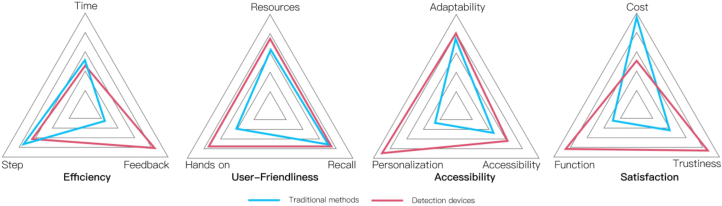
Usability Study In this section, we collected feedback from users through a scale questionnaire aimed at validating the feasibility of the design solution. The questionnaire contains three parts: (a) a brief introduction to the traditional nodule self- examination technique and the design scheme of this study; (b) a usability scale part. We divided the evaluation criteria into four dimensions: effi- ciency, user-friendliness, accessibility, and satisfaction, taking into account the requirements for product usability in the International Organization for Standardization’s ISO standards, as well as the basic principles of human- computer interaction design; (c) the openness section. We ask users to fill in the evaluation of this design solution and encourage them to write down comments and suggestions for improving the product.
The questionnaires were distributed through social networking platforms, and a total of 156 people completed them, and after screening, 148 valid questionnaires were obtained.
138 Zheng and Luo
The results are shown in Figure 5. The design solution proposed in this study scored significantly higher than the traditional self-inspection method in terms of information feedback, personalized settings, functional settings, and testing confidence, showing a higher willingness to use the product. However, there was a large divergence in the cost of use. Combined with the responses in the open-ended section, some participants believed that the self-inspection device enabled home nodule detection, which was more cost- effective than going to the hospital for testing. On the other hand, some participants were concerned that the device would be sold at a higher price, whereas traditional nodule self-testing is free. In addition, accessibility scores were low, with some participants reflecting that middle-aged and older users may have a bit of difficulty getting started with the app. In addition, in terms of functionality, some participants suggested that they would like to add a storage box or rack for storing the testing device, as well as a user switching function to make it easier to record the status of women’s nodules at home separately. These valuable feedbacks will provide important references for our subsequent product development so that we can continuously optimize and improve the product design.
Figure 5: Usability evaluation.
DISCUSSION
Compared with the traditional touch self-examination and hospital test- ing methods, the self-examination device proposed in this study provides more objective results and more convenient operation. Through the human- computer interaction design of “handheld device + app”, we provide users with a good user experience, effectively assisting them in daily nodule self-examination.
However, we still need to improve the accessibility design. For example, women with hand disabilities or visual impairment may find it difficult to fully utilize the device. Meanwhile, some middle-aged and elderly users may encounter trouble in using the device because they are not familiar with smartphone operation. In addition, the price of the ultrasound device is rela- tively high, and the frequency of self-examination of nodules recommended by doctors is about 1–2 times per month, which leads to a low frequency of use of the device and will make consumers willing to buy it.
To address these challenges, we plan to improve the accessibility design and develop a human-computer interaction model that is applicable to the entire
A Human-Computer Interaction Design Solution 139
family. By optimizing the design, one device can meet the nodule testing needs of all women in the family, thus increasing product utilization and motivating more women to pay attention to their health.
CONCLUSION
After user research and analysis, this study designed a small home nodule detection device to facilitate early detection of nodules. Based on the design requirements derived from the research, the self-test device is characterized by its compact size and easy operation, which is suitable for non-professional healthcare professionals to use at home. The device is paired with a mobile app to provide users with testing instructions and feedback on test results, as well as symptom logging, reminders, and health education, making the device more functional and user-friendly. Compared with the previous aux- iliary means of detection, the device provides users with a more comfortable human-computer interaction experience, and has a significant positive impact on users’ willingness and confidence in self-testing. It can well solve the cur- rent problems in the process of nodule self-inspection, which is of great significance for the promotion of women’s health and provides new ideas and directions for future nodule self-inspection.
REFERENCES
Billones, R. K. et al. (2015) ‘Intelligent Operating Architecture for audio-visual breast self-examination multimedia training system’, TENCON 2015 - 2015 IEEE Region 10 Conference [Preprint]. doi: 10.1109/tencon.2015.7372889. Bolf, E. L., Sprague, B. L. and Carr, F. E. (2019) ‘A linkage between thyroid and breast
cancer: A common etiology?’, Cancer Epidemiology, Biomarkers & Prevention, 28(4), pp. 643–649. doi: 10.1158/1055-9965.epi-18-0877. Cho, S.-H. et al. (2023) ‘High-resolution tactile-sensation diagnostic imaging system for thyroid cancer’, Sensors, 23(7), p. 3451. doi: 10.3390/s23073451. Du, W. et al. (2023) ‘Conformable ultrasound breast patch for deep tissue scanning
and imaging’, Science Advances, 9(30). doi: 10.1126/sciadv.adh5325. Elsheakh, D. N. et al. (2023) ‘Complete breast cancer detection and monitoring system by using microwave textile based antenna sensors’, Biosensors, 13(1), p. 87. doi:10.3390/bios13010087. Goldenberg, J. L. et al. (2008) ‘Uncovering an existential barrier to breast self-
exam behavior’, Journal of Experimental Social Psychology, 44(2), pp. 260–274. doi:10.1016/j.jesp.2007.05.002. Jin, Y. J. et al. (2022) ‘Association between thyroid cancer and breast cancer: Two longitudinal follow-up studies using a national health screening cohort’, Journal of Personalized Medicine, 12(2), p. 133. doi: 10.3390/jpm12020133. Karadeniz Küçük, A. and ¸Sener, B. (2021) ‘Design for positive breast self-exam expe-
rience using mobile apps’, Proceedings of the Design Society, 1, pp. 1013–1022. doi: 10.1017/pds.2021.101. Kutlu, R. and Bicer, U. (2017) ‘Evaluation of breast cancer risk levels and its relation with breast self-examination practices in women’, Journal of Breast Health, 13(1), pp. 34–39. doi: 10.5152/tjbh.2016.2832.
140 Zheng and Luo
Ogbene, L. E. and Egwuagu, I. E., (2023) ‘Capacity buliding programmer on breast self examination and knowledge on warning sign on breast can- cer among women’s’, Global Research for New World Order, 1(1), p. 9. doi: 10.59795/grnwo.v1i1.15 Tran, Q.-L. and Davies, L. (2023) ‘Thyroid cancer incidence differences between men and women’, Current Opinion in Endocrine and Metabolic Research, 31, p. 100472. doi:10.1016/j.coemr.2023.100472. Tuna, A. et al. (2014) ‘Effectiveness of online education in teaching breast self-
examination’, Asian Pacific Journal of Cancer Prevention, 15(7), pp. 3227–3231. doi: 10.7314/apjcp.2014.15.7.3227. Yan Lan-ping. et al. (2023) ‘Performance evaluation of artificial intelli- gence breast ultrasound (AIBUS) in breast cancer screening within pri- mary medical setting’, Modern Preventive Medicine, 50(03):567-570+576. doi: 10.20043/j.cnki. MPM.202203238. Yao Wangjun. et al. (2023) ‘Research on the Recognition Method of Benign and Malignant Nodules in Thyroid Ultrasound Images Based on Deep Convolutional Neural Networks’, Acta Universitis Medicanalis Anhui, 58(05), 854-858. doi: 10.19405/j.cnki. issn1000-1492.2023.05.025 Yuan, Y. and Ren, T. (2023) ‘Human Computer Interaction Design Practice in poster
design’, 2023 3rd International Conference on Intelligent Technologies (CONIT). doi: 10.1109/conit59222.2023.10205806.
LISTED IN THE AHFE DIGITAL BOOKSTORE CATALOGUE
Explore the complete digital volume
Accessibility, Assistive Technology and Digital Environments
Read this individual research paper free through the original publisher, or explore the full digital proceedings book.
ISBN 978-1-958651-97-1
Explore this ISBN in the AHFE Bookstore ↗Listed in the July 2026 bookstore catalogue; search by ISBN to confirm current availability · Digital book purchase optional