Jinyu Cai, Jing Luo, Ruling Yang (2022). A design of emergency services for pre-hospital cardiac arrest. In: Healthcare and Medical Devices. AHFE Open Access, vol. 51, pp. 214–219. https://doi.org/10.54941/ahfe1002119
The frequency of sudden cardiac death is increasing year by year. Timely rescue of cardiac arrest patients using aed devices can greatly improve patient survival rates. However, in most cases, patients do not receive timely assistance. The purpose of this project is to provide more timely and safer rescue for cardiac arrest patients. Therefore, this design integrates relevant resources through a set of service design to improve the response rate of cardiac arrest events and allow patients to receive timely assistance. First, we use literature reading method to understand the current development of technology and services. Then, we conducted structured interviews with stakeholders about the EMS process. Based on this, we used functional analysis and scenario simulation methods to explore the needs and summarize the service touchpoints. Finally, service design tools, such as service blueprints, user journey maps,system map etc., are used to describe the service design. The results of this project will help to improve the survival rate of cardiac arrest patients, and also have some reference value for the improvement of urban EMS system.
Cardiac arrest happens frequently in public places. The disease has few warning symptoms and a high mortality rate. Early cardioversion with a defi- brillator is the only effective treatment for ventricular fibrillation (Li, 2014). Patients can be effectively treated with defibrillation within four minutes of onset. However, ambulances do not always arrive in time to help patients. The AED (Automated External Defibrillator) is simple to operate and can be used by the general public after training so that it can play a certain role in emergency situations. However, there are still many unsolved problems, such as inadequate coverage of AED in public places and far from reaching areas with a high incidence of cardiac arrest (Zhang, 2015), the use of AED is not widespread enough, the pre-hospital first-aid system is not perfect, infor- mation technology and medical treatment failed to achieve good connection (Zhang, X., et al. 2020) and so on.
Based on these problems, there are a series of social assistance programs such as promotion of MPDS (Medical Priority Dispatch System) (Liu, 2021),
A Design of Emergency Services for Pre-Hospital Cardiac Arrest 215
promoting the AED quantity configuration, carrying out CPR (Cardio- Pulmonary Resuscitation) and AED usage training, establishing teams of first aid volunteers and implementing the interconnection between volun- teer assignment and ambulance command and dispatch platform (Liu, 2021). Pre-hospital first aid platform is also the trend of future design, which can effectively connect pre-hospital and in-hospital first aid, improve the effici- ency of diagnosis and treatment activities and reduce patient mortality and waste of medical resources (Deng, Zhang and Li, 2021). There are still some areas for improvement.
There is a systemic nature to service design, which is a design activity that allows different stakeholders to collaborate and co-creatively work organi- cally within a system to achieve a quality user experience and service benefits (Hu and Li, 2019). This design approach can effectively serve the current pre-hospital cardiac arrest emergency. The service design integrates the pati- ent, user, rescue equipment, medical staff, hospital, and other relevant factors in an efficient and systematic way. For example, aed equipment is destined for the general public, and the proportion of people with relevant training or simple knowledge is low and the absolute number is small. Then there is a need to plan the way, scenario, location and other factors for personnel training rationally. Therefore this will be a system where continuous learning can serve as social education and make the whole service system healthy and recyclable.
In addition to the issue of training of aed device operators, the relation- ship between the number and storage of aed devices is open to question. The location of sudden cardiac arrests allows for some frequency calculati- ons and probability projections based on existing big data tools to guide the deployment of aed devices. However, even using the most optimistic assum- ptions, deployment of AEDs in locations with very low rates of cardiac arrest is unlikely to be cost effective (Cram, Vijan and Fendrick, 2003). There- fore, the deployed AED must be accessible and easily identifiable to potential responders. Therefore, many places with low cardiac arrest rates may care- fully consider encouraging optimization of existing EMS services rather than spending limited resources on AEDs that are unlikely to be used (Cram, Vijan and Fendrick, 2003).
People are considering pre-hospital cardiac arrest resuscitation-related designs and developments from different directions. Some have proposed positioning medical drones with AED capabilities, using a location model to determine the optimal configuration of the drones, thus significantly redu- cing the response time (Pulver, Wei and Mann, 2016). Ambulance robots have also been proposed from a smart city perspective, which could carry an AED in the event of cardiac arrest and save some lives (Samani and Zhu, 2016). While these studies have improved the response speed of aed devices, there is still time to think about the specific issues of using the population, and pati- ent docking, etc. Pre-hospital emergency care is never just about getting one part right, but about integrating the entire service process for optimization from a system design perspective.
So, this design study aims to connect the four basic links of “rescue - pati- ent - science - hospital admission”. Through the research method of service
design, a cardiac arrest-oriented social emergency operation model is establi- shed. In the process from patient discovery to hospital admission, patients are rescued in time, aed equipment is reasonably allocated, emergency personnel are communicated in time, and all people learn first aid knowledge, so that the social emergency environment is more secure.
USER RESEARCH User research can tap into the electricity, find the core needs, and give dire- ction to the design. The user research of this project includes questionnaires and interviews.
Questionnaire and Interview User research can tap into the electricity, find the core needs, and give dire- ction to the design. The user research of this project includes questionnaires and interviews.
Take Shenzhen, where the researcher is located, as an example. In gene- ral, AEDs are equipped in more public places, so the research visited train stations, subway stations, schools, parks, shopping centers and other places equipped with AEDs.
The focus of the questionnaire and interviews at this stage was on the knowledge and participation in emergency medical care, knowledge of AED equipment, knowledge of cardiac arrest, and attitude toward emergency rescue.
The results showed that even in the young Shenzhen, people’s knowledge of emergency medical care is still lacking, and they lack the awareness of emergency medical care to some extent. Even if there are people who know the “AED”equipment, it is difficult to really start to rescue. At the same time, people are also worried about being held responsible for negligence. People who have received training will significantly increase their self-confidence in using AEDs. The more educated people are, the more socially responsible they are and the more willing they are to take the initiative to acquire first aid knowledge and training. Younger people are more capable of accepting the “Internet + first aid” service model than older people over 60 years old. This reinforces the fact that pre-hospital first aid is not just a spontaneous act of citizens. It is a social service that requires multiple players and a multi-faceted approach to help pre-hospital cardiac arrest patients.
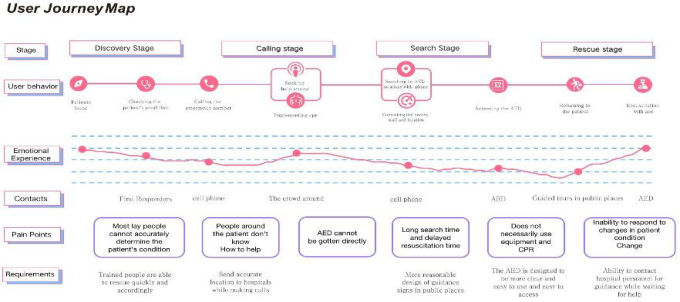
User Journey Map User journey map is a tool that visualizes the interaction between users and services and systems in an experience from the user’s perspective (Wei and Wu, 2019). The user journey map allows for an overall analysis of the service design from a process perspective. On this basis, pain points and requirements are uncovered so that optimization and improvement can be made. As shown in Figure 1, the user journey diagram is used to first sort out the stages of handling cardiac arrest events in public places. In this study, the first respon- ders (the people who discover the patient first) are the main users. Based on this user journey route, relevant behaviors, experiences, touchpoints, etc. are
A Design of Emergency Services for Pre-Hospital Cardiac Arrest 217
Figure 1: User journey map.
analyzed. Ultimately, guidance is derived to serve the design of pre-hospital emergency services.
Design Process The opinions and information collected from the previous research are impor- tant references for the continuation of the research. Therefore, the project will solve the following problems:
Therefore, the project will address the following questions.
(1) How to get timely and effective resuscitation of cardiac arrest patients. (2) How to popularize the knowledge of first aid among the general public. (3) How to make aed reach the patient quickly. (4) How to let the doctors in the hospital know the patient’s condition in advance and make reasonable resource allocation.
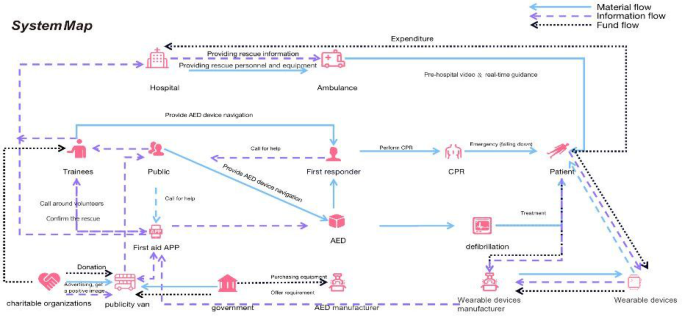
To address the above issues, we use system diagrams to systematically elaborate and analyze the new service model. As shown in Figure 2, this is the new system map in the ideal state. In this system, in addition to the original patient, doctor, ambulance, and AED, we also introduce other sta- keholders and service touchpoints. For example: trained volunteers, social organizations, charities, government departments, wearable devices, etc.
People are advised to use wearable devices for real-time monitoring of heart rate in high-risk groups after a physical examination. High-risk pati- ents with cardiac arrest wearable devices will automatically call for help. At the same time, there is no shortage of young people who have purchased wearables on their own and have the option to take advantage of this service as well. There is another important part of the system diagram: the first aid app, which will be downloaded mainly by trained volunteers and, ideally, by educated members of the public. There is such a paradox of location and population for the masses to receive training in first aid knowledge, mea- ning that if training is conducted in a fixed building, people in that area can master first aid knowledge to a certain extent. In order to make such know- ledge available to more people, we do not open more training sites the better - people will hardly go back after they have acquired the knowledge. Then
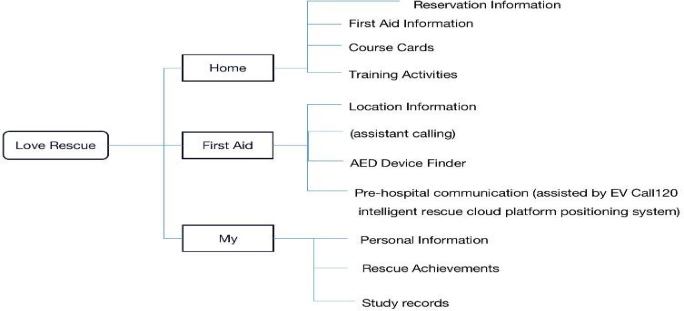
Figure 2: System map.Figure 3: Framework diagram.
space resources and human resources would be wasted. The new word in this system highlights the “mobile knowledge cart” to educate the public about first aid, rescue in emergencies, and help trained people to become volunteers and download the app. the app will call suitable volunteers in the surroun- ding area to request support. It also calls the emergency number and gives the hospital and the volunteer a precise location through EMS service. The location of the available aed devices is also provided to the volunteers for easy access.
As a key touch point of the app, the architecture diagram is shown in Figure 3, which can and can reflect the process of this rescue service more clearly.
CONCLUSION
The service design of pre-hospital cardiac arrest first aid solves the problem that cardiac arrest patients are difficult to get timely defibrillation rescue after the onset of cardiac arrest in public places; the knowledge of first aid is popu- larized through a movable publicity vehicle. This kind of vehicle solves the
A Design of Emergency Services for Pre-Hospital Cardiac Arrest 219
contradiction of space and crowd, so that more and more people can learn how to provide assistance to patients. At the same time rescuers can commu- nicate with hospitals in real time and get professional guidance according to the first aid platform. Hospitals can also get information based on the first aid platform and allocate resources in advance. The design is still in the conce- ptual design stage, but the results will help optimize the future emergency system.
REFERENCES
Cram, P., Vijan, S. and Fendrick, A. M. (2003) “Cost-effectiveness of automated external defibrillator deployment in selected public locations,” Journal of general internal medicine, 18(9), pp. 745–754. Deng, GH., Zhang, QL. and Li, QL. (2021). “The role of medical priority dispatch
system in pre-hospital emergency command and dispatch and its problems and countermeasures,” Chinese Journal Hygiene Rescue, 7(3), pp. 159–161. Hu, F. and Li, WQ. (2019). “Definition of “Service Design”,” Packaging Engineering, 40(10), pp. 37–51. Li, H. (2014). “Early resuscitation and care of patients with myocardial infarction,”
Today Nurse, 5. pp. 114–115. Liu, YC. (2021). “Design and application of digital pre-hospital emergency platform based on Internet of Things,” Electronic Technology & Software Engineering, 04, pp. 166–167. Pulver, A., Wei, R. and Mann, C. (2016) “Locating AED enabled medical drones to
enhance cardiac arrest response times,” Prehospital emergency care: official jour- nal of the National Association of EMS Physicians and the National Association of State EMS Directors, 20(3), pp. 378–389. Samani, H. and Zhu, R. (2016) “Robotic automated external defibrillator ambulance for emergency medical service in smart cities,” IEEE access: practical innovations, open solutions, 4, pp. 268–283. Wei, W., Wu, CH. (2019). “Comparison of User Experience Map, Customer Journey
Map and Service Blueprint”, Packaging Engineering, 40(14), pp. 217–223. Zhang, X., et al. (2020). “Problems and Countermeasures in the Development of Domestic Pre-hospital Emergency System,” Medical Information, 33(23), pp. 12–14. Zhang, YT. (2015). Domestic Public Emergency Medical Service Design Strategy And
Application. Shanghai Jiao Tong University.
LISTED IN THE AHFE DIGITAL BOOKSTORE CATALOGUE
Explore the complete digital volume
Healthcare and Medical Devices
Read this individual research paper free through the original publisher, or explore the full digital proceedings book.
ISBN 978-1-958651-27-8
Explore this ISBN in the AHFE Bookstore ↗Listed in the July 2026 bookstore catalogue; search by ISBN to confirm current availability · Digital book purchase optional