Miao Liu, Wenjun Wang (2022). Analysis of antibiotic purchasing service design based on SAPAD-AHP method. In: Healthcare and Medical Devices. AHFE Open Access, vol. 51, pp. 248–255. https://doi.org/10.54941/ahfe1002124
In the medical field, more than half of people will choose antibiotics for self-medication, they believe that antibiotics can be used for illnesses such as colds and fevers, or even for viral infections, which accelerates bacterial immunity to antibiotics. Misuse of antibiotics is not only unhelpful, but can damage the organism in a variety of ways that can lead to drug resistance, drug toxicity and allergic reactions. Worldwide, hundreds of thousands of people die each year due to bacterial resistance. In China, the use of antibiotics is even higher in outpatient and inpatient settings. The misuse of antibiotics poses a serious threat to the effectiveness of their use. In order to raise awareness of the dangers of antibiotic misuse, reduce people's choice of non-essential antibiotic medication, and expand and improve monitoring of health care institutions, this study introduces the SAPAD model and AHP to tap into users' real needs and complete a study of users' service design system for antibiotic drug purchase.The article uses observation method, user interview method and questionnaire method in the early stage to get the process of users' medicine purchase in common flu. Based on the SAPAD model framework, the user behavior is disassembled, and the people and things involved in the drug purchase process are listed to complete the mapping of behavior-object-meaning. The study obtained meaning clusters by clustering analysis of meaning layers, and combined with AHP to calculate the weight of each meaning cluster to derive core meaning clusters. The SAPAD model is a user-centered model framework for solving practical problems, which can start from the user's behavior, analyze, cluster and reorganize the meaning behind the behavior layer by layer, and finally dig into the user's real needs; the AHP method combines qualitative and quantitative analysis, and is highly logical and scientific, which can be applied to this topic The effective combination of SAPAD model and hierarchical analysis can gradually quantify the qualitative analysis and obtain more objective research results, which provides new ideas for the theoretical research framework of service design.This study completes the construction of meaning-based objects through the mapping of core meaning clusters to objects. The research process analyzes the key behaviors of users in purchasing drugs in common influenza, and obtains four semantic level meaning clusters through cluster analysis, namely "want to buy drugs quickly and correctly", "want to fully understand the effects of drugs", "want doctors to provide advice on appropriate medication" and "want to raise awareness of antibiotic medications". The study used AHP to analyze the meaning clusters and calculated the weights of each level to obtain the core meaning clusters of "buy the right medicine quickly", "get the right medication diagnosis", and "understand the effect of the medicine".The study reconstructed the service design system for users to purchase drugs in the process of common influenza through user requirements, summarized the key design elements, and improved the service function modules of online drug purchase and online consultation and advice.This study combines SAPAD model and AHP to design research on the user's antibiotic purchase process. Through the SAPAD model, we deeply study the user behavior, get the mapping of user behavior and meaning, and combine the quantitative research of AHP to get the core meaning cluster "quickly buy the right medicine", "get the right diagnosis of medication" and "understand the effect of medication", which guide the design of the service system of user's medication purchase process and the design of the APP for online medication purchase consultation. The SAPAD-AHP method in this study improved the function of the service system for antibiotic purchase process, and the designed output APP effectively improved the user's knowledge on the cautious use of antibiotics, strengthened the supervision of doctors' prescribing of antibiotics, and provided an effective solution to improve the problem of excessive use of antibacterial drugs in primary care institutions and rural areas.
In China, about 50% of hospital outpatients use antibiotics, while the pro- blem of antibiotic overuse is more prominent in grassroots hospitals in less developed western regions (Zhang et al., 2019). According to authorities, China is one of the most serious antibiotic abuse countries in the world, and if it will fall into a tragedy without medicine (Zhang et al., 2019). Therefore, improving people’s awareness of the harm of antibiotic abuse, reducing people’s choice of antibiotic drug treatment in grassroots hospitals, can effectively improve people’s medical and health level.
Semiotics Approach of Product Architecture Design (SAPAD) (Chen et al., 2018) is a user-centered model framework for solving practical problems. It was co-created by Professor Hu Fei and Professor Sato. Based on the product semiology theory, the SAPAD framework can analyze, cluster and reorganize the meaning behind the behavior layer by layer, and finally tap into the real needs of the users. Hierarchical analysis method (Analytic Hierarchy Pro- cess, AHP) has the characteristics of combining qualitative and quantitative
Analysis of Antibiotic Purchasing Service Design based on SAPAD-AHP Method 249
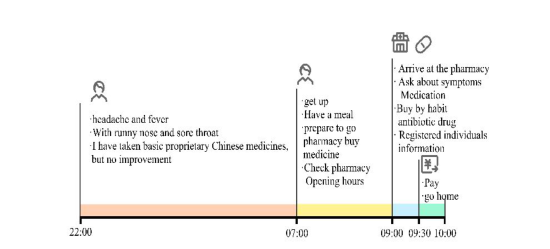
Figure 1: User A’s drug purchase path.
analysis, systematization and hierarchy, which can exclude subjective factors to the maximum extent based on the SAPAD framework, obtain clear and accurate results, and make it more objective. By introducing the hierarchi- cal analysis method, it can solve the more subjective problems of the SAPAD framework analysis process, so as to provide a reference for improving the SAPAD framework (Feng, 2017; Long, 2007).
DESCRIPTION OF SAPAD-AHP METHODS The SAPAD model first disassembled user behavior, gradually decomposed into tasks and sub-tasks; and then lists the objects (people and things) invo- lved in the sub-task one by one, forming a behavior-object mapping. Meaning is divided into physical layers, language structures, empirical layers, seman- tic layers, pragmatic layers, and social layers according to the hierarchy, mapping tasks with these six levels, forming a behavior-meaning mapping. Then significance clustering analysis for these 6 levels to obtain significance clusters.
The analysis of the significance clusters obtained from the cluster analysis combined with AHP divides the significance clusters and the corresponding significance into the criterion and scheme layers. The expert method is used to compare the index at each level to form a judgment matrix, through which the weight occupied by each index is calculated through the judgment matrix (Long, 2007).
SAPAD-AHP DESIGN EXAMPLE ANALYSIS: TAKE THE PROCESS OF BUYING ANTIBIOTICS BY THE GRASSROOTS PEOPLE AS AN EXAMPLE Through the preliminary user interview, it was finally determined to take a user A in a county seat in Weihai City to conduct in-depth research.
User A, female, 50 years old, living in a county seat in Weihai City, is a professional financial officer.Members of the family will have cold and fever symptoms in the process of changing seasons, and the frequency of daily drug purchase behavior is normal.Track the cold-drug purchase process of user A through non-participatory observation method, and then conduct in-depth interview with user A to fully understand the details of the whole process
Consult sym- ptom medica- tion hospital Register to consult a doctor
Online/offline registration Doctor’s appointment Consult a doctor Get medication advice
Hospital/Mobile/Staff/ Registration Machine Hospital/Mobile/Staff/ Registration Form Hospital/Mobile/ Registration/Doctor Hospital/Mobile Phone /Registration List/Doctor/Drug List
from the beginning stage of cold to the end of drug purchase. See Figure 1 to map the drug purchase path of A.
Through the user path analysis, five behavior modules were found: disco- ver a cold, query pharmacy, go to drugstore to buy medicine, consult symptoms and medication, and buy medicine.Take the consultation sym- ptom medication behavior module as an example, the consultation symptom medication behavior module can be divided into online medical consultation, consultation for medication advice, and registration consultation for doctors. Three tasks correspond to different sub-tasks (see Table 1).
The SAPAD framework is based on Stamper’s symbolic ladder framework theory, which divides the meaning of user behavior into six levels, namely: physical layer, experience layer, language structure layer, language and mea- ning layer, language layer, and social layer (Chen et al., 2021) mapped the tasks with six levels to obtain a behavior-meaning mapping.According to the user 5 behavior module, 26 subtasks are divided into six meaning layer mapping, physical layer corresponds to 7 meanings, semantic layer to 18 meanings, verbal layer to 17 meanings, empirical layer to 8 meanings, and pragmatic layer / social layer to 12 meanings.
Clustering is the process of classifying the data into different classes or clusters. Data in the same cluster are strongly correlated and not betw- een different clusters. Experience layer emphasizes the user’s use skills and
Analysis of Antibiotic Purchasing Service Design based on SAPAD-AHP Method 251
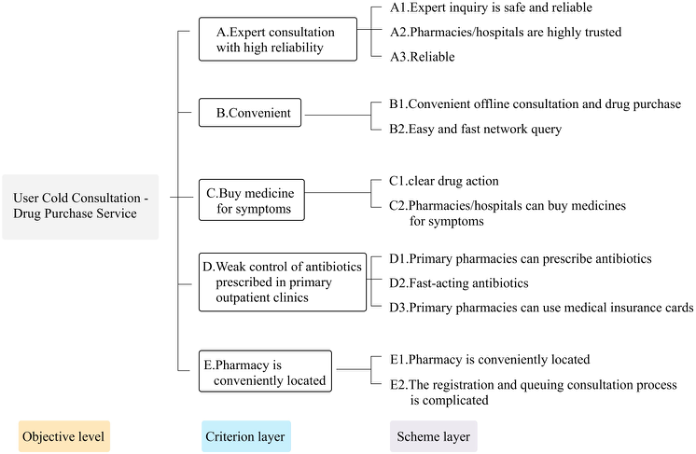
Figure 2: User A’s drug purchase experience hierarchy model.
life experience. Through cluster analysis, 5 significance clusters: (1) rapid and convenient network access to information (including doctor informa- tion, medication advice, traffic conditions); (2) reliable offline consultation (including pharmacy consultation, hospital consultation); (3) rapid home drug preparation and treatment; (4) Chinese patent medicine has no effect; (5) pharmacies can issue antibiotic drugs.
The semantic layer emphasizes human emotion and personality.Cluster analysis obtained five significance clusters. The pragmatic layer represents the purpose of the symbol and the propagation effect of the group in the semitics, and here represents the user’s expectations of the drug purchase experience. Cluster analysis has five significance clusters.
The significance clusters obtained from the cluster analysis were analyzed using AHP. The three-level division is shown in Figure 2.
Pairwise comparison of the five metrics of the criterion layer is performed using the Saaty scale. Weight calculated that R is 0.0429 <0.1, indicating that the consistency of the index is within the acceptable range and the weight value is valid. See Table 3 for arranging the index weights in the criterion layers from high to low.
Similarly, the CR value of the judgment matrix of the “user cold consultation-drug purchase service” scheme layer is 0.0079<0.1d, etc., indi- cating that the consistency of the scheme layer is within the acceptable range.
After the weight calculation of AHP, the core significance clusters are sum- marized as follows: rapid and convenient purchase of drugs, get appropriate drug diagnosis, antibiotic drug purchase to increase supervision.
By mapping the three core significance clusters-object-key behaviors (see Figure 3), 6 key behaviors for rapid and convenient drug purchase, 7 key
252 Liu and Wang
Table 2. Standardized judgment matrix.
Table available in the original PDF paper.
Index A.Expert B.Online consultation is convenient
E.Pharmacy is conveniently located
consultation with high reliability
C.Consultation can help to buy medicines for symptoms
D.Weak control of antibiotics prescribed in primary outpatient clinics A. 0.1875 0.2903 0.1163 0.2830 0.2632 B. 0.0625 0.0968 0.1163 0.0943 0.1579 C. 0.5625 0.2903 0.3488 0.2830 0.2632 D. 0.1875 0.2903 0.3488 0.2830 0.2632 E. 0.0375 0.0323 0.0698 0.0566 0.0526
Table 3. User cold consultation - order of weights of drug purchase service criteria.
Table available in the original PDF paper.
Indicator name Weights CR Index order
0.3557
1 C. Consultation can help to buy medicines for symptoms
0.2695
0.0429<0.1 2 D. Weak control of antibiotics prescribed in primary outpatient clinics 3 A. Expert consultation with high reliability 0.2238 4 B. Online consultation is convenient 0.1023 5 E. Pharmacy is conveniently located 0.0486
Figure 3: Core meaning cluster-object-key behavior mapping.
behaviors for appropriate drug diagnosis, and 7 key behaviors for increased supervision of antibiotic purchase were obtained.
USER COLD CONSULTATION-DRUG PURCHASE SERVICE DESIGN BASED ON “BEHAVIOR-MEANING-OBJECT” The 20 key behaviors were summarized into five key behaviors, including transparency of drugstore drug prescribing information, recording of anti- biotic drug purchase information on the Internet of Things platform, online medical professionalism, increasing the supervision of antibiotic drug pre- scribing, and popularizing the harm of antibiotic abuse. According to the summary, all parties in the society cannot meet the above five key behaviors at the same time, so they need to integrate all parties’ information through the
Analysis of Antibiotic Purchasing Service Design based on SAPAD-AHP Method 253
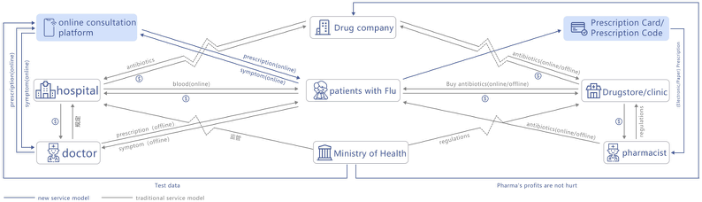
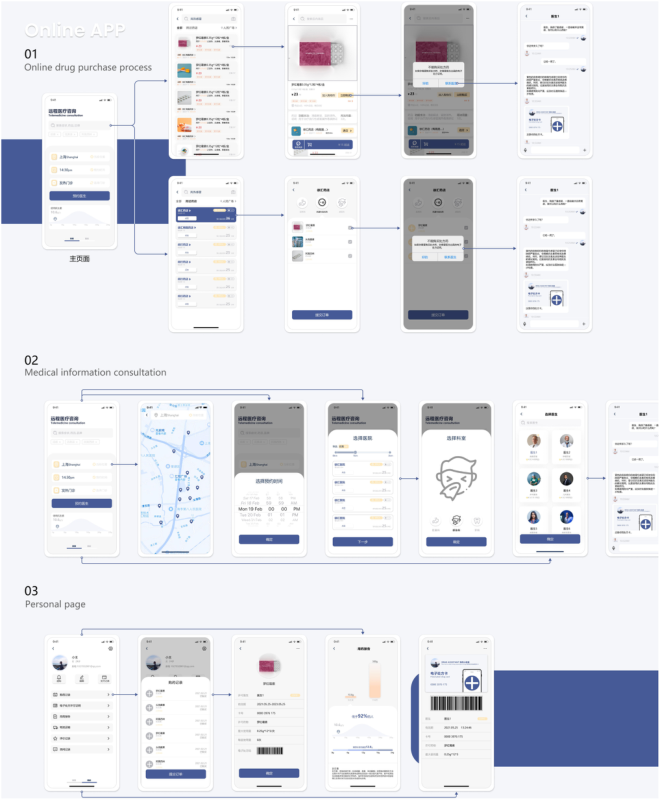
Figure 4: User cold consultation - drug purchase service system.Figure 5: Online medical APP.
Internet of Things platform to achieve the transparency of drug information and supervise the drug prescribing behavior, and the service map is shown in the figure 4.
254 Liu and Wang
First, the service system introduces the official medical APP (as shown in Figure 5). Users can conduct online medical consultation through the APP, and consulting doctors can choose, which can solve the problem of “sym- ptomatic medicine”;at the same time, the online drug purchase service is provided, and users can consult doctors about the corresponding diseases through the online consultation function, so as to facilitate the purchase of drugs. The introduction of official medical APP has somewhat improved the professionalism of online medical treatment, and increased the supervision of antibiotics prescribing.
Second, the service system combines the Internet of Things platform to introduce the concept of electronic prescription card and associate the ele- ctronic prescription card with the medical insurance card.Users before buy antibiotic drugs need by qualified doctor approval, through online commu- nication with the doctor, by the doctor to judge whether the user needs antibiotic treatment, if need to use antibiotics, doctors will submit drug application in the system, users through electronic prescription card to buy medicine.This method partly increases the necessary communication between users and doctors, greatly reduces the use of non-essential antibiotic drugs, and pharmacy prescribing records also become transparent.
CONCLUSION
This study combines SAPAD model and hierarchical analysis method to design the process of users purchasing cold drugs, and deeply studies the user behavior through SAPAD model to obtain the mapping of user behavior and significance.Combined with the quantitative research of the hierarchi- cal analysis method, the core significance clusters of “rapid and convenient drug purchase”, “appropriate drug diagnosis” and “antibiotic drug purchase increased supervision” were obtained, and guided the service system design of the user drug purchase process and the APP design of the online drug purchase consultation.In this study, the SAPAD-AHP method improved the service system function of the antibiotic purchase process, designed and pro- duced the APP, effectively improved the users’ cognition of antibiotic abuse, strengthened the supervision of antibiotics issued by doctors, and provided an effective solution to improving the problem of antimicrobial overuse in primary medical institutions and rural areas.
REFERENCES
Chen Chunlin, Zhai Shaoqin, Fu Lizhi. Current status, hazards and countermeasures [J]. Livestock and Poultry Industry, 2018, 29(04): 47-48. DOI:10.19567/j.cnki.1008-0414.2018.04.030. Chen Shanshan, Duan Qijun, Li Yajun. A Design Study of the Child Dentist Service
System Based on SAPAD-AHP [J]. Packaging Engineering, 2021, 42(10): 115-123. DOI: 10.19554/j.cnki.1001-3563.2021.10.016. Feng Yun. Research on Drug Information and Service System Design for Chain drugstores [D]. Jiangnan University, 2017. Long, Q.: Research on the application of AHP fuzzy comprehensive evaluation
method inperformance evaluation. Metall. Econ. Manage. (2), 45–48 (2007)
Analysis of Antibiotic Purchasing Service Design based on SAPAD-AHP Method 255
Xu Erxi, Wu Shaoting, Yuan Ruoxi, Zhang Chenhuan, Zhang Yi. Review of antibiotic abuse studies [J]. Modern Trade Industry, 2019, 40(36): 72. DOI: 10.19311/j.cnki.1672-3198.2019.36.036. Zhang Yan, Yan Xiaoju, Sun Yue, Wu Han, and Lu Jinfeng. Current status of anti-
biotic abuse in China and its distribution in the environment [J]. Contemporary Chemical Industry, 2019, 48(11): 2660-2662+2666. DOI: 10.13840/j.cnki.cn21- 1457/tq.2019.11. 050.
LISTED IN THE AHFE DIGITAL BOOKSTORE CATALOGUE
Explore the complete digital volume
Healthcare and Medical Devices
Read this individual research paper free through the original publisher, or explore the full digital proceedings book.
ISBN 978-1-958651-27-8
Explore this ISBN in the AHFE Bookstore ↗Listed in the July 2026 bookstore catalogue; search by ISBN to confirm current availability · Digital book purchase optional