Qingkun Li, Zhenyuan Wang, Wenjun Wang, Chao Zeng, Weimin Liu, Jiawei Mu, Quan Yuan, Bo Cheng (2022). The public requirements on interior facilities of highly automated vehicles in China. In: Human Factors in Transportation. AHFE Open Access, vol. 60, pp. 93–99. https://doi.org/10.54941/ahfe1002438
Under highly automated driving, it is possible for drivers to work, entertain and relax in the vehicles. These non-driving related activities bring new challenges in designing interior facilities of highly automated vehicles. It is promising to improve highly automated vehicles’ acceptance and user experience by developing interior facilities based on drivers’ needs. This study adopted an online questionnaire to explore the public requirements on interior facilities of highly automated vehicles in China. Moreover, the needs of different groups were analyzed and compared for a detailed understanding of the effects of various individual characteristics. The results indicated that people expected to communicate with the automated driving systems and were unwilling to lose their right to control the vehicle completely. In addition, individual characteristics significantly affected the requirements. This study contributes to understanding the public requirements on interior facilities and improving the acceptance of highly automated vehicles.
Automated vehicles have received increasing attention, as they are expected to enormously reduce the driving workload and improve traffic safety (Li et al., 2021a). However, fully automated driving has not been realized yet due to the limitation of relevant technologies, suggesting that a human dri- ver is still required for the present automated vehicles (Zeeb et al., 2015). Under highly automated driving, human drivers are not instructed to moni- tor surrounding traffic continuously but still need to take over the vehicle if there is a take-over request issued by the systems (Schinkel et al., 2019; Li et al., 2021b). Hence, it signifies that human drivers change from active ope- rators to passive observers during automated driving, compared with manual
driving vehicles (Aria et al., 2016). The changing of the roles makes it pos- sible for human drivers to work, entertain and relax continuously during automated driving (Jorlöv et al., 2017; Pud¯ane et al., 2021). Thus, driver’s activities in automated vehicles will be significantly different from those in conventional cars.
Several previous studies have investigated the expected naturalistic non- driving related activities under automated driving, such as watching movies and sleeping, by online surveys and driving simulation experiments (Hecht et al., 2019). These non-driving related activities for drivers under highly automated driving, seldom being considered for designing the vehicle inte- riors of conventional vehicles, bring new challenges and requirements for developing highly automated vehicles’ interior facilities (Mathis et al., 2021). Therefore, it is promising to improve the acceptance of highly automated vehicles by developing interior facilities based on drivers’ needs.
Numerous existing studies have investigated the seating configuration and position preferences, including reclined seats, rotated swivel seats, and the combinations of backrest and seat pan angle (Bohman et al., 2020; Stangl- meier et al., 2020). These studies contributed to a better understanding of drivers’ general requirements on the seating configuration and position of automated vehicles. However, the seating preference is only one aspect of the interior facilities of highly automated vehicles, indicating that only focusing on the seating preference is not adequate to systematically understand drivers’ needs and improve the acceptance of highly automated vehicles. Therefore, it is necessary to investigate drivers’ requirements on various interior facilities of highly automated vehicles.
However, there is still a lack of such researches, impeding the development of interior facilities that meet the needs of the drivers. Hence, this study adopted an online questionnaire to explore drivers’ requirements on inte- rior facilities of highly automated vehicles in China. Moreover, the needs of different groups of drivers were analyzed and compared for a detai- led understanding of the effects of various individual characteristics on the requirements on interior facilities of highly automated vehicles.
SURVEY DESIGN The survey consists of two parts, including fifteen questions and one mul- tidimensional Likert scale. Participants’ individual characteristics, including gender, age, residence, income, occupation, education, carsickness experie- nce, accident experience, driving experience, knowledge of the automation, attitude to automation, and experience of using automated driving systems were collected in the first part. The second part obtained their requirements on interior facilities of highly automated vehicles as the drivers through a multidimensional five-point Likert scale.
Respondents were instructed to rate the nine interior facilities, including voice assistants, seats with tables, cancellation of operating devices (e.g., ste- ering wheel and pedals), partitions that separate each seat, entertainment and office equipment connected to personal smartphones, a monitor displaying real-time operation information of the vehicle, a large-scale touch screen,
The Public Requirements on Interior Facilities of Highly Automated Vehicles in China 95
reclining seats for lying comfortably, and devices to ease motion sickness on a bipolar Likert scale: strongly agree (5), agree (4), neither agree nor disagree (3), disagree (2), strongly disagree (1). Note that highly automated driving was explained as not equal to fully automated driving. To ensure that the description in the survey is not ambiguous or misleading, the survey was improved in two pretest rounds, including a total of 110 respondents.
PARTICIPANTS AND DATA ANALYSIS Participants were recruited via a Chinese online survey platform named WJX and received monetary compensation for their participation. In total, responses from 367 subjects from different cities in China were collected in September 2021. To ensure the validity and quality of the data, we incorporated quality control procedures. This study was approved by the Institution Review Board of Tsinghua University. The detailed demographic characteristics are stated in the following section.
The validity check was conducted to remove invalid samples prior to the data analysis. Descriptive statistics on overall respondents were collected for drivers’ requirements on interior facilities of highly automated vehicles. The Mann-Whitney U test and Spearman correlation analysis were adopted to analyze and compare the requirements on interior facilities for different groups of drivers. The statistical significance level was set at α = 0.05 in the present study.
DEMOGRAPHIC STATISTICS In total, responses from 367 subjects were collected, and the data of 214 respondents were adopted for the analysis after conducting the validity check, suggesting the valid response rate was 58.31%. The mean age of the 214 respondents was 30.13 years (Min = 18, Max = 61, SD = 6.28) and their genders were basically balanced with 113 males (52.8%) and 101 females (47.2%). The respondents were from 28 provincial-level administrative regi- ons of China. Moreover, the respondents included students, officers, workers, engineers, teachers, salespeople, managers, accountants, doctors, etc.
As self-reported, 87.9% of respondents had a valid driving license, and 46.7% have ever driven automated vehicles. In addition, 42.9% of respon- dents hold a positive attitude towards automated vehicles, whereas 14.2% of respondents were neutral about it, and 42.9% of respondents hold a negative attitude. The education of the respondents was 11.8% below undergradu- ate, 79.9% with a bachelor’s degree, 7.8% with a master’s degree and 0.5% with a Ph.D. degree. According to participants’ self-report, 42.6% were never involved in carsickness, whereas 52.5% sometimes and 4.9% were always involved in carsickness. In addition, 26.5% of the respondents have ever experienced traffic accidents, among which 9.3% were hurt in the accidents.
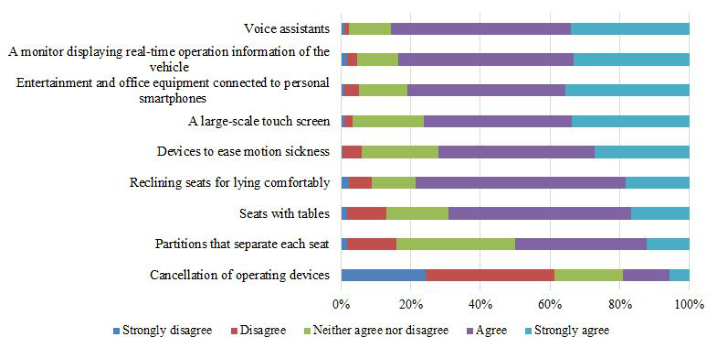
DRIVERS’ GENERAL REQUIREMENTS ON INTERIOR FACILITIES As shown in Figure 1, the drivers’ general requirements on the nine interior facilities of highly automated vehicles were obtained based on the average
Figure 1: Drivers’ general requirements on interior facilities of highly automated vehicles.
of all the respondents’ ratings. The most required interior facility were voice assistants, followed by a monitor displaying real-time operation information of the vehicle and entertainment and office equipment connected to personal smartphones, which shared the same importance. A large-scale touch screen, devices to ease motion sickness, and reclining seats for lying comfortably were interior facilities in high demand. However, seats with tables, partitions that separate each seat, and cancellation of operating devices (e.g., steering wheel and pedals) were below the average, indicating fewer drivers’ general require- ments for highly automated vehicles. It is worth noting that the cancellation of operating devices (e.g., steering wheel and pedals) were the least required interior facility and significantly different from the others.
The results indicated that as the driver of highly automated driving veh- icles, people expected to communicate with the automated driving systems and were unwilling to lose their rights to control the vehicle completely.
CARSICKNESS AND REQUIREMENTS ON INTERIOR FACILITIES According to the previous studies, carsickness was considered one of the cri- tical problems for highly automated vehicles due to the absence of vehicle control during automated driving (Wada, 2016). In addition, carsickness was proven to significantly affect drivers’ activities during automated driving. Thus, it is necessary to investigate its impact on requirements on interior facilities of highly automated vehicles. Considering the distribution of the samples, we divided the respondents into two groups, which were respon- dents ever involved in carsickness and never involved in carsickness. Then, the present study compared the requirements on interior facilities of highly automated vehicles between the two groups.
The Mann-Whitney U test was adopted to compare the requirements on interior facilities between respondents ever involved in carsickness and never involved in carsickness. The results showed that there were significant differe- nces between the two groups of respondents in terms of their requirements for
The Public Requirements on Interior Facilities of Highly Automated Vehicles in China 97
interior facilities, including devices to ease motion sickness (p = 0.001), voice assistants (p = 0.004), a large-scale touch screen (p = 0.016), and entertain- ment and office equipment connected to personal smartphones (p = 0.022). Specifically, people ever involved in carsickness prefer devices to ease motion sickness and voice assistants but are even less likely to need a large-scale touch screen and entertainment and office equipment connected to personal smartphones. In addition, it is worth noting that the cancellation of operating devices was the least required interior facility for both groups of respondents.
The results indicated that the carsickness significantly affected drivers’ requirements on certain interior facilities of highly automated vehicles, espe- cially for facilities to ease or aggravate carsickness. Moreover, drivers were unwilling to lose the rights to control the vehicle entirely for both respondents ever involved in carsickness and never involved in carsickness.
DRIVING EXPERIENCES AND REQUIREMENTS ON INTERIOR FACILITIES The driving experiences of the respondents were collected, including driving years, driving frequency and experience of using automated driving systems. The Mann-Whitney U test was adopted to assess the effect of the experience of using automated driving systems on the requirements on interior facilities of highly automated vehicles, whereas the Spearman correlation analysis was adopted to assess the effect of driving experiences on the requirements on interior facilities of highly automated vehicles.
The results indicated a significant effect of the experience of using auto- mated driving systems on the requirements on entertainment and office equipment connected to personal smartphones (p = 0.005), a large-scale touch screen (p = 0.023), seats with tables (p = 0.026), and a monitor displaying real-time operation information of the vehicle (p = 0.033). Speci- fically, people with the experience of using automated driving systems prefer entertainment and office equipment connected to personal smartphones, a large-scale touch screen and a monitor displaying real-time operation infor- mation of the vehicle, whereas they showed less interest in seats with tables. Moreover, the driving years were found to significantly impact the require- ments on a large-scale touch screen (ρ=0.203, p = 0.003) and devices to ease motion sickness (ρ=-0.180, p = 0.008). In addition, there was a significant effect of driving frequency on the requirements on entertainment and office equipment connected to personal smartphones (ρ=0.172, p = 0.012) and a monitor displaying real-time operation information of the vehicle (ρ=0.154, p = 0.024).
CONCLUSION
This study adopted an online questionnaire to explore the public require- ments on interior facilities of highly automated vehicles in China. In addition, the needs of groups with different individual characteristics were analyzed and compared for a detailed understanding. The results indicated that peo- ple expected to communicate with the automated driving systems and were
unwilling to lose their right to control the vehicle completely. In addition, carsickness and driving experiences significantly affected the requirements. However, there was no significant effect of gender and education.
This study contributes to understanding the public requirements on inte- rior facilities in China, comprehending the effects of individual characteristics on the requirements and improving the acceptance of highly automated veh- icles. However, it is an inevitable problem in online surveys that the sample bias affects the analysis and comparison. In addition, the effect of the experie- nce of different levels of automated vehicles was not distinguished due to the survey design. Moreover, this study investigated the requirement of highly automated vehicles. However, for the three levels of automation in highly automated vehicles (L3, L4 and L5), drivers’ tasks and responsibilities are dif- ferent, indicating that it is necessary to investigate the requirement, especially for cancellation of operating devices, under the three different levels.
ACKNOWLEDGMENT
This work was supported by Tsinghua University-Toyota Joint Research Center for AI Technology of Automated Vehicle (TTAD2021-05), the Nati- onal Natural Science Foundation of China (No. 51965055 and 52072214), and the Research Foundation for Talented Scholars of Henan University of Technology under Grant 2020BS066.
REFERENCES
Aria, E., Olstam, J., & Schwietering, C. (2016). Investigation of automated vehicle effects on driver’s behavior and traffic performance. Transportation research procedia, 15, 761–770. Bohman, K., Örtlund, R., Kumlin Groth, G., Nurbo, P., & Jakobsson, L. (2020). Eva-
luation of users’ experience and posture in a rotated swivel seating configuration. Traffic injury prevention, 21(sup1), S13–S18. Hecht, T., Darlagiannis, E., & Bengler, K. (2019). Non-driving related activities in automated driving–an online survey investigating user needs. In Internatio- nal Conference on Human Systems Engineering and Design: Future Trends and Applications (pp. 182–188). Springer, Cham. Jorlöv, S., Bohman, K., & Larsson, A. (2017). Seating positions and activities in
highly automated cars–a qualitative study of future automated driving scenarios. In International research conference on the biomechanics of impact (pp. 13–22). Li, Q., Hou, L., Wang, Z., Wang, W., Zeng, C., Yuan, Q., & Cheng, B. (2021a).
Drivers’ visual-distracted take-over performance model and its application on adaptive adjustment of time budget. Accident Analysis & Prevention, 154, 106099. Li, Q., Wang, Z., Wang, W., Zeng, C., Li, G., Yuan, Q., & Cheng, B. (2021b). An Adaptive Time Budget Adjustment Strategy Based on a Take-Over Performance Model for Passive Fatigue. IEEE Transactions on Human-Machine Systems. Mathis, L. A., Widlroither, H., & Traub, N. (2021). Towards Future Interior
Concepts: User Perception and Requirements for the Use Case Working in the Autonomous Car. In International Conference on Applied Human Factors and Ergonomics (pp. 315–322). Springer, Cham.
The Public Requirements on Interior Facilities of Highly Automated Vehicles in China 99
Pud¯ane, B., van Cranenburgh, S., & Chorus, C. G. (2021). A day in the life with an automated vehicle: Empirical analysis of data from an interactive stated activity- travel survey. Journal of choice modelling, 39, 100286. Schinkel, W. S., van der Sande, T. P., & Nijmeijer, H. (2019). Driver intervention dete-
ction via real-time transfer function estimation. IEEE Transactions on Intelligent Transportation Systems, 22, 772-781 Stanglmeier, M. J., Paternoster, F. K., Paternoster, S., Bichler, R. J., Wagner, P. O., & Schwirtz, A. (2020). Automated driving: A biomechanical approach for sleeping positions. Applied ergonomics, 86, 103103. Wada, T. (2016). Motion sickness in automated vehicles. In Advanced Vehicle
Control AVEC’16 (pp. 169–174). CRC Press. Zeeb, K., Buchner, A., & Schrauf, M. (2015). What determines the take-over time? An integrated model approach of driver take-over after automated driving. Accident analysis & prevention, 78, 212–221.
LISTED IN THE AHFE DIGITAL BOOKSTORE CATALOGUE
Explore the complete digital volume
Human Factors in Transportation
Read this individual research paper free through the original publisher, or explore the full digital proceedings book.
ISBN 978-1-958651-36-0
Explore this ISBN in the AHFE Bookstore ↗Listed in the July 2026 bookstore catalogue; search by ISBN to confirm current availability · Digital book purchase optional