Quan Yuan, Qingkun Li, Jun Li, Jiangqi Zhu (2024). Clustering Analysis of Research Direction for Intelligent Cockpit Ergonomics based on Knowledge Mapping. In: Advances in Human Factors of Transportation. AHFE Open Access, vol. 148, pp. 316–322. https://doi.org/10.54941/ahfe1005222
Intelligent cabins have become a hot topic in the development of automated vehicles, with a focus on multimodal human-computer interaction. Using knowledge mapping, this paper investigates international literature regarding intelligent cockpits (IC) over the past 22 years. The research characteristics are analyzed through cluster analysis, based on which the future development directions are provided. Since 2019, there has been a significant increase in global publication volume. Researchers have extensively researched new functions and technologies such as gesture interaction, virtual environment, human-machine interface, external human machine interface, and human-machine interaction, with some technologies already being applied in practice. The extension of intelligent cockpit-related concepts has further developed technologies such as electronic skin, health detection, speech emotion recognition, and electromyography control. In the future, nanomaterials with excellent properties will be further integrated and applied in intelligent cabins to adapt to their highly integrated functional module group. Fields such as biology, mathematics and systems science, ophthalmology and neuroscience, physics, and chemistry are involved in the development of IC. The main development features of IC are multimodal interaction, virtual-real combined display, virtual agents, and emotional interaction. Overall, the safety, comfort, and convenience of passengers have always been the prime goals of the research on IC.
In recent years, with the maturity of technologies such as the Internet of Vehi- cles, autonomous driving, and artificial intelligence (AI), the design of car cabins has gradually shifted from traditional cabins to intelligent cockpits.
Clustering Analysis of Research Direction for Intelligent Cockpit Ergonomics 317
In this process, there have been new changes in human-computer interaction in automobiles, and the design of cockpit ergonomics has also undergone disruptive changes.
Ahmed et al. (2019) propose an ergonomics approach that is used to infuse human factor engineering (HFE) guidelines during the early design process. Then, Ahmed et al. (2021) present a computational design methodology that employs Digital Human Modelling (DHM) research and the surrogate mod- eling technique to integrate ergonomics early in design. From the driver and passengers’ perspective, a subjective evaluation experiment was set up to collect data on four important indicators affecting the comfort of the intel- ligent cockpit: sound, light, heat, and human–computer interaction (Yang et al., 2022). To study the intelligent cockpit comfort evaluation model, this paper divides the intelligent cockpit comfort influencing factors into four factors and influencing indices: acoustic environment, optical environment, thermal environment, and human-computer interaction environment (Yang et al., 2022). The subjective and objective weights obtained by improved Analytic Hierarchy Process (AHP) and Technique for Order Preference by Similarity to an Ideal Solution (TOPSIS) are combined by Game Theory (Yang et al., 2023). Yazdani et al. (2021) propose a novel alternative frame- work for posture estimation, assessment, and optimization for ergonomically intelligent physical human-robot interaction. In order to retain assessment quality while improving computational considerations, Yazdani et al. (2022) propose a novel framework for postural assessment and optimization for ergonomically intelligent physical human-robot interaction. From the per- spective of the cyber-physical-social system (CPSS), Li et al. (2023) propose the intelligent cockpit composition framework, which includes three layers of perception, cognition and decision, and interaction. Liang et al. (2020) identify the requirements of the intelligent cockpit test task, the key points of the test task, the evolution mode of the intelligent level, the conception of the test environment, and so on.
To solve the shortcomings of traditional safety ergonomics theories and methods, first of all, Dong et al. (2022) answer the basic questions of ISE, including the basic concepts, characteristics, attributes, contents, and research objects. Wu (2022) reveals interaction methods and apparatus for intelligent cockpit, devices, and mediums. Lei et al. (2022) proposed that equipping the intelligent cockpit with an external human-machine interface for interacting with pedestrians can enhance the trust and acceptance of self- driving cars by traffic participants. Socha et al. (2020) deal with the influence of cockpit ergonomics change on the performance and driver workload dur- ing a driving process. Influential work includes (Wang, 2020). The goal of human-machine intelligence is to understand and create intelligence in the homo machine, an intelligent organism made of human- and artificial agents. Rockbach et al. (2021) define intelligence in a way that highlights decision- making and adaptation and apply this definition to the design of the homo machine. Wei (2021) proposes an intelligent cockpit based on artificial intelli- gence technologies such as voice recognition ASR,TTS,NLP,and multi-round dialogue.
Knowledge mapping, as a cutting-edge visual research method in biblio- metrics, can be used to display the relevant research status (Ji et al., 2023). By conducting analysis and mining of literature on intelligent cockpit human- machine engineering, we aim to understand the current research status in related fields and look forward to future directions.
KNOWLEDGE MAPPING RESULTS The Database selected for knowledge graph mining is Web of Science Core Library, Science Citation Index Expanded Citation Index. The retrieval formula for retrieving data is TS = ((“Intelligent cockpit”) OR (“human machine interaction”) OR (“human machine interface”) OR (“flat screen display”) OR (“head-up display”) OR (HUD) OR (“in-vehicle screen”) OR (“voice interaction”) OR (“eye movement interaction”) OR (“gesture interaction”) OR (“in-vehicle virtual agent”) OR (“ human computer inter- action”) OR (“human computer interface”) OR (“ external human machine interaction”)).
As for the search results, 119847 pieces of data were obtained. After dedu- plication using Citespace, the data was analyzed using literature analysis software such as Vosviewer and Citespace to obtain a visual display.
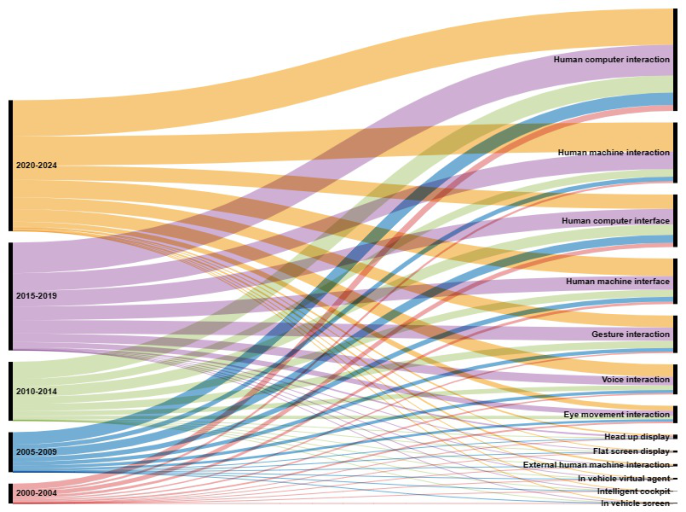
The research in the field of intelligent cabins has been developing slowly. However, since 2019, as shown in Figure 1, there has been a significant increase in the number of publications, indicating that related fields and technologies have received attention from researchers.
Figure 1: Sankey diagram of literature quantity changing with years.
Clustering Analysis of Research Direction for Intelligent Cockpit Ergonomics 319
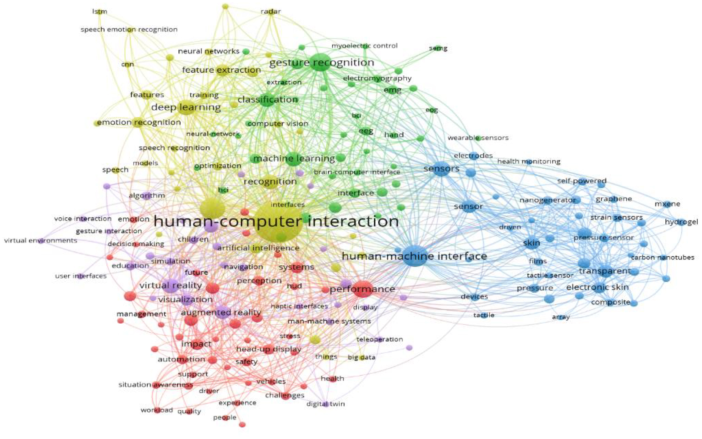
Through keyword co-occurrence (see Figure 2), it can be seen that novel interaction modes include head-up display (HUD), gesture interaction, speech recognition, brain-computer interface, tactile interface, emotional interac- tion, as well as new functions and technologies such as virtual reality, augmented reality, situational awareness, health detection, and deep learning.
Figure 2: Results of the keyword co-occurrence.
From the perspective of relevant citation relationships, in the development of IC, various related fields (e.g., biological science, mathematics and systems science, ophthalmology and neuroscience, physics, chemistry) are involved.
DISCUSSION
Current Main Research Features of IC With the development of technology, multimodal human-computer interac- tion has become the most crucial feature of the development of IC.
Aiming at in-cabin environments (e.g., light, heat, sound, and vibration), using essential perceptual characteristics (e.g., vision, hearing, touch, and motion) as channels, the intelligent cockpit achieves multimodal interac- tion by combining new interaction models while possessing existing mature interaction modes. The purpose is to overcome the limitations of exist- ing interaction modes and achieve higher satisfaction and accuracy in the human-machine interaction mode and human-machine interface usage of the intelligent cockpit, ultimately making the intelligent cockpit human- machine environment system achieves high intelligence and security. Our results demonstrate the application of the three basic perceptual characteris- tics of vision, touch, and motion, with additional interaction modes including HUD, facial expression recognition, and gesture recognition.
The research methods mainly include the comprehensive application of AI and big data technology, such as virtual reality, situational awareness, aug- mented reality, health detection, deep learning, and other specific applications of functions and technologies.
In summary, innovation around IC is currently the main feature, pro- viding more empowerment and increment for automotive human-machine engineering.
Lack of Research on Ergonomics Design Methods for IC At present, the intelligent cockpit interface with multimodal interaction lacks design optimization for the combination of human-vehicle-road under intelligent and connected conditions.
The traditional design ideas, methods, and evaluation systems of automo- tive human-machine engineering cannot meet the functional requirements of various new, multi-dimensional, and interactive modes in the future intel- ligent car cockpit. So, we need new human-machine engineering design methods and evaluation systems related to IC.
The focus of traditional automotive ergonomics design is on driver- centered safety, comfort, and other single-function designs. However, the relationship between humans, machines, and the environment in the cockpit of automated vehicles has become increasingly complex, and the human- machine interaction interface and mode need to be more intelligent to meet the personalized needs of users during vehicle operation. Therefore, it is crucial to improve the relevant design methods and evaluation systems.
Meanwhile, the uncertainty of intelligent interaction and the limited research in multiple fields related to human-machine-environment systems should be noted. As the current specific traffic environment is complex, along with the increase in the level of vehicle automation, the driver can engage in tasks unrelated to driving, the interaction between the driver and other traffic participants becomes the interaction between the self-driving car and other road users, and the human-machine interaction is thus extended from inside the vehicle to outside the vehicle, which generates new design chal- lenges. How to improve multimodal interaction while meeting relevant safety requirements is still a difficult point that research needs to face.
IC Multimodal Interaction Requires Interdisciplinary Research Through the above research, it is understood that the interdisciplinary inte- gration involved in IC is more significant. The combination of traditional vehicle engineering and human factors engineering has become a classic, while the interconnection of vehicles with more disciplines has become a new feature, including theories and technologies in biological science, math- ematics, systems science, medicine, neuroscience, physics, chemistry, and other fields. The future intelligent cockpit is an important platform for interdisciplinary interactive applications.
CONCLUSION
The development of intelligent cockpit for automated vehicles is considerably rapid. This article investigates the research progress, main characteristics, and
Clustering Analysis of Research Direction for Intelligent Cockpit Ergonomics 321
development trends of IC based on knowledge mapping approach. The hot topics, disciplinary correlations, and development directions obtained from existing research provide important references for the research and break- throughs of IC. Moreover, it is also found that there is a lack of research content that promotes the integration of automotive engineering, human fac- tors, and other interdisciplinary fields. Notably, multimodal interaction is the biggest highlight of the new function of intelligent cockpit, since the develop- ment of AI technology will bring more possibilities for the advancement of intelligent cabins. In closing, safety, comfort, and convenience have always been the main goals of automotive cockpit services.
ACKNOWLEDGMENT
This research is supported by the National Natural Science Foundation of China, grant number 52072214.
REFERENCES
Amir Yazdani; Roya Sabbagh Novin; Andrew Merryweather; Tucker Hermans; “DULA and DEBA: Differentiable Ergonomic Risk Models for Postural Assess- ment and Optimization in Ergonomically Intelligent PHRI”, ARXIV-CS. RO, 2022. Amir Yazdani; Roya Sabbagh Novin; Andrew Merryweather; Tucker Hermans;
“Ergonomically Intelligent Physical Human-Robot Interaction: Postural Estima- tion, Assessment, and Optimization”, ARXIV-CS. RO, 2021. First A. Baohua. Liang; Second B. Yu. Chen; Third C. Heng. Wu; “A Conception of Flight Test Mode for Future Intelligent Cockpit”, 2020 Chinese Automation Congress (CAC), 2020. Haozhe Lei, Quanyan Zhu. “Cognitive Level-$k$ Meta-Learning for Safe and
Pedestrian-Aware Autonomous Driving”, ARXIV-CS. RO, 2022. Jianjun Yang; Qilin Wan; Jiahao Han; Shanshan Xing; “An Evaluation Model for Automobile Intelligent Cockpit Comfort Based on Improved Combination Weighting-cloud Model”, PLoS One Volume 14, Issue 11, 2023. Jianjun Yang; Shanshan Xing; Yimeng Chen; Ruizhi Qiu; Chunrong Hua; Dawei
Dong; “A Comprehensive Evaluation Model for The Intelligent Automobile Cockpit Comfort”, Scientific Reports Volume 12, Issue 1, 2022. Jianjun Yang; Shanshan Xing; Yimeng Chen; Ruizhi Qiu; Chunrong Hua; Dawei Dong; “An Evaluation Model for The Comfort of Vehicle IC Based on Passenger Experience”, Sustainability Volume 18, Issue 3, 2022. Jonas D. Rockbach; Thomas E. F. Witte; “Human-Machine Intelligence: Frigates Are
Intelligent Organisms”, 2021 IEEE International Conference on Systems, Man, and Cybernetics (SMC), 2021. Longjun Dong; Jiachuang Wang; “Intelligent Safety Ergonomics: A Cleaner Research Direction for Ergonomics in the Era of Big Data”, International Journal of Environmental Research and Public Health Volume 20, Issue 1, NO. 423, 2022. Qiang Wang; “Research and Application of “Intelligent Ergonomics” in Industrial
Design”, E3S Web of Conferences Volume 179, No. 02112, 2020. Salman Ahmed; Lukman Irshad; H. Onan Demirel; Irem Y. Tumer; “A Comparison Between Virtual Reality and Digital Human Modeling for Proactive Ergonomic Design”, 10th International Conference on Human-Computer Interaction Volume 11581, pp. 3–21, 2019.
Salman Ahmed; Lukman Irshad; Mihir Sunil Gawand; H. Onan Demirel; “Integrating Human Factors Early in The Design Process Using Digital Human Modelling and Surrogate Modelling”, Journal of Engineering Design, 2021. Siyuan Wu; “Interaction Method and Apparatus for Intelligent Cockpit, Device, and
Medium”, 2022–04-11. Song Wei; “Paper Research and Application of Intelligent Cockpit Based on Artificial Intelligence Technology for Distribution Network Maintenance Schedule”, 2021 International Conference on Control Science and Electric Power System (CSEPS), 2021. Sorokin L, Chadowitz R, Kauffmann N. “A Change of Perspective: Designing the
Automated Vehicle as a New Social Actor in a Public Space”, Extended Abstracts of the 2019 CHI Conference on Human Factors in Computing Systems, 2019. V. Socha; L. Socha; L. Hanakova; Viktor Valenta; Stanislav Kusmirek; A. Lališ; “Pilots’ Performance and Workload Assessment: Transition from Analogue to Glass-Cockpit”, Applied Sciences Volume 10, Issue 15, 2020. Wei Ji; Quan Yuan; Gang Cheng; Shengnan Yu; Min Wang; Zefang Shen; Tiantong
Yang; “Traffic accidents of autonomous vehicles based on knowledge mapping: A review”, Journal of Traffic and Transportation Engineering Volume 10, Issue 6, pp. 1061–1073, 2023. Wenbo Li; Lei Wu; Cong Wang; Jiyong Xue; Wensi S. Hu; Shen Li; Gang Guo; Dongpu Cao; “Intelligent Cockpit for Intelligent Vehicle in Metaverse: A Case Study of Empathetic Auditory Regulation of Human Emotion”, IEEE Transactions on Systems, Man, and Cybernetics: Systems Volume 53, Issue 4, 2023.
LISTED IN THE AHFE DIGITAL BOOKSTORE CATALOGUE
Explore the complete digital volume
Advances in Human Factors of Transportation
Read this individual research paper free through the original publisher, or explore the full digital proceedings book.
ISBN 978-1-964867-24-3
Explore this ISBN in the AHFE Bookstore ↗Listed in the July 2026 bookstore catalogue; search by ISBN to confirm current availability · Digital book purchase optional