Rutger Verstegen, Ruolin Gao, Regina Bernhaupt, Pavlo Bazilinskyy, Marieke Martens (2024). Combining Internal and External Communication: The Design of a Holistic Human-Machine Interface for Automated Vehicles. In: Advances in Human Factors of Transportation. AHFE Open Access, vol. 148, pp. 150–160. https://doi.org/10.54941/ahfe1005205
In this paper, we explore the field of holistic Human-Machine Interfaces (hHMIs). Currently, internal and external Human-Machine Interfaces are being researched as separate fields. This separation can lead to non-systemic designs that operate in different fashions, make the switch between traffic roles less seamless, and create differences in understanding of a traffic situation, potentially increasing confusion. These factors can limit the adoption of automated vehicles and lead to less seamless interactions in traffic. For this reason, we explore the concept of hHMIs, combining internal and external communication. This paper introduces a working definition for this new type of interface. Then, it explores considerations for the design of such an interface, which are the provision of anticipatory cues, interaction modalities and perceptibility, colour usage, building upon standardisation, and the usage of a singular versus a coupled interface. Then, we apply these considerations with an artefact contribution in the form of an hHMI concept. This interface communicates anticipatory cues in a unified manner to internal and external users of the automated vehicle and demonstrates how these proposed considerations can be applied. By sharing design considerations and a design concept, this paper aims to stimulate the field of holistic Human-Machine Interfaces for automated vehicles.
There are 5 levels of vehicle automation, with level 5 denoting full driving automation (SAE International, 2021). Automated vehicles (AVs) promise numerous benefits to society, such as improved transportation efficiency and safety (Kosuru and Venkitaraman, 2023; Verberne, Ham and Midden, 2012). With the car executing the driving task, its passengers can conduct non- driving related tasks (NDRTs), such as working or watching a video (Wilson et al., 2022), which is the case in Level 3, 4 and 5. This paper will focus on driving automation in which the driver is allowed to do other tasks than driving. The new stage in which a vehicle is (temporarily) performing the
Combining Internal and External Communication: The Design of a Holistic HMI 151
driving task, brings new challenges concerning communication both towards the passenger and other road users who need to interact with the AV.
For the successful introduction of AVs, communication with both internal and external road users is essential (Bengler et al., 2020). These vehicles have multiple forms of Human-Machine Interfaces (HMIs) to facilitate this com- munication. Inside an AV, passengers may still wish to receive information on a vehicle’s status and behaviour on an internal HMI (iHMI), which can influence passengers’ trust (Hartwich et al., 2021). Outside an AV, other road users may not see a human driver controlling the vehicle, who could facilitate explicit communication (e.g. eye contact, gestures) to communicate (Merat et al., 2018). For this reason, researchers consider that AVs will need new communication methods for safe, clear and unambiguous interactions with external road users (Habibovic et al., 2018; Merat et al., 2018). To provide external road users with information about an AV, the concept of communica- tion using external Human-Machine Interfaces (eHMIs) has been introduced. Dey et al. (2020a) found that the field of eHMIs is a ‘jungle’ of designs, with their literature review showing over 70 concepts. Both for internal and exter- nal users, driving dynamics (e.g. braking behaviour, steering and speed) play a role in inferring the intention of a car (Cramer, Kaup and Siedersberger, 2018; Dey and Terken, 2017). There is a large availability of separated HMI types and researched designs to inform internal and external (road) users of AVs.
Dong et al. (2023) state that communication with AVs often focuses on either iHMIs or eHMIs. We consider that there are three reasons to opt for a holistic approach to interface design instead: (1) The need for a holistic (over- arching) perspective on communication with AVs is recognised by multiple authors (Bengler et al., 2020; Dong et al., 2023; Gao and Martens, 2022). These authors consider the variety of systems and factors in transport to be complex and thus require a more holistic approach toward development. (2) A holistic approach between internal and external road users may help facili- tate transitions between roles in traffic because of standardisation/uniformity in communication methods (Dong et al., 2023). (3) A holistic HMI could prevent differences in knowledge about the intent of the AV between its pas- sengers and other road users. This is an occurring phenomenon that is already observed by safety drivers or passengers of AVs, who then take the role of communication (such as gesturing or talking on behalf of the AV) with other road users (Eden et al., 2017; Brown, Broth and Vinkhuyzen, 2023). Though some eHMIs might already be visible to passengers of AVs (such as a light strip; Nissan Motor Corporation, 2015), this is an ancillary effect that is not designed and tested for purposefully. Based on the argumentation above, we consider that the development and design of holistic HMIs should be further explored as a potential solution for communication with AVs.
What Is a Holistic Human-Machine Interface?
The word ‘holistic’ is defined by the Cambridge Dictionary (Cambridge Uni- versity Press, 2024) as: “dealing with or treating the whole of something or someone and not just a part”. Compared to eHMIs and iHMIs, holistic Human-Machine Interfaces thus do not focus on one group of users but focus on all users as a whole.
As of the writing of this paper, the authors do not know of any work providing a working definition for holistic HMIs. Though some authors use the word holistic in the context of HMIs which do not focus on internal and external communication simultaneously (e.g. Gao and Martens, 2022; Lau, Jipp and Oehl, 2022; Verstegen, Dey and Pfleging, 2021), we believe that holistic HMIs in the true sense, should broaden their scope to truly communicate to all users.
Therefore, we define the holistic Human-Machine Interface (hHMI) as the following: An interface intended to communicate an automated vehicle’s (future) state or actions directed to both internal and external road users as a whole.
Aim of This Paper As discussed above, hHMIs are a novel area that, to the authors’ knowledge, does not have any reports describing HMIs that fully align with our proposed definition. This paper aims to support the future design and development of hHMIs. For this reason, this paper does not validate the potential of such interfaces. Rather, it explores considerations for the design of an hHMI. With an artefact contribution, we demonstrate how these considerations can be applied to an hHMI design focusing on an AV showing its anticipated driving actions.
HOLISTIC DESIGN: EXPLORATION OF CONSIDERATIONS Since there is a lack of holistic designs and the requirements for these designs, this section will focus on exploring a (preliminary) overview of considerations (letter C indicating each consideration). These considerations are based on a manual review of existing academic, industrial, and regulative literature from a combination of the fields of iHMI and eHMI design.
C1: Anticipatory Cues From the field of eHMI research, there are two styles concerning messages to communicate: egocentric (advice to another road user) and allocentric (intent of the vehicle). Though egocentric messages are shown to be more clear and persuasive to pedestrians (Eisma et al., 2021), the standard ISO/TR 23049:2018 and the consensus of most experts is that an AV should not advise or instruct external road users on what actions to perform, but rather focus on communicating its intent (ISO, 2018; Tabone et al., 2021). In this sense, AV’s communication should allow others to plan their reactions to its actions, just as current brake lights or turning indicators do. Furthermore, letting an AV provide cues to signal intentions is in line with documentation from the relevant working group from the UNECE (2020).
From a passenger’s perspective (person currently not driving), being able to anticipate the actions of their AV may influence their user experience. An interface that can provide cues to signal intentions could affect motion
Combining Internal and External Communication: The Design of a Holistic HMI 153
sickness, uncertainty, and trust calibration, which are crucial challenges to AV research (Carsten and Martens, 2019).
C2: Interaction Modalities and Perceptibility Currently, concepts for iHMIs and eHMIs are primarily visual (Bengler et al., 2020). To not disturb a passenger performing an NDRT, the HMI should lend itself to be precepted as a secondary task, such as a peripheral display. Thus, the theory on peripheral interactions, attention levels, and visibility should be considered (e.g., Bakker and Niemandsverdriet, 2016; Kooi and Mosch, 2006). For external road users, looking at a vehicle with an eHMI also allows them to observe the vehicle’s dynamics, which can also help explain the vehi- cle’s next actions (Dey and Terken, 2017). Visual elements should preferably be placed in a position people naturally look at, as can be found in gaze behaviour studies. For instance, Dey et al. (2019) found that when looking from the edge of the road to an approaching vehicle, the gaze shifts from looking at the road before a vehicle to looking at the vehicle in general as it approaches, towards looking at the driver’s location when getting close. Results from Eisma et al. (2019) demonstrate that the roof, windshield, and bumper are the clearest places for a visual eHMI.
However, a truly holistic design should focus on the inclusion of all users. For such a design, we argue for using additional modalities as well. No matter whether a user is visually occupied or has bad eyesight, the addition of another modality can solve interaction challenges. Though less relevant for passengers, this notion is further supported by evidence suggest- ing that adding multiple modalities can decrease reaction times (Diederich and Colonius, 2004), which can be important when communicating with external road users.
C3: Colour Usage For visual elements, colour associations should not interfere with existing meanings in car interiors and exteriors (e.g. a red light could be confused as either a braking light or a red warning light), as is already specified by SAE J 578–202004 (SAE International, 2020) and Campbell et al. (2016). Existing research shows a strong association between cyan and automated driving communication (Dey et al., 2020b). The cyan blue tint allows for good peripheral visibility (Werner, 2018). Additionally, cyan blue is already used by car manufacturers in concepts for interiors and exteriors for AVs and in the interiors of commercially sold automated driving systems (BMW Group, 2023; Mercedes-Benz Group, 2021; Nissan Motor Corporation, 2015). The usage of the ‘blue-green’ colour space is further supported to indicate Auto- mated Driving Systems by the SAE in J 3134–201905 and J 578–202004 (SAE International, 2019; 2020).
C4: Building Upon Standardisation There is a vast availability of communication methods for eHMIs and iHMIs, resulting in a multitude of communication technologies (e.g. screens, road
projections, augmented windows) and styles (e.g. text, icon, sounds, anthro- pomorphising) (Bengler et al., 2020; Dey et al., 2020a). However, to design for clear and unambiguous interactions and reducing uncertainty, it is impor- tant that users have an understanding of the meaning of interface elements. As described by the Interaction Design Foundation, standardization and consis- tency can help reduce learning and confusion (Wong, 2021). For this reason, we argue the design of hHMIs should build upon existing design principles. For example, a designer could consider using derivatives of existing lights (e.g. indicators) or symbols (e.g. traffic signs), some of which are already present in HMI concepts (Dey et al., 2020a).
With the development of new interfaces, there is a need for updating or creating new standardisation to avoid confusion, as is already recog- nised in the field of eHMI design (Bengler et al., 2020; Habibovic et al., 2018). Such standardisation can set boundaries for designs and allow users to learn what design functions are like. Thus, a consideration for the design of hHMIs is to build upon existing standards and set new standards for holistic communication.
C5: Singular Versus Coupled Interfaces Holistic communication in multiple directions with one singular interface can create challenges concerning positioning and technological viability. As a solution to mitigate these problems, instead of using a singular interface to achieve holistic communication, a designer could also consider a coupled ‘mirroring’ interface. For instance, signs or sounds projected outside of the vehicle could be mirrored on the inside to achieve an interconnected HMI presenting synchronised information to all users.
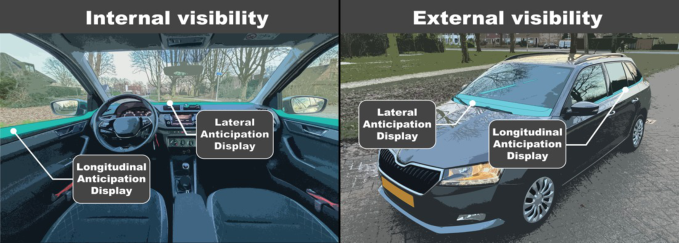
DESIGN CONCEPT In this section, we demonstrate how the design considerations from the pre- vious section could be executed in a holistic design. This design is visualised on a manually driven vehicle for demonstration purposes (see Figure 1) but is intended to be placed on an AV. In the section below, the link between the consideration and the suggested design will be further explained.
Figure 1: Overview of the first hHMI concept sketched in cyan on a vehicle to commu- nicate the positioning of the design elements. Showing the interface elements viewed from the inside (left) and the outside (right).
Combining Internal and External Communication: The Design of a Holistic HMI 155
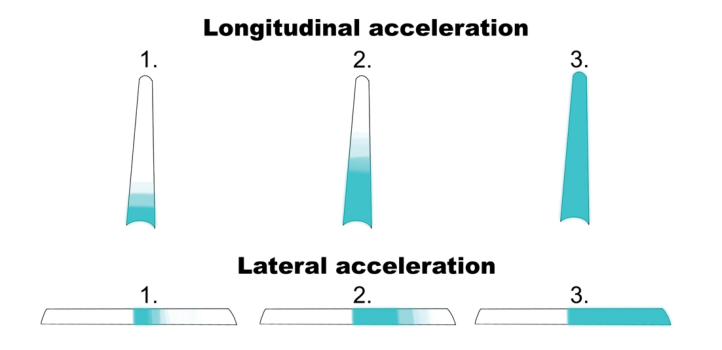
Application of Considerations Anticipatory cues (C1) are communicated with the designed interface, using light strips that surround the bottom of the window trim. Based on exploratory research into pulsing behaviour (Dey et al., 2020b), this design opts for a pulsing motion to communicate the vehicle’s intent. These pulsing motions not only communicate the direction that the vehicle will go in, but are also coupled to communicate the acceleration dynamics. For instance, a fast physical acceleration of the car will be announced with a fast-pulsing animation. Such coupling of the direction and the acceleration is inspired by interaction coupling (Wensveen, Djajadiningrat and Overbeeke, 2004). The coupling works as follows: the forward-stretching window trim is used to project forward-facing anticipatory cues, and the sideways-stretching trim is used to project sideward-facing anticipatory cues (see Figure 2).
Using anticipatory cues pulsing in the direction a vehicle will move in, is inspired by an existing principle of vehicle design (C4). Namely, modern turn indicators already apply sideways pulsing motions to indicate a vehicle will be executing a sideways acceleration. The coloured (C3) lighting strips in this design further build on the existing usage of cyan to indicate the automated driving status of this vehicle.
These strips are placed inside and outside the windows, making for a uni- fied design (C5). The placement will likely influence perceptibility (C2). From around the vehicle, the window strips could be visible to external road users. Regarding internal users, we argue the strips could be placed in the (periph- eral) vision of the vehicle’s passengers. Furthermore, perceptibility is argued for based on earlier research on peripheral displays (Kooi and Mosch, 2006) and peripheral visibility of blue tints (Werner, 2018), supporting the notion that these pulsing motions may be well perceivable from the peripheral vision.
Figure 2: Interaction properties of the concept: (top) longitudinal display pulses to indi- cate future longitudinal movement, (bottom) lateral display pulses to indicate future lateral movement.
DISCUSSION AND FUTURE WORK In this paper, we explored the novel field of hHMI design. Our contributions are the following: (1) After establishing a working definition for an hHMI, (2) we focused on setting the first design considerations, (3) after which we demonstrated the application of these principles on a novel design targeting internal and external users using unified communication. Each contribution will be detailed below.
Considerations We presented preliminary considerations based on literature, regulations (under development), and expert opinions for the design of an hHMI. The considerations are as follows: C1 Anticipatory cues, C2 Interaction modali- ties and perceptibility, C3 Colour usage, C4 Building upon standardisation, and C5 Singular versus coupled interfaces. Firstly, we share these considera- tions to stimulate discussion on what should be considered when designing an hHMI. Secondly, it allows other designers to consider and apply this rationale to various designs.
Concept hHMI We presented an hHMI concept demonstrating how the design considerations for hHMI can be applied. The concept shows a new design that uses antici- patory cues to communicate holistically the future direction and acceleration of the AV. Traffic scenarios can be complex, with many traffic participants from a multitude of directions. For this reason, in the field of eHMIs, research in on-vehicle interfaces with scalability is interesting (Dey et al., 2020a). The presented concept shows potential since its light strips are placed under all windows (windshield, side windows and rear window) inside and out- side the vehicle, potentially increasing visibility and scalability. Secondly, users inside an AV can engage in NDRTs (Wilson et al., 2022) but could still desire to be informed about the vehicle’s state (Hartwich et al., 2021). We addressed this problem by taking peripheral visibility into account for the hHMI. We demonstrated how one hHMI can be used for internal and external communication while tackling problems from both fields.
Limitations and Future Research The preliminary overview of considerations for hHMI design that this paper contributed, is not definitive. We challenge other authors to question and elaborate further on these considerations. The specific interface presented in this publication should be subject to empirical testing to further understand the effectiveness of the proposed concept. Additionally, the design could be elaborated with other cues (such as auditory) to adhere better to the proposed considerations. The usage of anticipatory cues could have an influence on motion sickness (Kuiper et al., 2020; Reuten et al., 2023), which thus should be further researched. The field of hHMIs needs further research in order to understand clearly what the effects are of such interfaces.
Combining Internal and External Communication: The Design of a Holistic HMI 157
CONCLUSION
This paper allowed us to consider how to design for hHMIs. We shaped the first considerations that could be taken into account for such a design. After that, these considerations for the development of an hHMI were applied. The designed interface demonstrates how internal and external communication challenges could be combined into a holistic interface, which could thus allow for a more uniform communication method. The proposed considerations and HMI concept should be further developed and evaluated, as should the general field of hHMI design.
ACKNOWLEDGMENT
The authors want to thank Jan Souman for his guidance on another project, that inspired the hHMI concept. This research was supported by funding from the Dutch Research Council NWO-NWA (Grant No. NWA.1292.19.298).
REFERENCES
Bakker, S. and Niemantsverdriet, K. (2016) “The interaction-attention continuum: Considering various levels of human attention in interaction design”. Interna- tional Journal of Design, 10(2), pp. 1–14. Bengler, K., Rettenmaier, M., Fritz, N. and Feierle, A. (2020) “From HMI to HMIs:
Towards an HMI framework for automated driving” Information, 11(2), p. 61. doi: https://doi.org/10.3390/info11020061. BMW Group, (2023). Level 3 highly automated driving available in the new BMW 7 Series from next spring. Available at: https://www.press.bmwgroup.com/global/ article/detail/T0438214EN/ (Accessed at 26 January 2024). Brown, B., Broth, M. and Vinkhuyzen, E. (2023) “The Halting problem: Video anal-
ysis of self-driving cars in traffic”. In Proceedings of the 2023 CHI Conference on Human Factors in Computing Systems (pp. 1–14). doi: https://doi.org/10.1145/ 3544548.3581045. Cambridge University Press, (2024) holistic. In Cambridge Dictionary. Available at: https://dictionary.cambridge.org/dictionary/english/holistic (Accessed: 12 January 2024). Campbell, J. L., Brown, J. L., Graving, J. S., Richard, C. M., Lichty, M. G.,
Sanquist, T. and Morgan, J., (2016). Human factors design guidance for driver- vehicle interfaces. Report No. DOT HS, 812(360), p. 252. Carsten, O. and Martens, M. H. (2019) “How can humans understand their automated cars? HMI principles, problems and solutions”. Cognition, Technology & Work, 21(1), pp. 3–20. doi: https://doi.org/10.1007/s10111-018-0484-0. Cramer, S., Kaup, I. and Siedersberger, K. H. (2018) “Comprehensibility and per-
ceptibility of vehicle pitch motions as feedback for the driver during partially automated driving”. IEEE Transactions on Intelligent Vehicles, 4(1), pp. 3–13. doi: https://doi.org/10.1109/TIV.2018.2886691. Dey, D. and Terken, J. (2017) “Pedestrian interaction with vehicles: roles of explicit and implicit communication”. In Proceedings of the 9th international conference on automotive user interfaces and interactive vehicular applications (pp. 109–113). doi: https://doi.org/10.1145/3122986.3123009.
Dey, D., Habibovic, A., Löcken, A., Wintersberger, P., Pfleging, B., Riener, A., Martens, M. and Terken, J. (2020a) “Taming the eHMI jungle: A classifica- tion taxonomy to guide, compare, and assess the design principles of automated vehicles’ external human-machine interfaces”. Transportation Research Inter- disciplinary Perspectives, 7, p. 100174. doi: https://doi.org/10.1016/j.trip.2020. 100174. Dey, D., Habibovic, A., Pfleging, B., Martens, M. and Terken, J. (2020b) “Color
and animation preferences for a light band eHMI in interactions between auto- mated vehicles and pedestrians”. In Proceedings of the 2020 CHI conference on human factors in computing systems (pp. 1–13). doi: https://dx.doi.org/10.1145/ 3313831.3376325. Dey, D., Walker, F., Martens, M., & Terken, J. (2019) “Gaze patterns in pedestrian interaction with vehicles: Towards effective design of external human-machine interfaces for automated vehicles”. In Proceedings of the 11th international conference on automotive user interfaces and interactive vehicular applications (pp. 369–378). doi: https://doi.org/10.1145/3342197.3344523. Diederich, A. and Colonius, H. (2004) “Bimodal and trimodal multisensory enhance-
ment: Effects of stimulus onset and intensity on reaction time”. Perception & psychophysics, 66(8), pp. 1388–1404. doi: https://doi.org/10.3758/bf03195006. Dong, H., Tran, T. T. M., Bazilinskyy, P., Hoggenmüller, M., Dey, D., Cazacu, S., Franssen, M. and Gao, R. (2023) “Holistic HMI Design for Automated Vehi- cles: Bridging In-Vehicle and External Communication”. In Adjunct Proceedings of the 15th International Conference on Automotive User Interfaces and Interac- tive Vehicular Applications (pp. 237–240). doi: https://doi.org/10.1145/3581961. 3609837. Eden, G., Nanchen, B., Ramseyer, R. and Evéquoz, F. (2017) “On the road with
an autonomous passenger shuttle: Integration in public spaces”. In Proceedings of the 2017 CHI conference extended abstracts on human factors in computing systems (pp. 1569–1576). doi: https://dx.doi.org/10.1145/3027063.3053126. Eisma, Y. B., Reiff, A., Kooijman, L., Dodou, D. and de Winter, J. C. (2021) “External human-machine interfaces: Effects of message perspective”. Trans- portation research part F: Traffic psychology and behaviour, 78, pp. 30–41. doi: https://doi.org/10.1016/j.trf.2021.01.013. Eisma, Y. B., van Bergen, S., Ter Brake, S. M., Hensen, M. T. T., Tempelaar, W. J. and
de Winter, J. C. (2019) “External human–machine interfaces: The effect of display location on crossing intentions and eye movements.” Information, 11(1), p. 13. doi: https://doi.org/10.3390/info11010013. Habibovic, A., Lundgren, V. M., Andersson, J., Klingegård, M., Lagström, T., Sirkka, A., Fagerlönn, J., Edgren, C., Fredriksson, R., Krupenia, S. and Saluäär, D. (2018) “Communicating intent of automated vehicles to pedestrians.” Frontiers in psychology, 9, p. 1336. doi: https://doi.org/10.3389/fpsyg.2018.01336. Hartwich, F., Hollander, C., Johannmeyer, D. and Krems, J. F. (2021) “Improv-
ing passenger experience and Trust in Automated Vehicles through user-adaptive HMIs:”The more the better” does not apply to everyone”. Frontiers in Human Dynamics, 3, p. 669030. doi: https://doi.org/10.3389/fhumd.2021.669030. ISO, (2018). ISO/TR 23049:2018(en): Road Vehicles — Ergonomic aspects of external visual communication from automated vehicles to other road users. Avail- able at: https://www.iso.org/obp/ui/#iso:std:iso:tr:23049:ed-1:v1:en (Accessed 15 January 2024). Kooi, F. L. and Mosch, M. (2006) “Peripheral motion displays: tapping the potential
of the visual periphery”. In Proceedings of the Human Factors and Ergonomics Society Annual Meeting (Vol. 50, No. 16, pp. 1604–1608). Sage CA: Los Angeles, CA: SAGE Publications. doi: https://doi.org/10.1177/154193120605001619.
Combining Internal and External Communication: The Design of a Holistic HMI 159
Kosuru, V. S. R. and Venkitaraman, A. K. (2023) “Advancements and challenges in achieving fully autonomous self-driving vehicles”. World Journal of Advanced Research and Reviews, 18(1), pp. 161–167. doi: https://doi.org/10.30574/wjarr. 2023.18.1.0568. Kuiper, O. X., Bos, J. E., Diels, C. and Schmidt, E. A., (2020) “Knowing what’s com-
ing: Anticipatory audio cues can mitigate motion sickness”. Applied ergonomics, 85, p. 103068. doi: https://doi.org/10.1016/j.apergo.2020.103068. Lau, M., Jipp, M. and Oehl, M. (2022) “Toward a holistic communication approach to an automated vehicle’s communication with pedestrians: combining vehicle kinematics with external human-machine interfaces for differently sized auto- mated vehicles”. Frontiers in psychology, 13, p. 882394. doi: https://doi.org/10. 3389/fpsyg.2022.882394. Merat, N., Louw, T., Madigan, R., Wilbrink, M. and Schieben, A. (2018) “What
externally presented information do VRUs require when interacting with fully Automated Road Transport Systems in shared space?”. Accident Analysis & Prevention, 118, pp. 244–252. doi: https://doi.org/10.1016/j.aap.2018.03.018. Mercedes-Benz Group, (2021). Easy Tech: Conditionally automated driving with the DRIVE PILOT. Available at: https://group.mercedes-benz.com/company/ma gazine/technology-innovation/easy-tech-drive-pilot.html (Accessed: 15 January 2024). Nissan Motor Corporation, (2015). Nissan IDS Concept: Nissan’s vision for the
future of EVs and autonomous driving. Available at: https://global.nissannew s.com/en/releases/release-3fa9beacb4b8c4dcd864768b4800bd67-151028-01-e (Accessed 25 January 2024). Reuten, A. J. C., Smeets, J. B. J., Rausch, J., Martens, M. H., Schmidt, E. A. and Bos, J. E. (2023) “The (in) effectiveness of anticipatory vibrotactile cues in mit- igating motion sickness”. Experimental Brain Research, 241(5), pp. 1251–1261. doi: https://doi.org/10.1007/s00221-023-06596-8. SAE International, (2019). Automated Driving System (ADS) Marker Lamp
J3134_201905. Available at: https://www.sae.org/standards/content/j3134_ 201905/. SAE International, (2020). Chromaticity Requirements for Ground Vehicle Lamps and Lighting Equipment J578_202004. Available at: https://www.sae.org/standa rds/content/j578_202004/. SAE International, (2021). Taxonomy and Definitions for Terms Related to Driving
Automation Systems for On-Road Motor Vehicles J3016_202104. Available at: https://www.sae.org/standards/content/j3016_202104/. Tabone, W., De Winter, J., Ackermann, C., Bärgman, J., Baumann, M., Deb, S., Emmenegger, C., Habibovic, A., Hagenzieker, M., Hancock, P. A. and Happee, R. (2021) “Vulnerable road users and the coming wave of automated vehicles: Expert perspectives”. Transportation research interdisciplinary perspectives, 9, p. 100293. doi: https://doi.org/10.1016/j.trip.2020.100293. UNECE, (2020). Functional Performance Requirements for Automated Driving Sys-
tems and ADS-Equipped Vehicle. Available at: https://unece.org/DAM/trans/doc/ 2020/wp29grva/GRVA-05-40e.pdf (accessed 26 January 2024). Verberne, F. M., Ham, J. and Midden, C. J. (2012) “Trust in smart systems: Sharing driving goals and giving information to increase trustworthiness and acceptability of smart systems in cars”. Human factors, 54(5), pp. 799–810. doi: https://doi.or g/10.1177/0018720812443825.
Verstegen, R., Dey, D. and Pfleging, B. (2021) “CommDisk: A holistic 360 eHMI concept to facilitate scalable, unambiguous interactions between auto- mated vehicles and other road users”. In 13th International Conference on Automotive User Interfaces and Interactive Vehicular Applications (pp. 132–136). doi: https://doi.org/10.1145/3473682.3480280. Wensveen, S. A., Djajadiningrat, J. P. and Overbeeke, C. J. (2004) “Interaction
frogger: A design framework to couple action and function through feedback and feedforward”. In Proceedings of the 5th conference on Designing inter- active systems: processes, practices, methods, and techniques (pp. 177–184). doi: https://dx.doi.org/10.1145/1013115.1013140. Werner, A. (2018) “New colours for autonomous driving: An evaluation of chromaticities for the external lighting equipment of autonomous vehicles”. Colour Turn, (1). doi: https://doi.org/10.25538/tct.v0i1.692. Wilson, C., Gyi, D., Morris, A., Bateman, R. and Tanaka, H. (2022) “Non-Driving
Related tasks and journey types for future autonomous vehicle owners”. Trans- portation research part F: Traffic psychology and behaviour, 85, pp. 150–160. doi: https://doi.org/10.1016/j.trf.2022.01.004. Wong, E. (2021) Principle of Consistency and Standards in User Interface Design.
Available at: https://www.interaction-design.org/literature/article/principle-of-c onsistency-and-standards-in-user-interface-design (Accessed 12 February 2024).
LISTED IN THE AHFE DIGITAL BOOKSTORE CATALOGUE
Explore the complete digital volume
Advances in Human Factors of Transportation
Read this individual research paper free through the original publisher, or explore the full digital proceedings book.
ISBN 978-1-964867-24-3
Explore this ISBN in the AHFE Bookstore ↗Listed in the July 2026 bookstore catalogue; search by ISBN to confirm current availability · Digital book purchase optional