Mervyn Franssen, Haoyu Dong, Rutger Verstegen, Marieke Martens (2024). Exploring the Effects of Interior Design Elements on the Uncertainty of Passengers of Fully Automated Cars. In: Advances in Human Factors of Transportation. AHFE Open Access, vol. 148, pp. 213–223. https://doi.org/10.54941/ahfe1005211
Humans are masters in predicting each other’s behaviour and acting relatively appropriately in ambiguous and uncertain situations. Although road accident statistics show a slight decrease in the number of road traffic deaths, these numbers are still very high. Fully automated cars are said to offer the potential to bring everyone everywhere, avoid accidents, and save parking spaces. This does not mean that the objective benefits of fully automated cars are also perceived this way by society. We may feel uncertain about the intentions, behaviour, and reliability of these fully automated cars. Our uncertainty influences our behaviour and interaction. Uncertainty can alter our mental state and, thus, our behaviour. Uncertainty further shapes perceptions of and interactions with fully automated cars. People mustn't feel uncertain about the capability of the fully automated car to prevent misuse. Interior design could play a role in mediating the uncertainty that passengers of fully automated cars perceive. A study was conducted to explore the effects of interior design elements on the uncertainty of passengers of fully automated vehicles. Results of the conducted study, with 113 participants, indicate that factors such as familiarity, trust, and perceived control are significant considerations when addressing perceived uncertainty through interior design. Furthermore, the introduction of unfamiliar design elements and perceived loss of control may lead to an increase in feelings of psychological uncertainty.
Humans are masters in predicting each other’s behaviour and acting rela- tively appropriately in ambiguous and uncertain situations, when fully alert. Although road accident statistics show a slight decrease in the number of road traffic fatalities, these numbers are still very high (World Health Organiza- tion, 2023). These accidents can potentially be overcome by means of vehicle automation (Jeong, Oh and Lee, 2017). Fully automated cars are said to offer the potential to bring everyone everywhere, avoid accidents, and save parking
spaces. This does not mean that the objective benefits of fully automated cars are also perceived this way by society. Feelings and opinions on automated vehicles are mixed (Kyriakidis, Happee and de Winter, 2015). Road users may feel uncertain about the intentions, behaviour, and reliability of these fully automated cars. Psychological uncertainty can alter our mental state (Morriss et al., 2022) and is assumed to influence our behaviour (Windschitl and Wells, 1996). Psychological uncertainty could have an influence on the way a pas- senger experiences a fully automated car and, thus, how they interact with it. A challenge in automated driving is ensuring effective human-machine inter- faces (HMIs) to support the drivers to remain aware of the limitations of the system and react accordingly. This will ensure that the trap complacency phe- nomenon (Parasuraman and Manzey, 2010) is avoided, which happens due to the perceived psychological uncertainty that arises when working with auto- mated vehicles. Similar challenges that arise in automated driving often deal with complex human thought patterns that are influenced by psychological uncertainty, but also factors like risk assessment and trust (Christoph et al., 2020). Psychological uncertainty has the potential benefit of making a pas- senger more alert, but it has a negative effect on the emotions of passengers (Anderson et al., 2019) and potentially how they behave in a fully auto- mated car. To mediate perceived psychological uncertainty, interior design emerges as a potential factor. Original equipment manufacturers (OEMs) have increasingly utilized high-quality materials and precise craftsmanship to alter customers’ perception of cars, by positioning their cars as luxury items to the public (Vigneron and Johnson, 2017). Interactive technologies also play a role in how passengers perceive a vehicle at first glance (Yardım and Pedgley, 2023). Through design and modern-day usage, the image of a car has shifted from a tool for travel to a driving companion (Kern and Schmidt, 2009). This shift will likely keep on evolving since cars are becoming more and more auto- mated, leaving fewer tasks for a human driver. However, in this transition, passengers may feel uncertain about their role and the car’s capabilities. Peo- ple should not feel uncertain about the capability of the fully automated car to prevent feelings of unsafety or discomfort. This study explored how inte- rior design elements can influence individuals’ perception of psychological uncertainty toward fully automated cars, by reviewing different interiors of the fully automated cars. Through the analysis of the experimental factors, we have explored and identified how different design elements can mediate the perceived psychological uncertainty of the passengers of fully automated cars.
Psychological Uncertainty Uncertainty is often described as a state of not knowing (Rowe, 1994). People can be uncertain about many things, and uncertainty can be experienced in different forms, but when researching uncertainty as a human behavioural trait, the term ‘psychological uncertainty’ is often used to emphasize the psychological nature of the construct (Windschitl and Wells, 1996). Psycho- logical uncertainty can be a mediator of human responses (Kappes et al., 2018; Windschitl and Wells, 1996), as well as being linked to negative human emotions (Morriss, 2022). Psychological uncertainty is often used to measure
Exploring the Effects of Interior Design Elements on the Uncertainty of Passengers... 215
the anxiety levels of participants (Grupe and Nitschke, 2013). However, psy- chological uncertainty itself is rarely researched as a concept that we can mediate. It is relevant to look at the possibility of mediating psychological uncertainty, since it plays a role in the behaviour of people. Design could play a role in mediating the amount of uncertainty that a user perceives when using a product or service. This research delved into the interior car design of fully automated vehicles and the effect that it can have on the psychological uncer- tainty that participants perceive, also referred to as perceived psychological uncertainty in this study.
Uncertainty in Automated Cars The development and introduction of automated cars is not a new concept anymore, but one that is deployed in the market step by step. Although the benefits for both the driver and road safety are feasible, unanticipated problems and failures have been observed. Drivers can be surprised by the behaviour of their automated vehicles, which in turn can lead to unintended mistakes (de Winter et al., 2014) Often confusion is created when the system does not share sufficient information with the driver or passenger (Sarter et al., 1997). System transparency has a key role in the maintenance of the trust of the driver or passenger (Choi and Ji, 2015). The driver’s or passen- ger’s trust, in turn, has an influence on the perceived risk (Choi and Ji, 2015), which is linked to perceived psychological uncertainty (Mayer, Davis and Schoorman, 1995; Mitchell, 1999).
The Interior Design of Automated Cars While the potential of interior design to mediate perceived psychological uncertainty remains a subject of ongoing inquiry, existing literature within the domain of interior design for automotive offers insight into this endeav- our. The effects of different car interiors have been researched in the context of luxury of HMI as well as the attractiveness and innovativeness that can be perceived from changing the interior of cars (Leder and Carbon, 2005). Specifically, research has delved into the impact of lighting and material. Studies examined individual’s preferences and responses to vehicle interior lighting, focusing on aspects such as colour, brightness and positioning (Caberletti et al., 2010; Kim, Choi and Suk, 2022; Weirich, Lin and Khanh, 2022a; Weirich, Lin and Khanh, 2022b). This study conducted an online sur- vey to investigate the impact of interior design elements on the perceived psychological uncertainty that people may experience in fully automated vehicles
METHODOLOGY
Participants were presented with photo-realistic images showcasing various interior designs of the same fully automated car in random order. They were required to evaluate their perceived psychological uncertainty towards these different interior designs.
Participants In total, 113 participants (M = 58, F = 53, Other = 1, Prefer not to say = 1) participated in the online survey. The participants were recruited via a study invitation, using snowball sampling (Naderifar, Goli and Ghaljaie, 2017). All participants were above the age of 18 years old and digitally agreed to informed consent prior to participation. This study procedure was approved by the Ethical Review Board of the Eindhoven University of Technology. Par- ticipants did not receive compensation for their contribution and participated voluntarily. The most common age group was 25–34 (58), followed by 18– 24 (40), 45–54 (6), 35–44 (5), and 55–64 (4). Regarding a driver’s licence, 98 participants indicated they had one and 15 did not. The majority of partici- pants reside in the Netherlands (102), and a minority in China (6), England (2), Canada (2), and Italy (1). Since we were studying perceived psychologi- cal uncertainty, we thought it was important to understand more about the general psychological uncertainty participants experience in their daily lives. 32% of the participants often experience psychological uncertainty in their day-to-day lives, whereas 42% did not. Regarding preference towards fully automated cars, 47% of the participants had a positive or very positive atti- tude, whereas 22% were negative or very negative. Lastly, participants were queried about the perceived capability of the fully automated car compared to a human driver. 36% of the participants thought the human driver is the better driver, 34% thought it was the automated vehicle, and 17% thought they were equally capable. 12% of the participants stated that they did not know.
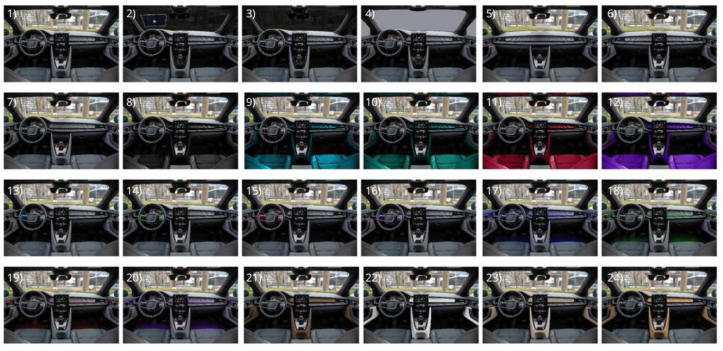
Interior Design Elements In this survey, various interior design elements were compared and evalu- ated regarding the perceived psychological uncertainty of the participants. The design elements evaluated encompassed modifications to the dashboard area of a fully automated car, which involved the inclusion or exclusion of a steering wheel, information tablet, and external visibility. Furthermore, tradi- tional interior design aspects were examined, including the colour of ambient lighting and a steering wheel light, interior colour, and the material compo- sition of the dashboard of the fully automated car. The investigated colours included red, green, blue, and purple. Material selection for the interior com- ponents was informed by prevalent practices in Color, Material and Finish (CMF) design (Becerra, 2016). All of the aforementioned design elements were digitally rendered using Photoshop software by overlaying them onto an original photograph of a vehicle, resulting in photo-realistic images. The original photograph served as the baseline for comparison in the survey. The full list of the interior design images shown to the participants is shown in Figure 1.
Exploring the Effects of Interior Design Elements on the Uncertainty of Passengers... 217
Figure 1: Images of different interior design: 1) baseline, 2) tinted windows with enter- tainment, 3) tinted windows, 4) removed window view, 5) removed steering wheel and information tablet, 6) removed steering wheel, 7) removed information tablet, 8) fabric-black, 9) fabric-blue, 10) fabric-green, 11) fabric-red, 12) fabric-purple, 13) steer- ing wheel light-blue, 14) steering wheel light-green, 15) steering wheel light-red, 16) steering wheel light-purple, 17) ambient light-blue, 18) ambient light-green, 19) ambi- ent light-red, 20) ambient light-purple, 21) material-leather, 22) material-metal, 23) material-fabric, 24) material-wood.
Procedure The survey was presented through Microsoft Forms and was accessible on multiple devices, such as phones, tablets, and desktops.
Prior to the survey, participants were introduced to the purpose of the survey and the requirement of being at least 18 years old to participate. Additionally, participants were informed about their right to contact the researchers for any inquiries and the voluntary nature and confidentiality of their responses. Then, they were required to provide online consent.
Participants first provided demographic information, including their age group, gender, residential country, driving experience, opinions on automated vehicles and general perceived psychological uncertainty level. Subsequently, participants commenced the survey and were shown 25 images depicting different interior designs of the same fully automated car. The images were presented in a randomised order, but with the baseline image always being the first and repeated randomly once among the remaining images. After view- ing each image, participants were prompted to rate their level of perceived psychological uncertainty on a scale from 0 to 10, where 0 indicated ‘abso- lutely not uncertain’ and 10 indicated ‘absolutely uncertain’. Additionally, an open-ended question asking participants to describe the elements they were uncertain about the previously shown images, was interspersed three times among the images.
Data Analysis All data for this study was analysed with a focus on descriptive data, including mean, standard deviation, and median, to compare the levels of
perceived psychological uncertainty that participants experienced across dif- ferent images, since the data did not fit normal distribution (Nadarajah, 2005). For analysing the open questions, code themes were derived from the responses through a content analysis (Harwood and Garry, 2003) by the first author. These code themes were based on a review of the content by the researchers.
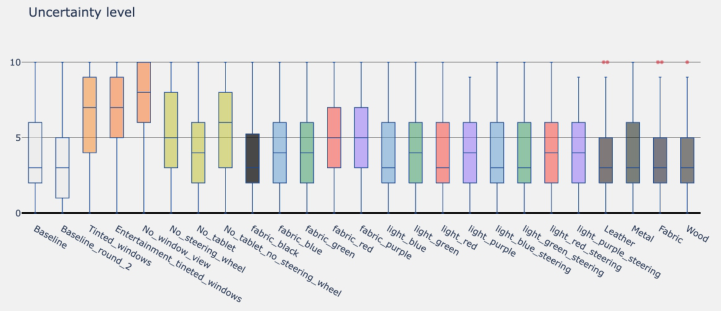
Baseline The baseline image of the fully automated car (Figure 1) was shown twice to participants: once as the first and a second time randomly among all the other images (Figure 1). The first baseline image received an average perceived psy- chological uncertainty rating of 3.66 (SD = 2.76) on a scale of 0 to 10. The second baseline that was shown scored an average perceived psychological uncertainty rating of 3,60 (SD = 2.74) on a scale of 0 to 10.
Tinted and Blinded Windows “Tinted windows” scored an average perceived psychological uncertainty rating of 6.54 (SD = 2.90). “Tinted windows with entertainment’ scored an average perceived psychological uncertainty rating of 6.51 (SD = 2.80). “Removed window view” scored an average perceived psychological uncer- tainty rating of 7.31 (SD = 3.02).
Removal of the Steering Wheel and Information Tablet ‘Removed steering wheel’ was presented in the survey, which yielded an aver- age perceived psychological uncertainty score of 5.36 (SD = 2.95). ‘Removed information tablet’ scored an average perceived psychological uncertainty score of 4.03 (SD = 2.59). A combination of the above ‘removed steering
Exploring the Effects of Interior Design Elements on the Uncertainty of Passengers... 219
wheel and information tablet’, yielded an average perceived psychological uncertainty score of 5.61 (SD = 2.93).
Ambient Light The ambient light that was coloured blue yielded a perceived psychological uncertainty average of 3.96 (SD = 2.59). Green resulted in a perceived psy- chological uncertainty average of 3.96 (SD = 2.50). Red yielded a perceived psychological uncertainty average of 3.92 (SD = 2.68), and Purple resulted in a perceived psychological uncertainty average of 4.07 (SD = 2.55).
Steering Wheel Light The steering wheel with a blue light yielded a perceived psychological uncer- tainty average of 3.78 (SD = 2.65). Green resulted in a perceived psycho- logical uncertainty average of 3.89 (SD = 2.57). Red yielded a perceived psychological uncertainty average of 4.03 (SD = 2.63), and Purple resulted in a perceived psychological uncertainty average of 4.03 (SD = 2.56).
Altering the Colour of the Fabric ‘Fabric-black’ resulted in a perceived psychological uncertainty average of 3.61 (SD = 2.70). Blue yielded a perceived psychological uncertainty average of 4.26 (SD = 2.69). Green resulted in a perceived psychological uncer- tainty average of 4.29 (SD = 2.69). Red yielded a perceived psychological uncertainty average of 4.58 (SD = 2.73), and Purple resulted in a perceived psychological uncertainty average of 4.96 (SD = 2.71).
Altering the Material of the Interior The alteration of the interior material was done with four different mate- rials. Leather yielded a perceived psychological uncertainty average of 3.64 (SD = 2.62). Metal resulted in a perceived psychological uncertainty average of 3.64 (SD = 2.67). Fabric yielded a perceived psychological uncertainty average of 3.55 (SD = 2.61), and Wood resulted in a perceived psychological uncertainty average of 3.53 (SD = 2.55).
Content Analysis Content analysis (Harwood and Garry, 2003) derived four keywords and themes. “Lowered/lack of ability to look outside” was mentioned by 64 par- ticipants, followed by “Colours” (39), “Absence steering wheel” (38), and “ability to interfere” (22).
CONCLUSION AND DISCUSSION Valuable insights on the influence on the perceived psychological uncer- tainty of participants through the alteration of interior design elements are found. One of the most striking results is found when comparing the mean perceived psychological uncertainty between the baseline image and other stimuli (Figure 2). We found that compared to the baseline image (ordinary
modern car interior), almost all altered elements seem to provoke additional perceived psychological uncertainty among participants.
Tinted windows and the absence of external visibility, as seen in the “removed window view” stimulus, elicit the highest levels of perceived psy- chological uncertainty among participants. This seems a logical result based on the fact that when trust in automated vehicles is low, people will look outside to anticipate and see what the car is doing (Walker et al., 2019). Similarly, the removal of essential components like the steering wheel con- tributes to increased perceived psychological uncertainty rating, while the absence of the information tablet only slightly increases the perceived psy- chological uncertainty. These findings are consistent with those from the content analysis, suggesting a central theme of a perceived loss of control and overview. Participants found losing the ability to look outside or having a limited view of the outside as the most psychological uncertainty-provoking elements, followed by the removal of the steering wheel. We therefore posit that perceived psychological uncertainty is related to other psychological con- structs, as described in the literature, such as trust, risk perception and the feeling of being in control (Choi and Ji, 2015; Mayer, Davis and Schoorman, 1995; Mitchell, 1999). Furthermore, alterations in colours seem to have an impact on psycholog- ical uncertainty ratings, both in fabric and LED lights (ambient light and on the steering wheel). Red and purple fabric colours yielded higher perceived psychological uncertainty ratings, with purple ambient light and steering wheel lights also showing the highest provoked psychological uncertainty. The content analysis also revealed “colours” as elements participants felt uncertain about, possibly because purple is perceived as less common than red, green, and blue. Additionally, red caused more perceived psychologi- cal uncertainty when presented on the steering wheel, potentially due to its association with negative connotations, especially in control-related elements within the car.
Overall, these findings suggest a tendency towards increased uncertainty when encountering less commonly used elements in the car, which partici- pants may have a lesser understanding of (Rowe, 1994).
One notable alteration that appeared to lower perceived psychological uncertainty was the usage of wood as a material in the interior. This reduction in perceived psychological uncertainty may be attributed to the familiarity of wood in interior design, as wood has been commonly used in the past. Addi- tionally, we postulate that it could potentially enhance the overall experience of the car and thereby potentially lower perceived psychological uncertainty since wood has often been associated with luxury (Vigneron and Johnson, 2017). Additionally, all material alterations scored very close to the baseline, indicating minimal deviation in perceived psychological uncertainty. Simi- larly, the change of interior colour to black resulted in a lower perceived psychological uncertainty score than the first baseline and a score very close to the second baseline. We considered that black, as a fairly common colour in interior car design, could lead to a sense of familiarity and reduced perceived psychological uncertainty among participants.
Exploring the Effects of Interior Design Elements on the Uncertainty of Passengers... 221
Lastly, a very intriguing result was found in the presence or absence of the steering wheel. The presence of the steering wheel, giving ability to inter- fere, caused a significant number of participants to feel uncertain. This was because they wondered why the ability to interfere was necessary if the car was able to drive on its own. However, this feeling was not shared amongst all participants since others felt more uncertain when the steering wheel was removed.
This study was conducted as an online survey. Perceived psychological uncertainty is a complex state of mind that has many triggers that are still unidentified. Exploring the same stimuli through the usage of a real car could yield different insights. This research tested for mainly visual cues. However, experiencing the car in real life could trigger different emotions and different feelings. A recommendation for future research would be to further explore the interesting findings in a lab setting with real-life materials.
This research explored the effects of interior design elements on the per- ceived psychological uncertainty of passengers of fully automated cars. The results indicate that factors such as familiarity, trust, and perceived con- trol are significant considerations when addressing perceived psychological uncertainty through interior design. Furthermore, the introduction of unfa- miliar design elements and perceived loss of control may lead to an increase in feelings of psychological uncertainty.
ACKNOWLEDGEMENT
This project is supported by the research program National Research Agenda, which is financed by the Dutch Research Council (Project Number: 1292.19.298).
REFERENCES
Anderson, E. C., Carleton, R. N., Diefenbach, M. and Han, P. K. J. (2019). ‘The Relationship Between Uncertainty and Affect’. Frontiers in Psychology, 10. doi: ht tps://doi.org/10.3389/fpsyg.2019.02504. Becerra, L. (2016). The fundamental principles of CMF design : colour, material,
finish. Amsterdam, The Netherlands: Frame Publishers. Caberletti, L., Elfmann, K., Kummel, M. and Schierz, C. (2010). ‘Influence of ambient lighting in a vehicle interior on the driver’s perceptions’. Light- ing Research & Technology, 42(3), pp. 297–311. doi: https://doi.org/10.1177/ 1477153510370554. Choi, J. K. and Ji, Y. G. (2015). ‘Investigating the Importance of Trust on Adopting
an Autonomous Vehicle’. International Journal of Human-Computer Interaction, 31(10), pp. 692–702. doi: https://doi.org/10.1080/10447318.2015.1070549. Christoph, M., Cleij, D., Ahlström, C., Bakker, B., Beggiato, M., Borowsky, A., …Van Nes, C. N (2019). ‘Mediating between human driver and automation: state-of-the art and knowledge gaps’. D1.1 of the H2020 project MEDIATOR. Available at: https://mediatorproject.eu/deliverables (Accessed: 31 January 2023). de Winter, J. C. F., Happee, R., Martens, M. H. and Stanton, N. A. (2014). Effects of
adaptive cruise control and highly automated driving on workload and situation awareness: A review of the empirical evidence. Transportation Research Part F: Traffic Psychology and Behaviour, 27, pp. 196–217. doi: https://doi.org/10.1016/ j.trf.2014.06.016.
Grupe, D. W. and Nitschke, J. B. (2013). ‘Uncertainty and anticipation in anxiety: an integrated neurobiological and psychological perspective’. Nature Reviews Neuroscience, [online] 14(7), pp. 488–501. doi: https://doi.org/10.1038/nrn3524. Harwood, T. G. and Garry, T. (2003). ‘An Overview of Content Analy- sis. The Marketing Review, 3(4)’, pp. 479–498. doi: https://doi.org/10.1362/ 146934703771910080. Jeong, E., Oh, C. and Lee, S. (2017). ‘Is vehicle automation enough to prevent
crashes? Role of traffic operations in automated driving environments for traf- fic safety’. Accident Analysis & Prevention, 104, pp. 115–124. doi: https://doi.or g/10.1016/j.aap.2017.05.002. Kappes, A., Nussberger, A. M., Faber, N. S., Kahane, G., Savulescu, J. and Crockett, M. J. (2018) ‘Uncertainty about the impact of social decisions increases prosocial behaviour’. Nature human behaviour, 2(8), pp. 573–580. Kern, D. and Schmidt, A. (2009). ‘Design space for driver-based automotive user
interfaces’. Proceedings of the 1st International Conference on Automotive User Interfaces and Interactive Vehicular Applications - AutomotiveUI ‘09. doi: https: //doi.org/10.1145/1620509.1620511. Kim, T., Choi, K. and Suk, H.-J. (2022). ‘Affective responses to chromatic ambient light in a vehicle’. arXiv (Cornell University). doi: https://doi.org/10.48550/arxiv. 2209.10761. Kyriakidis, M., Happee, R. and de Winter, J. C. F. (2015). ‘Public opinion on
automated driving: Results of an international questionnaire among 5000 respon- dents’. Transportation Research Part F: Traffic Psychology and Behaviour, 32, pp. 127–140. doi: https://doi.org/10.1016/j.trf.2015.04.014. Leder, H. and Carbon, C.-C. (2005). ‘Dimensions in appreciation of car interior design’. Applied Cognitive Psychology, 19(5), pp. 603–618. doi: https://doi.org/ 10.1002/acp.1088. Mayer, R. C., Davis, J. H. and Schoorman, F. D. (1995). ‘An Integrative Model of
Organizational Trust’. The Academy of Management Review, 20(3), pp. 709–734. Mitchell, V. (1999). ‘Consumer perceived risk: conceptualisations and models’. European Journal of Marketing, 33(1/2), pp. 163–195. doi: https://doi.org/10.1108/ 03090569910249229. Morriss, J., Tupitsa, E., Dodd, H. F. and Hirsch, C. R. (2022). ‘Uncertainty Makes
Me Emotional: Uncertainty as an Elicitor and Modulator of Emotional States’. Frontiers in Psychology, 13. doi: https://doi.org/10.3389/fpsyg.2022.777025. Nadarajah, S. (2005). ‘A generalized normal distribution’. Journal of Applied Statistics, 32(7), pp. 685–694. doi: https://doi.org/10.1080/02664760500079464. Naderifar, M., Goli, H. and Ghaljaie, F. (2017). ‘Snowball sampling: a Purposeful
Method of Sampling in Qualitative Research’. Strides in Development of Medical Education, 14(3). doi: https://doi.org/10.5812/sdme.67670. Parasuraman, R. and Manzey, D. H. (2010). ‘Complacency and Bias in Human Use of Automation: An Attentional Integration’. Human Factors: The Journal of the Human Factors and Ergonomics Society, 52(3), pp. 381–410. doi: https://doi.or g/10.1177/0018720810376055. Rowe, W. D. (1994). ‘Understanding Uncertainty’. Risk Analysis, 14(5), pp. 743–750. doi: https://doi.org/10.1111/j.1539-6924.1994.tb00284.x. Sarter, N., Woods, D. and Billings, C. (1997). ‘Automation surprises’. Handbook of
Human Factors and Ergonomics. Vigneron, F. and Johnson, L. W. (2017). ‘Measuring Perceptions of Brand Luxury’.
Advances in Luxury Brand Management, pp. 199–234. doi: https://doi.org/10. 1007/978-3-319-51127-6_10.
Exploring the Effects of Interior Design Elements on the Uncertainty of Passengers... 223
Walker, F., Wang, J., Martens, M. H. and Verwey, W. B. (2019). ‘Gaze behaviour and electrodermal activity: Objective measures of drivers’ trust in automated vehicles’. Transportation Research Part F: Traffic Psychology and Behaviour, 64, pp. 401–412. doi: https://doi.org/10.1016/j.trf.2019.05.021. Weirich, C., Lin, Y. and Khanh, T. Q. (2022). ‘Evidence for Human-Centric In-Vehicle
Lighting: Part 1’. Applied Sciences, 12(2), p.552. doi: https://doi.org/10.3390/ap p12020552. Weirich, C., Lin, Y. and Khanh, T. Q. (2022). ‘Evidence for human-centric in-vehicle lighting: Part 2—Modeling illumination based on color-opponents’. Frontiers in Neuroscience, 16. doi: https://doi.org/10.3389/fnins.2022.969125. Windschitl, P. D. and Wells, G. L. (1996). ‘Measuring psychological uncertainty: Ver-
bal versus numeric methods’. Journal of Experimental Psychology: Applied, 2(4), pp. 343–364. doi: https://doi.org/10.1037/1076-898x.2.4.343. World Health Organization (2023). Global status report on road safety. Available at: https://www.who.int/teams/social-determinants-of-health/safety-and-m obility/global-status-report-on-road-safety-2023 (Accessed: 31 January 2023). Yardım, S., and Pedgley, O. (2023). ‘Targeting a luxury driver experience: Design con-
siderations for automotive HMI and interiors’. International Journal of Design, 17(2), pp. 45–66. doi: https://doi.org/10.57698/v17i2.03
LISTED IN THE AHFE DIGITAL BOOKSTORE CATALOGUE
Explore the complete digital volume
Advances in Human Factors of Transportation
Read this individual research paper free through the original publisher, or explore the full digital proceedings book.
ISBN 978-1-964867-24-3
Explore this ISBN in the AHFE Bookstore ↗Listed in the July 2026 bookstore catalogue; search by ISBN to confirm current availability · Digital book purchase optional