Pavlo Bazilinskyy, Dimitra Sodou, Joost De Winter (2022). Crowdsourced Assessment of 227 Text-Based eHMIs for a Crossing Scenario. In: Human Factors in Transportation. AHFE Open Access, vol. 60, pp. 141–155. https://doi.org/10.54941/ahfe1002444
Future automated vehicles may be equipped with external human-machine interfaces (eHMIs) capable of signaling whether pedestrians can cross the road. Industry and academia have proposed a variety of eHMIs featuring a text message. An eHMI message can refer to the action to be performed by the pedestrian (egocentric message) or the automated vehicle (allocentric message). Currently, there is no consensus on the correct phrasing of the text message. We created 227 eHMIs based on text-based eHMIs observed in the literature. A crowdsourcing experiment (N = 1438) was performed with images depicting an automated vehicle equipped with an eHMI on the front bumper. The participants indicated whether they would (not) cross the road, and response times were recorded. Egocentric messages were found to be more compelling for participants to (not) cross than allocentric messages. Furthermore, Spanish-speaking participants found Spanish eHMIs more compelling than English eHMIs. Finally, it was established that some eHMI texts should be avoided, as signified by low compellingness, long responses, and high inter-subject variability.
Future automated vehicles (AVs) may be equipped with external Human- Machine Interfaces (eHMIs) that inform or instruct other road users. The eHMIs so far mostly target pedestrians, although eHMIs that address cycli- sts (e.g., Vlakveld et al., 2020; Volvo, 2018) and drivers (Rettenmaier, Albers & Bengler, 2020) have been proposed as well. eHMIs come in different forms, such as LED strips, lamps, icons, and text messages. This paper focuses on text-based eHMIs. Text-based eHMIs are often used in industry (Cortes, 20201; Daimler, 2017a; drive.ai, 2018; Mercedes-Benz, 2015; Nissan, 2015; Rinspeed AG, 2017; see Bazilinskyy, Dodou & De Winter, 2019 for a review) and academic literature (see Dey et al., 2020).
Text-based eHMIs have the presumed advantage of conveying precise information compared to abstract eHMIs, such as LED strips. However, the size of the display for rendering a text message is limited, and long phrases may thus be unlikely to be implemented on AVs. Additionally, some resea- rchers (Cefkin, 2018; Dey et al., 2022; Tabone et al., 2021a) have advised
against text-based eHMIs because text requires focused attention and takes time to read.
Text-based eHMIs have been found to vary in length considerably, ranging between the two-character OK (Song et al., 2018a) and GO (Vlakveld et al., 2020) to the 51-character CAR SLOWS DOWN. YOU CAN CROSS THE STREET SAFELY NOW (Rinspeed AG, 2017). Although lengthy, the latter message may be clear, as it explains what the pedestrian can do (so-called ego- centric information) and what the car will do (allocentric information). Eisma et al. (2021) found that DON’T WALK yielded faster responses than STOP and BRAKING, presumably because it provides an egocentric instruction to the pedestrian.
The language of a text-based eHMI likely matters too. Some have critici- zed text-based eHMIs for their language requirements (Métayer & Coeugnet, 2021; Rasouli & Tsotsos, 2019; Tabone et al., 2021a). The literature focu- ses almost exclusively on English eHMIs (exceptions exist, such as eHMIs in Japanese: Daimon, Taima & Kitazaki, 2021; Lee et al., 2021; Liu et al., 2020; Soshiroda et al., 2021; German: Song et al., 2018a; Forke et al., 2021; Hebrew: Hochman et al., 2020; and Chinese: Lanzer et al., 2020). Curren- tly, only a few studies have assessed how text-based eHMIs are interpreted cross-nationally. Bazilinskyy, Dodou & De Winter (2019) found that partici- pants from English-speaking countries gave higher clarity ratings to eHMIs in English text than participants from other countries. Lanzer et al. (2020) compared polite versus dominant eHMI messages and found that a polite message resulted in more compliance among Chinese participants but not among Germans.
She (2020) and She, Neuhoff & Yuan (2021) previously evaluated 14 eHMI messages, including advisory (e.g., SAFE TO CROSS), commanding (e.g., CROSS), and informative ones (e.g., BRAKING) with an online sam- ple. The authors found that the commanding and advisory messages resulted in higher trust and compliance with the AV’s intentions than the informa- tive messages. She (2020) noted that “even though the author has not seen literatures (sic) that directly support this finding yet, it is common that a more direct instruction, e.g., command or advice, is much easier for people to process and follow in a short time.”
In summary, although text-based eHMIs are widely proposed, little knowledge exists about which text message is most clear to pedestrians while taking minimal time to read and understand. Furthermore, little knowledge exists about how participants with different language abilities interpret eHMIs in different languages. This paper contributes to eHMI design by focusing on the wording of text-based eHMIs. It was determi- ned for 227 eHMIs whether they were compelling to (not) cross the road and whether they yielded fast or slow responses. Additionally, we exami- ned how text-based eHMIs are interpreted cross-nationally. Considering that, next to English, Spanish is one of the most spoken languages glo- bally, we focused our cross-national evaluation on eHMIs in Spanish versus English.
Crowdsourced Assessment of 227 Text-Based eHMIs for a Crossing Scenario 143
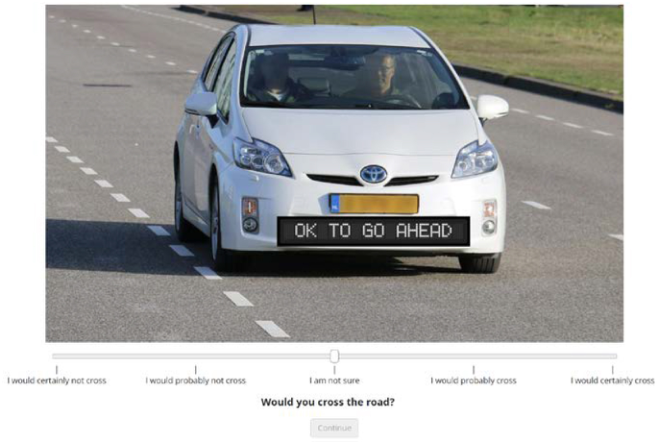
Figure 1: Experiment page with an image and a slider to provide the response.
METHOD
We generated 227 eHMI images in the form of a rectangular black display. The eHMIs were positioned on a photo of a test vehicle driving in Delft, The Netherlands (Fig. 1; Bazilinskyy, Dodou & De Winter, 2019; Rodríguez Palmeiro et al., 2018). We used a photo with a driver because future AVs may still require a human to resume control.
First, 47 text-based eHMIs were identified in the literature. These 47 messages were translated to Spanish, thus totaling 94 eHMIs (Table 1). Six eHMIs were added, namely I’LL STOP (Lee et al., 2021; Soshiroda et al., 2021), I’M WAITING (Habibovic et al., 2018), I’M ABOUT TO YIELD (Habibovic et al., 2018; Lagström & Malmsten Lundgren, 2016), I’M RESTING (Lagström & Malmsten Lundgren, 2016), I CAN SEE YOU (Mah- adevan, Somanath & Sharlin, 2018), and OK (Song et al., 2018a), the first five being interpretations of light-based eHMIs. These six eHMIs were not translated to Spanish.
Messages used in augmented reality, e.g., DANGER: VEHICLE IS APPRO- ACHING (Tabone et al., 2021b) and CLEAR THE AREA (Matsuda, 2016), were excluded. We also excluded texts that did not involve a car approa- ching a pedestrian crossing, e.g., BYE BYE TRISTAN (Rinspeed AG, 2017), ON MY WAY (Daimler, 2017a), I AM ABOUT TO START (Habibovic et al., 2018), STOPPED (Wang et al., 2019), STOPPED NOW AND WILL START SOON (Verma et al., 2019).
127 eHMIs were added by combining several verbs from the eHMI lite- rature (CONTINUE, CROSS, GO, GO AHEAD, MOVE, PASS, PROCEED, WAIT, WALK) with the words PLEASE and NOW. Furthermore, we added YOU, I, OK TO, or CAR at the beginning of the message, and we interchanged CAN and MAY where applicable. Additionally, we produced eHMIs with contracted forms of verbs, e.g., WON’T STOP and WILL NOT STOP.
Table 1. 94 of the 227 eHMIs used in the experiment. 47 eHMIs were obtained from the literature and translated to Spanish (listed in parentheses).
Table available in the original PDF paper.
1. AFTER YOU (DESPUES DE USTED) (Arame et al., 2020; Daimon, Taima & Kitazaki, 2021; Lee et al., 2021; Löcken, Golling & Riener, 2019; Nissan, 2015; Soshiroda et al., 2021; She, Neuhoff & Yuan, 2021) 2. BRAKE (FRENO) (Barendse, 2019; Strickland et al., 2016) 3. BRAKING (FRENANDO) (Deb, Strawderman & Carruth, 2018; Eisma et al., 2021; She, Neuhoff & Yuan, 2021; Song et al., 2018b) 4. CAR BRAKES (EL COCHE FRENA) (Forke et al., 2021) 5. CAR IS BRAKING (EL COCHE ESTA FRENANDO) (Koo et al., 2015) 6. CAR SLOWS DOWN. YOU CAN CROSS THE STREET SAFELY NOW (EL COCHE ESTA FRENANDO. YA PUEDE CRUZAR LA CALLE DE MANERA SEGURA) (Rinspeed AG, 2017) 7. COMING THROUGH (AVANZANDO) (She, Neuhoff & Yuan, 2021; Urmson et al., 2015) 8. CROSS (CRUCE) (Carmona et al., 2021; Hochman et al., 2020; Mahadevan, Somanath & Sharlin, 2018; She, Neuhoff & Yuan, 2021; Stadler, Cornet & Frenkler, 2019) 9. CROSS NOW (CRUCE AHORA) (Matthews, Chowdhary & Kieson, 2017) 10. CROSSING (CRUZANDO) (Cortes, 2021) 11. DANGEROUS TO CROSS (PELIGROSO CRUZAR) (She, Neuhoff & Yuan, 2021) 12. DON’T CROSS (NO CRUCE) (Asha et al., 2021; Chang, 2020; She, Neuhoff & Yuan, 2021) 13. DON’T WALK (NO CAMINE) (Bazilinskyy, Dodou & De Winter, 2019; Eisma et al., 2021; Fridman et al., 2018; She, Neuhoff & Yuan, 2021) 14. DRIVE (CONDUCIR) (Barendse, 2019) 15. DRIVING (CONDUCIENDO) (Eisma et al., 2020, 2021; Hochman et al., 2020) 16. GO (VAMOS) (Eisma et al., 2021; Song et al., 2018a; Vlakveld et al., 2020) 17. GO AHEAD (AVANCE) (Ackermann et al., 2019; Daimler, 2017b) 18. I DO NOT POSE ANY DANGER (NO REPRESENTO NINGÚN PELIGRO) (Zandi et al., 2020) 19. I HAVE SEEN YOU (LE HE VISTO) (Zandi et al., 2020) 20. I SEE YOU (LE VEO) (Bai et al., 2021; Mahadevan, Somanath & Sharlin, 2018) 21. I WILL STOP (VOY A PARAR) (Arame et al., 2020; Daimon, Taima & Kitazaki, 2021) 22. I WOULD LIKE TO CONTINUE MY DRIVE (ME GUSTARIA CONTINUAR MI CONDUCCION) (Zandi et al., 2020) 23. I’M ACCELERATING NOW (ESTOY ACELERANDO AHORA) (Zandi et al., 2020) 24. I’M SLOWING DOWN (ESTOY FRENANDO) (Zandi et al., 2020) 25. MOVING (MOVIENDO) (Kannan, Lee & Min, 2021; Wang et al., 2019) 26. PASS (PASE) (Song et al., 2018b; Wang & Xu, 2020) 27. PEDESTRIAN CROSSING (CRUCE PEATONAL) (Cortes, 2021) 28. PLEASE WAIT (ESPERE POR FAVOR) (Wang & Xu, 2020) 29. PROCEED TO CROSS (PROCEDA A CRUZAR) (Ferenchak & Shafique, 2022) 30. RECOGNIZED (RECONOCIDO) (Song et al., 2018b) 31. RUNNING NOW AND WILL STAY RUNNING (CONDUCIENDO AHORA Y SEGUIRE CONDUCIENDO) (Verma et al., 2019) 32. RUNNING NOW AND WILL STOP SOON (FUNCIONANDO AHORA Y FRENARE PRONTO) (Verma et al., 2019) 33. SAFE (SEGURO) (Song et al., 2018b) 34. SAFE TO CROSS (SEGURO PARA CRUZAR) (Chang, 2020; Dalipi et al., 2020; drive.ai, 2018; Hudson et al., 2018; Knight, 2016; Matthiesen et al., 2018; She, Neuhoff & Yuan, 2021) 35. STOP (PARAR) (Bai et al., 2021; Eisma et al., 2021; Hochman et al., 2020; Kannan, Lee & Min, 2021; Mercedes-Benz, 2015)
Crowdsourced Assessment of 227 Text-Based eHMIs for a Crossing Scenario 145
Table 1. Continued.
Table available in the original PDF paper.
36. STOPPING (PARANDO) (Colley, Belz & Rukzio, 2021; Löcken, Golling & Riener, 2019; Nissan, 2015; Wang et al., 2019) 37. VEHICLE SLOWS DOWN (EL VEHICULO FRENA) (Wang & Xu, 2020) 38. VEHICLE STOPS (EL VEHICULO SE DETIENE) (Wang & Xu, 2020) 39. WAIT (ESPERE) (Barendse, 2019) 40. WAITING (ESPERANDO) (Eisma et al., 2020) 41. WAITING FOR YOU TO CROSS (ESPERANDO A QUE CRUCE) (drive.ai, 2018) 42. WALK (CAMINE) (Bai et al., 2021; Barendse, 2019; Bazilinskyy, Dodou & De Winter, 2019; Eisma et al., 2021; Fridman et al., 2018; She, Neuhoff & Yuan, 2021; Song et al., 2018b) 43. WARNING, I’M DANGEROUS (CUIDADO, SOY PELIGROSO) (Zandi et al., 2020) 44. WILL STOP (PARARE) (Bazilinskyy, Dodou & De Winter, 2019; Bazilinskyy et al., 2021) 45. WON’T STOP (NO PARARE) (Bazilinskyy, Dodou & De Winter, 2019; Bazilinskyy et al., 2021) 46. YIELDING (DEJANDOLE CRUZAR) (Cortes, 2021; She, Neuhoff & Yuan, 2021) 47. YOU CAN CROSS (PUEDE CRUZAR) (Mahadevan, Somanath & Sharlin, 2018)
All eHMIs were capitalized, presented in white text, and no accents were used (e.g., PARARE instead of PARARÉ). The text was center-aligned in a 15-character LED display. Participants performed the crowdsourcing experiment via Appen. We allo- wed contributors from all countries. It was not permitted to complete the study more than once from the same worker ID. A compensation of USD 0.35 was offered for completing the experiment and receive their payment. At the beginning of the questionnaire, the contact information of the rese- archers was provided. Participants were informed that the study would take approximately 20 minutes, that they could contact the investigators to ask questions, and that they had to be at least 18 years old. Information about anonymity and voluntary participation was provided as well. Participants provided consent via a dedicated questionnaire item. The research was appro- ved by the Human Research Ethics Committee of the Delft University of Technology.
The participants first completed questions about their demographics (age, gender, age of obtaining a driver’s license, etc.) and proficiency in English and Spanish. They were asked to complete five items to test their knowledge of English (taken from Cambridge University, 2022). The language setting of the browser was also logged. Next, they clicked on a link that opened the experi- ment. After opening the webpage, they were given a prompt “The experiment will switch to full-screen mode when you press the button below”. After cli- cking on the button “Continue” under the prompt, the experiment switched to a full-screen mode. Next, participants were presented with instructions about how to complete the task.
Participants were required to indicate whether they would cross the road in front of an AV for a randomly-selected 80 of the 227 eHMIs, by moving a slider below (Fig. 1). The slider represented a scale of 0 to 100. After moving the slider, the button ‘Continue’ became active, allowing the participant to proceed to the next image. At the top of the page, a bar displayed the progress.
At the end of the experiment, participants were shown a unique code. They were required to enter the code in the questionnaire to prove they completed the experiment.
RESULTS
A total of 1438 people participated between 12 January and 14 February 2022. The study received a satisfaction score of 3 on a scale from 1 to 5, with 4.3, 3.7, and 3.9 for ‘Instructions clear’, ‘Ease of job’, and ‘Pay’, respectively. Participants who reported not having read the instructions, who were under the age of 18, or who had not completed the task were removed. If people had completed the study more than once from the same IP address, only the first attempt coming from that IP address was retained. In total, 530 par- ticipants were removed, leaving 908 participants. The retained participants resided in 54 countries, with the most represented countries being Venezuela (n = 475), United States (n = 108), and India (n = 38). The sample consi- sted of 583 males, 321 females, and 4 participants who selected “I prefer not to respond” to the gender question. The mean age of the participants was 35.8 years (SD = 10.8). The participants had used an average of 21.8 min to complete the questionnaire and experiment (median = 17.2 min).
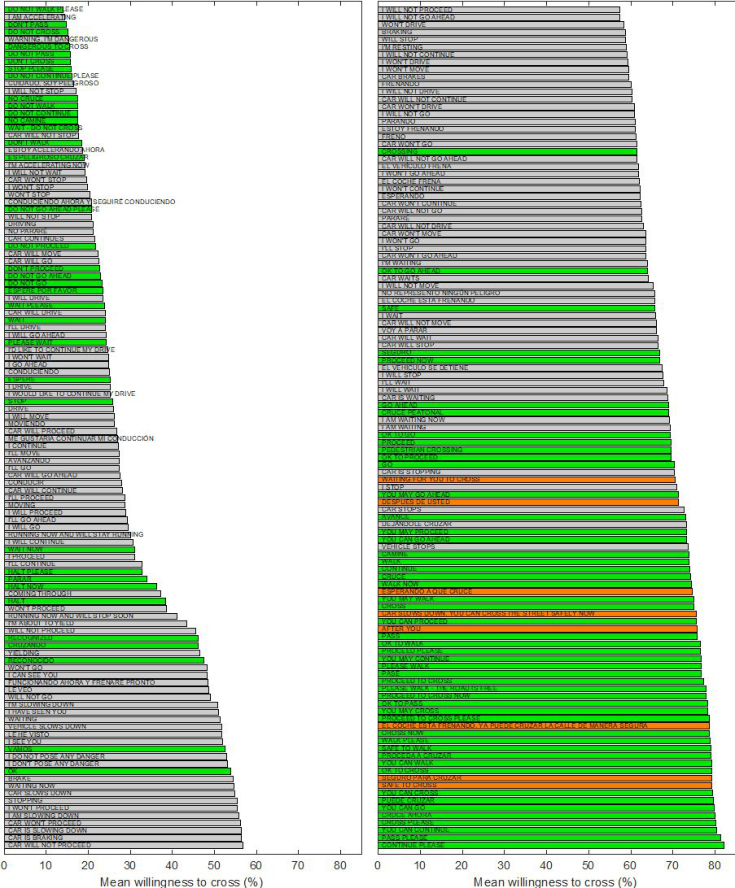
Figure 2 shows the participants’ mean willingness to cross for all 227 eHMIs. The eHMIs were a-priori categorized based on whether the message was egocentric (green bars), allocentric (gray bars), or both (orange bars). Egocentric messages address (and often instruct) the pedestrian, whereas allo- centric messages describe the state or action of the AV. Figure 2 shows that egocentric messages were more compelling than allocentric messages, i.e., participants were not willing (closer to 0%) or willing (closer to 100%) to cross, while allocentric messages left participants in doubt (closer to 50%). The most compelling English message to not cross was DO NOT WALK PLEASE, whereas the most compelling message to cross was CONTINUE PLEASE.
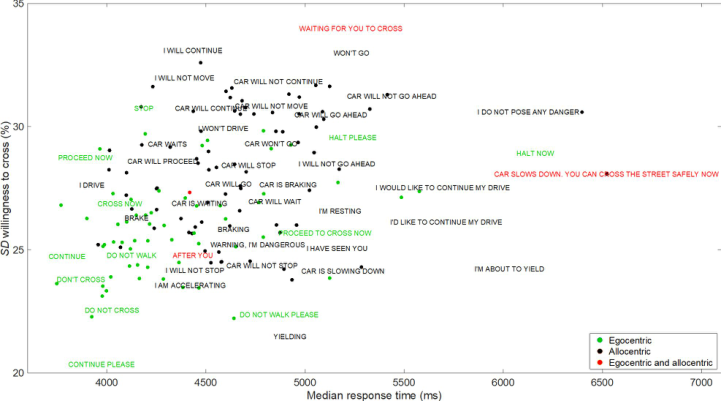
Figure 3 provides a scatter plot of two measures of ambiguity: median response time and standard deviation of the willingness to cross. It can be seen that egocentric messages were the least ambiguous. Furthermore, lengthier messages tended to take longer to respond.
The correlations between characteristics of the eHMIs are illustrated in Table 2. The compellingness score was defined as 2 × (|mean willingness to cross percentage - 50%|) (Eisma et al., 2020). A score of 100% indicates ‘very compelling’; that is, participants interpreted the message as either ‘cross’ or ‘not cross’. A score of 0% indicates ‘very uncompelling’, meaning that participants on average tended to answer near the midpoint of the scale. The correlation matrix indicates that egocentric messages were more compelling and yielded faster responses. Furthermore, longer messages were associated with slower responses.
Using linear regression analysis, we estimated the median response time as 3911 ms + 59.3 ms × number of characters – 245 ms if the message is egocentric. The corresponding predictive correlation of the median response time was r = 0.75 (180 eHMIs in English).
Crowdsourced Assessment of 227 Text-Based eHMIs for a Crossing Scenario 147
Figure 2: Willingness to cross for 227 eHMIs. Grey: allocentric, Green: egocentric, Orange: both.
A compelling eHMIs is not necessarily a desirable eHMI.A message such as CROSS PLEASE, although compelling, could be dangerous if the pedestrian does not check whether the road is free. In some cases, such as when the AV’s sensors do not have complete knowledge about the environment, an eHMI should not be compelling but merely acknowledge the pedestrian’s presence or communicate the AV’s state while leaving the decision to cross to the pedestrian. In such scenarios, the eHMI should yield a low compellingness score (i.e., willingness to cross close to 50%) yet not be ambiguous.
Table 3 shows the English eHMIs that yielded a mean willingness to cross between 45% and 55%; that is, these were uncompelling eHMIs. Also shown
Figure 3: Median response time versus mean willingness to cross for the 180 eHMIs in English text. Either the eHMI text or a marker is shown.Table 2. Correlation matrix among characteristics of English-text eHMIs (n = 180).
Table available in the original PDF paper.
1 2 3 4 5
1 Compellingness score (%) 2 Standard deviation of willingness to cross (%) −0.48 3 Median response time (ms) −0.38 0.31 4 Number of characters (#) 0.03 0.13 0.72 5 eHMI text is egocentric (0 or 1) 0.49 −0.39 −0.31 −0.11 6 eHMI text is allocentric (0 or 1) −0.47 0.42 0.36 0.19 −0.95
are the corresponding standard deviations and median response times, which are indexes of ambiguity. It can be seen that some messages acknowledge that all is fine (OK) or that the AV has detected the pedestrian (I CAN SEE YOU, I HAVE SEEN YOU, I SEE YOU, RECOGNIZED). These messages yielded low SDs and relatively fast responses. There is also a number of eHMIs that suggest the AV is slowing down (BRAKE, CAR SLOWS DOWN, I’M SLOWING DOWN, VEHICLE SLOWS DOWN, YIELDING, WAITING, WAITING NOW). These eHMIs were uncompelling, possibly because it may have been unclear whether the AV was slowing down enough for the pede- strian to cross the road. Finally, there is a number of allocentric messages that used negative wording (I DO NOT POSE ANY DANGER, I DON’T POSE ANY DANGER, WILL NOT GO, WILL NOT PROCEED, WON’T GO). These eHMIs yielded high SDs and may have been hard to understand.
It was decided to use browser settings as an indicator of language profici- ency because they reflect a participant’s language use and preference. Mean self-reported English-language proficiency (1 = No proficiency, 5 = Native or bilingual proficiency) was 2.48 for participants with browser setting Spa- nish and 3.3 for participants with browser setting English. Mean self-reported
Crowdsourced Assessment of 227 Text-Based eHMIs for a Crossing Scenario 149
Table 3. Results for eHMIs with a compellingness score smaller than 5% (sorted on SD).
Table available in the original PDF paper.
eHMI Mean willingness to cross (%)
SD willingness to cross (%)
Median response time (ms) YIELDING 46.4 21.5 4923.5 RECOGNIZED 46.1 22.2 4641 I CAN SEE YOU 48.3 24.2 4893.5 VEHICLE SLOWS DOWN 51.6 24.3 5284 I SEE YOU 52.0 24.5 4525 CAR SLOWS DOWN 54.8 24.5 4722.5 I HAVE SEEN YOU 50.9 25.1 5158 OK 53.9 25.1 3981 I’M SLOWING DOWN 50.7 26.0 4957 BRAKE 54.4 26.3 4151 I DO NOT POSE ANY DANGER 52.8 30.6 6121.5 WAITING 51.3 30.8 4173 WAITING NOW 54.7 31.2 4622.5 WILL NOT PROCEED 45.6 31.2 4971 I DON’T POSE ANY DANGER 53.2 31.3 5415 WILL NOT GO 49.0 31.4 4601 WON’T GO 48.2 33.0 5234
Spanish-language proficiency was 4.11 for persons with browser setting Spa- nish and 2.03 for participants with browser setting English. The number of correctly answered questions on the 5-item English language test was 2.86 for persons with browser setting Spanish and 3.03 for participants with browser setting in English.
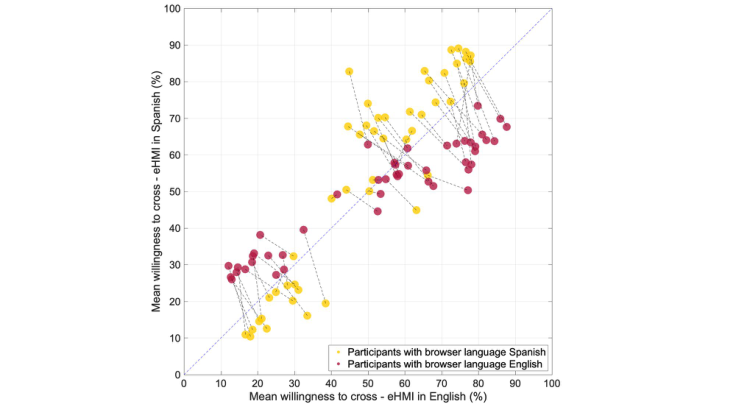
Figure 4 shows the mean willingness to cross for Spanish- and English- speaking participants. Spanish-speaking participants (n = 535) found eHMIs in Spanish more compelling than eHMIs in English, i.e., the yellow markers lie above (if > 50%) or below (if < 50%) the diagonal line. Furthermore, Spanish-speaking participants found eHMIs in Spanish more compelling than did English-speaking participants (n = 203), i.e., the yellow markers lie above (if > 50%) or below (if < 50%) the red markers.
DISCUSSION
Similar to our previous study addressing the color of a non-text-based eHMI (Bazilinskyy, Dodou & De Winter, 2020), this paper assessed text messages for eHMIs comprehensively. Based on the present crowdsourcing study, the following conclusions are offered:
Egocentric messages (e.g., OK TO CROSS, DON’T PASS) are more compelling than allocentric messages (e.g., STOPPING).
Egocentric messages yield faster responses than allocentric messages.
Longer eHMIs texts take longer to respond.
Figure 4: Mean willingness to cross for 47 eHMIs in English and their corresponding Spanish translation. A distinction is made between Spanish-speaking and English- speaking participants.
Some eHMIs (e.g., WILL NOT GO) are confusing because it is unclear who is addressed and/or because of their negative wording.
Spanish-speaking persons are more easily compelled by eHMIs in Spanish than by eHMIs in English. Furthermore, English-speaking participants appear to have difficulty comprehending eHMIs in Spanish.
This paper certainly does not provide the final word on text-based eHMIs. Although a large number of texts were used, our list of 227 eHMIs should not be seen as comprehensive. After conducting our study, we discovered extra messages, such as GET OUT OF THE WAY (Lanzer et al., 2020), PEDESTRIAN DETECTED (She, 2020), and ACCELERATING (She, 2020). Future research could include an even wider variety of messages.
A limitation is that this study used images rather than videos. Furthermore, participants did not need to cross the road, and there were no sounds, distra- ctions, or other road users. Also, participants took a long time to respond, about 3500 ms on average, which may have been caused by the slider inter- face. It can be expected that extreme responses (0% or 100%) took more time because they required larger mouse movements. If this were factored out, then egocentric messages would probably turn out to yield even faster response times.
The present study used eHMIs on top of the license plate, see also Bai et al. (2021), Barendse (2019), Bazilinskyy et al. (2021), Chang (2020), Dalipi et al. (2020), Eisma et al. (2020, 2021), Ferenchak & Shafique (2022), Song et al. (2018a), Verma et al. (2019), and Wang & Xu (2020). Other studies used the hood (Deb, Strawderman & Carruth, 2018; Hudson et al., 2018), windshield (Ackermann et al., 2019; Colley, Belz & Rukzio, 2021; Eisma et al., 2020; Forke et al., 2021; Fridman et al., 2018; Löcken, Golling & Riener, 2019; Matthiesen et al., 2018; She, Neuhoff & Yuan, 2021), side of
Crowdsourced Assessment of 227 Text-Based eHMIs for a Crossing Scenario 151
the AV (Bazilinskyy, Dodou & De Winter, 2019; Eisma et al., 2020), top of the AV (Eisma et al., 2020; Ferenchak & Shafique, 2022; Hochman et al., 2020; Knight, 2016; Lee et al., 2021; Soshiroda et al., 2021; Vlakveld et al., 2020), or a projection on the road in front of the AV (Eisma et al., 2020; Fridman et al., 2018). The interaction between eHMI position and efficacy of the text message needs further consideration, especially concerning visual occlusion.
A question remaining is whether text-based eHMIs have a future. Text can offer a compelling message but can take a long time to read. Furthermore, as was established in this study, language barriers exist. As noted in guideli- nes for external visual communication of automated vehicles: “The format and style of communication signals should be harmonious across OEMs in order to avoid the use of different messages for different types of vehicles in different countries” (International Organization for Standardization, 2018). It seems unlikely that manufacturers would deploy country-specific eHMIs. However, it can be argued that people with different language backgrounds may quickly learn basic messages such as WALK, so this could be a way forward if text-based eHMIs were to be deployed.
ACKNOWLEDGMENT & SUPPLEMENTS This research is supported by grant 016.Vidi.178.047, financed by the Neth- erlands Organisation for Scientific Research (NWO). Supplementary material and code are available at https://doi.org/10.4121/19102133 and https://gith ub.com/bazilinskyy/text-crowdsourced.
REFERENCES
Ackermann, C., et al. (2019) An experimental study to investigate design and assessment criteria: What is important for communication between pedestrians and automated vehicles? Applied Ergonomics. 75, 272–282. doi: 10.1016/j.apergo.2018.11.002. Arame, M., Handa, J., Goda, Y., Toda, M., Matsuba, R. & Daimon, T. (2020) Verification of affordance effect of HMI in the VR environment. Education and New Developments. pp. 294–298. doi: 10.36315/2021end063. Asha, A. Z., et al. (2021) Co-designing interactions between pedestrians in wheelch-
airs and autonomous vehicles. Designing Interactive Systems Conference 2021. pp. 339–351. doi: 10.1145/3461778.3462068. Bai, S., et al. (2021) Investigating external interaction modality and design between automated vehicles and pedestrians at crossings. IEEE Inter- national Intelligent Transportation Systems Conference. pp. 1691–1696. doi: 10.1109/ITSC48978.2021.9564867. Barendse, M. (2019) External human-machine interfaces on autonomous vehicles:
The effects of information type on pedestrian crossing decisions. MSc thesis, TU Delft. Bazilinskyy, P., Dodou, D. & De Winter, J. C. F. (2019) Survey on eHMI concepts: The effect of text, color, and perspective. Transportation Research Part F. 67, 175–194. doi: 10.1016/j.trf.2019.10.013.
Bazilinskyy, P., et al. (2020) External human-machine interfaces: Which of 729 colors is best for signaling ‘Please (do not) cross’? IEEE Inter- national Conference on Systems, Man, and Cybernetics. pp. 3721–3728. doi: 10.1109/SMC42975.2020.9282998. Bazilinskyy, P., et al. (2021) How should external Human-Machine Interfaces behave? Examining the effects of colour, position, message, activation dista- nce, vehicle yielding, and visual distraction among 1,434 participants. Applied Ergonomics. 95, 103450. doi: 10.1016/j.apergo.2021.103450. Cambridge University (2022) General English. https://www.cambridgeenglish.org/t
est-your-english/general-english Carmona, J., Guindel, C., Garcia, F. & De la Escalera, A. (2021) eHMI: Review and guidelines for deployment on autonomous vehicles. Sensors. 21, 2912. doi: 10.3390/s21092912. Cefkin, M. (2018) Towards socially acceptable autonomous driving. [Presentation]
Nissan Research Center Silicon Valley. Chang, C.-M. (2020) A gender study of communication interfaces betw- een an autonomous car and a pedestrian. AutomotiveUI ‘20. pp. 42–45. doi: 10.1145/3409251.3411719. Colley, M., Belz, J. H. & Rukzio, E. (2021) Investigating the effects of feedback communication of autonomous vehicles. AutomotiveUI ‘21. pp. 263–273. doi: 10.1145/3409118.3475133. Cortes, V. A. (2021) Rapid ethnography: Informing personas and interaction
rcedes-benz.com/article/abb6c304-1471-4db9-b52f-227a35125a71/(lightbox: image/b6819718-12ad-4e95-982a-5f2e1cd22847) Daimon, T., Taima, M. & Kitazaki, S. (2021) Pedestrian carelessness toward traffic environment due to external human-machine interfaces of automated vehicles. Journal of Traffic and Logistics Engineering. 9, 42–47. doi: 10.18178/jtle.9.2. 42–47. Dalipi, A. F., Liu, D., Guo, X., Chen, Y. & Mousas, C. (2020) VR-PAVIB: The virtual
reality pedestrian-autonomous vehicle interaction benchmark. AutomotiveUI ‘20. pp. 38–41. doi: 10.1145/3409251.3411718. Deb, S., Strawderman, L.J. & Carruth, D. W. (2018) Investigating pedestrian suggestions for external features on fully autonomous vehicles: A virtual reality experiment. Transportation Research Part F. 59, 135–149. Dey, D., Ackermans, S., Martens, M., Pfleging, B. & Terken, J. (2022) Interacti-
ons of automated vehicles with road users. User Experience Design in the Era of Automated Driving. pp. 533–581. doi: 10.1007/978-3-030-77726-5_20. Dey, D., et al. (2020) Taming the eHMI jungle: A classification taxonomy to guide, compare, and assess the design principles of automated vehicles’ external human- machine interfaces. Transportation Research Interdisciplinary Perspectives. 7, 100174. doi: 10.1016/j.trip.2020.100174. drive.ai (2018) The self-driving car is here. https://web.archive.org/web/ 20191120180349/https://www.drive.ai.
Crowdsourced Assessment of 227 Text-Based eHMIs for a Crossing Scenario 153
Eisma, Y. B., Reiff, A., Kooijman, L., Dodou, D. & De Winter, J. C. F. (2021) External human-machine interfaces: Effects of message perspective. Transportation Research Part F. 78, 30–41. doi: 10.1016/j.trf.2021.01.013. Eisma, Y. B., et al. (2020) External human-machine interfaces: The effect of
display location on crossing intentions and eye movements. Information. 11, 13. doi: 10.3390/info11010013. Ferenchak, N. N. & Shafique, S. (2022) Pedestrians’ perceptions of autonomous vehicle external human-machine interfaces. ASCE-ASME Journal of Risk and Uncertainty in Engineering Systems, Part B. 8, 034501. doi: 10.1115/1.4051778. Forke, J., et al. (2021) Understanding the headless rider: Display-based awareness and intent-communication in automated vehicle-pedestrian intera- ction in mixed traffic. Multimodal Technologies and Interaction. 5, 51. doi: 10.3390/mti5090051. Fridman, L., Mehler, B., Xia, L., Yang, Y., Facusse, L. Y. & Reimer, B. (2018) To
walk or not to walk: Crowdsourced assessment of external vehicle-to-pedestrian displays. Transportation Research Board 97th Annual Meeting. Habibovic, A., et al. (2018) Communicating intent of automated vehicles to pedestrians. Frontiers in Psychology. 9, 1336. doi: 10.3389/fpsyg.2018.01336. Hochman, M., Parmet, Y. & Oron-Gilad, T. (2020) Pedestrians’ understanding of a
fully autonomous vehicle’s intent to stop: A learning effect over time. Frontiers in Psychology. 11, 585280. doi: 10.3389/fpsyg.2020.585280. Hudson, C. R., et al. (2018) Pedestrian perception of autonomous vehicles with external interacting features. Advances in Human Factors and Systems Interaction. pp. 33–39. doi: 10.1007/978-3-319-94334-3_5. International Organization for Standardization (2018) ISO/TR 23049: 2018. Road
vehicles — Ergonomic aspects of external visual communication from automated vehicles to other road users. Geneva, Switzerland, ISO. Kannan, S. S., Lee, A. & Min, B.-C. (2021) External human-machine interface on delivery robots: Expression of navigation intent of the robot. 30th IEEE International Conference on Robot & Human Interactive Communication. pp. 1305–1312. doi: 10.1109/RO-MAN50785.2021.9515408. Knight, W. (2016) New self-driving car tells pedestrians when it’s safe to cross
the street. https://www.technologyreview.com/2016/08/30/7287/new-self-driving -car-tells-pedestrians-when-its-safe-to-cross-the-street Koo, J., et al. (2015) Why did my car just do that? Explaining semi-autonomous driving actions to improve driver understanding, trust, and performance. International Journal on Interactive Design and Manufacturing. 9, 269–275. doi: 10.1007/s12008-014-0227-2. Lagström, T. & Malmsten Lundgren, V. (2016) AVIP-autonomous vehicles’ intera-
ction with pedestrians. An investigation of pedestrian-driver communication and development of a vehicle external interface. MSc thesis, Chalmers University. Lanzer, M., Babel, F., Yan, F., Zhang, B., You, F., Wang, J. & Baumann, M. (2020) Designing communication strategies of autonomous veh- icles with pedestrians: An intercultural study. AutomotiveUI ‘20. pp. 122–131. doi: 10.1145/3409120.3410653. Lee, J., Daimon, T. & Kitazaki, S. (2021) Negative effect of external human-machine interfaces in automated vehicles on pedestrian crossing behaviour: A virtual rea- lity experiment. 21st Congress of the International Ergonomics Association (IEA 2021). pp. 718–725. doi: 10.1007/978-3-030-74608-7_88.
Liu, Y., Lyu, Y., Böttcher, K. & Rötting, M. (2020) External interface-based autonomous vehicle-to-pedestrian communication in urban traffic: Communication needs and design considerations. International Journal of Human-Computer Interaction. 36, 1258–1272. doi: 10.1080/10447318.2020.1736891. Löcken, A., Golling, C. & Riener, A. (2019) How should automated vehicles interact
with pedestrians? A comparative analysis of interaction concepts in virtual reality. AutomotiveUI ‘19. pp. 262–274. doi: 10.1145/3342197.3344544. Mahadevan, K., Somanath, S. & Sharlin, E. (2018) Communicating awareness and intent in autonomous vehicle-pedestrian interaction. CHI ‘18: CHI Conference on Human Factors in Computing Systems. doi: 10.1145/3173574.3174003. Matsuda, K. (2016) Hyper-reality. https://www.youtube.com/watch?v=YJg02ivYzSs Matthews, M., Chowdhary, G. & Kieson, E. (2017) Intent communication between
autonomous vehicles and pedestrians. ArXiv Preprint ArXiv:1708.07123. Matthiesen, T., Guo, J., Brannstrom, S. R. J. & Garms, J. (2018) Autonomous vehicle notification system. Patent 10,152,892 B2. Mercedes-Benz (2015) The F 015 Luxury in Motion. https://www.mercedes-benz.co
m/content/dam/brandhub/innovation/research-vehicle-f-015-luxury-in-motion /10-mercedes-benz-vehicles-F015-luxury-in-motion-3400x1440.jpg Métayer, N. & Coeugnet, S. (2021) Improving the experience in the pedestrian’s interaction with an autonomous vehicle: An ergonomic comparison of external HMI. Applied Ergonomics. 96, 103478. doi: 10.1016/j.apergo.2021.103478. Nissan (2015) Nissan IDS Concept. https://europe.nissannews.com/en-GB/releases
/release-36ee3cc23fc84b2032809e9b04006499-nissan-ids-concept-nissans-visio n-for-the-future-of-evs-and-autonomous-driving Rasouli, A. & Tsotsos, J. K. (2019) Autonomous vehicles that interact with pedestrians: A survey of theory and practice. IEEE Transactions on Intelligent Transportation Systems. 21, 900–918. doi: 10.1109/TITS.2019.2901817. Rettenmaier, M., Albers, D. & Bengler, K. (2020) After you?!–Use of external human-
machine interfaces in road bottleneck scenarios. Transportation Research Part F. 70, 175–190. doi: 10.1016/j.trf.2020.03.004. Rinspeed AG (2017) Rinspeed. https://www.rinspeed.eu/upload/thumbs/thumb_oasi s_ext_hires_024.jpg Rodríguez Palmeiro, et al. (2018) Interaction between pedestrians and automa-
ted vehicles: A Wizard of Oz experiment. Transportation Research Part F. 58, 1005–1020. doi: 10.1016/j.trf.2018.07.020. She, J. (2020) Advisory and adaptive communication improves trust in autonomous vehicle and pedestrian interaction. ASME 2020. doi: 10.1115/DETC2020-22692. She, J., Neuhoff, J. & Yuan, Q. (2021) Shaping pedestrians’ trust in autonomous veh-
icles: An effect of communication style, speed information, and adaptive strategy. Journal of Mechanical Design. 143, 91401. doi: 10.1115/1.4049866. Song, Y. E., Lehsing, C., Fuest, T. & Bengler, K. (2018a) External HMIs and their effect on the interaction between pedestrians and automated vehicles. Intelligent Human Systems Integration. IHSI 2018. pp. 13–18. doi: 10.1007/978-3-319- 73888-8_3. Song, Y. E., Lehsing, C., Fuest, T. & Bengler, K. (2018b) External HMIs and their
effect on the interaction between pedestrians and automated vehicles. [Presenta- tion]. Soshiroda, J., et al. (2021) Stopping position matters: Drawing a better communication between pedestrian and driverless automated vehicles on narrow roads. Human Factors and Ergonomics Society Annual Meeting. 65, 1531–1535. doi: 10.1177/1071181321651156.
Crowdsourced Assessment of 227 Text-Based eHMIs for a Crossing Scenario 155
Stadler, S., Cornet, H. & Frenkler, F. (2019) Towards user acceptance of autonomous vehicles: a virtual reality study on human-machine interfaces. International Journal of Technology Marketing. 13, 325–353. Strickland, R. D., Yuan, M., Bai, S., Weber, D. W. & Miucic, R. (2016) Vehicle to
pedestrian communication system and method. Patent 9,421,909. Tabone, W., et al. (2021a) Vulnerable road users and the coming wave of automated vehicles: Expert perspectives. Transportation Research Interdisciplinary Perspectives. 9, 100293. doi: 10.1016/j.trip.2020.100293. Tabone, W., Lee, Y. M., Merat, N., Happee, R. & De Winter, J. C. F. (2021b) Towards
future pedestrian-vehicle interactions: Introducing theoretically-supported AR prototypes. AutomotiveUI ‘20. pp. 209–218. doi: 10.1145/3409118.3475149. Urmson, C. P., Mahon, J., Dolgov, D. A. & Zhu, J. (2015) Pedestrian notifications.
Patent 8,954.252 B1. Verma, H., et al. (2019) Pedestrians and visual signs of intent: towards expressive autonomous passenger shuttles. Proceedings of the ACM on Interactive, Mobile, Wearable and Ubiquitous Technologies, 31. doi: 10.1145/3351265. Vlakveld, W., Van der Kint, S. & Hagenzieker, M. P. (2020) Cyclists’ intentions to
yield for automated cars at intersections when they have right of way: Results of an experiment using high-quality video animations. Transportation Research Part F. 71, 288–307. doi: 10.1016/j.trf.2020.04.012. Volvo (2018) A new way to travel. 360c. https://www.volvocars.com/intl/cars/conc epts/360c Wang, P., et al. (2019) Safety implications of automated vehicles providing exter-
nal communication to pedestrians (UC-ITS-2019-12), Institute of Transportation Studies. Wang, Y. & Xu, Q. (2020) A field study of external HMI for autonomous vehicles when interacting with pedestrians. HCI in Mobility, Transport, and Automotive Systems. pp. 181–196. doi: 10.1007/978-3-030-50523-3_13. Zandi, B., Singer, T., Kobbert, J. & Khanh, T. Q. (2020) International study on
the importance of communication between automated vehicles and pedestrians. Transportation Research Part F. 74, 52–66. doi: 10.1016/j.trf.2020.08.006.
LISTED IN THE AHFE DIGITAL BOOKSTORE CATALOGUE
Explore the complete digital volume
Human Factors in Transportation
Read this individual research paper free through the original publisher, or explore the full digital proceedings book.
ISBN 978-1-958651-36-0
Explore this ISBN in the AHFE Bookstore ↗Listed in the July 2026 bookstore catalogue; search by ISBN to confirm current availability · Digital book purchase optional