Jochem Verstegen, Pavlo Bazilinskyy (2024). Slideo: Bicycle-to-Vehicle Communication to Intuitively Share Intention to Turn with Automated Vehicles. In: Advances in Human Factors of Transportation. AHFE Open Access, vol. 148, pp. 202–212. https://doi.org/10.54941/ahfe1005210
In urban environments, cycling is an important method of transportation due to being sustainable, healthy and less space-intensive than motorised traffic. Most literature on interactions between automated vehicles (AVs) and vulnerable road users (VRUs) focuses on external Human-Machine Interfaces positioned on AVs and telling VRUs what to do. Such an interface requires cyclists to actively look for and interpret the information and can reduce their ability to make their own decisions. We designed a physical bicycle-to-vehicle (B2V) interaction that allows cyclists to share the intention to turn with AVs through vehicle-to-everything (V2X) communication. We explored four concepts of interaction with hands, feet, hips, and knees. The final concept uses haptic feedback in each handle. The test with nine participants explored the clarity of the feedback and compared two variations: (1) providing feedback in the beginning, during and at the end and (2) giving feedback only at the beginning and end. Results indicate that the general meaning of both variants is clear and that the preferred variation of feedback is up to personal preference. We suggest that B2V interactions should be possible to personalise.
In a future where most vehicles are automated, creating a network of coop- erative/communicative vehicles will be an opportunity with many important advantages. Automated vehicles (AVs) are expected to soon exchange infor- mation with infrastructure through a network operating through vehicle-to- everything (V2X) communication (Ahangar et al., 2021; de La Fortelle et al., 2014). Connected AVs are assumed to (1) improve traffic safety, as connectiv- ity allows for effective prevention of collisions and smoother driving (ICCS, 2013; Ye and Yamamoto, 2019), (2) have environmental benefits as it will be possible to optimise route planning for reduced stop-and-go driving and per- form platooning for reduced aerodynamic drag, (3) allow for shared mobility and seamless integration with public transit and (4) decrease congestion on the road (Taiebat et al., 2018).
Slideo: Bicycle-to-Vehicle Communication to Share Intention to Turn With Automated Vehicles 203
be able to participate in these networks as well, especially as cities are becoming more human-centred and promoting alternative travel methods to decrease the use of cars (Kuss and Nicholas, 2022). Of all types of VRUs, cyclists are the most difficult for AVs to detect due to their relatively small size, variation in appearance and unpredictability (Fairley, 2017). In The Netherlands, cyclists contribute to 36% of traffic fatalities and 68% of severe injuries (SWOV, 2023). If AVs are unable to detect cyclists reliably, cycling may become an even riskier endeavour. Similar to an idea proposed by Volvo (Volvo Car USA, 2014), Ford, Tome Software and Trek Bicycle sug- gested a solution in 2017 to help AVs detect cyclists using bicycle-to-vehicle (B2V) communication in the form of a device that any cyclist can attach to themselves or their bicycle (Burns, 2017). This device would wirelessly com- municate in real-time the cyclist’s location, velocity, and direction to nearby AVs, so they could prevent collisions. Bonnington (2018) disagreed with this approach and argued that VRUs should not be responsible for their detection in traffic and postulated that AVs should be able to detect cyclists on their own (Bonnington, 2018) since wireless devices may be affected by a weak connection or an empty battery. Additionally, requiring each cyclist to invest in expensive technology would make cycling less accessible.
While this bicycle-positioned technology should not be required to make cycling safer, it has the potential to make cycling more comfortable and efficient. B2V communication can help AVs better predict the intentions of cyclists and offer them enough space on the roads to undertake the intended action (Bazilinskyy et al., 2018). This is also supported by Berge et al. (2022), who state that on-bicycle Human Machine Interfaces (HMIs) may be bene- ficial in improving the predictability of cyclists, but that it should never be required to guarantee safety in traffic for cyclists (Berge et al., 2022).
Existing research about the interaction between AVs and VRUs using exter- nal Human Machine Interfaces (eHMIs) focuses on the AV showing its intent to the VRU (allocentric), or telling the VRU directly what to do (egocentric) (Bazilinskyy et al., 2022, 2019; Dey et al., 2020; Hou et al., 2020; Schlackl et al., 2020). The topic of VRUs communicating their intent to AVs, like in Epke et al. (2021) research about pedestrians using hand gestures to commu- nicate crossing intent (Epke et al., 2021), is underexplored, especially when it comes to cyclists.
Aim of Study This design study aims to take a different approach from the existing liter- ature on AV-VRU interactions, focusing on communication between cyclists and connected AVs. The aim is to design a non-distracting physical interac- tion that allows a cyclist to intuitively communicate their intention to turn to the AVs, using a V2X communication network.
DESIGN SPRINT We started the design process with a design sprint, a methodology for teams to quickly build and test a prototype (Knapp et al., 2016). We focused on designing a physical interaction to allow cyclists to communicate their
204 Verstegen and Bazilinskyy
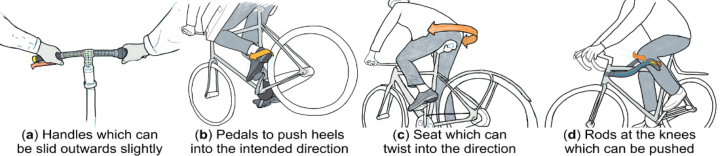
intention to turn to the AVs around them. When a cyclist can clearly com- municate their intentions, AVs can consider such information when planning their routes and collectively offer the cyclist the needed space to make the turn, ideally without anyone having to come to a full stop. The design sprint resulted in four initial concepts of interaction with hands, feet, hips and knees. Each concept required a certain movement from this body part to indicate a direction (see Figure 1).
ASSESSMENT OF INITIAL CONCEPTS OF INTERACTION
Method
We then used an online questionnaire to assess the four different design con- cepts of interaction, to find which location for interaction is preferred by the respondents. The study was approved by the Ethical Review Board of Eind- hoven University of Technology and participants gave their informed consent to use their data.
Figure 1: Sketches of four initial concepts of interaction used in the online questionnaire.
The questionnaire consisted of 50 items. First, the participants were asked about their cycling experience and the quality of cycling infrastructure at the location where they grew up. Then, for each concept, the participants were asked to rate statements on expectations regarding intuitiveness, perceived safety, trust in functionality, clarity of feedback, and willingness to use each concept on a scale from 1 (‘Fully disagree’) to 5 (‘Fully agree’). Figure 1 shows the sketches used for these questions. To allow for additional qualitative insights, there were three optional open-ended questions about each concept, asking the participants what they liked, what they would improve, and to pro- vide additional comments. Then the participants were asked six questions to compare the four concepts, asking which concepts would: be easiest to trig- ger/activate, be most likely to misfire, allow for the best feedback about AVs, create the right sense of safety, be most likely to be used, and be least likely to be used. To answer each of these six questions, the participants could select from one to three concepts. Finally, they were asked about their age, inter- est in technology and opinion on the feasibility of cycling with the proposed concepts next to AVs. The questionnaire was distributed in the personal and professional networks of the authors through Microsoft Forms and posted on the online forum Radar (https://radar-forum.avrotros.nl). The comments to this post were considered for the interpretation of results. The question- naire and the printout of the forum topic are available in the supplementary material.
Slideo: Bicycle-to-Vehicle Communication to Share Intention to Turn With Automated Vehicles 205
RESULTS
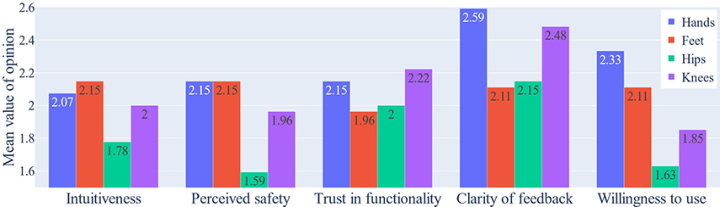
The questionnaire was answered by 29 participants. Responses were col- lected between 24 March 2023 and 12 April 2023. Data and code used to produce all graphs are available in the supplementary material. One par- ticipant who stated their age was 115 and provided non-sensual responses and one participant who had no cycling experience were removed, leaving N = 27. We could not link if any responses to the forum post were made by the respondents of the questionnaire. Figure 2 shows the mean values for the statements on intuitiveness, perceived safety, trust in functionality, clarity of feedback, and willingness to use for the four concepts. Overall, respon- dents provided a negative attitude to all four concepts. For the statements on clarity of feedback (M = 2.59) and willingness to use (M = 2.33), the con- cept of interaction with hands yielded the highest mean scores, with it being second for the statements on intuitiveness (M = 2.07) and trust in function- ality (M = 2.15). For perceived safety, it was rated equally as the concept of interaction with feet (M = 2.15). Regarding this concept, people mostly worry about the likelihood of accidental activation and lack of stability: “I am afraid that the sliding [interaction] can also happen when it is not needed, increasing the chances of a cyclist losing balance.” On the forum, one par- ticipant commented: “It’s unfortunate that for the questions asking which concept I would prefer to use, the option ‘none of them’ was missing”. 8 respondents explicitly remarked that it should always be the responsibility of AVs to keep cyclists safe. Older respondents also provided lower scores. On the forum, one respondent stated “Do you think a grandma who can barely stay upright on her bike can use these concepts?”. To which someone else responded: “In that case, I highly doubt she should still be using a bike in the first place.”
Figure 2: Opinion of participants about the four concepts.
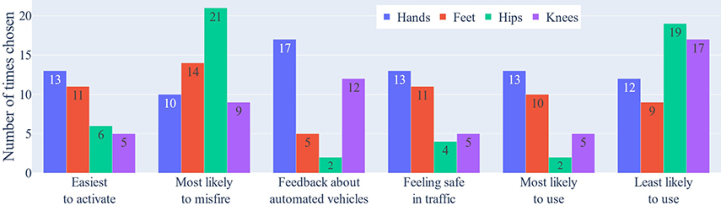
Figure 3 shows how often each concept was chosen in the questions comparing the four concepts. For the questions on the likelihood of mis- firing and the unlikeliness of use, a concept that was chosen less indicates a positive attitude. For the other questions, higher values indicate a positive attitude. The concept of interaction with hands received the most positive opinions for questions on the easiness of use (13), provision of feedback about AVs (17), feeling of safety in traffic (13) and likeliness of use (13). It was attributed with the second most positive attitude for questions on the likelihood of misfiring (10) and unlikeliness of use (12). These results
206 Verstegen and Bazilinskyy
indicate that the concept of interaction with hands is the easiest to use, allows to provide appropriate feedback, feels safe, and is the most likely to be used.
Figure 3: Comparison of the four concepts. For “most likely to misfire” and “least likely to use”, lower values indicate a positive attitude; for other questions, higher is more positive.
EXPLORATORY PROTOTYPE AND FINAL DESIGN CONCEPT While the main use case of our design is to communicate the intention of a cyclist to turn to AVs, additional features can be added to make better use of the technology added to bicycles and potentially make it more valuable to users. We outlined two personas to reflect common reasons for cycling: one persona cycles as a means of commuting to work, and the other persona cycles as a leisure activity. The supplementary material contains extended descriptions of the personas. Both personas would benefit from communicat- ing their intentions but also have individual needs. For example, a commuter should easily grab their bicycle and go, while a recreational cyclist may ben- efit from turn-by-turn navigation with haptic feedback. An on-bicycle device like our concept needs to have an interactive and reliable sensor (e.g. a button or a slider), a vibration motor in each handle, communication and navigation capabilities, smartphone connectivity, low power consumption, and universal sizing to fit on standard handlebars.
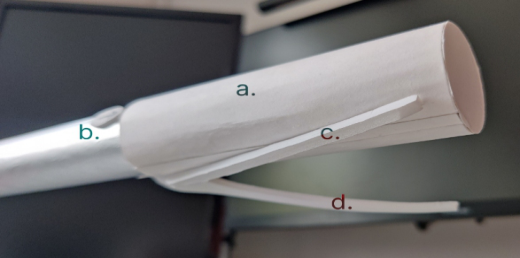
Since there are already various controls on or near the handles, such as braking or switching gears, not just any interaction is available for indi- cating a direction. For instance, squeezing the handlebar requires multiple fingers which may already be positioned on the brake handle to slow down. To find a solution that works together with the existing controls on the bicycle, we made the first physical prototype featuring concepts of inter- action combined with the common existing controls (see Figure 4). The sliding motion is a possibility (‘a’ in Figure 4), as it can be done even when all fingers are used for various controls. It is also different from rotation, which is often used for gear switching. A button to be pressed by the thumb could work (‘b’ in Figure 4), but there may already be various other applications with buttons that could get in the way, like on e-bicycles. A lever to push with the fingers (‘c’ in Figure 4) would not work, since the fingers may often be placed on the brake handle (‘d’ in Figure 4).
Slideo: Bicycle-to-Vehicle Communication to Share Intention to Turn With Automated Vehicles 207
Figure 4: Exploratory prototype with (a) a slidable handle, (b) a thumb button, (c) a lever for the fingers, and (d) a brake handle.
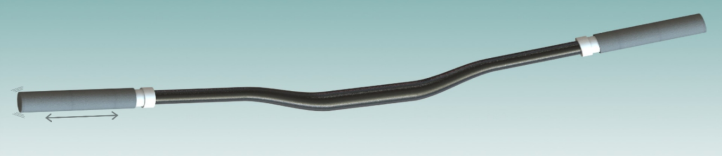
Then, we designed the final concept: handles which can slide outwards (like pulling them off the handlebar) for 1 cm (value chosen through trial- and-error), to indicate the intention to take the next turn in that direction. Sliding the left handle to the left will communicate to nearby AVs that you are planning to turn left, and vice versa. Based on the needs of our personas, each handle has a vibration motor inside of it to offer the user haptic feedback in three steps: (1) confirming that their intention to turn has been registered, (2) indicating that communication with AVs is ongoing, and (3) confirming when the AVs will provide the needed space to turn. The vibration motors can also be used for turn-by-turn navigation, by vibrating the corresponding handle when a turn is approaching. We made a physical prototype with a working mechanism and haptic feedback, by 3D printing the handles shown in Figure 5 and attaching them to an existing handlebar. The vibration motors are controlled by an Arduino Uno microcontroller, with the option to trig- ger the feedback cycle by pushing a button for demonstration purposes. The code, electronics schematics and STL files are provided in the supplementary materials.
Figure 5: Digital render of the final design concept, used for 3D printing a prototype.
USER TEST OF FINAL DESIGN CONCEPT
Method
On 13 June 2023, we performed a user test of the final design concept with nine participants in three comparable locations in Eindhoven and Maastricht, The Netherlands. Table 1 shows two three-step variations of haptic feedback. They are identical, but Variation B gives no feedback during Step 2. The
208 Verstegen and Bazilinskyy
purpose of the user test was to find whether people prefer to be kept aware of any communication happening in the background.
Table 1. Two variations of haptic feedback in the user test.
Table available in the original PDF paper.
Feedback steps Variant A Variant B Same as A 3 vibrations at 70% motor strength for 100 ms, no vibrations for 100 ms in between (1) Confirmation that intention to turn has been registered
Nothing
(2) Indication that communication with AVs is ongoing
Vibrations at motor strength increasing from 5% to 15% for 350 ms and decreasing from 15% to 5% for 350 ms, repeated while providing feedback Same as A
(3) Confirmation that the AVs will provide the needed space
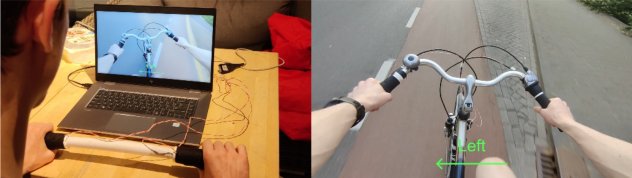
Vibrations at 60% motor strength for 200 ms, no vibrations for 100 ms, vibrations at 100% motor strength for 500 ms The user test setup was as follows: after the arrival of the participant, the author explained the idea of connected AVs, the goal of the study of allow- ing cyclists to participate in this network and introduced the design concept. While holding the prototype with built-in vibration motors, the participant viewed twice a 2 min 30 s long video on a laptop (see Figure 6); once for each variant in randomised order. The first-person video showed a person cycling on typical roads in The Netherlands with the slidable handles always visible. During the video a green arrow and text ‘Left’/‘Right’ (HEX value #4FFF55, see Figure 6) indicated the direction of the turn. Later the corresponding han- dle could be seen being slid out, at the same time the haptic feedback cycle started in the participant’s hands. From 1 min 27 s to 1 min 38 s of the video, there were no turns, and the text ‘Straight’ was shown. After ten turns with the same variant of feedback, the video ended, and the participant was asked to answer six questions regarding their experience on a scale of 1 to 10 in a Microsoft Forms form (see supplementary material):
1. How effective were the vibration patterns in providing feedback? 2. How well did the vibration patterns help you understand the environ- ment? 3. How comfortable did the vibration patterns feel? 4. How easy to understand were the vibration patterns? 5. How natural did the vibration patterns feel? 6. Overall, how satisfied are you with this user feedback?
Figure 6: User test setup with the prototype (left) with a still from the video (right).
Slideo: Bicycle-to-Vehicle Communication to Share Intention to Turn With Automated Vehicles 209
Additionally, the form contained open questions about the meaning of experienced haptic feedback and if they thought they needed additional explanation to understand the meaning. After the participants experienced both variants of feedback, the author concluded a semi-structured interview focusing on their preferences, during which the actual meaning of all vibra- tions was explained. We carried out the user test in multiple but similar locations. The prototype used Arduino to synchronise the provision of feed- back with the video using pre-programmed timing of events. The prototype had to be started manually at the same time as the video by pressing the space bar on the laptop and the switch connected to the Arduino at the same time. Both the Arduino code and the video are available in the supplementary material.
RESULTS
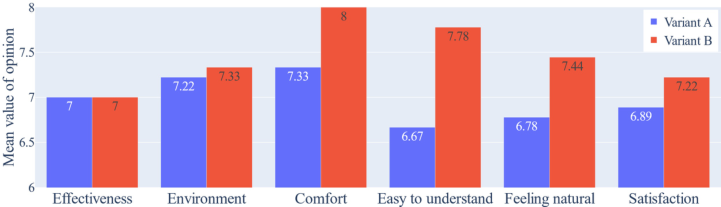
Figure 7 shows the opinions of the participants on their experience with the concept. Six out of nine participants correctly understood the meaning of the vibration patterns after watching the video for the first time, and the remaining three participants also did not understand it correctly after the second time. Four participants correctly noted the meaning of the second step of the feedback.
The opinions about which variant was preferred were mixed. The four participants who correctly understood the meaning of the second step pre- ferred the variant with it (Variant A in Table 1). The participants who did not provide the correct meaning of vibrations in Step 2 in the corresponding ques- tions in the form preferred Variant B. After the explanation of the meaning of all vibrations, all participants kept their opinions about both variants. Partic- ipants who preferred Variant B mentioned they favoured it for its simplicity, it is more minimalistic and therefore easier to comprehend. Participants with a preference for Variant A said that they preferred to know what was going on. Step 2 of Variant A informed them their intention was still being processed, resulting in them feeling more patient when awaiting a confirmation.
Figure 7: Opinion of participants in the user test on the qualities of the variants of feedback.
DISCUSSION
In this study, we explored a new and original way to allow interaction between cyclists and AVs. Assuming future traffic with connected AVs, we
210 Verstegen and Bazilinskyy
developed a design concept that allows cyclists to communicate their inten- tions to turn to nearby AVs. We conducted a questionnaire and polled the opinions of people in an online forum to assess the four initial concepts of interaction, leading to the final design concept of non-distracting interaction through sliding handles on the handlebar, which was assessed in a user study.
The feedback on the four offered concepts received through the question- naire was mostly negative, which may be interpreted as the respondents thinking that all four ideas were bad. However, it may be due to people’s attitude towards AVs in general, combined with the observation that many seemed to believe that the proposed four concepts were meant to improve safety. On the forum, there was a discussion about how AVs should not be allowed on the road if they cannot deal with cyclists properly, with which we fully agree. As the concepts were novel, more explicit descriptions that they are not meant to improve traffic safety, but rather to increase comfort, may have been of benefit. However, the questionnaire results helped argue that hands are generally preferred over feet, hips or knees to perform an interac- tion to communicate the intention to turn. One major reason is that haptic feedback is easiest to sense with hands, but another explanation is that people are simply used to using their hands to interact with devices, other people, and vehicles (Epke et al., 2021). It makes sense for them to think this is the most sensible or only option. The observation of older people being more neg- ative regarding the concepts could be explained by them not having grown up with connected technology like younger generations did. They might be less accepting of new technologies like AVs in general.
Based on the differences in preferences observed during the user test of the final design, we argue that the preferred variant is a matter of personal preference. Some people prefer to have a constant flow of information, so they know something is happening, whereas others do not care as much about what is happening in the background and only want to know the result. While more work can be done to create better haptic feedback in general, in a final product it would make sense to allow users to personalise some aspects of it. For instance, it should be possible to toggle elements of communication on/off or tweak the intensity of the feedback.
We can conclude that a physical on-bicycle interaction could be a good addition to future V2X traffic with connected AVs. It should never be a requirement for safety, merely an addition to the bicycle that can be used by those who wish to do so.
Our concept of the sliding handles is one example to achieve this. There is room for improvement in the sliding handle concept: one may investigate the force required to slide and investigate further what kind of haptic feedback should be provided. It is also worth exploring different interaction concepts, as the sliding handles will not work with various types of handlebars, such as drop handlebars on racing bicycles, or the classic Dutch ‘omafiets’ (i.e., city bicycle). Furthermore, research is required on the compatibility of the proto- cols used for V2X communication with bicycles, and how to keep the cost as well as power consumption low enough for bicycle-mounted technology to be feasible.
Slideo: Bicycle-to-Vehicle Communication to Share Intention to Turn With Automated Vehicles 211
SUPPLEMENTARY MATERIAL Supplementary material containing the questionnaire and anonymous data, persona descriptions, STL files for the prototype, Arduino code, video and user test form is available at https://doi.org/10.4121/4c9e31e5-9b2e-4046-b9ce-42b6ea84a901.
REFERENCES
Ahangar, M. N., Ahmed, Q. Z., Khan, F. A., Hafeez, M. (2021) A Survey of Autonomous Vehicles: Enabling Communication Technologies and Challenges. Sensors 21, 706. https://doi.org/10.3390/s21030706 Bazilinskyy, P., Dodou, D., de Winter, J. (2022) Crowdsourced Assessment of 227
Text-Based eHMIs for a Crossing Scenario. Presented at the International Confer- ence on Applied Human Factors and Ergonomics (AHFE 2022), New York, NY, USA. https://doi.org/10.54941/ahfe1002444 Bazilinskyy, P., Dodou, D., de Winter, J. (2019) Survey on eHMI concepts: The effect of text, color, and perspective. Transportation Research Part F: Traffic Psychology and Behaviour 67, 175–194. https://doi.org/10.1016/j.trf.2019.10.013 Bazilinskyy, P., Heisterkamp, N., Luik, P., Klevering, S., Haddou, A., Zult, M., Dia-
lynas, G., Dodou, D., de Winter, J. (2018) Eye movements while cycling in GTA V. Presented at the Tools and Methods of Competitive Engineering (TMCE 2018), Las Palmas de Gran Canaria, Spain. Berge, S. H., Hagenzieker, M., Farah, H., de Winter, J. (2022) Do cyclists need HMIs in future automated traffic? An interview study. Transportation Research Part F: Traffic Psychology and Behaviour 84, 33–52. https://doi.org/10.1016/j.trf.2021. 11.013 Bonnington, C. (2018) The Cyclist Problem. Slate. https://slate.com/technology
/2018/02/self-driving-cars-struggle-to-detect-cyclists-bicycle-to-vehicle-commu nications-arent-the-answer.html (accessed 27 March 2023). Burns, M. (2017) Tome Software and Trek Bicycle are looking to AI to make biking safer. TechCrunch. https://techcrunch.com/2017/09/07/tome-software-and-tr ek-bicycle-are-looking-to-ai-to-make-biking-safer/ (accessed 21 April 2023). de La Fortelle, A., Qian, X., Diemer, S., Grégoire, J., Moutarde, F., Bonnabel, S.,
Marjovi, A., Martinoli, A., Llatser, I., Festag, A., Sjöberg, K. (2014) Network of automated vehicles: The AutoNet 2030 vision. Presented at the World Congress on Intelligent Transport Systems. Dey, D., Habibovic, A., Löcken, A., Wintersberger, P., Pfleging, B., Riener, A., Martens, M., Terken, J. (2020) Taming the eHMI jungle: A classification taxon- omy to guide, compare, and assess the design principles of automated vehicles’ external human-machine interfaces. Transportation Research Interdisciplinary Perspectives 7, 100174. https://doi.org/10.1016/j.trip.2020.100174 Eisses, S. (2011) Safety and comfort of the Vulnerable Road User, ITS Action Plan. Epke, M. R., Kooijman, L., de Winter, J. C. F. (2021) I See Your Gesture: A VR-Based
Study of Bidirectional Communication between Pedestrians and Automated Vehi- cles. Journal of Advanced Transportation 2021. https://doi.org/10.1155/2021/ 5573560 Fairley, P. (2017) The Self-Driving Car’s Bicycle Problem. IEEE Spectrum. https://sp ectrum.ieee.org/the-selfdriving-cars-bicycle-problem (accessed 27 March 2023). Hou, M., Mahadevan, K., Somanath, S., Sharlin, E., Oehlberg, L. (2020)
Autonomous Vehicle-Cyclist Interaction: Peril and Promise, in: Proceedings of the 2020 CHI Conference on Human Factors in Computing Systems, CHI ‘20. Association for Computing Machinery, New York, NY, USA, pp. 1–12. https: //doi.org/10.1145/3313831.3376884
212 Verstegen and Bazilinskyy
ICCS (2013) Co-operative Systems in Support of Networked Automated Driving by
2030. I-SENSE Group. https://i-sense.iccs.gr/projects/autonet2030/ (accessed 29 March 2023). Knapp, J., Zeratsky, J., Kowitz, B. (2016) Sprint: How to Solve Big Problems and Test New Ideas in Just Five Days. Simon and Schuster. Kuss, P., Nicholas, K. A. (2022) A dozen effective interventions to reduce car use in
European cities: Lessons learned from a meta-analysis and transition management. Case Studies on Transport Policy 10, 1494–1513. https://doi.org/10.1016/j.cstp .2022.02.001 Schlackl, D., Weigl, K., Riener, A. (2020) eHMI visualization on the entire car body: results of a comparative evaluation of concepts for the communication between AVs and manual drivers, in: Proceedings of Mensch Und Computer 2020, MuC’20. Association for Computing Machinery, New York, NY, USA, pp. 79–83. https://doi.org/10.1145/3404983.3410011 SWOV (2023) Fietsers. SWOV. https://swov.nl/nl/factsheet/fietsers Taiebat, M., Brown, A. L., Safford, H. R., Qu, S., Xu, M. (2018) A Review on
Energy, Environmental, and Sustainability Implications of Connected and Auto- mated Vehicles. Environmental Science & Technology 52, 11449–11465. https: //doi.org/10.1021/acs.est.8b00127 Volvo Car USA (2014) Volvo Cars and POC to demonstrate life-saving wearable cycling tech concept at International CES 2015. Volvo Car USA. https://www.me dia.volvocars.com/us/en-us/media/pressreleases/155565/volvo-cars-and-poc-to- demonstrate-life-saving-wearable-cycling-tech-concept-at-international-ces-201 (accessed 01 February 2024). Ye, L., Yamamoto, T. (2019) Evaluating the impact of connected and autonomous
vehicles on traffic safety. Physica A: Statistical Mechanics and its Applications 526, 121009. https://doi.org/10.1016/j.physa.2019.04.245
LISTED IN THE AHFE DIGITAL BOOKSTORE CATALOGUE
Explore the complete digital volume
Advances in Human Factors of Transportation
Read this individual research paper free through the original publisher, or explore the full digital proceedings book.
ISBN 978-1-964867-24-3
Explore this ISBN in the AHFE Bookstore ↗Listed in the July 2026 bookstore catalogue; search by ISBN to confirm current availability · Digital book purchase optional