Miao Liu, Loufei Zhang (2022). Innovative Exploration of A New Air Health Product Based on Analytic Hierarchy Process. In: Ergonomics In Design. AHFE Open Access, vol. 47, pp. 231–240. https://doi.org/10.54941/ahfe1001941
In order to better meet the diversified needs of consumers for air purifiers, a new type of air purifier is explored to meet the current social trends. This paper analyses the development opportunities of air purifiers through SET analysis, and then reconstructs the concept of air purifier through design Matterology, divides 5 design criteria and 16 design elements, and constructs a hierarchical analysis model. The design practice was conducted by calculating the weights of design elements and obtaining design priorities using the ensemble averaging method. Through a combination of the Design Matterology and AHP analysis, a product that emphasis the provision of a quality space environment for the user rather than simply purifying air is explored and a design practice is developed.
Changing conditions of the times have also contributed to a change in peo- ple’s consumer attitudes, which has directly led to transformation in various industries. The concept of the air purifier began in its original form in 1823 with the invention of a smoke protection device by two men, John and Char- les Dean, and has undergone many changes since then. Some of these changes have been caused by technology, such as the invention of high performa- nce HAPE filtration materials during World War II, which directly led to the prototype of industrial air purifiers. Others have been caused by changes in people’s needs, for example, in the 1960s and 1970s, when air pollution was severe and homes were in desperate need of air purification products, the concept of home air purifiers took shape. These changes had pushed air purifiers to one climax after another, especially with the emergence of global epidemic of COVID 19, which directly stimulated the rapid development of germicidal and disinfectant air purifiers. However, as the global situation of epidemic of COVID 19 improved and the demand for disinfectant air puri- fiers became saturated, exploring a new way out became an urgent problem for the air purification industry (Yuguo explored the impact of COVID 19 on the design of indoor environments. Xu Rong and Yuan Jing studied the deve- lopment of vehicle-mounted and indoor filter technologies, Qiao Xin and
Luo Weidong explored the development trend of air purifiers from a macro perspective, and Li Focusing on the current social trends), this paper explo- res a new type of air purifier using Science of Human Affair combined with Analytic Hierarchy Process (AHP).
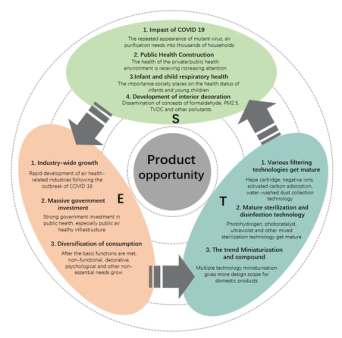
OPPORTUNITY OF CURRENT AIR PURIFIERS SET analysis is an innovative research method based on product opportu- nity gap discovery, which can guide product design through a comprehensive analysis of three factors related to product-related social change, economic trends and advanced technology The SET model for air purifiers based on Analytic Hierarchy Process (AHP) can effectively help analysis the internal and external logic of development of design and identify opportunities for product innovation (see Figure 1).
The SET analysis of the products shows that the air purifier industry in general has a good development trend. Specifically, technological changes, especially the development of sterilization, filtration and sensor identifica- tion technologies, provide firm technical support for the compounding and diversification of air purifier (Shi Fangfang 2020 has done systematic rese- arch on indoor purification technology). The future air purifier is liberated from the limitation of technical conditions, and it is an inevitable trend to develop in the direction of compounding and functional diversification.
DECONSTRUCTING USER’S DEMAND BASED ON OF SCIENCE OF HUMAN AFFAIR After the new direction of air purifier development has been clarified through SET, this paper combines Science of Human Affair to reconstruct and analysis the concept of composite air purifier products and clarify the future concept of air purifier.
Science of Human Affair is a design philosophy proposed by Liu Guanzh- ong, who believes that “things” are external to the existence of “things”, it
Innovative Exploration of a New Air Health Product Based on Analytic Hierarchy Process 233
Table 1. Components of the air purifier “thing” system.
Table available in the original PDF paper.
Elements Element interpretation Time Not just when it is used, including the state before and after use Space The entire interconnected system space, not the space occupied by individual air purifiers Subject The people in the system, the people walking, the people resting, the people working Object All factors that affect the space of the subject, including humidity, temperature, oxygen content, etc. Behaviour The service provided to the subject, the active provision of quality air Information The emotions or messages that can be expressed by the associated system Meaning The purpose and reason for the behaviour, containing emotions and values
not only influences the internal structure, material, technology and form of the “thing”, but also influences the way the “thing”exists and its form. Speci- fically, it emphasizes the importance of getting rid of the past product concept, take the initial “thing” as a starting point, reconstructing the relationship between “thing” and “object”. It is a way of getting the design goal tan- gible through analysis, induction, association, creation and evaluation, and emphasizes the “adaptability” and “selectivity” of design (Liu, Guanzhong 2021). In Science of Human Affair the “thing” system is consisted of time, space, subject, object, behavior, information and meaning (see Table 1). In this paper, the seven components are used to deconstruct and restore the design goals of the ideal air purifier and to indicate the development direction of the new air purifier.
First of all, the subject “human” is the core of the “thing” system of air purifier, so, the biggest test of the whole “thing” system is how to satisfy the needs of “people”. “People” in this context is not isolated, unconnected, it is in some kind of interconnected system, it can be people in motion, “People” in reading or people in rest. The current air purifier does not define clearly the concept of “people”, it is one-sided and isolated. Its emphasis is on the output of air that is harmless to people in all states, ignoring the needs of a diverse and differentiated range of people. At the same time, the “object” of the air purifier system should not be just the air in the space, but the whole space system where the “person”located. The isolation of the “object” often leads to monotony of the “act”. Because the current air purifier product sees the object as air in isolation, the act it performs is only to “purify air”. By treating the whole spatial system in which the subject is located as the object, the “act” will be more diverse, and will not be limited by a specific “purification” method or a specific technique. In this way, the “act” concept can be developed to provide the user with a comfortable and healthy spatial environment, meeting the diverse needs of users.
Secondly, “Meaning” emphasis the purpose and reason for the act, and includes the inclination of emotions and value judgments based on social
234 Liu and Zhang
background at the time. In the air purifier “thing” system, “meaning” is directional. Traditional air purifiers emphasize the ‘meaning’ of providing harmless air to the user. In the past decades, air pollution was a pressing issue, air purifiers had to establish their value based on the fact. Now, the air pollution phenomenon has improved considerably with the implementation of various measures in the world, the face of air pollution has changed. The- refore, designers’ value judgement of air purifiers based on this background also needs to be adjusted. The ‘meaning’ of an air purifier system should now be more than just providing harmless air, it should be linked to more internal and external conditions, such as the current epidemic.
Thirdly, to reconstruct the demand for air purifiers from a “time” perspe- ctive, the objective of air purifiers today is to remove various pollutants from the air to ensure that the air quality is harmless to the user. However, the logic of the current air purifier function is that pollution had present in the air at first and then the air purifier removes them. This purification logic is not only behind in time, but also in logic. The user always has to breathe unhealthy or even harmful air before using the air purifier and then carry out the function of air purification after the air purifier has started to operate. Therefore, when looking at the current air purifier concept from a “time”perspective, the logic of its operation needs to be corrected first, as the user’s needs need to be met in the whole process, including before, during and after use.
The term “information” refers to the emotion or information that can be expressed by the associated system, specifically, it refers to the words, patterns, or colour in which the product conveys a certain information to the user. Air quality, as a non-obvious indicator, is difficult to perceive through the human senses. Therefore, how to convey non-explicit indicators through other media becomes crucial. The appropriate visual and informati- onal medium allows the user to have a more intuitive experience of what the product has to offer, such as the display of words, changes in light colour, etc. All these ways can give user a better experience.
“Space” here includes not only physical space, but also psychological space. In terms of physical space, the air purifier needs to quickly and effectively clean the entire space and maintain a good air environment. Psych- ologically, it is about providing a comfortable and healthy environment for the user. Current air purifiers over-emphasize the function of purification by “subtraction”, to filter, neutralize, and remove harmful elements from the air in physical, mechanical, and even chemical ways. But human “space needs” include not only the harmlessness of breathing air, but also includes suitable temperature, humidity, oxygen content and so on. Therefore, there is only an upper limit to air quality under subtraction, and it does not break this upper limit. Instead, designers should consider doing ‘additions’, such as combining intelligent AI technology, sensing technology, to systematically control the air quality, increasing the oxygen content, reducing the carbon dioxide content, maintaining the suitable level of humidity, to maintain a most comfortable space environment for users. It can also change the appearance of the air purifier and combine it with interior landscaping, transforming the concept of the product from a product that takes up space to one that beautifies the space. It can also be of great benefit to user’s emotional experience.
Innovative Exploration of a New Air Health Product Based on Analytic Hierarchy Process 235
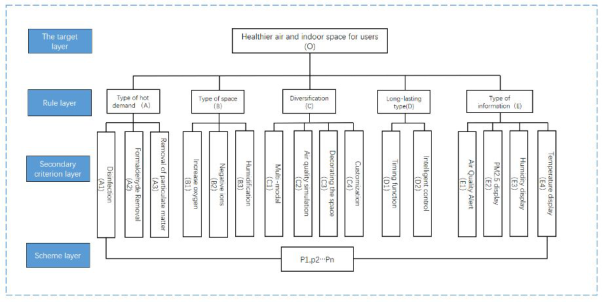
Figure 2: Analytic hierarchy process model.
Overall, the design of air purifier should meet the following five criteria based on Science of Human Affair : (1) Diversity: the relevance of the object of service, people in different states, people at work, people at rest, people in motion, associated with the entire air purifier system; (2) Hot demand : in line with the current era of background values and judgments, catering to the hot issues that air purifiers need to address; (3) Long-lasting: the consistency of the service provided to the user, including before, during and after use; (4) Spatial environment : the creation of a comfortable physical and psychologi- cal space, such as controlling the oxygen content, humidity and temperature in the space, etc.; (5) Information conveyance: Convey the intention of the design through various means such as screen display, transforming invisible air quality into tangible patterns.
ANALYSIS OF DESIGN ELEMENT WEIGHTS Analytic Hierarchy Process (AHP) is a method to simplify complex problems. As a multi-criteria method which can help decide design direction, It can simplify complex decisions by establishing hierarchical analysis model, and can be used to calculate the weight of decision attribute indexes, which can greatly reduce the workload of investigation (ZHANG Bing-jiang 2014).
The Analytic Hierarchy Process model is constructed based on the demand criteria of the air purifier reconstructed by Science of Human Affair spe- cifically: (A):A1 Disinfection, A2 formaldehyde removal, A3 Removal of particulate matter; (B):B1 Increase oxygen, B2 Negative ions, B3 Humidi- fication; (C):C1Multi-modal C2 Air quality simulation, C3 Decorative the space; (D): D1 timing function, D2 intelligent control; (E):E1 Air quality alert, E2 PM2.5 display, E3 Humidity display, E4 Temperature digital display (see Figure 2).
[Equation or mathematical symbol available in the original paper PDF]
[Equation or mathematical symbol available in the original paper PDF] a11 a12 . . . a1n a21 a22 . . . a2n
Equations and mathematical formulas are available in the original paper PDF.
... ... ... ... an1 an2 . . . ann
236 Liu and Zhang
As shown in the judgment matrix A, Aij represents the comparison of indi- cator i and indicator j, and aijj>0, aii = 1, aij = 1/aji. Then the geometric average algorithm is introduced to calculate the weight of each index in cri- terion layer and sub-criterion layer, and the specific steps are shown below: (1) Calculate the product of the scale of each layer as shown below, where bij represents the indicator in the i-th row and j-th column, and M is the amount of indicator.
The geometric mean of the product of the tiers is judged and the relative weights are calculated, with the formula shown below.
Calculate the maximum characteristic root with the following formula, where BWi represents the i-th component of BW and n is the order.
BWi
n X
(4) Conduct consistency test, the formula is as follows, CR is the consiste- ncy ratio, when CR ≤0.1, it means that the consistency test is passed, and there is no logical error in the judgment matrix. When CR>0.1, it means that the consistency test is not passed and there is a problem with the judgment matrix, which needs to be checked and adjusted for calculation again.
n −1
This paper invited 12 experts in the air purifier industry, 6 designers with a background in air purifier design and 6 marketing managers respectively, to assign values to different indicators and ask them to score each criterion level according to a scale of 1 to 9 (SAATY T L 1988).
[Equation or mathematical symbol available in the original paper PDF]
[Equation or mathematical symbol available in the original paper PDF]
Equations and mathematical formulas are available in the original paper PDF.
According to the above calculation method, the indicator weights of each level can be obtained: the weights of the criterion level (A,B,C,D,E) corre- sponding to The target layer (O) are 0.2314, 0.2702, 0.0709, 0.0633, 0.3642; “Hot demand” (A1,A2.A3) are 0.1337, 0.0522, 0.0454 respectively; “Spa- tial environment” (B) corresponding to the criteria (B1,B2,B3) are 0.0681, 0.1453, 0.0568 respectively; “Diversification” (C) corresponding to the cri- teria (C1,C2,C3,C4) are 0.0064, 0.0178, 0.0420, 0.0048 respectively; the criteria (D1,D2) corresponding to “long-lasting” demand (D) are 0.0119, 0.0514 respectively; “Conveying information” (E) corresponding to the cri- teria (E1, E2, E3, E4) are 0.2012, 0.0763, 0.0637, 0.0231, respectively. To ensure the feasibility of the data, all data were tested for consistency and the results were less than 0.1, indicating that the consistency test results passed, as shown in Table 2.
INNOVATIVE AIR PURIFIER SOLUTION Acquisition of Design Focus
According to the calculation results of the above AHP analysis of the weight of design element, it can be seen that E “Conveying information” >B “Spatial environment”>A “Hot demand”>D “Long-lasting”>C “Diversification”. In the design of the air purifier, the three criteria of “Conveying information”, “Spatial environment” and “Hot demand” demand should be fully satisfied, and the last two criteria should be respectively selected to meet the optimal one or two sub-criteria. the focus is on information communication. Speci- ally, clearly transforming the non-explicit state of the air environment into information that users can identify, so that users can feel the service brought by the product; in the space effect, emphasis is placed on improving the In terms of Spatial environment, attention should be paid to the need to improve
238 Liu and Zhang
Table 3. An air health machine for home use.
Table available in the original PDF paper.
Perspective 1 Perspective 2 Operator interface
Table 4. A public air purifier for public.
Table available in the original PDF paper.
Perspective 1 Perspective 2 Operator interface
the spatial environment including humidity, temperature, oxygen content and so on; In terms of Hot demand, take full account of the increased demand for sterilization hot spots brought about by the epidemic. Besides, we should also take into account the needs of long-acting and diversification in design.
Design Practice These needs are elected to be considered are: E1 “Air quality alert”, E2 “PM2.5 digital display”, E3 “humidity display”, E4 “temperature digital display”, B1 “Increase oxygen”, B2 “Negative ions”, B3 “Humidification”, A1 “sterilisation”, A2 “formaldehyde removal”, A3 “Removal of particu- late matter”, C2 “Air quality simulation”, C3 “Decorating the space”, D2 “Intelligent control”.
Project 1: An air health machine for home use(see Table 3). The project 1 focuses on satisfying E1, E2, E3, B1, B2, B3, A1, A2, A3, C2. Limited to meet the C3, D2. Different from the traditional air purifier which emphasize “purification”, it is designed with the concept of “produ- cing” healthy air. It provides healthy air by simulating the air content of the five regions which has the best air quality in the world, including dry humidity, oxygen content, temperature and particulate content, etc. Combi- ned with the H13 laminated cloth cartridge and photocatalyst technology, it can effectively remove bacteria and viruses, formaldehyde, TVOC and other pollutants to produce healthy air for users. At the same time, the screen intui- tively displays the composition and proportion of air, allowing users to clearly learn the house air quality and the service status of the machine.
Project 2: A public air purifier for public(see Table 4). The project 2 focuses on satisfying: E1, E2, E3, E4, B1, B3, A1, A2, A3, C2, C3.
The scheme addresses the need of “space” in the above design context, which emphasizes the provision of a good spatial environment for the user,
Innovative Exploration of a New Air Health Product Based on Analytic Hierarchy Process 239
including a visual spatial environment. By combining the concept of an air purifier with the concept of three-dimensional planting, the design meets the diverse needs of the users of the public space.
CONCLUSION
With the normalization of the Epidemic COVID 19, the whole society atta- ches great importance to air health, as a result, air purifiers are developing rapidly and the demand for air purifiers is becoming more and more diversi- fied. This paper reconceptualizes the concept of air purifiers through Science of Human Affair and combines it with SET Analysis to propose a new perspe- ctive that users’ needs for air health should not be limited to the purification of air, but rather emphasis the ability of the device to provide a systematic healthy environment for the user.
Combined with the Analytic Hierarchy Process, the study also found that the demand for hotspots has also changed, with “Increase oxygen”, “Nega- tive ions” and “Sterilization and disinfection” gaining more importance, while the traditional concepts of “PM2.5”, “temperature” and “humidity” have become less important. The reasons behind this phenomenon require further research. The importance ranking of needs based on AHP can help designers to better understand the current trends of air cleaner. This paper also incorporates the importance ranking to design two new air purifiers that can hopefully be of some value to readers. This study is limited by the sample size, the professional background and emotional inclination of the research subjects, the test evaluation results may have some deviation. Subse- quent research will further expand the sample size and scope to improve the preciseness of the experiment.
REFERENCES
Cao E G, Zhang X. (2014) Research on the design of home aging interactive product system based on SET analysis method. Mechanical design, 31(12): 120–122. Li Yu-guo, Cheng Pan, Qian Hua. (2021,) Dominant Transmission Route of SARS-
CoV-2 and Its Implication to Indoor Environment. Chinese Science Bulletin, 66(4– 5). Liu, Guanzhong, Li and Sen. (2021) Design deontology: abstraction and concretization of goals . Packaging Engineering, 42(12):4–6. Peng J. (2013)The application of electrostatic dust removal technology in the puri-
fication transformation of central air conditioning systems . Building Energy Efficiency, 41(4) : 15. Qiao Xin, Luo Weidong. (2015) Development trend of indoor air purifier. Shanxi Architecture, 41(24): 177–178. Saaty T L. (1988) What is the analytic hierarchy process Mathematical Models for
Decision Support. Berlin: Springer, pp. 109–121. Shi F F, Qiu L M. (2014) A review of indoor air purification technologies and products . Journal of Refrigeration, 35(05):14–17. Tang Kui-yu, Liang Hong-jiao. (2021) Lifestyle Choices in the Post-epidemic Era.
Edition), 23(1): 50–57.
240 Liu and Zhang
Xu R, Yuan J. (2020) Current status and trends in the development of filters for indoor and vehicle air purifiers. Chemical Progress, 39(5): 1975–1976. Zhang Bing-jiang. (2014)Analytic Hierarchy Process and Its Application Cases].Beijing:Publishing House of Electronics Industry Zhao Y, Liu Kuanzhong. (2019) The application of matter science in the design of product service system model. Packaging Engineering, 40(2): 122–127.
LISTED IN THE AHFE DIGITAL BOOKSTORE CATALOGUE
Explore the complete digital volume
Ergonomics In Design
Read this individual research paper free through the original publisher, or explore the full digital proceedings book.
ISBN 978-1-958651-23-0
Explore this ISBN in the AHFE Bookstore ↗Listed in the July 2026 bookstore catalogue; search by ISBN to confirm current availability · Digital book purchase optional