Yao Fang, Zhaolin Lu, Yang Xu, Mengying Gao, Tongtong Zhao (2022). Under the Era of Light Health Preservation--- The Influence of College Students' Study Pressure on Their Choice of Regimen. In: Ergonomics In Design. AHFE Open Access, vol. 47, pp. 85–91. https://doi.org/10.54941/ahfe1001923
To study the influence of college students' learning pressure on their health-preserving style choices, we conducted two-stage research. The first stage (research analysis): We took college students as the research object, distributed questionnaires, and collected samples. Taking the survey data of 120 valid questionnaires as research samples, and analyzing the results with statistical software, it empirically tests the relationship between college students' learning pressure and their choice of health care methods. The results showed that: 1) Academic stress had a significant positive effect on college students' drug hard-core health regimen, showing a strong correlation. The greater the learning pressure, the more students choose the drug regimen; 2) In the academic stress, the heavy scientific research task has the most significant positive impact on the college students' drug hardcore regimen, followed by the unsuitable teaching methods of teachers, and finally the time spent in the competition. The second stage (Design and Evaluation): We designed a persuasive mobile application, named Doit, aimed at the user group of college students to help them balance academic stress and physical health. The SUS usability scale is distributed utilizing an online questionnaire. The final evaluation results show that more than half of users are satisfied with the design of the application interface and believe that Doit is easy to use and easy to learn and can provide a good user experience.
With the development of the social economy, the concept of health preserva- tion has gradually entered the daily life of college students, and the increasing academic pressure has put forward new requirements and challenges for col- lege students’ physical and mental health. With the outbreak, student stress has been exacerbated by frequent and prolonged lockdowns and related aca- demic disruptions. For students, the heavy academic load and expectations of good academic performance can cause them to experience the pain of academic stress (Noronha, L., 2016, pp. 320–327; Reddy, J.K et al. 2017, pp. 39–52). As Misra, Crist, and Burant (2003) stated, academic-related
stress is a major and minor stressor for many international students, and test anxiety is one of the dominant factors of academic stress. A 2020 online survey by the National Medical Research Center for Child Health of the Ministry of Health of the Russian Federation shows that one-third of students report panic and apathy before the start of the new school year (Fomina, S.N. et al. 2021); Indian study shows: Dentistry, medicine, and engineering stu- dents suffer from Among the effects of stress, academic factors account for the most weight (Waghachavare, V.B. et al. 2013, p. 429); a study of students in a major university in Israel shows that college students are most stressed by course load and academic evaluation, and are least affected by personal, social and family factors (Zeidner, M., 1992, pp. 25–40).
A survey of college students’ health-preserving methods shows that college students’ understanding of health-preserving methods tends to be consistent, and the order of choice is diet, mental health, exercise, and traditional Chi- nese medicine (Yin, X.W., and Qiu, D.M., 2004). However, in 2018, “punk health care” attracted people’s attention. “Punk health care” is a contradi- ctory behavior of the youth community due to anxiety, hesitation, tension, depression, despair, and other emotions (Hu, L.Y.et al. 2019), Contemporary college students urgently need a support system to relieve academic stress and maintain a healthy life, and most students tend to avoid seeking trea- tment from others and healthcare providers for stress, and prefer tele mental health (TMH) more private information resources rather than formal resou- rces, such as online therapy and interactive software (Rickwood, D.J. et al. 2015; Palmer, K.M., 2015; Rickwood, D.J. et al. 2015; Palmer, K.M., 2015). In this study, we designed a college student’s academic and health mana- gement application called Doit which is used to improve the life status of college students and maintain their health. To achieve our goal, we adopt a user-centered design approach for application design and evaluation, which is divided into the following 2 stages.1)We carried out user research among 120 Chinese college students, through questionnaires to understand the degree of their learning pressure and their corresponding health preservation meth- ods, and conducted data analysis through quantitative research methods, to find out the degree of academic pressure of college students and their choice of health preservation methods. relationship between methods. 2) A high-fidelity prototype (HFP) was designed according to the data analysis conclusions of the questionnaire. We conducted usability testing to evaluate the reasonableness of each feature in the design. The SUS scale was used to measure the usability of platform interaction design in relieving college stu- dents’ learning pressure and guiding them to make healthy lifestyle choices. Our research results show that the average SUS score is 72.62, which proves that most users believe that our product usability is above the standard line, verifying its feasibility.
RELATED RESEARCH At present, there are few studies on the impact of college students’ study pressure on self-cultivation behavior. Most of the changes in young people’s
Under the Era of Light Health Preservation — The Influence of College Students’ 87
unhealthy habits are supported by persuasion theory. Oyibo K (2016) pro- posed a design science research (DSR) method, aiming to design persuasive technology to Promote physical activity in college students to address seden- tary behaviors due to technological advances7. In addition, another study by Oyibo K and Vassileva, J. (2021) shows that well-designed UI are more per- suasive than poorly designed UI, and designers should prioritize utilitarian interests (perceived usefulness) and hedonic interests (perceived aesthetics), while Not Perceived Usability and Perceived Credibility. The research analy- zed the potential of the IKEA effect in the application of mobile health persuasion through experiments, and provided a new perspective through research, and should pay attention to self-assembly and its application in the field of mobile health persuasion technology (Wang, Y., Pfeil, U. and Reiterer, H. 2016). L.M. van der Lubbe et al. (2021) experimentally found that participants rated tablet computers positively to increase dietary protein intake in older adults, so a diet tracking app designed for older adults is a viable and appreciated tool, that can be used in dietary intervention studies in older adults.
Based on these works, we believe that it is reasonable to apply persuasion design to health promotion applications. The main direction is to reduce the difficulty of behavior to improve the behavioral ability of college students. In addition, designing more effective trigger factors can improve the behavioral motivation of college students. The focus of the healthy behavior-oriented design for college students is to make interesting persuasion at different time points in the learning process of college students through the design of the application, so that college students can subtly change their negative beha- viors, to develop healthier living habits and efficiency. Higher study habits: monitoring the behavior rhythm of college students’ daily life, can timely remind college students to exercise properly and maintain their health.
METHOD
Study 1: Questionnaire Survey We divide the variables in the question of “the influence of study pressure on college students’ health care” into three types: independent variable, con- trol variable, and dependent variable. Among them, the independent variable is the student’s academic pressure factor, the dependent variable is the stu- dent’s health care method, and the control variable is the student’s situation factor. The independent variable is further subdivided into four dimensions: the frequency of classes every day, the length of daily self-study, the degree of learning pressure, and the main reasons for learning pressure; the dependent variable is divided into two dimensions: the main reason for health preserva- tion and the selected health preservation method. Then, the operation and problem design are carried out separately for each dimension.
The questionnaire was tested for ex-ante validity, all the items were dis- rupted, and others were asked to judge each item based on four categories: personal information statistics, the degree of learning pressure, the explora- tion of health-preserving behaviors, the impact of living habits, and personal stress on health-preserving behaviors Which category does it belong to.
Table 1. Correlation analysis.
Table available in the original PDF paper.
Drug hard-core health care (health tea, health drugs, such as vitamins, nutrients, etc.)
Scientific health preservation (work and rest rules, healthy diet, active exercise, etc.)
Punk health (while consuming one’s own health, taking remedial measures, such as: staying up late to apply a mask, etc.)
0.203* 0.232* −0.027
Time spent in competition 0.200* 0.108 0.087 Time spent by students in work (such as class cadres, assistant managers, etc.)
0.211* 0.222* 0.093
Teachers’ teaching methods are not suitable 0.075 0.252** 0.075 Heavy research tasks
* p<0.05 ** p<0.01
Finally, a total of 10 questionnaires were recovered, of which 10 were valid questionnaires. All questions were classified correctly with a rate of over 80%, thus obtaining our final questionnaire. This research uses the methods of intentional sampling and snowball sam- pling, aiming at the target group of college students. The main way is to distribute online questionnaires in the circle of friends and college students and spread them among college students. In the end, a total of 136 que- stionnaires were recovered. Eliminate 16 invalid questionnaires, such as non-full-time undergraduates, incomplete questionnaire answers, and five or more consecutive identical answers (scores), and 120 valid questionnaires were obtained.
SPSS was used to analyze the reliability of the 30 five-scale items in the questionnaire, and the overall Cronbach’s alpha coefficient was 0.781, which was greater than the acceptable standard of 0.7. The KMO value was 0.636, which was greater than the standard of 0.6, and the Bartlett value was at a significance level of Sig of 0.000, indicating that the research data was of high quality and could be used for further analysis.
In this study, Pearson’s correlation coefficient test was used to describe the correlation between 14 independent variables and dependent variables (see Table 1). The study found that the competition time was significantly positively correlated with the choice of punk health regimen and drug har- dcore program; the stress caused by students’ working hours was significantly positively correlated with the choice of punk regimen. In this project, the pres- sure brought by teachers’ inappropriate teaching methods was significantly
Under the Era of Light Health Preservation — The Influence of College Students’ 89
positively correlated with the choice of punk health regimen and the choice of drug hardcore regimen; the pressure brought by heavy scientific research tasks was associated with the choice of drug hardcore regimen a significant positive correlation.
There was no significant correlation between the independent variables of class time and learning pressure and the three dependent variables, so there was no correlation between the daily class time and learning pressure and the choice of health care methods.
To sum up, for the item of punk health regimen, the incompatibility of teachers’ teaching methods in the independent variable has the strongest cor- relation with it, followed by the time spent by students in work; for the item of drug hardcore health regimen, the independent variable is scientific rese- arch. Task weight has the strongest correlation with it, followed by the time spent in competition, and the third is the incompatibility of the teacher’s tea- ching method; for the item of scientific health preservation, no item in the independent variable is correlated with it.
Taking 14 items as independent variables, the punk health care method, the scientific health care method, and the drug hardcore health care method was respectively used as dependent variables for multiple linear regression analysis to obtain the analysis results: punk health care method and scientific health care method The sig. value of no item is less than 0.05, indicating that the independent variable has no significant positive impact on the choice of punk health care and scientific health care. The results of the multiple linear regression analysis of the drug hard-core self-cultivation method show that the sig. value of the teacher’s teaching method is not suitable, and the scientific research task is heavy is less than 0.05, indicating that these two independent variable items have an impact on the drug hard-core health care method. The selection had a significant positive effect.
Our research conclusions are as follows: 1) Academic pressure has a signi- ficant positive impact on the choice of the drug regimen for college students. The greater the learning pressure, the more people choose drug regimens. 2) In the academic pressure, the heavy scientific research task has the most significant positive impact on the drug hardcore health preservation of col- lege students, followed by the unsuitable teaching methods of teachers, and finally the time spent in the competition. 3) There is no relationship between the degree of academic pressure and the choice of scientific health and punk health for college students, and there is no correlation.
Study 2: Model Building and Prototype Evaluation Based on the above conclusions, we decided to design an APP to guide college students to reduce the unhealthy method of taking medicines due to academic pressure. Assuming that the scientific research task is not changed, from the perspective of design, it will help students to better Complete scientific rese- arch tasks to reduce their mental or physical burden has become the focus of our design.
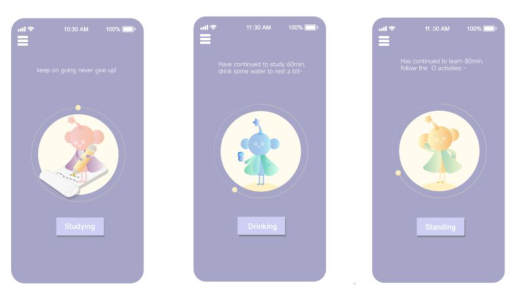
We designed Doit, a mobile application platform that assists college stu- dents’ healthy life, and used Adobe Illustrator 2021 to make a prototype, as
shown in Figure 1. The design proposition is to help college students manage their study time and at the same time add the supervision of self-cultivation behavior. In terms of learning, we have designed a time axis to facilitate users to record their study time. At the same time, a motivational pop-up window has been set up to help users learn more by pushing some inspiring sentences. Good concentration on study. In terms of self-cultivation, we have set remin- ders to drink water and sit and stand for long periods, interspersed in the learning process. It is presented in the image of Mr. O, and the body of Mr. O changes color to remind users to switch between different behaviors. While adding fun to the learning process, self-cultivation behavior occurs naturally, and the interaction process is relaxed and pleasant.
We evaluated the rationality of the platform interaction design through the SUS usability test scale. After removing 2 consecutive 5-item questionnai- res with the same answer, we finally obtained 43 valid questionnaires from college students for data analysis. The result is the SUS scale average score: 72.62, including ease of learning: 77.91, usability: 71.29. It means that more than half of the college students believe that the overall ease of use of our products is above the pass line and meets the needs of users.
CONCLUSION
We designed a persuasive mobile application called Doit, aimed at college stu- dents to help them balance academic stress and physical health. We adopted a user-centered design method. First, we distributed questionnaires to target users through quantitative research methods to study the impact of college students’ academic pressure on the choice of self-cultivation methods. Based on the data analysis conclusions, we designed and evaluated a high-fidelity prototype. Our evaluation results show that more than half of users are sati- sfied with the design of the application interface and believe that Doit is easy to use and learn, can provide a good user experience.
ACKNOWLEDGMENT
The smooth progress of this research is due to the support and help of my supervisor, Professor Zhaolin Lu, and thanks to the target users who helped us conduct user research.
Under the Era of Light Health Preservation — The Influence of College Students’ 91
REFERENCES
Arria, A.M., Winick, E.R., Garnier-Dykstra, L.M., Vincent, K.B., Caldeira, K.M., Wilcox, H.C. and O’Grady, K.E., 2011. Help-seeking and mental health service utilization among college students with a history of suicide ideation. Psychiatric Services, 62(12), pp. 1510–1513. Fomina, S.N., Besschetnova, O.V. and Chuvilina, O.V., 2021, June. The Impact
of Self-Isolation on the Mental Health of University Students in the Covid-19 Pandemic. In 2021 IEEE International Conference on Educational Technology (ICET) (pp. 306–311). IEEE. Hu, L.Y., Liu, Y.N., and Wu, C.M., 2019. Contradiction, Differentiation, Rebellion: An Analysis on the Youth Subculture Phenomenon of “Punk Healthcare”. Con- temporary Youth Research, (1), pp. 75–79. Misra, R., Crist, M. and Burant, C.J., 2003. Relationships among life stress, social
support, academic stressors, and reactions to stressors of international students in the United States. International Journal of Stress Management, 10(2), p. 137. Moses, T., 2010. Being treated differently: Stigma experiences with family, peers, and school staff among adolescents with mental health disorders. Social science & medicine, 70(7), pp. 985–993. Noronha, L., 2016. The implication of academic stress in adolescents. International
Journal of Scientific Research and Modern Education (IJSRME), Volume1 (1), ISSN, pp. 2455–5630. Oyibo, K., 2016, July. Designing culture-based persuasive technology to promote physical activity among university students. In Proceedings of the 2016 Conference on User Modeling Adaptation and Personalization (pp. 321–324). Oyibo, K. and Vassileva, J., 2021. Relationship between Perceived UX Design Attri-
butes and Persuasive Features: A Case Study of Fitness App. Information, 12(9), p. 365. Palmer, K.M., 2015. Undergraduate College Students’ Attitudes About Internetbased Mental Health Interventions. The University of South Florida. Rickwood, D.J., Mazzer, K.R. and Telford, N.R., 2015. Social influences on seeking
help from mental health services, in-person and online, during adolescence and young adulthood. BMC psychiatry, 15(1), pp. 1–9. Reddy, J.K., Menon, K., and Thattil, A., 2017. Understanding academic stress among adolescents. Artha Journal of Social Sciences, 16(1), pp. 39–52. van der Lubbe, L., Klein, M., Visser, M., Wijnhoven, H. and Reinders, I., 2021,
June. Experiences with using persuasive technology in a diet trial for older adults. In The 14th PErvasive Technologies Related to Assistive Environments Conference (pp. 244–251). Wang, Y., Pfeil, U. and Reiterer, H., 2016, October. Supporting self-assembly: The IKEA effect on mobile health persuasive technology. In Proceedings of the 2016 ACM Workshop on Multimedia for Personal Health and Health Care (pp. 19–22). Waghachavare, V.B., Dhumale, G.B., Kadam, Y.R. and Gore, A.D., 2013. A study of
stress among students of professional colleges from an urban area in India. Sultan Qaboos University Medical Journal, 13(3), p. 429. Yin, X.W., and Qiu, D.M., 2004. Choice of Health Information among College Students. Chinese Journal of Health Education, 20(12), pp. 1105–1106. Zeidner, M., 1992. Sources of academic stress: The case of first-year Jewish and Arab
college students in Israel. Higher Education, 24(1), pp. 25–40.
LISTED IN THE AHFE DIGITAL BOOKSTORE CATALOGUE
Explore the complete digital volume
Ergonomics In Design
Read this individual research paper free through the original publisher, or explore the full digital proceedings book.
ISBN 978-1-958651-23-0
Explore this ISBN in the AHFE Bookstore ↗Listed in the July 2026 bookstore catalogue; search by ISBN to confirm current availability · Digital book purchase optional