Ruoxin Yuan, Jintao Kang, Rui Liu, Zhang Heng, Chunxiao Li, Xiaojie Xie, Zhaolin Lu (2022). Emoticon Input Method Design Based on Theory of Use and Gratification. In: Ergonomics In Design. AHFE Open Access, vol. 47, pp. 465–471. https://doi.org/10.54941/ahfe1001971
A set of input method prototype for emoticons inputting and modifying is designed to improve user experience of emoticons cross platform. Based on use and gratification theory, core requirements and pain points for emoticons usage were summarized. The core needs of using emoticons include communication efficiency, emotional expression, personality interest and identity recognition. The outstanding problems of emoticon usage are expressing ambiguity, misunderstanding and invalid information, also the closeness and exclusivity of circle culture. According to the found key points, a questionnaire mainly composed of Likert Scale was designed to validify the proposed needs through collecting data of college students’ behavior habits and preferences. To explore the influence of various factors and diversities of different groups on experience when using emoticons, the statistics analysis was then carried out by IBM SPSS Statistics, which included descriptive statistics and regression analysis. 7 interviews were carried out based on results of questionnaire statistics analysis to excavate root causes. The results show that (a) a seek sense of integration exits when using emoticons on social media, which means usage tend to vary from usage sceneries and recipients to perform properly and fit into various groups. (b) personalized expression meets the need of self-identity and entertainment but also suffer the risk of misunderstanding and confusion. (c) cross platform emoticon use and emoticon edit are two main factors that damage convenience of emoticon use.Based on the above conclusions, a way of editing and using expression package was designed to improve the user experience and avoid the problems of complex process of emoticon choosing and editing and vague expression of emoticons. The emoticon input method can effectively solve the cumbersome problem of cross platform expression package collection and sending process combined with the functions of expression package editing and crowd classification which further optimizes the use process and improves the use experience.
Emoticons Development and Current Status Since 1982, when Scott Fahlman,a professor at Carnegie Mellon University first used the human character smile “:-) “, online emotional symbols have gone through the era 1.0 of Kaomoji, the era 2.0 of emojis and the era 3.0 of series Emoticons. Today, emoticons have been entering the multi-dimensional
era 4.0 of co-creation and sharing with continuous enrichment of content, types and forms.
Because of their full emotional expression, rich contents and efficient usage, emoticons have played a more and more indispensable role in people’s daily online communication and had significance influence on people’s online social life and culture industry development. However, the current emoticons are also facing problems of platform barriers, complicated editing processes and insufficient personalized experience. At the same time, emoticons face the risk of spreading negative culture and alienating disparate social groups.
Use and Gratification Theory (U&G) First put forward by Elihu Katz, U&G examines physical and psycholo- gical utility of mass communication to human beings by analyzing what motive audiences to use mass media and how mass media satisfies their needs. (Blumler, J. G. and Katz, E., 1974) Other than traditional understanding which puts audiences into a passive position in mass communication process, the use and gratification theory points out audience’s active and determinant actors and emphasizes the great effect of their needs and wishes. U&G is lar- gely intended to identify the psychological needs that motivate the use of a particular medium to gratify those needs (Ko. et al, 2005).
Studies concerning U&G reflected a desire to understand audience invo- lvement in mass communications in terms more faithful to the individual user’s own experience and perspective than the effects tradition could attain. Different from the traditional way of simultaneous interpreting the audience, U&G emphasizes the initiative of the audience and highlights the status of the audience. It suggests that the effect of mass media on people is influenced by human concerning factors (J.G. Blumler, 1979).
U&G researchers summarized five major needs of media using: (a) cogni- tive needs, (b) emotional needs, gaining emotional, (c) personal integration needs, (d) social integration needs, (e) stress relieve needs (Katz, E., Haas, H., & Gurevitch, M. ,1973) Katz also summarized the audience’s media contact as a causal chain process, that is, “social factors + psychological factors - media expectations - media contact - demand satisfaction” and put forward the basic model of the “use and satisfaction” process. In 1977, Japanese sch- olars enriched the model of the “use and satisfaction” process based on the Katz model. In 1996, scholars, Newhagen and Rafaeli discovered and sum- marized three main motivations for users to use the internet: communication, interaction and access to information.
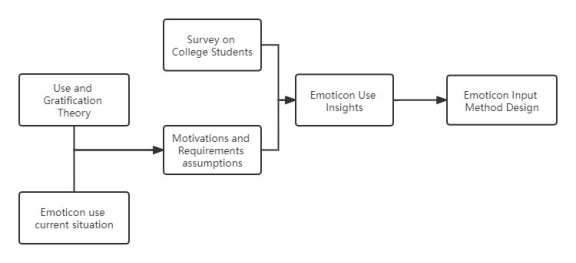
Use and gratification theory inspires a way to solve existing problems and promote user experience of emoticons from the perspective of audience, and this paper explores that solution through model establishment, user research and design practice. (see Figure 1).
USE AND GRATIFICATION IN EMOTICON USE EXPERIENCE Today, with the prevalence of mass media, the status and participation of audiences in communication process have been significantly improved. Emo- ticons highly reflect the subject consciousness of the audience in the Internet
Emoticon Input Method Design Based on Theory of Use and Gratification 467
Figure 1: Research framework.
environment. Introducing the use and gratification theory into the social rese- arch of emoticons can help analyze the needs of users at different levels in use of emoticons, and at the same time serve as a reference for user research.
Emoticon use gratifies audience’s multidimensional needs including infor- mation exchange, emotional feeling expression, affection interaction and entertainment which promote communication efficiency, emotional exch- ange, personalized expression and identity cognition.
The birth of the series of emoticons makes it easier to obtain emoticons for common scenes, and using emoticons to communicate has become a convenient and efficient way of expression. Replacing common phrases such as “okay”, “thank you” and “ha-ha” with emoticons not only makes the expression more vivid and intuitive, but also improves the efficiency of conve- ying and receiving information. In addition to expressing simple information, emoticons also have the unique ability to convey complex information.
The static emoticon package combines the form of graphics and text, and the dynamic emoticon package introduces rich dynamic effects on this basis. Compared with textual information, these rich and diverse informa- tion have significant and unique advantages in emotional expression. Some emojis simulate real-world emotional expressions by directly presenting pho- tos or illustrations of human faces and animal expressions, and have a strong sense of substitution in the process of communication. Other emojis express specific emotions (also known as “playing memes”) by restoring scenes or extracting key symbols and using existing jokes or hot topics. Such commu- nication can become a phenomenon-level symbol on social media. Express a group emotion.
The selection, use and creation of emoticons are not only determined by the information itself, but also often reflect the audience’s personality, aesthetics and interest. Due to individual differences in aesthetics and tastes, even if similar content is expressed, people will have different visual effe- cts, language styles and emojis of themes. Taking visual style as an example, “two-dimensional” people like to use anime-style emoticons, many elderly people tend to use colorful and realistic illustrations, and pet lovers often use cat and dog photos and animated emoticons.
The popularity of emoticons in mass communication and their unique collection, creation, and use processes make their dissemination largely
Table 1. Outlines of questionnaire and interview.
Table available in the original PDF paper.
Methods Categories Questions
Questionnaire
Basic information Gender, Age, Education Emoticon usage Types of emoticons used Access to emoticons Usage scenario of emoticons Recipients of emoticons Emoticon use experience
Convenient and quick answer Emotional and expressive Ease embarrassed atmosphere Hard to understand meaning of some emoti- cons Being overwhelmed by too much emoticons Seem to be insincere when using emoticons Interview Root cause excavation
Core motivations Pain points Ungratified needs
dependent on the online social process. The use of emoticons in WeChat (qq) group chats, Weibo topics, Baidu post bar and other media is based on spe- cific groups. People’s emoji-related behaviors in a group environment reflect the group’s communication habits, content tendencies, emotional states, and circle culture.
USER RESEACH AND DATA ANALYSIS To learn about quantitative results about emoticon use of Chinese college stu- dents, questionnaire research was conducted and proceeded by data analysis on IBM SPSS Statistics. After organizing the survey results and insights, inte- rview outline was listed out (see Table. 1) which aims to excavate the root cause about emoticon use and gratification.
The formation of questionnaire consists of questionnaire design, problem screening, reliability and validity test and continuous modification till the test value up to standard (Cronbach’s Alpha:0.771, KMO:0.788). After questi- onnaire distribution and collection through online questionnaire tool, 174 pieces of valid questionnaires were collected. Then, data analysis including descriptive statistics and regression analysis was conducted on IBM SPSS Statistics.
The survey results show that (a) Emoticon usage varies from usage scenery and recipients. (b) When facing unfamiliar ones, the use of emoticons has a most positive effect. (c) Using emoticon is probable to show the insincerity of users especially when it serves as a tool for activating the atmosphere. (d) The use of emoticons in Friends or Moments can significantly improve online social experience.
The interview outline is based on use and gratification theory together with the results of questionnaire research. Semi-structured interviews to
Emoticon Input Method Design Based on Theory of Use and Gratification 469
7 interviewees (4 female and 3 male college students) were conducted with audio recordings and transcripts at the same time.
The interviews conclusion shows that (a) a seek sense of integration exits when using emoticons on social media, which means usage tend to vary from usage sceneries and recipients to perform properly and fit into various groups. (b) personalized expression meets the need of self-identity and entertainment but also suffer the risk of misunderstanding and confusion. (c) cross plat- form emoticon use and emoticon edit are two main factors that damage convenience of emoticon use.
Through user feedback collection and operation testing, it is found that on several key nodes with high user demand, the current prevailing emoji use platforms (such as WeChat, qq, Weibo, etc.) have complicated operation steps in cross-platform operation, emoji editing and emoji selection. Emo- ticon input method offers a platform to achieve cross-platform emoticon use, thus creating good experience and minimizing the operation steps for users. In terms of editing and creating emoticons, the operation steps are generally cumbersome.
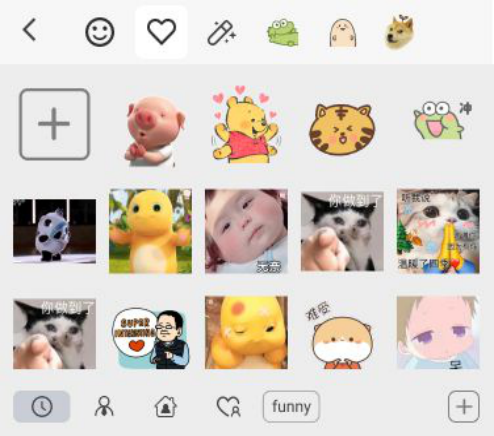
Personalized Classification Mechanism Studies have shown that the difference between crowds and scenes greatly affects the user’s emoticon usage behavior, and selecting appropriate emoti- cons under different conditions can improve the quality of communication. According to the sending group, the emoticons are classified and recom- mended, and the user can store the proper emoticons in various categories and choose emotions through different categories (see Figure 2). Personali- zed classification mechanism improves the efficiency of selecting emoticons scenarios and reduce the memory burden.
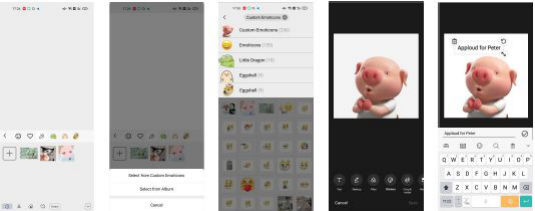
Inserted Editing Function People’s use of emoticons has obvious personal characteristics, which are affected by factors such as their social environment and personality prefere- nces. In specific scenarios, the existing emoticons may be hard to accurately convey the user’s intentions or emotional feelings. The addition of the quick editing function can largely solve this problem. By long-pressing the selected emoticon package, you can enter the emoticon editing interface to perform operations such as cropping, rotating, text adding, graffiti and stickers to quickly create a unique emoticon (see Figure 3). This editing function is not only conducive to accurate expression and understanding of emoticons, but also allows more users to enjoy the fun of creating emoticons with less efforts, which activates the emoticon community and creativity.
According to the use and gratification theory, the motivation and needs of the use of emoticons are summarized which include communication effici- ency, emotional exchange, personalized expression and identity cognition. Emoticons use insights are discovered through survey and interview. Com- bined with the above information, the emoticon input method is designed to meet the needs of users for use efficiency, personalized expression and social interaction. The emoticon input method overcomes platform barrier, provide categories based on recipients, integrate emoticon editing function and offer proper recommendation to new acquaintances, which successfully gratify user’s multidimensional needs and improve use experience.
ACKNOWLEDGMENT
The authors would like to acknowledge Prof. Lu Zhaolin, our course tea- cher who made significant contribution in quantitative research methods
Emoticon Input Method Design Based on Theory of Use and Gratification 471
teaching and design practice guidance. Also, all the participants in our que- stionnaire and interview deserve our heartfelt appreciation for their patient and dedicated involvement.
REFERENCES
Blumler, J. G. (1979), The Role of Theory in Uses and Gratification Studies, Communication Research, 6 (1), 9–36. Blumler, J. G., Katz, E. (1974). The uses of mass communication Newbury Pank, CA:
sage. Huang, E. (2008). Use and gratification in e-consumers. Internet Research, 18(4), pp. 405–426. Katz, E., Haas, H., & Gurevitch, M. (1973). On the Use of the Mass Media for
Important Things. American Sociological Review, 38(2), 164–181. Ko, H., Cho, C-H. and Roberts, M.S. (2005), Internet uses and gratifications, Journal of Advertising, Vol. 34 No. 2, pp. 57–70. Newhagen, J., & Rafaeli, S. (1996). Why Communication Researchers Should Study
the Internet: a Dialogue, Journal of Journal of Computer-Mediated Communica- tion, Volume 1, No.4. Tsuneo Yamane et al. (1977), テキストブック社会学[Sociology Textbook].ed.
Tokyo: Yuhikaku Books
LISTED IN THE AHFE DIGITAL BOOKSTORE CATALOGUE
Explore the complete digital volume
Ergonomics In Design
Read this individual research paper free through the original publisher, or explore the full digital proceedings book.
ISBN 978-1-958651-23-0
Explore this ISBN in the AHFE Bookstore ↗Listed in the July 2026 bookstore catalogue; search by ISBN to confirm current availability · Digital book purchase optional