Congjun Jin, Rui Liu (2024). An Evaluation of Capabilities, Benefits, and Challenges of Developing Digital Twin Models for Sustainable Development. In: Human Factors in Design, Engineering, and Computing. AHFE Open Access, vol. 159, pp. 1641–1651. https://doi.org/10.54941/ahfe1005732
Since the recent AECO industry has increasingly focused on sustainable development, with an emphasis on achieving long-term goals like enhancing eco-sustainability and durability, the demand for applying digital and revolutionary technologies has increased. Digital twin technology, enabling a digital model to represent a physical entity in real-time dynamically, has gained wide attention in manufacturing, aerospace, and healthcare. Although digital twin technology, which integrates with various digital technical tools, has been explored by some researchers, The overall understanding of how digital twin technology can be applied to sustainable construction is still unclear. This knowledge gap leads to unnecessary difficulty and hinders the full realization of digital twin capacities in sustainable development. This research conducts a literature review to examine the current state of digital twins and related technologies in the AECO industry, aiming to bridge this gap. A variety of technologies, tools, and algorithms employed in the applications of digital twin technology have been analyzed. The results present the four major processes of establishing digital twin models for sustainable development: data harvesting, data transmission and processing, modeling and simulation, and decision-making process. Additionally, four distinct scenarios within the decision-making process relevant to sustainable construction are specified. Furthermore, the digital twins' capabilities, benefits, and challenges have been evaluated. Although digital twin models cooperating with extensive technologies have capabilities and benefits in terms of modeling and visualization, real-time simulation and monitoring, data integration and analysis, and making predictive decisions in optimization, challenges still exist and need to be addressed in future applications. This review highlights the challenges of digital twin technology, including data security, data integration, and interoperability, which provides future research directions for digital twin studies.
The world is currently facing and engaging the threat of climate change and environmental issues to preserve our living community (Tagliabue et al., 2021). According to the sources from Inventory of U.S. Greenhouse Gas Emission and Sinks (2019–2022), the U.S. greenhouse gas emissions totalled 6.343 million tons of carbon dioxide equivalent in 2023, a 1% increase compared to the previous year. In addition, the World Energy Council and European Union show that the global energy demand may exceed by over 50% by 2050, while the total amount of energy available in the world in 2023 will decrease by 4.5% compared to 2022 (Hong et al., 2015). Undoubtedly, the climate crisis is deteriorating and the natural resources are exhausting as greenhouse gas emissions and energy demand continue to rise. Alarming environmental and climate concerns encourage environmental commissions such as the United Nations Environment Programme (UNEP) to advocate sustainable development goals to prevent such detrimentally environmental effects and accommodate economic growth (Solaimani & Sedighi, 2020). According to the statistical report, the construction industry accounts for 35% of greenhouse gas emissions which has become the fastest driver of economic growth (Liu et al., 2020). Under the current context, sustainable development in the construction industry has received growing attention globally and sustainable practices are scientifically and technologically should be empowered. They are developed via synthesizing various smart technical tools such as Building Information Modeling (BIM), Virtual Reality (VR), Blockchain, Digital Twin (DT), the Internet of Things (IoT), and Artificial intelligence (AI) technologies, etc. Therefore, technological innovation plays an indispensable role. Digital Twin is widely promoted to represent digital models dynamically and mimic real asset behaviors, providing more technical and scientific opportunities among these technologies. Cooperating with other technologies such as AI technologies, the DT capabilities of prediction and optimization regarding sustainable buildings’ system design, energy performance analysis, and live simulation are beneficial for decision-makers to make sound sustainability-related decisions. At present, challenges and opportunities coexist due to the underdevelopment of emerging technologies and increased high-quality requirements of SC, the application of DT models in the SC project is at an early stage. To bridge this gap, this study not only discusses the concept and academic understating of digital twin models but focuses on the major processes according to the requirements and features for developing digital twin models. In addition, realizing the main capabilities, benefits, and challenges of DT models helps understand and explore the further applications of digital twins and contributes to SC within the AECO industry.
Section 2 reviews various definitions, levels of development, and relative technologies of DT. Section 3 proposes the systematic literature review methodology of this study. Section 4 summarizes four major processes for developing DT models, and an evaluation of the capabilities and challenges for the applications of DT-related technologies in Section 5 follows it. Section 6 is the final part, which concludes and raises future research possibilities.
An Evaluation of Capabilities, Benefits, and Challenges 1643
DIGITAL TWIN Definition
Digital Twin was first proposed by the National Aeronautics and Space Administration (NASA), which defines it as Systematical Modeling, Simulation, Computational Technology, and Information Processing (Opoku et al., 2023). DT originates from the application of Cyber-Physical Systems (CPS), In 2006, the CPS concept was created from the application of extensive embedded systems (Tao et al., 2019), with the assistance of computational processing, this physical system generates feedback loops from results of computational simulation (Hasan et al., 2022). To develop a CPS system, many technical tools and components are involved. For example, Web- based graphic user interface (GUI), mutual directional interaction between physical tools and the IoT, and programming visual model. The most essential component among such processes of CPS is “bi-directional communication.” Based on the bi-directional connection process, CPS provides real-time sensing, gives the system real-time feedback and dynamic control of physical systems. DT is another concept associated with CPS. DT maps the behavior rule of the actual asset/system computationally and updates its condition adaptively of the asset/system. Although the DT model is known as the digital reflection of a physical entity/process/system, there is much research that mentioned the confusion between the digital twin and BIM since the BIM model also is used to present physical entities virtually. However, there are many differences between them. For example, the BIM model is a database of geometrical and temporal information of the physical asset, but the establishment and updating of BIM models with the limitation of linkage between the digital model and the real asset are achieved by manually inputting, while the DT model achieves real-time and bi-directional communication between the two counterparts. In addition, BIM is generally used as a database of information during project planning and estimating phases, while the DT model simulates and monitors the actual status of systems and enables decision-makers to obtain feedback and active evaluation from simulating results. Therefore, the DT model with the strength of the interaction between the natural world and virtual environment exceeds the BIM model, and BIM is considered a technical tool to provide model support during the simulation and modeling process of building DT models.
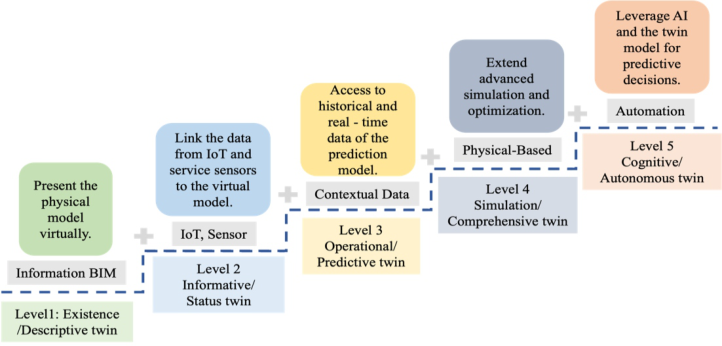
Levels of Development The Apollo program NASA first defined the terminology of ‘twins’ as two identical space vehicles, which allowed it to reflect the live status of the space vehicle when it is operating. In 2003, the University of Michigan defined the term ‘digital twin’ as ‘the digital equivalent of the entity’, this definition is generally accepted for the public domain. In addition, the definition of DT varies slightly with the changing of each specific area. The multiplicity of conceptual proposals of DT from various fields easily leads to misunderstanding of it (Liu et al., 2021). Thus, it is necessary to clarify what is the real DT based on its developing levels (see Figure 1).
1644 Jin and Liu
Figure 1: Development levels of digital twin based on DT maturity (adapted from KPMG 2022).
Initially, for the existence/descriptive twin, DT was created physically and seen as a purely virtual description of a product/asset in the real world. (Zheng et al., 2019) considered DT as an object, including a group of virtual information models and data. Based on the simple definition, the DT represents the virtual form of physical entities in the real world within this paradigm (Boje et al., 2023).
With the sensor data assistance, static data from the existing twin is expanded to a dynamic dimension, so that the twin model is called informative/status twin. (Opoku et al., 2023) specified the dynamic linkage between two components of DT (physical and virtual parts) by the joint of connected data between them, synthesizing successive data from sensing technology and the virtual model to build the digital-physical link. Therefore, the DT model serves as a product and process information repository to store the physical properties, and status of engineering entities throughout its lifecycle.
In the additional level (operational/predictive twin), DT applied possibilities expand by adding historical data to achieve a real-time view of operational assets. It is considered as a technology or means such as modeling and simulation at this level, which component of many other technologies such as CPS, and digital shadow. (Opoku et al., 2023) also proposed DT as a data-added technical means since it enables various data series to predict and continually update the conditions of physical entities. Some scientists considered DT itself as an active process.
The physical-based level (simulation/comprehensive twin) enhances the capabilities of high-fidelity simulations to develop the optimal twin. (Sacks et al., 2020) described DT as the representation of combining three parts: 1) Physical part (e.g., equipment, building, or equipment); 2) Digital part, which is the digital representation of the physical part gathered from sensors and other resources; 3) Data processing: raw data is first collected from sensing technologies, the following data integration and transformation are
An Evaluation of Capabilities, Benefits, and Challenges 1645
achieved by algorithms, and prediction algorithms give end-users feedback and conductive suggestions regarding prediction.
The Cognitive/Autonomous twin leverages AI and real-time data, which helps decision-makers makes optimization of physical entities based on automatic data processing and analysis. DT was regarded as a source of data and enriched when monitoring and sensing physical assets over time. Hence, the twin model is separated into three data layers: the perception layer (data is collected by sensors and collectors such as 3D scanners, satellite images, etc.); the data layer that is supported by twin data; and the functional platform layer. Although there are many different definitions for DT, all of them integrate the idea that the DT model is a high-fidelity virtual model for mirroring physical objects to simulate their behaviors and provide suggestions for decision-makers for future prediction and optimization.
Relative Technologies and Applications of DT Technology to build the DT model is also known as DT technology, such as IoT platform, cloud computing, mobile devices, and smart sensors. Specifically, the basis input for developing the DT model is data, which is collected from several data-based devices such as sensors, RFID tags, readers, scanners, and cameras. However, the huge volume of data is different structure-related (unstructured, semi-structured, or structured), and transmitting data into the twinning process is via the cloud server, which consumes a huge time and money. Thus, many technologies are applied to address this issue for different data-related processes. For example, while edge computing technology pre-processes the collected data, data fusion, and data mapping technologies are utilized to make the pre-processed data meaningful. 5G technology is employed to ensure data security and improve data trust during real-time transformation. (Katsigarakis et al., 2022) proposed a novel network framework to develop the DT model. The Digital Twin Layer in this network includes physical entity modeling and a center for controlling the twin model. With the assistance of AI algorithms, physical entity modeling to build models for prediction, automatic detection, and monitoring under different scenarios. However, the DT model is established based on a huge of near real-time data from multiple channels, such as physical entities, external environment, inventory, and historical records, the time delay in identifying risk is the main issue. Since data is the core of DT whether in creating models, simulation, or giving feedback on prediction and optimization, data acquisition, data transmission, and data management are key issues (Aheleroff et al., 2021). Data acquisition is collected by smart sensors requires better access to data by filtering the large amount of data. Data transmission mainly covers three stages: physical model, digital twin virtual model, and database transformation. The logical sequence of database transformation is as follows: data acquisition and decision control are conducted between the physical model and database data transmission; results of synchronous simulation are generated when the DT model interacts with the database. Data management refers to data analysis and processing, software fusion, interoperability, and open-source software. Therefore, with
1646 Jin and Liu
the assistance of various technologies, the DT model can be applied to three major key applications. (1) Geometric representation and equivalent relationship of the actual entity. (2) Bi-directional connection. (3) AI-driven assessment for optimization and prediction in the decision-making process.
METHODOLOGY
The study conducts a comprehensive literature review research methodology to summarize and evaluate how the DT technology develops and applies in SC. This study adopts a three-step process to identify, filter, and select the target literature. Specifically, the study carried out the primary literature search from three prominent databases: Elsevier’s ScienceDirect, Scopus, and Web of Science databases. Considering that Elsevier’s Scopus database employs the board publications, the primary article search starts from it. In addition, ScienceDirect and Web of Science also are considered better retrievals in further searching for literature. The following literature search was applied to consider the keywords with suitable Boolean operators: ((“sustainable construction” OR “sustainable building”) AND (“implementation” OR “application”) AND (“digital” OR “virtual” “twin” OR “digital” OR “technology” OR “model”)). Duplication checking was used for screening. Furthermore, to present the latest development and application of DT technology, this study only employs the literature from the past decade (2015–2024). At the same time, the non-peer-reviewed reports, websites, and forums were excluded, while only the journals and conference papers were reviewed. Lastly, only the English language as the language type was chosen for the study.
FINDINGS The findings of this study summarize the major processes and technologies for establishing and applying DT models for SC (see Table 1). The major processes include the data harvesting process, data transmission and processing process, modeling and simulation process, and decision-making process.
Table 1. Technologies for DT applications in SC projects.
Table available in the original PDF paper.
References
Modeling and Simulation
Decision-Making Process
Data Harvesting Data Transmission and Processing Wireless sensors, RFID, IoT BIM, 3D geometry model
(Aheleroff et al., 2021)
LiDAR, photo- grammetry, and laser scanning
Select the building’s materials, shape, and orientation
3D point cloud XML, MySQL MATLAB, SIMULINK
Energy system planning (Katsigarakis et al., 2022) GPS, laser scanning
AI algorithms Machine Learning, AI
System modeling and simulation
(Liu et al., 2021); (Lydon et al., 2019) AI algorithms Blockchain VR Monitoring, tracking, and predicting system performance
(Jia et al., 2022); (Tuegel et al., 2011)
An Evaluation of Capabilities, Benefits, and Challenges 1647
Data Harvesting Data harvesting stands as the primary and essential component of any digital transformation. As the basis input of digital twin, the data is identified, collected, and produced from devices such as sensors, RFID tags and readers, and cameras. For example, to obtain the building facility/asset data, sensors need to be equipped for inferring the system’s working status, while building health monitoring sensors can detect and measure various parameters of buildings’ elements, including structural strains and vibrations, temperature, and humidity of building materials and corrosion levels of buildings.
Data Transmission and Processing Data transmission and processing refers to transforming data and information for digital modeling and analysis before further simulation demonstration. The required data type, data speed, and data volume for data transmission determine the data transforming tools. Capturing and transmitting data through technologies including LiDAR (Light Detection and Ranging), photogrammetry, laser scanning, and 5G networks ensure the security of the transformed data in real-time. The preprocessed data then can be processed via converting technologies such as Extensible Markup Language (XML) and My Structured Query Language (MySQL) into a readable format to ensure systematic data mapping.
Modeling and Simulation The modeling and simulation phase is where BIM and other visualization and simulation tools sit. BIM acts as a data duct and database in the establishment of the DT model. In general, the BIM model provides significant opportunities to preserve and incorporate both geometric and non-geometric characteristics in an organized digital form (Cavka et al., 2017). The BIM model assists in synthesizing geometric data and time series data that indicate real- time occurring events and updates on the same three-dimensional model. Furthermore, simulation engines such as MATLAB and SIMULINK are also embedded in this process for further analysis of the energy performance of building elements/structures and facility conditions.
Decision-Making Process Once the data is processed and analyzed properly, end users and project managers are considered primary roles in the decision-making processes based on regular feedback and predictive suggestions from analysis results of simulating models. Within the SC context, DT models are mainly applied within the following four scenarios: (1) Selecting the building’s shape, orientation, and materials; (2) Planning and replanning the energy system of buildings; (3) Monitoring the manufacturing and logistics process of building materials; (4) Evaluation of the building’s system performance such as the temperature, humidity, occupant comfort level, and greenhouse gas emission of indoor heating equipment.
1648 Jin and Liu
EVALUATION AND DISCUSSION Capabilities of DT-Related Technologies
Wireless sensors, RFID, and 3D point cloud. These sensing technologies establish the symbiosis of digital environments for SC. The symbiotic virtual environment makes systems in the buildings become ‘smart’ via the closed loop of real-time data collection and feedback (Jia et al., 2022). The attached wireless sensors in buildings are used to collect their behavior, states, location, etc. In addition, sensors can update the digital environment with changes based on timely information exchange within a wireless network in the physical environment. The representative sensing technologies for developing DT models in SC are the Global Position System (GPS), laser scanning technologies, structural health monitoring (SHM) sensors, energy monitoring sensors, and smart grid sensors. In application, 3D point clouds, a fundamental component of sensing technologies, are dense collections of data points in three-dimensional space, often captured and transferred through technologies like LiDAR, photogrammetry, and laser scanning.
Modeling and simulation technologies. The visualized result of modeling and simulation gives decision-makers a better appreciation of the real-time status of physical systems since they provide a comprehensive version to understand the signals from sensors in real-time. Technical tools such as BIM, VR, and IoT improve the capabilities of virtual monitoring of system-centered activities for building systems and processes in SC.
AI technology. The huge information from heterogeneous sensors can be processed effectively via AI technology to improve the decision-making process for project professionals. Data-driven decision-making process is required for the evaluation of intelligent assets and processes. The DT model combines AI to perform recalibration, optimization, and prediction of systems and influence fault forecasting and process intervention. Furthermore, AI algorithms, machine learning, and deep learning strengthen the AI capabilities for data precision and the degree of completeness, such AI-driven applications are reflected in predictive modeling, indoor environmental quality monitoring, simulation analysis, and data integration and management.
Blockchain. SC involves various activities, processes, and parties. However, the volume of data causes the deterioration of data security, applying blockchain in DT models for sustainable building not only enhances trust during the data and information exchange among different parties but reduces the project risk once the single point fails in the network system. Therefore, there is no doubt that blockchain technology improves data security and visibility, information reliability, and resilience in a collaborative environment. More importantly, blockchain gives the DT model accountable- added value due to the capability of activity-related information sharing in real-time.
Challenges of DT-Related Technologies Data connection. The efficient and intelligent data communication between the physical and its twin models is poor. On the one hand, data is collected
An Evaluation of Capabilities, Benefits, and Challenges 1649
from various sensors from physical assets to make the virtual model highly like the physical one, data connection should be fast, guaranteed, and available. On the other hand, comprehensive and complex activities are involved in the whole life cycle of the building, where the data connection between monitoring model simulation results and analytics must be updated over time. Unfortunately, these conditions cannot yet be taken for granted currently.
Data security. Data security is also becoming a challenge when applying the DT model in the supply chain process, which is by its nature of segmented activities and various stakeholders. Acquiring, accumulating, and sharing data lacks protection, by this, can easily lead to damage for any organization.
Data integration and interoperability. To build a real-time simulation, sensors, and other visualization technologies are used. However, some existing buildings lack adequate sensing technologies to collect all data which leads to the inadequacy and inauthenticity of virtual models. In addition, the powerful computing devices that are used to process collected data are also unsound.
Lack of professionals. although the DT concept was introduced and applied several years ago, it is not widely familiar to most stakeholders and personnel in the AECO industry specifically for sustainable projects. It is needed to strengthen their professional skills via technical training and drills.
CONCLUSION AND FUTURE WORK In conclusion, the vision and academic support from the previous literature for applying DT models in SC is very promising. A comprehensively systematic literature review was developed for the study to explore the practical applications and technologies for establishing DT models and to enhance the understanding of challenges in the SC field. First, the definition and different levels of development of DT, and the relative technologies regards DT were comprehensively identified. Second, the literature review research methodology was proposed for further evaluation and discussion. The results of the paper summarized the whole process of establishing DT models and categorized various technologies for four major processes: data harvesting, data transmission and processing, modeling and simulation, and decision-making processes. In addition, four typical scenarios in the decision-making process relevant to SC were proposed, which provided the roadmap for further research. The DT applications and related technologies were evaluated for their capabilities, benefits, and challenges in the discussion section. Future research directions should focus on energy performance simulation and energy-efficiency-related forecasting of building elements/systems at the planning stage of the decision-making process while using the DT models for energy management and real-time sustainability evaluation should be considered over the whole decision-making process. In addition, huge data from various sources are required, thus, AI technologies such as machine learning and deep learning are needed to be paid more attention to since such technologies provide the creation of intelligent models
1650 Jin and Liu
for the collected data that can make predictions automatically and give end- users suggestions. Finally, stakeholders equipped with professional abilities and strong computing devices are cornerstones for the establishment and applications of DT models.
ACKNOWLEDGMENT
The author would like to thank Professor Dr. Liu for instructive feedback on earlier drafts of this paper. The author declares no conflicts of interest with this work. This research did not relate to any specific funding.
REFERENCES
Aheleroff, S., Xu, X., Zhong, R. Y. and Lu, Y. (2021) ‘Digital Twin as a Service (DTaaS) in Industry 4.0: An Architecture Reference Model’, Advanced Engineering Informatics, 47. Available at: https://doi.org/10.1016/j.aei.2020. 101225. Boje, C., Hahn Menacho, Á. J., Marvuglia, A., Benetto, E., Kubicki, S., Schaubroeck,
T. and Navarrete Gutiérrez, T. (2023) ‘A framework using BIM and digital twins in facilitating LCSA for buildings’, Journal of Building Engineering, 76. Available at: https://doi.org/10.1016/j.jobe.2023.107232. Cavka, H. B., Staub-French, S. and Poirier, E. A. (2017) ‘Developing owner information requirements for BIM-enabled project delivery and asset management’. Gao, Y., Li, H., Xiong, G. and Song, H. (2023) ‘AIoT-informed digital twin communication for bridge maintenance’, Automation in Construction, 150. Available at: https://doi.org/10.1016/j.autcon.2023.104835. Guo, F., Wang, K., & Cao, E. (2023). A Digital Twin (DT) Framework at Design and
Construction Phases. https://www.researchgate.net/publication/371416031 Hasan, S. M., Lee, K., Moon, D., Kwon, S., Jinwoo, S. and Lee, S. (2022) ‘Augmented reality and digital twin system for interaction with construction machinery’, Journal of Asian Architecture and Building Engineering, 21(2), pp. 564–574. Available at: https://doi.org/10.1080/13467581.2020.1869557. Hong, T., Koo, C., Kim, J., Lee, M., & Jeong, K. (2015). A review on sustainable
construction management strategies for monitoring, diagnosing, and retrofitting the building’s dynamic energy performance: Focused on the operation and maintenance phase. In Applied Energy (Vol. 155, pp. 671–707). Elsevier Ltd. https://doi.org/10.1016/j.apenergy.2015.06.043 Jia, W., Wang, W. and Zhang, Z. (2022) ‘From simple digital twin to complex digital twin Part I: A novel modeling method for multi-scale and multi-scenario digital twin’, Advanced Engineering Informatics, 53. Available at: https://doi.org/ 10.1016/j.aei.2022.101706. Katsigarakis, K., Lilis, G. N., Rovas, D., González-Gerpe, S., Bernardos, S., Cimmino,
A., Poveda-Villalón, M. and García-Castro, R. (2022) ‘A Digital Twin Platform generating Knowledge Graphs for construction projects’. Available at: https://co gito.iot.linkeddata.es/. Liu, Z., Meng, X., Xing, Z. and Jiang, A. (2021) ‘Digital twin-based safety risk coupling of prefabricated building hoisting’, Sensors, 21(11). Available at: https: //doi.org/10.3390/s21113583.
An Evaluation of Capabilities, Benefits, and Challenges 1651
Lydon, G. P., Caranovic, S., Hischier, I. and Schlueter, A. (2019) ‘Coupled simulation of thermally active building systems to support a digital twin’, Journal of Energy and Buildings, 202, 109298. Opoku, D. G. J., Perera, S., Osei-Kyei, R., Rashidi, M., Bamdad, K. and Famakinwa,
T. (2023) ‘Barriers to the Adoption of Digital Twin in the Construction Industry: A Literature Review’, Informatics, 10(1). Available at: https://doi.org/10.3390/in formatics10010014. Sacks, R., Brilakis, I., Pikas, E., Xie, H. S. and Girolami, M. (2020) ‘Construction with digital twin information systems’, Data-Centric Engineering, 1(6). Available at: https://doi.org/10.1017/dce.2020.16. Solaimani, S., & Sedighi, M. (2020). Toward a holistic view on lean sustainable
construction: A literature review. Journal of Cleaner Production, 248. https://doi. org/10.1016/j.jclepro.2019.119213 Tagliabue, L. C., Cecconi, F. R., Maltese, S., Rinaldi, S., Ciribini, A. L. C., & Flammini, A. (2021). Leveraging digital twin for sustainability assessment of an educational building. Sustainability (Switzerland), 13(2), 1–16. https://doi.org/10. 3390/su13020480 Tao, F., Qi, Q., Wang, L. and Nee, A. Y. C. (2019) ‘Digital Twins and Cyber–
Physical Systems toward Smart Manufacturing and Industry 4.0: Correlation and Comparison’, Engineering, 5(4), pp. 653–661. Available at: https://doi.org/10. 1016/j.eng.2019.01.014. Tuegel, E. J., Ingraffea, A. R., Eason, T. G. et al. (2011) ‘Reengineering aircraft structural life prediction using a digital twin’, International Journal of Aerospace Engineering. Available at: https://doi.org/10.1155/2011/154798. Wang, W., Guo, H., Li, X., Tang, S., Li, Y., Xie, L. and Lv, Z. (2022) ‘BIM Information
Integration Based VR Modeling in Digital Twins in Industry 5.0’, Journal of Industrial Information Integration, 28. Available at: https://doi.org/10.1016/j.ji i.2022.100351. Yang, B., Lv, Z. and Wang, F. (2022) ‘Digital Twins for Intelligent Green Buildings’, Buildings, 12(6). Available at: https://doi.org/10.3390/buildings12060856.
LISTED IN THE AHFE DIGITAL BOOKSTORE CATALOGUE
Explore the complete digital volume
Human Factors in Design, Engineering, and Computing
Read this individual research paper free through the original publisher, or explore the full digital proceedings book.
ISBN 978-1-964867-35-9
Explore this ISBN in the AHFE Bookstore ↗Listed in the July 2026 bookstore catalogue; search by ISBN to confirm current availability · Digital book purchase optional