Bahar Khayamian Esfahani, Souleymane Boundaouda Camara, Rita Bourma (2024). Bridging the Gap: Enhancing Mobility and Usability in Industrial Devices for Operational Efficiency. In: Human Factors in Design, Engineering, and Computing. AHFE Open Access, vol. 159, pp. 977–981. https://doi.org/10.54941/ahfe1005664
A shift from traditional pen and paper to advanced industrial devices can pose significant ergonomic challenges that impede efficiency and adoption, especially among refinery workers on the front lines. Due to usability and mobility issues, frontline workers in these industries resist adopting new technology which get in the way of their daily work. Consequently, duplication of work, manual data entry and human errors become common occurrences in this safety critical environment, where accuracy and timely data collection is key. In this paper, we present a mixed-methods case study to highlight the effectiveness of a user-centric approach to enhancing technology adoption, by prioritising human factors and ergonomic design principles. A design research exercise was conducted with 15 refinery operators leading to an iterative development process with continuous feedback sessions. This systematic approach allowed us to address user pain points, optimise their daily work, and improve their acceptance and adoption of mobility devices. Post-intervention data showed a significant increase in user satisfaction from 2/10 to 8/10 and a significant surge in device usage.
Industrial devices across refineries aim to provide a comprehensive and seamless experience for frontline operators by providing the necessary tools to enhance work execution and productivity, while ensuring devices meet the specific needs of users working in the field. Using industrial devices is highly important to technicians and operators, saving time and reducing paper reliance on manual data entry and human error risk during routine inspections. However, operators had significantly reduced utilisation of industrial devices, resulting in a historically low adoption rate and ultimately low satisfaction. This research case study aims to identify the underlying reasons for limited utilisation of industrial devices and identify key opportunities to increase the adoption of those devices to improve operational efficiency. Initially, this article reflects on the design
thinking approach adopted to understand the end-to-end user experience with industrial devices, specifically focusing on usability and ergonomical barriers in safety-critical environments such as climbing towers.
DESIGN THINKING Design thinking begins with understanding user needs and their impact on design decisions, aiming to improve the experiences and interactions of current and future users. In multidisciplinary research, design thinking helps understand interactions and needs in natural settings where behaviour occurs (Liedtka, 2018; Brown, 2008; Howcroft & Wilson, 2003). Norman emphasises that understanding people’s goals and challenges when interacting with a product is crucial for increasing the usability of designs, including products, systems, and services (Norman & Draper, 1986).
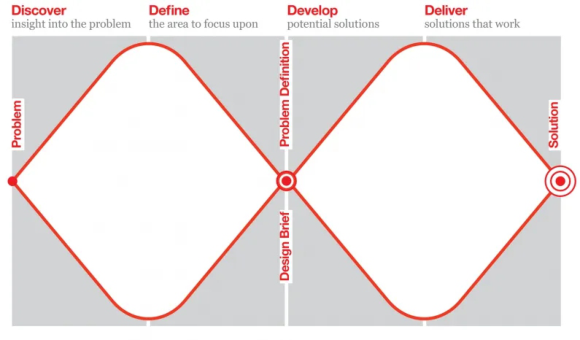
In addition, Vink and Hallbeck (2012) highlights the importance of involving end users in the design process to ensure human-centred technology meets user expectations and needs (Figure 1).
Figure 1: Double dimond design thinking process. (Adapted from the British Design Council, 2005).
UNDERSTANDING USERS AND THE PROBLEM SPACE In industrial settings, ergonomics play a crucial role in the design and implementation of technology, specifically for enhancing human–technology interaction (Booher, 2003; Ahram & Karwowski, 2018). According to Karwowski and Marras (2003), ergonomic interventions can significantly reduce workers’ physical strain and improve productivity. Ergonomics and usability issues often impede the adoption of digital tools in industrial environments.
The Hedge et al. (2010) study found that bulky and poorly designed devices can cause physical discomfort, including wrist and neck strain, which discourages prolonged use in critical environments.
Bridging the Gap: Enhancing Mobility and Usability in Industrial Devices 979
Qualitative research methods such as user interviews in the discovery process are also fundamental to gather in-depth insights based on attitudes, behaviours, and experiences providing a deeper understanding of the user (Bryman, 2012; Kvale & Brinkmann, 2009). Individual interviews are particularly valuable for identifying user needs, pain points, and expectations, which are essential for human-centred outcomes (Beyer & Holtzblatt, 1998). The interactive nature of interviews allows for clarification of responses through nonverbal cues, and exploration of new opportunities (Patton, 2002). The conversation between the researcher and the research participants is fundamental to reveal thoughts and concepts which are the product of interviews. In addition, Flick (2014, p. 10) highlights the importance of this relationship and says, “The interaction between the researcher and the participants leads to the generation of concepts, which are a product of the research act”. Robson (2002) explains how the researcher’s experience and intuition also play a key role in the mainly data-driven interpretation approach.
For this research, direct engagement with operators from the early stages was essential to identify their key pain points and barriers to adopting of industrial devices. By prioritising user needs and ergonomic principles, this research aims to enhance the usability and adoption of industrial devices, ultimately improving productivity and satisfaction among frontline workers in industrial settings.
THE ITERATIVE DISCOVERY RESEARCH This research focuses on one refinery. The approach is regularly adapted and enhanced for other refineries within the organization.
In total, 15 one-on-one interviews were initially conducted with the refinery operators as part of the early discovery exercise to understand the users and the problem space. Following discovery interviews, interactive feedback sessions were conducted iteratively, to pilot new pocket-size devices, as well as interim changes to application usability – based on user pain points discovered earlier. This process allows us to ensure the mobility devices introduced were fit for purpose. We then continuously listened to users through regular satisfaction surveys, including all operators of the selected refinery, to optimize our solution and ensure adoption.
Discovery interviews were conducted remotely using Microsoft Teams. With participants’ permission, interviews were recorded in Teams for transcription later and stored in a secure location for anonymous analysis. The collected data was analysed using the thematic analysis approach. Thematic data analysis is a process that involves a broad understanding of the raw data into in-depth meanings of themes and patterns within data (Braun & Clarke, 2006). This process consisted of going back through each interview to identify the commonalities and differences in the data and discussion points to identify key themes emerging from the data. The discovery interviews identified specific pain points related to applications’ usability, ergonomical barriers such as tablet weight and size, connectivity issues, and cumbersome authentication issues.
The interactive feedback sessions revealed that the biggest pain point for users was related to device portability and overall ergonomics. They preferred pocket-size devices instead of tablets – which can be cumbersome and challenging in their environment and operations. They needed to move around safely and constantly within an industrial complex. In their words: “Tablets are too large and couldn’t fit in pockets when climbing towers, so pen and paper were used instead.”
A user satisfaction survey post-intervention, showed an improvement in user satisfaction, soaring from 2/10 to an impressive 8/10 with the new mobility devices. This continuous engagement, enabled rapid adjustments to the devices and applications, addressing pain points and providing a unified application experience, significantly reducing users’ frustration.
Our iterative design intervention approach led to significant improvements in the ergonomic acceptance and usability of the devices. A higher level of engagement and acceptance was also evident in the frequency and duration of device usage, among these frontline workers. By prioritising users and their feedback in our design thinking, the intervention not only enhanced the ergonomic of the devices, but it also improved the overall operational efficiency of the refinery.
CONCLUSION
This case study highlights the benefits of a user-centric approach to overcoming ergonomic and usability challenges in industrial settings to enhance efficiency and productivity. The integration of design thinking principles led to significant improvements in user satisfaction and an optimised experience that improved acceptance and adoption of mobility solutions. This case study also highlights the broader implications for human factors and ergonomics in technology adoption by emphasizing the importance of prioritising user needs from early stages to foster positive mindset in technological changes and adoption. Particularly in safety critical environments, prioritising user needs is crucial for ensuring that technological innovations are both usable and ergonomically optimised for its intended users.
ACKNOWLEDGMENT
The authors would like to thank all participants who contributed to this research with their invaluable feedback.
REFERENCES
Ahram, T. and Karwowski, W., 2018. Advances in Human Factors, Software, and Systems Engineering. In Proceedings of the AHFE 2017 International Conference on Human Factors, Software, and Systems Engineering, July 17–21, 2017, The Westin Bonaventure Hotel, Los Angeles, California, USA. Beyer, H. & Holtzblatt, K., 1998. Contextual design: Defining customer-centered
systems. Morgan Kaufmann. Booher, Harold, ed. (2003). Handbook of human systems integration. New Jersey: Wiley.
Bridging the Gap: Enhancing Mobility and Usability in Industrial Devices 981
Braun, V. and Clarke, V., 2006. Using thematic analysis in psychology. Qualitative research in psychology, 3(2), pp. 77–101. Brown, T., 2008. Design thinking. Harvard Business Review, 86(6), p. 84. Brown, T. & Wyatt, J., 2009, 2015. Design thinking for social innovation. Annual
Review of Policy Design, 3(1), pp. 1–32. Bryman, A., 2012. Social Research Methods Fourth edi., Oxford: Oxford University Press. Design Council, 2005. A Study of the Design Process. Design Council, 44(0),
pp. 1–144. Flick, U., 2014a. An introduction to qualitative research. 5th ed., Berlin: SAGE. Hedge, A., 2016. Ergonomic workplace design for health, wellness, and productivity.
CRC Press. Howcroft, D. and Wilson, M., 2003. Paradoxes of participatory practices: the Janus role of the systems developer. Information and Organization, 13(1), pp. 1–24. Karwowski, W. and Marras, W. S. eds., 2003. Occupational ergonomics: principles
of work design. CRC Press. Kvale, S. and Brinkmann, S., 2009. Interviews: Learning the craft of qualitative research interviewing. Sage. Liedtka, J., 2018. Why design thinking works. Harvard Business Review, 96(5),
pp. 72–79. Norman, D. & Draper, S. W., 1986. User centered system design: new perspectives on human-computer interaction. Erlbaum. Patton, M. Q., 2002. Qualitative research & evaluation methods. Sage. Robson, C., 2011. Real world research: a resource for users of social research
methods in applied settings. Wiley. Vink, P. and Hallbeck, S., 2012. Comfort and discomfort studies demonstrate the need for a new model. Applied Ergonomics, 43(2), pp. 271–276.
LISTED IN THE AHFE DIGITAL BOOKSTORE CATALOGUE
Explore the complete digital volume
Human Factors in Design, Engineering, and Computing
Read this individual research paper free through the original publisher, or explore the full digital proceedings book.
ISBN 978-1-964867-35-9
Explore this ISBN in the AHFE Bookstore ↗Listed in the July 2026 bookstore catalogue; search by ISBN to confirm current availability · Digital book purchase optional