Matthew Wisniewski (2024). When hearing protection makes you worse at your job: objective measurement of decrements in sensorimotor tracking. In: Human Factors in Design, Engineering, and Computing. AHFE Open Access, vol. 159, pp. 968–976. https://doi.org/10.54941/ahfe1005663
Occupational hearing loss (HL) is a significant problem worldwide, even though it can be mitigated by the wearing of hearing protection devices (HPDs). When surveyed, workers report that worsened work performance while wearing HPDs is one reason why they choose not to wear them. However, there have been few studies to supplement these subjective reports with objective measures. In this study, listeners heard commands from the Coordinate Response Measure (CRM) corpus (i.e., sentences of the form "Ready <call sign> go to <color> <number> now). CRM sentences informed listeners of which of nine moving on-screen objects to track with a computer mouse (e.g., "blue four" refers the listener to a blue square). The commands were presented in background street noise and were heard under No HPD or HPD wearing conditions. HPD wearing was simulated with a digital filter meant to mimic the attenuation profile of an HPD. Continuous recording of tracking error allowed the simultaneous examination of how HPD wearing impacted speech comprehension, the accuracy of tracking, and how tracking accuracy varied as a function of time on task. Listeners spent less time tracking the correct object in the HPD wearing condition. Tracking error, after trimming data to those time points in which the target object was known, showed worse performance for the HPD condition than the No HPD condition. Workers' complaints of poorer performance while wearing HPDs are justified and extend beyond just auditory situational awareness. Considering these aspects of performance will be an important part of addressing HPD non-use in occupational settings.
Occupational HL risks can be mitigated with hearing protection devices (HPDs), but worker compliance in wearing these devices is far less than optimal (Fausti et al., 2005). When surveyed, workers point to poor work performance as a reason for not wearing HPDs. For instance, in a sample of printing workers, 70% gave “interferes with communication” as a reason for not wearing hearing protection, while 46% reported a general interference with job performance (Morata et al., 2001; also see Abel, 2008; Nandi &
When Hearing Protection Makes You Worse at Your Job 969
Dhatrak, 2008; Reddy et al., 2014; Talcott et al., 2011). Military personnel frequently report that they choose not to wear their hearing protection in situations where the poorer performance that results could put their life at risk (Casali et al., 2009; Gallagher et al., 2014). Musicians also report that wearing an HPD worsens their playing ability (Nelson et al., 2020).
For the most part, research attempting to objectively characterize these self-reports has been focused on the consequences for auditory situational awareness. Unsurprisingly, wearing an HPD impairs sound detection, localization, and speech comprehension (Gallagher et al., 2014; Smalt et al., 2019; Suter, 1989). This reflects a natural tradeoff wherein the attenuation of sound by an HPD (important for mitigating HL) diminishes the ability to extract information from an environment’s acoustics (Gallagher et al., 2014). However, workers’ self-reports could reflect more than problems with auditory perception. For instance, HPD wearing could negatively impact non-auditory aspects of job performance due to the downstream effects of increased listening effort experienced while wearing an HPD. The theoretical basis is that extracting information from sound filtered through an HPD requires more cognitive resources, thus there are less resources available to perform other tasks simultaneously (for review, see Gagné et al., 2017). Workers may still be able to hear important acoustic signals while wearing their HPD, but it comes at a cost of performance detriments for other tasks they must perform simultaneously.
There is recent empirical data to support this notion. Wisniewski and Zakrzewski (2020) employed a dual-task paradigm where listeners’ primary task was to report the content of speech. A secondary task was to hold a four note musical sequence in memory during speech presentation. When the speech was filtered in a manner meant to mimic wearing an HPD, secondary task auditory memory performance was worsened more so than when listening to the same speech unfiltered (also, see Smalt et al., 2019). Some human factors work has put HPD performance effects to the test in more realistic scenarios. For instance, the type of HPD has been shown to impact performance in military training missions involving group reconnaissance (Casali et al., 2009). In that study, ratings of soldiers’ performance as satisfactory or unsatisfactory by expert military observers was negatively affected by wearing HPDs with strong attenuation profiles (also, see Casali et al., 2007; Sheffield et al., 2017).
Here, a task was developed in which presented speech informs the listener of which objects to track on a computer screen (cf. Tun et al., 2009). The intention was to characterize the impacts of HPD use on speech comprehension (i.e., tracking of the correct object), but also the accuracy to which objects could be tracked (i.e., how tightly the cursor hovered over the target object). Tracking accuracy was continuously recorded so that we could examine how it was impacted by ongoing task events and changed over the course of a session. The goal was to have an objective characterization of workers’ performance complaints and a task that could be used in further investigation of this as an occupational health issue.
970 Wisniewski
METHODS
Listeners. Listeners (N = 22) participated in exchange for credit in psychology courses at Kansas State University. All listeners self-reported normal hearing. Procedures were approved by the local ethics committee and all listeners signed an informed consent document.
Equipment and Materials. Listeners performed the task in a sound attenuating booth (WhisperRoom, Knoxville, TN). An RME Fireface audio interface and an ART SLA-2 amplifier (ART Pro Audio, Niagara Falls, NY) were used to present sounds over Reftone LD-3 speakers (Reftone, Woodland Hills, CA). Listeners used a computer mouse to track objects on an 24” computer monitor. All procedures were programmed in MATLAB (Mathworks, Natick, MA) employing the Psychophysics Toolbox (Brainard, 1997) and custom code. Stimuli, Task, and Procedure. A DBX RTA-M omnidirectional microphone (Sandy, UT) was used to record a ∼35 minute excerpt at a busy intersection in Manhattan, KS during rush hour. Sound events included mostly closely passing vehicles with a constant background of traffic. The recording was made in Audacity (www.audacityteam.org) through a Focusrite Scarlet Audio Device (Focusrite, UK). The average level of the recording was ∼70 dBA. Later sound presentation in the booth was calibrated to reproduce this level at the location of the listener. Eight randomly timed clips of 5 minutes in duration were taken from this recording to make 8 separate blocks of background sound.
In the CRM, listeners hear sentences of the form: “Ready <call sign> go to <color> <number> now” (Bolia et al., 2000). Call signs can be Baron, Charlie, Ringo, Laker, Arrow, Tiger, Eagle, or Hopper. Eight different talkers are present in the corpus (4 female). For the purpose of combing the CRM with the planned object tracking task (see below), colors were limited to Red, White, and Blue. Numbers were limited to Three, Four, and Five. Eight 5 minute audio clips were made by combining CRM corpus sentences separated in their onset by 1–4 s (uniformly randomly determined) with a 10% probability of a sentence containing the “Baron” call sign. This yielded an average of 29.5 (SD = 3.4) “Baron” sentences per 5 minute clip. Talker selection for each CRM sentence presentation was completely random. The level of each sentence was roved from –6 dB to 0 dB in relation to the average level of the street noise.
To simulate listening with an HPD, we designed a digitial filter using MATLAB’s designfilt() function. The function’s arbitrary magnitude finite impulse response option was used to create an attenuation profile that matched that of a Howard Leight Max passive HPD recorded by Gallagher et al. (2014). In the HPD condition, sounds were digitally filtered before presentation to the listener.
The tracking task consisted of nine moving shapes on screen that could be colored red, white, or blue, and have 3 (triangle), 4 (square), or 5 (pentagon) sides. Each shape had side lengths of 50 pixels. In the initial frame of the video, each object had a randomly determined position on screen (e.g., X = 900, Y = 150), and a desired randomly determined new position that
When Hearing Protection Makes You Worse at Your Job 971
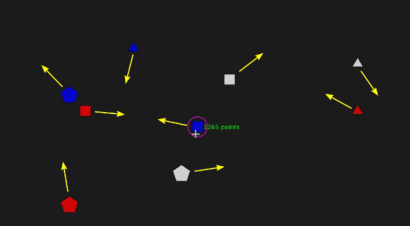
it would move towards (e.g., X = 100, Y = 800). In each successive frame, objects would move towards their next position at a fixed speed (7 pixels at 30 fps). When they reached that location, a new desired location was randomly set and the process was repeated. Eight separate 5 minute videos were created using this procedure. Figure 1 shows an example video frame. In the figure, a cross is shown at the cursor location as would be the case in the actual experiment. The pink circle shows a Euclidean distance of 50 pixels used as a cutoff to gain points during tracking (see below). Yellow arrows display object movement directions. Neither yellow arrows or the Euclidean distance borders were seen by listeners.
Figure 1: An example frame from the object tracking task. Here, the target object is the blue square associated with the CRM command phrase “Ready Baron, go to blue four now”. The cursor (gray cross) is within 50 pixels of the object’s center (solid pink line) and is thus gaining points. Yellow arrows show movement direction of objects on screen.
Street noise, CRM sentence streams, and videos were combined for the task. Listeners were instructed to hover a cross controlled by the mouse over the object indicated by the last CRM “Baron”call sign sentence. For instance, if the last sentence was “Ready Baron go to blue four now”, the subject was tasked to track the blue square. When the center of the cross was within 50 pixels (Euclidean distance) of the target object’s center, points were gained at a rate of 1 per video frame. Points were displayed in green beside the cross. When the listener was outside of this window, the points were displayed in red and were lost at a rate of 1 per frame. Upon presentation of the next “Baron” call sign sentence, the target object switched after the word “now”.
A short warm-up period was used to acclimate listeners to the task demands. First, the listener heard only “Baron” call sign sentences with white noise as background masking and slowly moving objects. This allowed listeners to see how points where related to tracking accuracy and learn that they needed to switch objects when new “Baron” sentences were presented. The complexity was then increased by including the full range of call signs so that listeners were made aware to only track objects indicated by “Baron” call sign sentences. Lastly, object movement speed was increased to the experiment rate. A research assistant guided the listener through the warm- up and monitored point earnings to make sure that each listener understood the task.
972 Wisniewski
The 8 examples of street noise, CRM sentences, and video were combined for use in 8 separate experimental blocks. Half of the blocks presented sounds with no filtering (No HPD condition). Half of the blocks presented sounds that were filtered (HPD condition). The HPD condition alternated across the 8 block session with half of the listeners performing the HPD condition on the odd numbered blocks, and the other half on the even numbered blocks. Videos were randomly assigned to blocks for each listener.
Performance Measures and Statistics. Points gained in the task is a measure that reflects both speech comprehension (i.e., hearing the target object in CRM sentences) and sensorimotor tracking accuracy (i.e., being with 50 pixels of the target). Because of this, it is not a good measure for separating these different task aspects. For this reason, we used listeners’ tracking data along with the positions of target objects to classify individual time points as either tracking or not tracking. This was accomplished by running a moving average ∼2s window over the data (61 points), computing the Spearman correlation for each time window between the cursor location and the location of the target object. Any correlation deemed to be significant at an alpha level of .01, and positive, led to the center timepoint for the window being classified as tracking. We then took the number of tracking frames as a measure of speech comprehension performance. For sensorimotor tracking accuracy, we trimmed the data to only those time points classified as tracking, and then calculated the average Euclidean distance between the center of the cross cursor controlled by listeners and the center of the target object in screen pixels. This allowed us to characterize tracking performance relatively uncorrupted by error induced by a listener not knowing which object to track at any one moment in time.
These dependent measures were entered into linear mixed effects modeling analyses. All models were fit in MATLAB’s statistics toolbox using maximum likelihood. Separate models were fit for each performance measure. Fixed effects for each model included a categorical effect of HPD condition, a continuous effect of block, and their interaction. The random effects structures included per subject intercepts and slopes for each of the fixed effects, and an intercept for the video presented on a block to account for potential variability in difficulty associated with each video. The significance of a fixed effect was assessed with likelihood ratio tests comparing the full model with that of a reduced model having the fixed effect of interest removed.
RESULTS
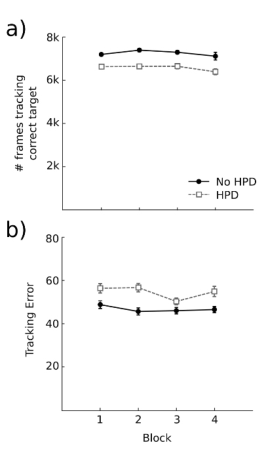
The average number of frames in which listeners’ cursor movements tracked the target object for each HPD condition and block are shown in Figure 2a. There was a significant effect of HPD condition, X2(1) = 12.39, p < 0.001, indicating that the number of tracked frames was greater for the No HPD compared to the HPD condition, βHPD = −669, CI = [–1000.50 –337.95]. No other fixed effects were significant, p > 0.55. Tracking error is shown in Figure 2b. There was a significant effect of HPD condition, X2(1) = 11.45, p < .001, with the HPD condition showing less accurate tracking of the
When Hearing Protection Makes You Worse at Your Job 973
target object, βHPD = 11.23, CI = [5.54 16.92]. No other fixed effects were significant, p > .43.
That the number of frames in which listeners tracked the target object differed between conditions is not all too surprising given that poorer speech comprehension under HPD use is a known problem. If listeners cannot hear the <color> <number> combination, they cannot move to the correct object and will thus gain less points. However, the data so far show significant decrements to object tracking performance even when listeners know the correct object to track. This suggests auditory situational awareness and listening effort related difficulties during HPD wearing.
Figure 2: Tracking performance across blocks and for each HPD condition in Experiment 1. (a) Number of frames classified as tracking across blocks for the No HPD and HPD conditions. (b) Mean distance between the cursor and the target object at points in which the target object was likely to be known. Error bars show within-subject standard errors of the mean (Cousineau, 2005).
DISCUSSION
This work shows that workers’ self-reports of worse job performance while wearing HPDs is justified by objective performance data. Listeners spent less time tracking the correct object while wearing an HPD. Though much of this could be attributed to an impairment in speech comprehension in noise while wearing an HPD, there was another index of worsened performance even when listeners demonstrated accurate knowledge of object switches. Even when the target object was known, tracking accuracy was poorer while “wearing” and HPD.
Current hearing loss prevention programs (HLPPs) are inadequate. In a study of ∼1.8 million workers, only a 2% decrease in the incidence of HL
974 Wisniewski
was found over almost three decades (Masterson et al., 2015). A recently updated Cochrane Library review shows that the average HLPP shows very little evidence of benefit (Tikka et al., 2019). New approaches to occupational HL prevention are needed to supplement under-performing current practices. Most methods in HLPPs either focus on reducing environmental noise at its source, or reducing noise exposure with effective, and correctly worn, HPDs (Fausti et al., 2005). The former method helps, but cannot be the only solution. For instance, a construction company can buy saws that reduce noise levels >10 dB (e.g., from 107 dBA to 96 dBA), but the quieter saws can still be loud and damaging. Current HLPP strategies associated with the latter involve providing access to HPDs, training to wear HPDs correctly, and training to provide information on the consequences of noise exposure (for review, see Brennan-Jones et al., 2020; Chen et al., 2020). Other than a few suggestions to determine HPD selection based on the optimal performance/attenuation trade-off (Casali et al., 2007; 2009), other strategies are rarely developed to address the performance issues raised by the current experiments.
This data suggests that HLPPs should include some kind of component devoted to addressing the work performance issues that arise while wearing an HPD. One potential solution may be to include perceptual training along with the typical training meant to provide factual information about HPDs and HL. In Wisniewski and Zakrzewski’s (2020) study demonstrating a detriment to secondary auditory working memory task performance while listening with a simulated HPD, a single session of perceptual training improved both speech comprehension and secondary auditory working memory performance. The same extent of improvements was not seen for a group trained in a no HPD condition. In another study, listeners given auditory localization training while wearing hearing protection showed localization performance akin to their own open ear performance after training (Casali et al., 2007; 2009). Adding perceptual learning protocols to HLPPs may be a low-cost supplement to traditional approaches. Such a strategy would address problems of performance and their relationship to HPD non-use. This could break stalled progress in the development of effective HLPPs.
CONCLUSION
Negative impacts of wearing an HPD extend beyond just auditory situational awareness to performance in sensorimotor tracking. This adds another dimension to worker complaints and suggests that further needs to be done to characterize relationships between HPD use and various types of performance detriments. Given that occupational HL is a large worldwide health problem, these relationships need to be considered in HLPPs.
ACKNOWLEDGMENT
This work was supported in part by the Cognitive and Neurobiological Approaches to Plasticity (CNAP) Center of Biomedical Research Excellence
When Hearing Protection Makes You Worse at Your Job 975
(COBRE) of the National Institutes of Health, United States, under grant number P20GM113109 and by the Centers for Disease Control under grant number 5R03OH012318-02. I thank Chayanon Chuwonganant, Alexandria Zakrzewski, Chelsea Joyner, and Michael Tollefsrud for assistance in protocol management, data collection, and comments on ongoing project activities.
REFERENCES
Abel, S. M. (2008). Barriers to hearing conservation programs in combat arms occupations. Aviation, Space, and Environmental Medicine, 79, 591–598. Bolia, R. S., Nelson, W. T., Ericson, M. A., & Simpson, B. D. (2000). A speech
corpus for multitalker communications research. Journal of the Acoustical Society of America, 107, 1065–1066. Brainard, D. H. (1997). The psychophysics toolbox. Spatial Vision, 10, 433–436. Brennan-Jones, C. G., Tao, K. F. M., Tikka, C., & Morata, T. C. (2020).
Cochrane corner: interventions to prevent hearing loss caused by noise at work. International Journal of Audiology, 59, 1–4. Casali, J. G., Ahroon, W. A., & Lancaster, J. A. (2009). A field investigation of hearing protection and hearing enhancement in one device: for soldiers whose ears and lives depend on it. Noise & Health, 11, 69–90. Casali, J. G., Lancaster, J. A., Valimont, R. B., & Gauger, D. (2007). Headsets
in the light aircraft cockpit: speech intelligibility, PELs, and flight performance. Proceedings of the 2007 International Congress of Noise Control Engineering. Reno, NV, October 22–25. Paper No. 129. Casali, J. G., & Robinette, M. B. (2015). Effects of user training with electronicallymodulated sound transmission hearing protectors and the open ear on horizontal localization ability. International Journal of Audiology, 54, S37–S45. Chen, K. H., Su, S. B., & Chen, K. T. (2020). An overview of occupational
noise-induced hearing loss among workers: epidemiology, pathogenesis, and preventative measures. Enviornmental Health and Preventive Medicine, 25, 65. Cousineau, D. (2005). Confidence intervals in within-subject designs: a simpler solution to Loftus and Masson’s method. Tutorials in Quantitative Methods for Psychology, 1, 42–45. Fausti, S. A., Wilmington, D. J., Helt, P. V., Helt, W. J., Konrad-Martin, D.
(2005). Hearing health and care: the need for improved hearing loss prevention and hearing conservation practices. Journal of Rehabilitation Research & Development, 42, 45–62. Gagne, J. P, Besser, J., & Lemke, U. (2017). Behavioral assessment of listening effort using a dual-task paradigm: a review. Trends in Hearing, 21, 1–25. Gallagher, H. L., McKinley, R. L., Theis, M. A., Swayne, B. J., & Thompson, E. R.
(2014). Performance assessment of passive hearing protection devices. Air Force Research Lab Report AFRL-RH-WP-TR-2014-0148. Masterson, E. A., Bushnell, P. T., Themann, C. L., & Morata, T. C. (2016). Hearing impairment among noise-exposed workers - United States, 2003–2012. Morbidity and Mortality Weekly Report, 65, 389–394. Morata, T. C., Fiorini, A. C., Fischer, F. M., Krieg, E. F., Gozzoli, L., & Colacioppo, S.
(2001). Factors affecting the use of hearing protectors in a population of printing workers. Noise & Health, 4, 25–32. Nandi, S. S., & Dhatrak, S. V. (2008). Occupational noise-induced hearing loss in India. Indian Journal of Occupational and Environmental Medicine, 12, 53–56.
976 Wisniewski
Nelson, N. L., Killion, M. C., Lentz, J. J., & Kidd, G. R. (2020). Hearing protection success: musicians have a favorable response to hearing protection and listeners are unable to identify music produced by musicians wearing hearing protection. Journal of the American Academy of Audiology, 31, 763–770. Reddy, R., Welsch, D., Ameratunga, S., & Thorne, P. (2014). Development of the
hearing protection assessment (HPA-2) questionnaire. Occupational Medicine, 64, 198–205. Sheffield, B., Brungart, D., Tufts, J., & Ness, J. (2017). The effects of elevated hearing thresholds on performance in a paintball simulation of individual dismounted combat. International Journal of Audiology, 56, S34–S40. Smalt, C. J., Calamia, P. T., Dumas, A. P., Perricone, J. P., Bobrow, J., Collins, P. P.,
Markey, M. L., Quatieri, T. F. (2020). The effect of hearing-protection devices on auditory situational awareness and listening effort. Ear & Hearing, 41, 82–94. Suter, A. H. (1989). The effects of hearing protectors on speech comunication and perception of warning signals. (AMCMS Code 611102.74A0011), Department of Defense (DoD): Aberdeen Proving Ground, MD: U. S. Army Human Engineering Laboratory, 1–32. Talcott, K. A., Casali, J. G., Keady, J. P., & Killion, M. C. (2011). Azimuthal auditory
localization of gunshots in a realistic field environment: effects of open-ear versus hearing protection-enhancement devices (HPEDs), military vehicle noise, and hearing impairment. International Journal of Audiology, 51, S20–S30. Tikka, C., Verbeek, J. H., Kateman, E., Morata, T. C., Dreschler, W. A., & Ferrite, S. (2017). Interventions to prevent occupational noise-induced hearing loss. Cochrane Database of Systematic Reviews, 2017, CD006396. Tun, P. A., McCory, S., & Wingfield, A. (2009). Aging, hearing acuity, and the
attentional costs of effortful listening. Psychology of Aging, 24, 761–766. Wisniewski, M. G., & Zakrzewski, A. C. (2020). Effects of auditory training on lowpass filtered speech perception and listening-related cognitive load. Journal of the Acoustical Society of America, 148, EL394–EL400.
LISTED IN THE AHFE DIGITAL BOOKSTORE CATALOGUE
Explore the complete digital volume
Human Factors in Design, Engineering, and Computing
Read this individual research paper free through the original publisher, or explore the full digital proceedings book.
ISBN 978-1-964867-35-9
Explore this ISBN in the AHFE Bookstore ↗Listed in the July 2026 bookstore catalogue; search by ISBN to confirm current availability · Digital book purchase optional