Bahar Khayamian Esfahani, Jelena Milisavljevic-syed, Kalok C Lee (2024). Smart Packaging: overcoming barriers to medication adherence for older adults. In: Human Factors in Design, Engineering, and Computing. AHFE Open Access, vol. 159, pp. 1400–1405. https://doi.org/10.54941/ahfe1005707
Medication adherence is essential for managing ageing illnesses due to the growing population of older adults who are increasingly multi-medicated. This paper explores the current challenges and future opportunities in enhancing medication adherence for older adults. It highlights the importance of leveraging home-based healthcare technologies for older adults based on their needs. There are various types of healthcare technologies and smart packaging options available in the market today. Some examples include smart pill and medication dispensers with smart packaging features, Mobile applications with reminders, manual pill boxes and organisers. These devices use features such as alarms, reminders, and tracking systems to help older adults with their routine. However, older adults' medication management can be affected by changing needs associated with ageing. As a result of ageing, their cognitive and physical abilities are rapidly changing due to various conditions including dementia, reduced vision, and decreased dexterity. Exploratory interviews were conducted with five older adults age 65 and over. The interviews focused on the participants' experiences with managing their medications, including challenges associated with rapidly changing medical conditions and capabilities. The major concern identified by participants was the complexity of managing multiple medications due to rapidly changing health conditions including forgetfulness, sensory impairments, neurological conditions, and reduced dexterity. The results have opened new avenues for future research in 1) smart packaging and design features that prioritises accessibility and ease of use, 2) leveraging Artificial Intelligence (AI) in smart packaging towards more personalised products to improve medication adherence in older adults.
As Great Britain’s population ages, medication adherence becomes an increasingly critical concern, with over 18% of the population 65 years or older in 2021. As many as half of older adults may not follow their prescriptions despite the growing prevalence of multiple medications. With the advancement of healthcare technology, improving medication adherence
Smart Packaging: Overcoming Barriers to Medication Adherence 1401
among older adults has become a critical challenge. Medication adherence refers to the extent to which patients adhere to their medications regime as recommended by their healthcare provider (Osterberg and Blaschke, 2005). Patients who fail to adhere to their medication puts them at risk of poor health outcomes, increased mortality, and a burden on the NHS resources (Sabaté, 2003). Despite the surge in technology adoption globally, the specific needs of older adults, especially those with complex medication routines and rapidly changing health conditions, remains critical within the ageing demographic. Medication non-adherence is a multifactor challenge associated with biomedical, behavioural and social sciences (Yap et al., 2016) and defined the problem but not generated socio-technical solutions that are sufficiently context-aware. A context-aware solution for medicine adherence refers to an approach that recognizes and addresses the various contextual factors influencing an individual’s ability to adhere to their prescribed medication regimen. These factors can include socioeconomic status, cultural beliefs, access to healthcare, health literacy, family support, mental health, and physical abilities, among others. The engineering and physical sciences have sometimes sought a one-size-fits-all solution to ‘companion technologies’ around medications but the need for medication management varies enormously with patients’ age, time, place, and the combination of diseases and conditions (Clarkson, 2018). To enhance patients’ medication adherence, it is paramount to enhance their engagement with technological solutions for medication self-management by understand their overall experience in terms of their needs, removing barriers, and enabling independence. The aim of this paper is to explore challenges older adults face interacting with pillboxes for self-managing their medication at home and opportunities for addressing their changing requirements through smart packaging.
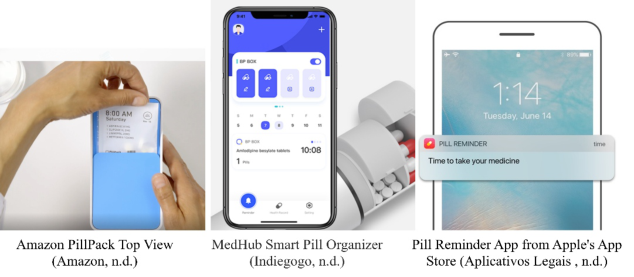
Pill Boxes and Organisers A growing number of products are becoming available in the market, ranging from medication management and delivery service to smart pill organizers, and pill reminders apps, where prominent examples are presented in Figure 1. Amazon pharmacy, and MedExpress (Amazon, 2022; MedExpress, 2022) allows patients to have medication delivered to their home. MedHub Smart Pill Organizer is an example that includes an air-drying compartment to help preserve medications, a light and noise alarm, a Bluetooth connection to smartphones, and a heart rate tracker (Indiegogo, 2022). In addition, there are many applications available on the market that send alerts at appropriate times as a reminder to take medication once uploaded with all appropriate information. One example is the Pill Reminder Medication Alarm from Applications Legais (Legais, 2022).
Figure 1: Current technology used for in-home medication management.
Whilst all previously mentioned examples are either available products or prototypes, several theoretical concepts have been outlined within the literature. López-Nores et al. (2008) proposed IoT based solution linked with home appliances into the network that allows medication intake monitoring from anywhere. In 2014, Yang et al. also proposed a solution that created a network within the home that links specific medical devices rather than everyday appliances. They also outlined their iMedBox, iMedPack, Bio-patch and how they would interact via their Health-IoT Cloud. However, large network infrastructure is needed to support such promising solutions. In this paper, the focus is on the medication factor that leads to the lack of user engagement and lack of medication adherence. There is an indication that in- home healthcare for the older population enabled by technological solutions, such as medication dispensers, pillboxes and smart packaging may alleviate medicine adherence issues, thus helping to bridge the gap between healthcare professionals and patients.
Promoting and enhancing user engagement with medication management is of great importance with great impact on the health of population (Bussell et al., 2017). Ways health care providers can promote better medication adherence. An important dimension of successful user engagement in medication self-management is associated with understanding diverse user needs with limited cognitive and physical capabilities (Howell et al., 2017).
METHODOLOGY
Qualitative research methods such as user interviews in the discovery process are also fundamental to gather in-depth insights based on attitudes, behaviours, and experiences providing a deeper understanding of the user (Bryman, 2012; Kvale & Brinkmann, 2009). Individual interviews are particularly valuable for identifying user needs, pain points, and expectations, which are essential for human-centred outcomes (Beyer & Holtzblatt, 1998). The interactive nature of interviews allows for clarification of responses through nonverbal cues, and exploration of new opportunities (Patton, 2002). The conversation between the researcher and the research participants
Smart Packaging: Overcoming Barriers to Medication Adherence 1403
is fundamental to reveal thoughts and concepts which are the product of interviews. In addition, Flick (2014, p. 10) highlights the importance of this relationship and says, “The interaction between the researcher and the participants leads to the generation of concepts, which are a product of the research act”. Robson (2002) explains how the researcher’s experience and intuition also play a key role in the mainly data-driven interpretation approach.
Exploratory interviews were conducted with five older adults (2 males and 3 females) aged 65 and over. The interviews focused on the participants’ experiences with managing their medications, including challenges associated with rapidly changing medical conditions and capabilities. The interviews were conducted remotely using Microsoft Teams. With participants’ permission, interviews were recorded in Teams for transcription later and stored in a secure location for anonymous analysis.
STUDY PROCEDURE AND RESULTS In this study, participants were given four popular UK medicine dispensers designed to address medication non-adherence, along with manufacturer instructions, and instructed to familiarize themselves with the devices over four weeks without taking medication. A 60-minute individual interview was conducted via Microsoft Teams following this period, covering 36 questions regarding user identification, attitudes, behaviours, and overall experiences with dispensers. Participants were asked to evaluate the following pill boxes and dispensers:
Aidapt Weekday Pill Dispenser: Features braille for users with visual impairments.
Smart Pillbox: Provides visual and audio reminders, suitable for those with memory lapses.
PIVOTELL® Advance Automatic Medication Pill Dispenser: Dispenses doses automatically, ideal for users with dexterity issues and dementia.
INPHER Pill Box: Color-coded for users with hearing loss.
The collected data was analysed using the thematic analysis approach. Thematic data analysis is a process that involves a broad understanding of the raw data into in-depth meanings of themes and patterns within data (Braun & Clarke, 2006). This process consisted of going back through each interview to identify the commonalities and differences in the data and discussion points to identify key themes emerging from the data. The instructions and packaging of products consistently failed to meet participants’ expectations. In addition to unclear instructions and small font sizes, they had difficulty understanding how to operate the digital pillboxes. Many preferred to label their pillboxes themselves due to these difficulties. The lack of clear labelling and comprehensive instructions was a significant barrier, even for native English speakers, leading to frustration and reluctance to use the products. In addition, there were significant challenges associated with rapidly changing medical conditions, such as forgetfulness and sensory impairments. Due to reduced dexterity and complex medication regimes,
participants reported difficulty opening packages, organizing medication, and handling devices. Compared to manual devices, automatic devices were considered complex and time-consuming, often requiring caregiver assistance. The study revealed that formal and informal caregivers need to communicate more effectively with users. There was a desire among participants for devices that could connect with family members and caregivers, providing medication management updates. Additionally, they suggested larger storage compartments, bolder colors, and larger lettering to assist with identification. Based on the findings, the research proposes the development of personalised context-aware smart packaging to address the diverse needs of older adults.
CONCLUSION
The major concern identified by participants was the complexity of managing multiple medications due to rapidly changing health conditions including forgetfulness, sensory impairments, neurological conditions, and reduced dexterity. Participants reported difficulty opening medication packages, following instructions, remembering to take medications on schedule, and keeping track of medications. The findings highlight the potential of smart packaging focused on the changing needs of this ageing demographic has the potential to enhance medication adherence. With this exploratory research, a pathway towards defining a foundational set of functional and non-functional requirements for personalised, and context-sensitive smart packaging has been established. These design features are aimed for accessibility and ease of use for older adults and encompasses their mental and physical impairments. The results have opened new avenues for future research in smart packaging and design features that prioritises accessibility and ease of use leveraging Artificial Intelligence (AI) in smart packaging towards more personalised products to improve medication adherence in older adults.
REFERENCES
Amazon. (2022). Amazon Pharmacy. Available from: https://pharmacy.amazon.co m/how-it-works. Beyer, H., and Holtzblatt, K. (1998). Contextual design: Defining customer-centered
systems. Morgan Kaufmann. Braun, V., and Clarke, V. (2006). Using thematic analysis in psychology. Qualitative Research in Psychology, 3(2), pp. 77–101. Bryman, A. (2012). Social Research Methods (4th ed.). Oxford: Oxford University
Press. Bussell, J. K., et al. (2017). Ways health care providers can promote better medication adherence. Clinical Diabetes, 35(3), pp. 171–177. Clarkson, P. J. (2018). What has engineering design to say about healthcare
improvement? Design Science, 4, p. e17. Flick, U. (2014). An introduction to qualitative research (5th ed.). Berlin: SAGE. Howell, E. H., et al. (2017). Medication self-management skills and cognitive impairment in older adults hospitalized for heart failure: a cross-sectional study. SAGE Open Medicine, 5, p. 2050312117700301.
Smart Packaging: Overcoming Barriers to Medication Adherence 1405
Indiegogo. (2022). MedHub Smart Pill Organizer Medical Intake Adviser. Available from: https://www.indiegogo.com/projects/medhub-smart-pill-organizer-medical- intake-adviser#/. Legais, A. (2022). APLICATIVOS LEGAIS. Available from: https://www.aplicativosl
egais.com/index-en.html. López-Nores, M., Pazos-Arias, J. J., García-Duque, J., and Blanco-Fernández, Y. (2008, January). Monitoring medicine intake in the networked home: The iCabiNET solution. In 2008 Second International Conference on Pervasive Computing Technologies for Healthcare (pp.116–117). IEEE. MedExpress. (2022). MedExpress. Available from: https://www.medexpress.co.uk/h
ow-it-works. Osterberg, L., and Blaschke, T. (2005). Adherence to medication. New England Journal of Medicine, 353(5), pp. 487–497. Patton, M. Q. (2002). Qualitative research & evaluation methods. Sage. Sabaté, E. (Ed.). (2003). Adherence to long-term therapies: evidence for action. World
Health Organization. Yang, G., Xie, L., Mäntysalo, M., Zhou, X., Pang, Z., Da Xu, L., Kao-Walter, S., Chen, Q., and Zheng, L. R. (2014). A health-IoT platform based on the integration of intelligent packaging, unobtrusive bio-sensor, and intelligent medicine box. IEEE Transactions on Industrial Informatics, 10(4), pp. 2180–2191. Yap, A. F., Thirumoorthy, T., and Kwan, Y. H. (2016). Medication adherence in the
elderly. Journal of Clinical Gerontology and Geriatrics, 7(2), pp. 64–67.
LISTED IN THE AHFE DIGITAL BOOKSTORE CATALOGUE
Explore the complete digital volume
Human Factors in Design, Engineering, and Computing
Read this individual research paper free through the original publisher, or explore the full digital proceedings book.
ISBN 978-1-964867-35-9
Explore this ISBN in the AHFE Bookstore ↗Listed in the July 2026 bookstore catalogue; search by ISBN to confirm current availability · Digital book purchase optional