Nichole Morris, Curtis Craig, Bradley Drahos, Katelyn Schwieters, Eugene Floersch, Mark Mazzeo, Jack Norfleet (2024). Patient Gender Treatment Gaps in Tactical Combat Casualty Care of Gunshot Wounds Mitigated by Training Experience. In: Human Factors in Design, Engineering, and Computing. AHFE Open Access, vol. 159, pp. 1194–1203. https://doi.org/10.54941/ahfe1005687
Optimizing Tactical Combat Casualty Care (TCCC) in the golden hour of care is critical to improve patient outcomes. Previous research demonstrates performance gaps in treating female soldiers compared to their male counterparts. This study examines TCCC performance of N = 29 combat lifesavers and Reserve Officers’ Training Corps cadets presented with two high-fidelity simulators, male and female, experiencing polytrauma. Participants were less likely to locate the female’s gunshot wound (GSW) to the chest and more likely to commit sealing errors. There was a significant patient gender x order interaction with more sealing errors and longer times to expose the female patient when the female was presented first. More training experience with female human patients was significantly associated with greater success in locating GSWs and fewer sealing application errors. A follow-up analysis found the beneficial effect of practice with female humans remained when controlling for practice with male humans.
In the United States, female soldiers make up 16.9% of active-duty service members and were recently allowed to serve in active-duty frontline combat roles (Department of Defense, 2019). Previous research has demonstrated that female soldiers may be at greater risk from specific combat injuries compared to their male counterparts, including chest and abdominal injuries (Barbeau et al., 2021; Cross et al., 2011). The disparities in patient outcomes for female soldiers compared to male soldiers may stem from improper or incomplete treatment of their injuries, particularly those to the chest, by first responders, i.e., combat lifesavers (CLS) and combat medics (68W). Chest injuries are prone to improper, incomplete, or be altogether missed during prehospital combat medic treatment activities (Lairet et al.,2019; Lairet et al., 2012; Schauer et al., 2021).
Patient Gender Treatment Gaps in Tactical Combat Casualty Care 1195
A previous examination of Tactical Casualty Care (TCCC) performance on male and female patient simulators by CLS trained soldiers and combat medics found the number of treatment errors to the patient’s chest for a gunshot wound (GSW) injury was predicted by the undressing methods and degree of chest exposure (partial or complete), with female patients less likely to have a complete chest exposure or be exposed through use of shears and, in return, receive more errors in GSW treatment (Schwieters et al., 2023). An additional examination of that simulation study cohort’s performance found that the participants were more likely to complete the standard treatment sequence out of order (i.e., failing to follow the MARCH mnemonic) and complete fewer procedures overall on the female patient compared to the male patient, particularly when the female patient was presented first (Craig et al., 2023). However, this effect was diminished among trainees with more overall training experience, categorized by less than one month, less than 2 years, or more than 2 years. Additionally, Craig and colleagues (2023) reported no interaction between patient order (i.e., male or female patient presented first) and trainee experience in the finding that female patients presented first received fewer procedures and procedures more frequently out of order. Similar work found that years of prior experience and treating female patient simulators were associated with increased time to identify a gunshot wound to the chest (Vaughan et al., 2023). This suggests that even more trained first responders were more error prone in treating the female patient if they were not provided the opportunity to first practice the same procedures on the male patient.
The finding by Craig and colleagues (2023) may suggest that these gender treatment gaps may be influenced by powerful social, cultural, or institutional factors that cannot be simply counteracted by increased training or experience alone. Kramer and colleagues (2015) found that social norms influenced participants’ tendency to be reluctant to disrobe or touch near a female patient’s breast in need of CPR. Alternatively, Craig’s finding may suggest that the standard training experience that soldiers receive does not adequately support training transfer to female patients or training experiences are unequally distributed so that only some, but not all, soldiers are provided training experiences that support their successful treatment of female combat casualties, particularly those in treating sensitive areas of the body like the chest.
While Craig et al. (2023) did not directly measure the type of training experience participants had previously received, they found approximately 1/3 of the participants voluntarily mentioned during their debrief interview that they had no training experience with female patient simulators. This finding corresponds to other research which has found female patients underrepresented in medical training including the Prehospital Trauma Life Support military manual which typically portrays simulated patients with a masculine appearance (Sotomayor et al., 2018). More broadly, an evaluation of the online offerings of full-body patient simulator providers found the products to be most frequently depicting white, male simulators and/or presenting the white, male option as the default even when other genders or skin tones were available (Schwieters, Morris and Craig, 2023). The
availability and marketing methods of full-body patient simulators may limit the inventory of diverse full-body patient simulators (both in terms of gender and skin tone or race) at training centers and stifle diverse training opportunities among both civilian and military medical trainees (Schwieters, 2024).
Current Study This study aims to further our understanding of the influences of various types of combat lifesavers’ training experiences on TCCC performance when treating male and female high-fidelity simulated patients experiencing polytrauma, including a gunshot wound to the chest. We hypothesized that CLS trained participants would commit more GSW treatment errors on the female patient, particularly when presented first. We predicted that errors would be mitigated by greater training experience on female patients, both human and simulated, with simulated female patient experience predicted to have a stronger influence on improved performance than human female patient experience.
The study was reviewed and approved by the University of Minnesota Institutional Review Board (STUDY00018750) and the U.S.Army DEVCOM Soldier Center Human Research Protection Official (HRPO) (Protocol #: ARL 23-053), both of which determined it was “Exempt Research” given it was research involving benign behavioral interventions and only included interactions involving education tests and surveys and interview procedures of which the identity of the human subject cannot be readily ascertained.
METHODS
A total of N = 29 soldiers (27.6% female) were recruited through an email listserv, social media posts, and recruitment flyers. Participant ages ranged from 18–23 (41%), 24–29 (24%), 30–35 (21%), and 35–41 (14%). Participants consisted of Minnesota Army National Guard soldiers (79.3%), University of Minnesota Reserve Officers’ Training Corps (ROTC) Cadets (13.8%), and former active-duty soldiers (6.9%). Participants had all completed the Army combat lifesavers (CLS) training or equivalent training through ROTC or Air Force. The recency of their TCCC training (or equivalent) ranged from 0 to 191 months (M = 22.82, SD = 36.69).
Participants were invited to participate in a two-part study, approximately 10 days apart, which first involved an online component in which they completed an online survey assessing experience and training in combat medicine and attitude and belief measures (i.e., phase one) followed by an on-site patient simulator study in which they would treat two patient simulators of different genders (i.e., phase two). Eligible participants completed an online informed consent, completed an online survey including their previous training experiences and basic demographic information. Participants self-reported their total medical training experience practicing on female simulators/manikins, retrofitted female simulators/manikins (e.g., male simulators with breast overlays or interchangeable genitalia), human female patients, male simulators/manikins, and human male patients.
Patient Gender Treatment Gaps in Tactical Combat Casualty Care 1197
Responses were categorized into frequency bins ranging from none to over 50 times, see Table 1.
Table 1. Frequencies of participants’ self-reported female and male training experiences.
Table available in the original PDF paper.
Training Type None n (%) 1–9 Times n (%) 10–49 Times n (%) 50+ Times n (%) Female human patient 8 (2.8) 14 (48.3) 6 (20.9) 1 (3.4) Female simulated patient 17 (58.6) 8 (2.8) 4 (13.8) 0 (0.0) Female retrofitted patient 22 (75.9) 6 (20.7) 2 (6.9) 0 (0.0) Male human patient 2 (6.9) 10 (34.5) 14 (48.3) 3 (10.3) Male simulated patient 1 (3.4) 10 (34.5) 11 (37.9) 7 (24.1)
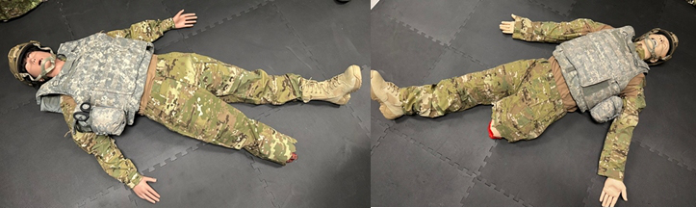
Following the completion of the online survey, participants were scheduled to complete the in-person simulation study. Participants completed a second informed consent upon arrival to the in-person study and were provided with a brief study overview before completing two tactical field care simulations. Participants were asked to treat two full-body patient simulators in counterbalanced order, a prototype female Operative Experience® Tactical Casualty Care Simulator and a male Laerdal® SimMan 3G, see Figure 1. Both patient simulators were presented with life-threatening polytrauma injuries, including a gunshot wound (GSW) to the chest. The gunshot wound to the chest (near both patient’s breasts) was simulated with special effects make-up primarily consisting of modeling putty, dark red cosmetic cream, and artificial blood paste to resemble an entrance and exit wound to the chest.
Figure 1: Images (left) of operative experience TCCS pro female simulator and image (right) of laerdal SimMan 3G patient simulator.
The simulators were dressed in a representative combat uniform, a black sports bra for the female patient, an Improved Outer Tactical Vest (IOTV) Gen III, and an Individual First Aid Kit (IFAK) stocked with standard medical supplies with shears provided. Participants were instructed to render care while operating within the boundaries of the Tactical Field Care phase and were provided 7 minutes for each simulated encounter. Following the simulation, participants completed a series of post-test questionnaires and received feedback on their performance from a former Army combat medic trainer, consistent with the Plus-Delta model (or After-Action Review, AAR)
for feedback/debriefing in time-limited training environments (Sawyer and Deering, 2013; Cheng et al., 2021). Finally, participants completed a debrief interview with research staff. Participants were paid $200 via prepaid debit card for completing both online and in-person study components.
During the simulated scenarios participants donned a helmet with a mounted camera to capture first-person interactions with each patient and additional cameras in the simulation space captured a top-down view of the simulation. Videos were reviewed and coded by three trained researchers to ensure intercoder reliability. A fourth trained researcher completed a final analysis of the codes to further ensure intercoder reliability and assess any remaining disagreements. Analysis of this data examined participants’ success in locating the wounds (yes/no), time to expose wounds (in seconds), wound sealing success (yes/no), and chest seal application errors (count). Coded chest seal application errors included packing of the wound, spider webbing of the chest seal creating air channels, leaving the wipe under the chest seal, off- center seal placement, placement directly over clothing, partial placement over clothing, folding of the chest seal prior to application, use of packaging to create seal, application without exhalation, and leaving of gauze under the seal.
Generalized estimating equations were conducted on these variables, while controlling for recency of TCCC training and amount of experience in their military role, and age, if the secondary variables met the criteria for being used as covariates (Howell, 2013, pp. 594–596). Generalized estimating equations (GEE) were used given the utility of GEEs for analyzing repeated measures data with many different possible distributions (Ballinger, 2004).
RESULTS
Locating wound error. The following analysis used GEEs with a binomial probability model and probit link function. For location error (yes/no), gender presentation of the patient simulator was significant, Wald χ2 = 4.16, df = 1, p = .041, 95% Wald CI [.017, .857] with a higher likelihood of committing a location error for the female simulator compared to the male simulator, B = .437, OR = 1.548. Goodness of Fit (QICC) = 61.447. Order of presentation was not significant (p = .817) and age of participant as the covariate was not significant (p = .216). A second GEE analysis including recency of TCCC training in the model with the other variables found that frequency of training with female humans emerged as significant, Wald χ2 = 5.62, df = 1, p = .018, 95% Wald CI [−1.535, −.146] with a lower likelihood of committing a location error with increased experience practicing with female humans, B = −.840, OR = .432, Goodness of Fit (QICC) = 56.945. Patient simulator gender effects became marginally significant (p = .076) and there was no effect of recency of TCCC training (p = .559).
Time to expose wounds. The following analysis used GEEs with a gamma probability model and log link function. There was a significant patient simulator gender by order interaction Wald χ2 = 7.311, df = 1, p = .007, 95% Wald CI [.114, .718]. The female patient simulator, when presented
Patient Gender Treatment Gaps in Tactical Combat Casualty Care 1199
first, had longer times to exposure relative to the other conditions, B = .416, OR = 1.516. Goodness of Fit (QICC) = 11.066.
Wound sealing success (Y/N). For sealing wounds on either the front (entrance wound) or back (exit wound), the following analysis used GEEs with a binomial probability model and probit link function. There was a significant interaction between the presented gender of the patient simulator and order, Wald χ2 = 4.082, df = 1, p = .043, 95% Wald CI [.017, .857] with a higher likelihood of committing a wound sealing error on the female simulator compared to the male simulator if the female simulator was presented first, B = 1.199, OR = 3.318. Goodness of Fit (QICC) = 74.402. Participant experience with female humans was marginally significant, Wald χ2 = 4.082, df = 1, p = .060, 95% Wald CI [−.991,.021], with more experience practicing with female humans trending towards leading to a reduced likelihood of committing a wound sealing error, B = −.485, OR = .616.
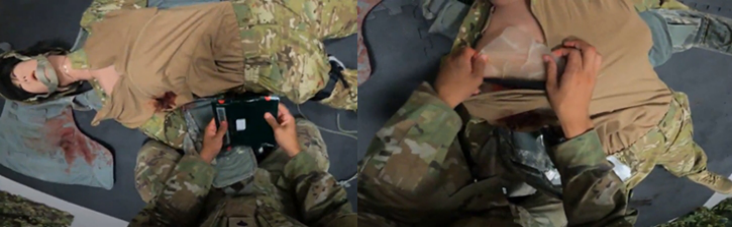
Chest seal application errors. For error count of the application of a chest seal, the following analysis used GEEs with a negative binomial probability model and log link function. The only significant effect was participant training experience with female humans, Wald χ2 = 6.491, df = 1, p = .011, 95% Wald CI [−.358, −.047], with more experience practicing with female humans being associated with a reduced likelihood of committing a procedural error, such as off-center placement or spider webbing (see Figure 2) while applying a chest seal to either patient, B = −.203, OR = .817, Goodness of Fit (QICC) = 36.412. The gender of the patient simulator and order were not significant factors.
Follow-up analyses examining the impact of training on male humans or male simulators failed to find significant effects (all ps > 05) above and beyond the contributing effects found by training on female humans.
Figure 2: Images (left) of female patient GSW to the chest (below breast) and image (right) of participant erroneously applying chest seal above patient breast with spider webbing in the seal.
CONCLUSION
The results are consistent with previous research demonstrating that TCCC performance is influenced by patient gender and order of patient
presentation. There was increased risk of failing to locate GSWs, slower responsiveness to expose and treat the GSW to the patient’s chest, and a greater likelihood to commit a chest sealing error for female patients. Altogether these degraded performance factors observed when the female patient was presented first may partly explain the increased mortality risk due to chest and abdominal injuries for female soldiers relative to male soldiers.
The self-reported training experience in practicing TCCC procedures on male and female patients (both simulated and human) present a stark imbalance in the opportunities that soldiers are afforded to prepare themselves to interact with, expose, and treat male and female combat casualties. Over half of the participants had never had an opportunity to practice on a female simulated patient, while only one participant reported the same total absence of experience on male simulated patients. Further, those with experience with female simulators skewed toward fewer overall opportunities (e.g., 1–2 times) while experience with male simulators was more normally distributed. These findings may highlight downstream impacts on limited training opportunities and access to full-body female patient simulators stemming from limited availability of diverse product offerings and inventories reported in previous studies (Schwieters, Morris and Craig, 2023; Schwieters, 2024).
Participants reported more training opportunities with male humans than female humans; however, there was a closer equivalency between these training opportunities across patient genders compared to the simulated patients. This finding offers some promise for enhanced training opportunities given the significant effect of female human training experiences on GSW location and treatment success and suggest that performance gaps in treating female patients may be partially mitigated with increased training opportunities with female human patients. Because there were more training opportunities with humans than with simulators, the amount of training may account for the significant effect of training with humans relative to training with simulators for performance in the present study. Another potential explanation for the benefit of training on humans relative to simulators may be the method of training. Limited training opportunities with female simulated patients may lead to a focus on a specific selection of procedures that is practiced repeatedly, or blocking. Block training is when technique A and technique B are practiced in a block (i.e., practice AAA, then BBB). The greater availability of female humans in TCCC training curriculum and the complexity of interacting with a fellow person may inadvertently lead to training on female humans to be interleaved across procedures and concepts (i.e., practice ABAB). Concentrated training or blocking has been found to be associated with poorer skill retention and performance compared to interleaved training (Goldin et al., 2014; Clayton et al., 2024).
The limited number of participants who had experience with simulated female patients may have restricted the statistical power of this study to determine the degree to which training on female simulators supports successful transfer of training to future female combat casualties. In line with the theory of identical elements (Woodworth and Thorndike, 1901), it
Patient Gender Treatment Gaps in Tactical Combat Casualty Care 1201
was hypothesized that experience with female simulators would have resulted in better training transfer than human female training experience given the expected greater similarities between the practice and test environments using simulators, but this relationship was not observed. However, the quality and the fidelity of few training experiences participants had been provided with female simulators, both standard and retrofitted, is not well known. Some participants mentioned the uncanny experience of retrofitted male simulators to appear female with only silicone or even fabric breasts attached. Such low- fidelity modifications (even when applied to a high-fidelity male simulator) may result in negative training transfer given the unclear expectations about the true differences between practicing on the simulator and performing on humans in the real world (Fritz, Gray and Flanagan, 2008).
Moreover, Morris and colleagues (2023) previously found that CLS participants reported limited training experiences in undressing and exposing patients and few had any experience cutting and removing a female patient’s bra. This raises an important question about which training experiences on female patients, either human or female, are most important to support CLS soldiers to expose and treat female combat casualties, particularly those with injuries near sensitive areas of the body. There are notable practical and ethical limitations in the use of peer human female trainees in practicing procedures that involve exposing sensitive areas of the body. Future studies should examine the needed level of fidelity of female simulators and training simulations (e.g., presence of a bra which must be removed for accurate treatment) as well as explore the use of standardized patients (i.e., trained patient actors, Beigzadeh et al., 2016) to best improve skill acquisition and retention for high-stress performance environments.
Finally, there may also be other factors, such as social or cultural beliefs that contribute to the increased reluctance to treat female patients for a chest injury, such as the belief that women are fragile or fears of having to remove clothing (Becker et al., 2019; Blewer et al., 2018; Perman et al., 2019). Follow up studies examining the self-reported attitudes and beliefs of this participant population will examine the extent to which these factors may have influenced performance. Future research should continue to examine the cultural influences that may interfere with swift and accurate treatment of female combat casualties and explore potential countermeasures to mitigate these influences.
ACKNOWLEDGMENT
The authors would like to acknowledge Marshall Mabry and William Kessler of the Human Factors Safety Laboratory, Jonathan Chaika and Lou Clark Ph.D., of UMN M Simulation, and the Minnesota Army National Guard for their assistance with conducting the study.
REFERENCES
Ballinger, G. A., 2004. Using generalized estimating equations for longitudinal data analysis. Organizational Research Methods, 7(2), pp. 127–150.
Barbeau, P., Michaud, A., Hamel, C., Rice, D., Skidmore, B., Hutton, B., Garritty, C., da Silva, D. F., Semeniuk, K. and Adamo, K. B., 2021. Musculoskeletal injuries among females in the military: a scoping review. Military Medicine, 186(9-10), pp. e903–e931. Becker, T. K., Gul, S. S., Cohen, S. A., Maciel, C. B., Baron-Lee, J., Murphy,
T. W., Youn, T. S., Tyndall, J. A., Gibbons, C., Hart, L. and Alviar, C. L., 2019. Public perception towards bystander cardiopulmonary resuscitation. Emergency Medicine Journal, 36(11), pp. 660–665. Beigzadeh, A., Bahmanbijri, B., Sharifpoor, E. and Rahimi, M., 2016. Standardized patients versus simulated patients in medical education: are they the same or different. Journal of Emergency Practice and Trauma, 2(1), pp. 25–28. Blewer, A. L., McGovern, S. K., Schmicker, R. H., May, S., Morrison, L. J.,
Aufderheide, T. P., Daya, M., Idris, A. H., Callaway, C. W., Kudenchuk, P. J. and Vilke, G. M., 2018. Gender disparities among adult recipients of bystander cardiopulmonary resuscitation in the public. Circulation: Cardiovascular Quality and Outcomes, 11(8), p. e004710. Cheng, A., Eppich, W., Epps, C., Kolbe, M., Meguerdichian, M. and Grant, V.,
2021. Embracing informed learner self-assessment during debriefing: the art of plus-delta. Advances in Simulation, 6(22), pp. 1–9. Clayton, L., Wells, M., Alter, S., Solano, J., Hughes, P. and Shih, R., 2024.
Educational concepts: A longitudinal interleaved curriculum for emergency medicine residency training. Journal of the American College of Emergency Physicians Open, 5(3), p. e13223. Cross, J.D., Johnson, A.E., Wenke, J.C., Bosse, M.J. and Ficke, J.R., 2011. Mortality in female war veterans of operations enduring freedom and Iraqi freedom. Clinical Orthopaedics and Related Research®, 469, pp. 1956–1961. Craig, C. M., Schwieters, K. R., Drahos, B. A. and Morris, N. L., 2023. A
pilot study on the role of experience and patient gender on MARCH treatment sequence. Military Medicine, 188(7-8), pp. e2041–e2048. Department of Defense, 2021. Demographics Profile of the Military Community
2021. https://download.militaryonesource.mil/12038/MOS/Infographic/2021- demographics-active-duty-members.pdf Fritz, P. Z., Gray, T. and Flanagan, B., 2008. Review of mannequin-based highfidelity simulation in emergency medicine. Emergency Medicine Australasia, 20(1), pp. 1–9. Goldin, S. B., Horn, G. T., Schnaus Jr, M. J., Grichanik, M., Ducey, A. J., Nofsinger,
C., Hernandez, D. J., Shames, M. L., Singh, R. P. and Brannick, M. T., 2014. FLS skill acquisition: a comparison of blocked vs interleaved practice. Journal of Surgical Education, 71(4), pp. 506–512. Howell, D. C., 2013. Statistical methods for psychology (8th Ed). Wadsworth CENGAGE Learning. PWS-Kent Publishing Co. Kramer, C. E., Wilkins, M. S., Davies, J. M., Caird, J. K. and Hallihan, G. M., 2015.
Does the sex of a simulated patient affect CPR? Resuscitation, 86, pp. 82–87. Lairet, J. R., Bebarta, V. S., Burns, C. J., Lairet, K. F., Rasmussen, T. E., Renz, E. M., King, B. T., Fernandez, W., Gerhardt, R., Butler, F. and DuBose, J., 2012. Prehospital interventions performed in a combat zone: a prospective multicenter study of 1, 003 combat wounded. Journal of Trauma and Acute Care Surgery, 73(2), pp. S38–S42.
Patient Gender Treatment Gaps in Tactical Combat Casualty Care 1203
Morris, N., Craig, C., Schwieters, K., Drahos, B., Mabry, M., Floersch, E. and Kessler, W., 2023. Limited training in undergarment and clothing removal techniques to expose wounds in combat care. In: Jay Kalra (eds) Emerging Technologies in Healthcare and Medicine. AHFE (2023) International Conference. AHFE Open Access, vol. 116. AHFE International, USA, pp. 156–164. Perman, S. M., Shelton, S. K., Knoepke, C., Rappaport, K., Matlock, D. D., Adelgais,
K., Havranek, E. P. and Daugherty, S. L., 2019. Public perceptions on why women receive less bystander cardiopulmonary resuscitation than men in out-of-hospital cardiac arrest. Circulation, 139(8), pp. 1060–1068. Sawyer, T. L. and Deering, S., 2013. Adaptation of the US Army’s after-action review for simulation debriefing in healthcare. Simulation in Healthcare, 8(6), pp. 388–397. Schwieters, K. R. (2024). An Examination of Biases in Training Design and
Treatment Decisions in Combat Medicine. Ph. D. Thesis. University of Minnesota. Schwieters, K. R., Drahos, B. A., Craig, C. M., Kessler, W., Mabry, M., Norfleet, J. E., Mazzeo, M. V. and Morris, N. L., 2023, September. The effect of patient gender and undressing method on chest exposure for the treatment of a gunshot wound. In Proceedings of the Human Factors and Ergonomics Society Annual Meeting (Vol. 67, No. 1, pp. 614–619). Sage CA: Los Angeles, CA: SAGE Publications. Schwieters, K. R., Morris, N. L. and Craig, C. M., 2023. Default bias in medical
patient simulators: Differences in availability and procedures. Human Factors in Healthcare, 3, p. 100040. Schauer, S. G., Rizzo, J. A., Walrath, B. D., Baker, J. B., Gillespie, K. R. and April, M. D., 2023. A conceptual framework for non-military investigators to understand the joint roles of medical care in the setting of future large scale combat operations. Prehospital Emergency Care, 27(1), pp. 67–74. Sotomayor, T. M., Mazzeo, M. V., Maraj, C. S., and Page, A. J. (2018). Saving female
lives using simulation: Elevating the training experience. Journal of Cyber Security and Information Systems, 6(4), pp. 28–37. Vaughan, S. R., Ballard, T., Ward-Demo, P., Vojta, L., Ahmed, A. E. and Costello, A.,
2023. Evaluation of Gender Disparity in Tactical Combat Casualty Care. Military Medicine, p. usad455. Woodworth, R. S. and Thorndike, E. L., 1901. The influence of improvement in one mental function upon the efficiency of other functions. (I). Psychological Review, 8(3), pp. 247–261.
LISTED IN THE AHFE DIGITAL BOOKSTORE CATALOGUE
Explore the complete digital volume
Human Factors in Design, Engineering, and Computing
Read this individual research paper free through the original publisher, or explore the full digital proceedings book.
ISBN 978-1-964867-35-9
Explore this ISBN in the AHFE Bookstore ↗Listed in the July 2026 bookstore catalogue; search by ISBN to confirm current availability · Digital book purchase optional