Nichole Morris, Curtis Craig, Katelyn Schwieters, Bradley Drahos, Marshall Mabry, Eugene Floersch, William Kessler (2023). Limited training in undergarment and clothing removal techniques to expose wounds in combat care. In: Emerging Technologies in Healthcare and Medicine. AHFE Open Access, vol. 116, pp. 156–164. https://doi.org/10.54941/ahfe1004367
A critical component of combat casualty care is to fully expose the patient to identify and treat injuries. Completing these actions under stressful conditions is expected to require adequate training. In this study 21 combat lifesaver trained soldiers were surveyed regarding their recent training exposing chest injuries of male and female soldiers. Nearly all participants (95.2%) reported experience in treating male simulated patients; however, only 52.4% reported any experience applying a chest seal on a male human or simulated patient and only 28.6% reported any experience removing the t-shirt of a male human or simulated patient. Seven participants (33.3%) reported experience in treating female simulated patients, 23.8% reported at least some experience applying a chest seal to a female human or simulated patient, and only 9.5% reported experience removing the female patient’s t-shirt and, similarly, a female patient’s bra. Findings suggest a pronounced gap in the CLS training curriculum.
Military combat casualties require swift treatment from medics or other soldiers trained in combat lifesaving care. Tactical Combat Casualty Care (TCCC) trains Combat Lifesavers (CLS) and combat medics to treat patients suffering from a range of severe injuries until evacuation to advanced med- ical care. Treating patients at the point of injury, prior to evacuation, is a key component of casualty care during the timeframe often referred to as the golden hour, signifying the critical period in which life-threatening injuries must be managed (Fisher & Miles, 2020).
Among some of the most serious and life-threatening injuries soldiers can experience in combat, a penetrating chest injury requires an occlusive or vented chest seal over the wound and, if a tension pneumothorax is suspected, a needle chest decompression (NCD). During the treatment of a penetrat- ing chest injury, the TCCC manual provides guidance for first responders, including combat medics and CLS, to fully expose the patient’s chest from navel to neck through cutting or unfastening to prepare the area for treat- ment (TCCC, 2017). Full exposure of the patient can best facilitate locating
Limited Training in Undergarment and Clothing Removal Techniques 157
all injuries and support clear and even placement of the occlusive dressing to ensure an air-tight seal.
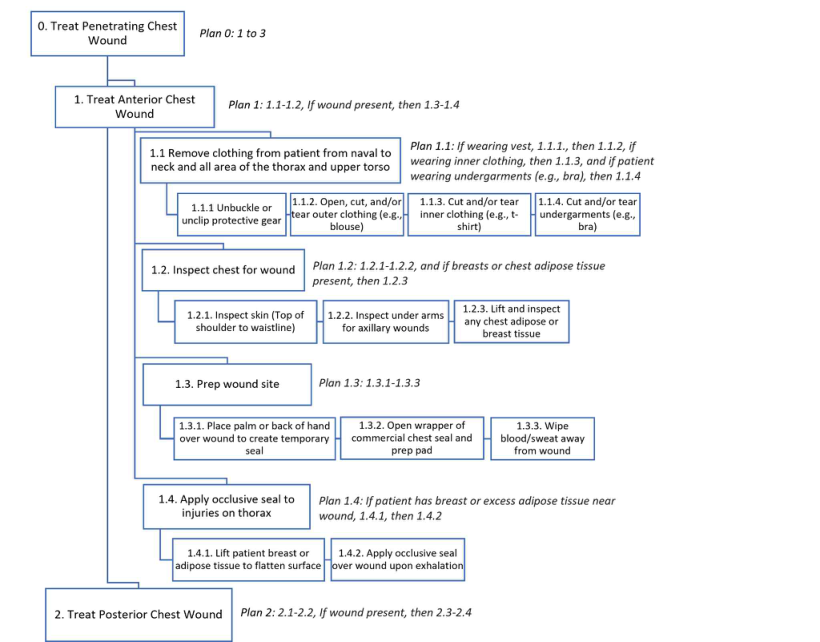
Hierarchical Task Analysis of Treating a Penetrating Chest Wound The process of treating an open or sucking chest wound under TCCC guid- ance was detailed by the human factors group within the research team in a hierarchical task analysis (HTA) to denote each of the preceding steps required to facilitate applying the occlusive dressing on a penetrating chest wound. The HTA is shown graphically in Figure 1 to depict the tasks and sub- tasks of treating a penetrating wound to the anterior chest but does not show the subsequent steps for treating posterior chest wounds. The HTA was cre- ated by referencing the Tactical Combat Casualty Care Handbook Version 5 (U.S. Army, 2017), Deployed Medicine Combat Casualty Care Instructional Videos (JTS / CoTCCC, 2018), and was separately checked and validated by a member of the research team that was not involved in the original creation of the HTA and is an expert former combat medic instructor and assistant director of a medical simulation center.
Figure 1: Graphical HTA of TCCC guidance for treating a penetrating chest wound to anterior chest.
This complete series of steps enables the successful treatment of the casualty’s penetrating chest injuries, meaning completing the final stage of applying the occlusive dressing to the anterior chest wound (i.e., Task 1.4) has certain preconditions that enable this step to be completed (e.g., Tasks 1.1-1.3). One way of conceptualizing the dependencies between tasks are couplings or potential couplings as described in FRAM, a method of repre- senting complex systems with the human factor in mind (Hollnagel, 2012). Upstream-downstream couplings occur when the variability in performance on two tasks (or functions) can combine in expected or unexpected ways, leading to desirable or undesirable outcomes (Hollnagel, 2012, pp. 77, 106). The idea of couplings characterizes the output of the subtasks outlined in Figure 1, describing a relationship between the upstream tasks of undress- ing the patient and the downstream tasks of applying the occlusive dressing. Imprecise output (i.e., improper completion) or failure to complete upstream tasks such as 1.1.3 and/or 1.1.4 (i.e., cutting/tearing to remove the t-shirt and/or bra) may decrease the likelihood of completing downstream tasks, such as 1.2 (i.e., inspect the chest for wounds), which would risk missing the chest injury altogether. Alternatively, efficient but not thorough methods to complete tasks, such as in task step 1.1.4 in which a first responder may lift, rather than cut, a female patient’s bra to expose the wound, but not the breast, may result in imprecise output of the task, increasing the likelihood of the application of the chest seal partially on the skin and partially on the bra, thus failing to achieve an airtight seal and possibly resulting in displacement of the chest seal.
The identification of the upstream and downstream couplings in the pro- cess of discovering and treating penetrating chest wounds highlights the importance of affording trainees with experience in practicing the entire sequence, thus narrowing performance variability on those tasks. However, given the brevity of medical training for soldiers and the cost of materials, experience with valid and high-fidelity trauma care simulations including practice with exposure techniques may be lacking or inadequate. Allowing trainees to cut or tear apart uniforms and undergarments during all training simulations with low or high-fidelity manikins, such as the Simulaids Res- cue RandyTM or the Laerdal SimMan 3GTM respectively, would come with considerable budgetary costs. Further, the process of re-dressing life-sized, weighted manikins in military uniforms for each training simulation would require considerable time and likely slow throughput.
A common approach among training centers is to use modified uniforms which have been tailored to feature Velcro seams to support reuse of the garments and offer greater expediency in the process of redressing manikins for training simulations. However, this feature not only provides a visual cue to guide exposure processes among trainees, but also facilitates undress- ing the patient with no need for shears, knives, or other cutting tools and requires lower physical force than that needed for tearing the durable fabric of a combat uniform.
Another important element in considering training in patient wound expo- sure during a combat casualty event is the inclusion of women in combat in the United States Armed Forces. Since 2016, women in the armed services
Limited Training in Undergarment and Clothing Removal Techniques 159
now make up 17.3% of all active-duty members (Department of Defense, 2021). Given the recency of the inclusion of women serving in direct ground combat roles in the United States Armed Forces and the limited availability of full body patient simulators to practice TCCC procedures (Schwieters et al., 2022), many soldiers trained as combat medics or combat lifesavers may have limited experiences in practicing TCCC procedures on female patient simu- lators. Further, experience with additional undergarment removal in order to treat female casualties, such as cutting or removing sports bras, may be even more limited. This lack of experience is especially critical as rescuers tend to remove less clothing from females in a simulated treatment event (Kramer et al., 2015) and appear to take longer to expose chest wounds and miss discovering the wounds altogether when initially treating female patients (Craig et al., 2022, 2023; Mazzeo et al., 2021).
This study aims to examine the training experiences of soldiers trained as combat lifesavers (CLS) regarding treating male and female patient sim- ulators, practicing chest seal application, and removing t-shirts and under- garments to practice treating chest injuries. The study findings may help to provide insight into possible gaps in training and opportunities to better prepare soldiers for combat casualty care in the future.
METHODS
Participants In total, 21 participants (23.8% female) completed the study. All participants had previously completed combat lifesavers (CLS) training (M = 2.1 years prior, SD = 2.5). Nearly all (90.5%) reported some medical training expe- rience (i.e., practicing applying a tourniquet, chest seal, and/or needle chest decompression (NCD) on a male or female human or simulated patient) in the past 6 months. The age range was 18 to 41 years old, with the most fre- quent age range reported as 24–29 years old (33.3%). The race of participants was self-reported by 16 (76.2%) as White or Caucasian, 2 (9.5%) as Asian, 2 (9.5%) as multiracial, and 1 (4.8%) as other. For education, 7 (33.3%) reported having some high school or a high school diploma/GED, 9 (42.9%) having some college, an associate’s degree, or technical degree, 2 (9.5%) hav- ing a bachelor’s degree, and 3 (14.3%) having a graduate degree. The rank of the soldiers ranged from E-4 to O-4, with the most frequent rank reported at Sergeant/E-5 (28.6%). The majority of participants, 18 (85.7%) served in the Minnesota National Guard, 2 (9.5%) served in the University of Minnesota Army ROTC, and 1 (4.8%) served active-duty in the Army.
Procedures Participants were recruited through Minnesota National Guard email dis- tribution lists, social media accounts, and flyers posted in local armories. Interested participants were provided an online QualtricsTM link to pro- vide eligibility information in an initial screening survey. Current soldiers who were CLS trained but were not Combat Medics were eligible to com- plete an initial online survey following informed consent. Participants were
then scheduled to participate in an in-person test approximately one week after their online participation. The in-person testing consisted of the partic- ipant performing TCCC on two full-body, high fidelity simulators, one male and one female, in counterbalanced order. The simulators each presented with life-threatening injuries requiring tourniquet, nasopharyngeal airway, chest seal, and NCD. The results of the TCCC performance are not analyzed here. Following treatment of the two simulators, participants completed a post-study survey and semi-structured interview.
The study was reviewed and approved by the University of Minnesota Institutional Review Board (STUDY00018750) and the U.S.Army DEVCOM Soldier Center Human Research Protection Official (HRPO) (Protocol #: ARL 23-053), both of which determined it was “Exempt Research” given it was research involving benign behavioral interventions and only included interactions involving educational tests and survey and interview procedures of which the identity of the human subject cannot be readily ascertained.
RESULTS
Participants were asked to report their overall experiences in practicing TCCC protocols on patient simulators at any time in their past train- ing. Twenty participants (95.2%) reported they had experience in treating male simulated patients in the past. The average frequency of total expe- riences with a male patient simulator was reported as M = 20.5 times (SD = 30.41). In contrast, only seven (33.3%) participants reported any past experience treating female simulated patients (either standard or retrofitted to present as female). The average frequency of total experiences among those who reported access to a female patient simulator was M = 6.75 times (SD = 6.95).
Participants were also asked to report their experiences in practicing individual TCCC treatments in the past 6 months. Along with total simu- lator experience, pairwise t-tests were conducted to examine differences in reported experience in practicing selected TCCC treatments on male and female human or simulated patients in the past 6 months, see Table 1.
Table 1. Pairwise t-test comparison of participants’ reported experiences in training with female vs male human or simulated patients.
Table available in the original PDF paper.
Practice Female Male t df p Any past simulator experience 33.3% 95.2% −3.389 20 0.003 Tourniquet practice (past 6 months) 61.9% 76.2% −1.369 20 0.186 Chest seal practice (past 6 months) 23.8% 52.4% −2.335 20 0.030 NCD practice (past 6 months) 14.3% 42.9% −2.335 20 0.030 Undershirt practice (past 6 months) 9.5% 28.6% −2.169 20 0.042
Practice in placing a tourniquet was the most frequently reported treatment and did not differ significantly in experience in treating male or female human or simulated patients. Practice in the past 6 months in placing a chest seal and NCD were reported less frequently compared to tourniquet placement
Limited Training in Undergarment and Clothing Removal Techniques 161
and the differences in experience practicing these procedures across patient genders were significant (p < .05), with fewer participants reporting practice on female human or simulated patients.
In reference to FRAM (Hollnagel, 2012), the upstream tasks (or functions, in FRAM) that reduce performance variability to afford precise application of the chest seal and NCD, i.e., removing the undershirt and, if applicable, bra, were performed even less frequently by participants in the past 6 months. Only six participants (28.6%) reported practice in removing a human or simulated male patient’s t-shirt, while two (9.5%) participants reported the same practice on female patients, a significant difference (p < .05). Further- more, the same two participants with reported practice removing a female patient’s t-shirt were the only participants to report practice removing the female human or simulated patient’s bra.
Follow-up interviews with participants indicated minimal experience in exposure practice and a lack of equipment provided in the field to effectively remove clothing during treatment. Participants reported alternative experi- ence practicing tearing open training uniforms which have been retrofitted with Velcro, but typically had never been granted access to cutting or tear- ing realistic uniforms or undergarments prior to practicing TCCC techniques. Moreover, most participants reported that the typical simulation training sce- nario is with a male manikin that is already undressed to expose wounds. Multiple participants commented on the novelty of the opportunity their study participation provided in allowing them to practice on a female simu- lator, pull the ripcord of an armor vest to release it, and to cut the uniform, t-shirt, and undergarments off a patient. Table 2 provides selected quotes illustrating the reported experiences in training and instruction regarding clothing removal.
Table 2. Example quotes from interviews regarding clothing removal training.
Table available in the original PDF paper.
Participant Quotes “For CLS certification, 5 months ago, [I] do not remember learning anything about clothing removal. I think they mentioned shears. I don’t remember learning anything specific about that…we did not practice cutting away clothing. No mention of clothing removal for torso.” “[Training’s] very inconsistent. There was one time they said, if you can’t get the shirt off just do your best to seal the thing, they’d show us different ways to do it - put tape, make sure the shirt’s tight, tape it. They tell you now to cut it.” “Whenever it’s CLS you always simulate it, mostly because they tell us to NOT cut the shirts. Whenever you do your test you’re just like “Ooh I’m cutting the shirt” [miming to pretend to cut shirt]” “No, this is the first [experience] I’ve ever had where I’ve had to actually undo the vest, I had to actually cut [the] uniform… I was like, holy buckets, I feel a little bit unprepared. That was a brand-new experience… Cutting the uniform, in the military we don’t like wasting resources, we would never cut the uniform off the manikin.”
Finally, some participants expressed doubt regarding their ability to expose wounds beyond lifting clothing because their improved first aid kit (IFAK)
does not typically contain shears that could facilitate cutting. The IFAK Gen- eration I had no standard tools for cutting or clothing removal; however, the IFAK Generation II does list a strap cutter, rescue (4240-01-570-0319) among its contents (U.S. Army, 2017). Participants infrequently mentioned the strap cutter, and it is unclear the extent to which it is available or included in training among this population. Table 3 provides exemplar quotes of par- ticipants’ discussing their lack of access to efficient cutting tools or uniforms that are allowed to be cut.
Table 3. Example quotes from interviews regarding access to cutting tools.
Table available in the original PDF paper.
Participant Quotes “I’ve never used…scissors to remove a shirt, especially cutting a nice shirt like that. [referring to shirt from TCCC performance test of the study]” “I always tell my guys ‘Go to Walmart and buy a pocketknife’ ‘Why?’ ‘Well, you’re gonna need it.’ … We don’t have shears on the IFAKs. To be quite honest, sometimes the IFAKs aren’t properly equipped … Because I’ve been in so long, it wouldn’t be a problem to take [the pocketknife] and cut the clothing away.” “We use the shears, which the medics usually carry, almost everybody now carries a seatbelt cutter on them, so we use the seatbelt cutter and just run down and cut everything open as wide as we can, but we generally get demonstrated how to do it, we don’t get to practice it because our clothing we have to pay for and it’s expensive. Some units do have old uniforms that we get to cut apart”
CONCLUSION
Training is intended to provide soldiers a basis for successful performance in the field, particularly in respect to novel tasks or infrequently practiced tasks requiring fast task completion time. Findings suggest a pronounced gap in the CLS training curriculum which ill-prepares CLS trained soldiers to adequately expose life-threatening wounds to afford swift and effective treat- ments, including chest seal and needle chest decompression, in real combat situations.
Pedagogical instruction to expose wounds without hands-on practice may hinder performance in combat environments. Further, the lack of access to female simulators and limited experience in cutting or removing undershirts and bras may disproportionately place risks on female soldiers due to delayed or incomplete treatment, especially when treating life-threatening injuries to the chest. Performance variability of exposure is coupled with performance in wound identification and potentially also coupled with treatment qual- ity and maintenance (e.g., clothing “sticking” to and dislodging chest seals and NCDs). Therefore, poor training in exposure reduces the efficacy of training on wound treatment in general, particularly for female soldiers. The results of this study demonstrate a paucity of experience in undressing male and, especially, female soldiers to properly treat a penetrating chest wound. Further, interviews highlight a common practice to skip or pretend to com- plete undressing during training and testing. Together, these findings suggest that the first time many soldiers may be afforded the opportunity to cut and remove clothing from a casualty would be in combat.
Limited Training in Undergarment and Clothing Removal Techniques 163
While the results of the study examine a small sample of primarily Min- nesota Army National Guard CLS trained soldiers, the findings appear to support other examples of performance gaps in treating penetrating chest wounds during combat. A study of penetrating chest wounds by prehospi- tal ground forces in Afghanistan from 2013–2014 found the medical officer was the highest-level provider placing chest seals on 64.5% of patients, while only 24.2% were placed by a medic, and 25.8% did not receive a chest seal (Schauer et al., 2017). These findings may demonstrate the outcomes of gaps in training by CLS trained soldiers, and possibly medics, in which penetrating chest wounds are often not being treated at the point of injury, thus risking missing the golden hour of treatment. Consequences for treatment delay may be more severe for female casualties. Even prior to serving in direct combat action, female soldier casualties were found to have a proportionally greater rate of fatalities relative to males, with a relatively high rate of abdomen and chest injuries (Cross et al., 2011).
Future work will examine the relationship between TCCC performance on high-fidelity male and female patient simulators based on experience with simulators and exposure techniques, and further elaborate the system model of TCCC treatment to better capture work-as-done (e.g., no shears pro- vided) instead of work-as-imagined as prescribed in the TCCC Handbook (U.S. Army, 2017). The model elaboration will focus on the contribution of experience/training as a precondition for minimizing performance variability (Hollnagel, 2012, p. 107) in exposure, potentially reducing the likelihood of unwanted medical outcomes due to upstream-downstream coupling between exposure, wound identification, and treatment.
ACKNOWLEDGMENT
The authors would like to acknowledge Jack Norfleet, Ph.D. and Mark Mazzeo of AFC Soldier Center, Jonathan Chaika and Lou Clark Ph.D., of UMN M Simulation, and the Minnesota Army National Guard.
REFERENCES
Craig, C. M., Drahos, B., Schwieters, K. R., Morris, N. L., Lye, M., Kowalewski, T. M., Norfleet, J. E. & Mazzeo, M. V. (2022, April). Evaluating Gender Differences in Treatment of Simulated Gunshot Wounds Using a Female Retrofit. In Frontiers in Biomedical Devices (Vol. 84815, p. V001T06A004). American Society of Mechanical Engineers. Craig, C. M., Schwieters, K. R., Drahos, B. A., & Morris, N. L. (2023). A pilot study on the role of experience and patient gender on MARCH treatment sequence. Military Medicine, 188(7-8), e2041-e2048. Cross, J.D., Johnson, A. E., Wenke, J.C., Bosse, M. J., & Ficke, J. R.(2011). Mortality
in female war veterans of operations enduring freedom and Iraqi freedom. Clinical Orthopaedics and Related Research®, 469, 1956–1961. Department of Defense. 2021 Demographics Profile of the Military Community.;
Fisher, A. D., & Miles, E. A. (2020). Lessons in prehospital trauma management during combat. Operational and Medical Management of Explosive and Blast Incidents, 145–161. Hollnagel, E. (2012). FRAM: The Functional Resonance Analysis Method: Modelling Complex Socio-technical Systems (1st ed.). CRC Press. https://doi.org/10.1201/9781315255071 JTS/CoTCCC (2018). Vented Chest Seal, Occlusive Dressing & Burping. Tactical Combat Casualty Care. Deployed Medicine. https://www.deployedmedicine.com/market/11/content/73 Kramer, C. E., Wilkins, M. S., Davies, J. M., Caird, J. K., & Hallihan, G. M.
(2015). Does the sex of a simulated patient affect CPR? Resuscitation, 86, 82–87. https://doi.org/10.1016/j.resuscitation.2014.10.016 Mazzeo, M., Chewning-Kulick, M., Pike, W., Cartwright, J., Rovira, E., & Thomson, R. (2021). Detecting hesitation during battlefield wound treatment on female sol- diers. In Advances in Human Factors and Ergonomics in Healthcare and Medical Devices: Proceedings of the AHFE 2021 Virtual Conference on Human Fac- tors and Ergonomics in Healthcare and Medical Devices, July 25-29, 2021, USA (pp. 329–336). Springer International Publishing. Schauer, S. G., April, M. D., Naylor, J. F., Simon, E. M., Fisher, A. D., Cunning-
ham, C. W., Morissette, D. M., Fernandez, R. R. D., & Ryan, K. L. (2017). Chest Seal Placement for Penetrating Chest Wounds by Prehospital Ground Forces in Afghanistan. Journal of Special Operations Medicine, 17(3), 85–89. Schwieters, K. R., Morris, N. L., & Craig, C. M. (2023). Default bias in medical patient simulators: Differences in availability and procedures. Human Factors in Healthcare, 3, 100040. U.S. Army (2017). 17-13: Tactical Combat Casualty Care Handbook, Version 5.
Read this individual research paper free through the original publisher, or explore the full digital proceedings book.
ISBN 978-1-958651-92-6
Explore this ISBN in the AHFE Bookstore ↗Listed in the July 2026 bookstore catalogue; search by ISBN to confirm current availability · Digital book purchase optional