Hong-in Cheng, Jun Jie Deng (2023). Workload analysis of courier trolley push and pull for express couriers. In: Emerging Technologies in Healthcare and Medicine. AHFE Open Access, vol. 116, pp. 139–145. https://doi.org/10.54941/ahfe1004365
Express couriers typically move packages by pushing and pulling trolleys as part of their duties. Rolltainers and hand carts are the most common courier trolleys. As a result of COVID-19, online shopping has expanded dramatically around the world and express courier services have become a part of everyday life. Work-related musculoskeletal disorders (WMSDs) are prevalent occupational diseases caused by repetitive pushing and pulling activities. This study investigated the physical and subjective workloads associated with straight and curved pushing/pulling of hand carts and rolltainers for express delivery. There have been many ergonomic studies conducted on pushing and pulling tasks, however, little research has been conducted on the effects of pulling and pushing directions on hand carts and rolltainers. Twenty-three professional express delivery workers participated in the study. A push and pull delivery trolley task was assessed using EMG and subjective perceived exertion in this study. A general observation was made that BIC and UT are less activated than TRI and ES when pushing and pulling delivery trolleys. Pushing a trolley is more effective than pulling one in reducing WMSD risk. A rolltainer would be preferred over a hand cart to reduce workload. The study found that hand carts generate more muscle activity when moved in a straight direction than when moved in a curved direction.
Operating manual trolleys with pushing and pulling is common in courier services. The repetitive nature of these actions can trigger work-related mus- culoskeletal disorders (WMSDs), leading to enduring discomfort and physical impairments (Guo et al., 2020; Song et al., 2020). Activities that involve pushing and pulling place stress on the upper body such as the arm, shoul- ders, and lower back (Lett et al., 2006; Nimbarte et al., 2013; Ohnishi et al., 2016). It has been estimated that WMSDs affect over 50% of the working population, making them the second most common occupational health issue and leading to substantial economic losses (Shuai et al., 2014).
In the wake of the COVID-19 pandemic, online shopping has experienced an unprecedented surge, and global retail e-commerce traffic has increased by approximately 37% from January 2020 to June 2020 (Ghodsi et al., 2022). There has been a significant increase in online shopping in Sweden, Italy, and South Korea recently (Andruetto et al., 2023; Rim et al., 2022). The
total number of packages delivered in Korea in 2021 was approximately 3.63 billion, with an average of 70 packages per individual (Rim et al., 2022). Delivery workers are also in high demand as online shopping becomes more popular. Even late at night or early in the morning, some couriers deliver packages before the morning.
There has been research conducted on the impact of handlebar heights on manual carts (Lee et al., 1991), as well as on the effects of different oper- ational modes and inclines on push-pull activities (Pinupong et al., 2020). Ground surface characteristics affect both the initial and subsequent stages of pulling and pushing two-wheeled carts (Lin et al., 2020; Laursen et al., 2020). When performing pushing and pulling tasks, skilled workers tend to exhibit reduced kinematic movements of the torso, including flexion, extension, and lateral bending (Lee et al., 2014).
Courier work involves manual pushing and pulling of delivery trolleys. The most common courier trolleys are hand carts and rolltainers. Few studies have examined the physical workload experienced by express couriers when handling these trolleys for package deliveries (Song et al., 2021). In this study, electromyography (EMG) was used along with subjective discomfort assess- ments to examine the pushing and pulling tasks performed by express courier delivery personnel, specifically when moving hand carts and rolltainers.
METHOD
Participants Twenty-three professional male express couriers from various courier ser- vice companies were recruited for the study. The participants were paid 100,000 KWN for their participation. Participants’ ages ranged from 28 to 57 years and their mean age with a standard deviation was 46.5±8.03. Their work experience was 6.85±4.77 years. The participants’ height and weight was 173.13±4.33 cm and 72.6±7.67 kg. Twenty-one of the 23 par- ticipants were right-handed, one was left-handed, and one was ambidextrous. No musculoskeletal disorders were reported by the participants. Kyungsung University’s Institutional Review Board (KSU-22-06-002) approved the ethics of all participants.
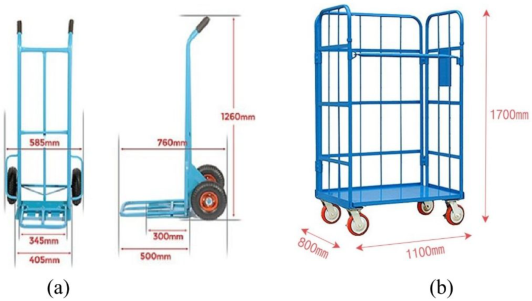
Apparatus and Trolleys This experiment was conducted with 2 types of trolleys (hand cart and roll- tainer), which are illustrated in Figure 1. Rolltainer wheels are made of polyurethane with a diameter of 6 inches and hand cart wheels are made of inflatable rubber tires with a diameter of 10 feet. Maximum load capacity of the hand cart and rolltainer is 200kg and 300kg. A hand cart weighed 13 kg and a rolltainer weighed 45 kg. Muscle activity was measured using a wireless surface EMG system (Ultium EMG, Noraxon, USA) at 2000 Hz with a band-pass filter between 20 and 250 Hz. The activity of the biceps brachii (BIC), triceps brachii (TRI), upper trapezius (UT), and erector spinae (ES) was recorded bilaterally using disposable Ag/AgCl dual electrodes (Noraxon, USA). A low pass filter at 6Hz
Workload Analysis of Courier Trolley Push and Pull for Express Couriers 141
was applied to smooth the measured muscle activity after it had been rectified in full wave mode and smoothed by the Root Mean Square (RMS) method (Song et al., 2020).
Figure 1: Delivery manual trolleys: (a) hand cart, (b) rolltainer.
Data Collection The experiment utilized a randomized within-subject design, with the inde- pendent variables being the type of trolley (hand cart and rolltainer), the type of task (pushing and pulling), and the transport direction (straight and curve). The dependent variables included muscle activity and subjective dis- comfort. Prior to participating in the experiment, each participant provided informed consent. Their personal information, including date of birth, age, work experience, height, and weight, was recorded.
After cleaning the skin with alcohol swabs, dual EMG electrodes were attached to the upper body muscles. Maximum voluntary contraction (MVC) measurements for each muscle were obtained before the experiment. Tests were conducted in a random order with regard to trolley types, tasks, and directions. To facilitate subsequent data analysis, the entire experiment process was recorded on video.
Participants were instructed to operate manual delivery trolleys consistent with real work situations. This included adopting the same posture and speed they would use in their typical work tasks.
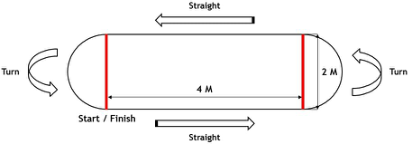
Figure 2 illustrates the experimental transport path. The participants moved the trolleys in the following manner: 1) in a straight line 4 meters from the start position, 2) along a curved line at the corner, and 3) back to the finish position along the path. A total of four round trips were made to complete the experimental procedure, and data from the second and third trips was collected and analyzed.
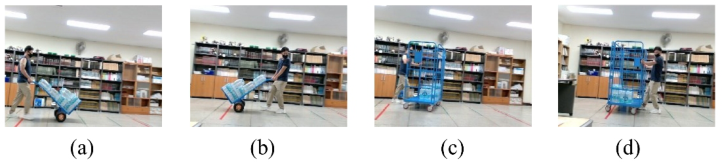
An example of a participant conducting a mission is shown in Figure 3. Participants were allowed to take approximately one to two minutes of rest between each round trip if they wanted. They evaluated the perceived exertion of the whole body and each body part after completing the task.
142 Cheng and Deng
Figure 2: Experiment transport path.Figure 3: Experimental tasks: (a) hand cart pushing, (b) hand cart pulling, (c) rolltainer pushing, (d) rolltainer pulling.
RESULTS
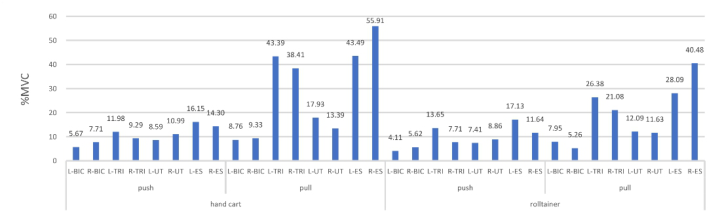
Muscle Activity An analysis of the normalized EMG(%MVC) data for trolley types, tasks, and directions is presented in Figure 4. Extreme outliers were identified with boxplot diagrams and excluded from the analysis. We found a wide range of %MVC of upper body muscles ranging from 4.1 to 55.9. Low %MVC may indicate a light workload compared to their usual workload. Regardless of the type of trolley, direction, or task, the muscle activ- ity produced by the TRI and ES was generally greater than that of the BIC and UT.
Figure 4: Mean %MVC of muscle activity.
The effects of trolleys, tasks, and transport directions on muscle activity were evaluated using repeated-measure ANOVA (Table 1). The main effects and interaction of factors were tested using the multivariate criterion of Wilks’s lambda (∧). The main effect of task and interaction between trol- ley and direction was significant on the left BIC. A follow-up paired-sample
Workload Analysis of Courier Trolley Push and Pull for Express Couriers 143
t test found that pull task produced significantly more muscle activity on the left BIC than push task (p=.005). During straight line transport, hand carts generated significantly more left BIC activity than rolltainers (p=.001). On the other hand, rolltainers activated more muscle work than hand carts in a curved direction (p=.010).
The effect of trolley and the interaction between trolley and direction was significant on the right BIC. The follow-up test showed that hand cart gener- ated more muscle activity than rolltainer when operating in straight direction (p=.001).
The main effect of task was significant on left TRI. The results showed that the pull task had higher muscle activity than the push task (p=.005). As with right TRI, the pull task was significantly more difficult than the push task (p=.001).
The main effect of task and interaction between task and trolley was sig- nificant on left UT. Post-hoc analysis for the significant interaction showed hand cart generated more %MVC than rolltainer when pulling the trolleys (p=.001).
Table 1. ANOVA p-values for main effects and interactions.
Table available in the original PDF paper.
Muscle Task Trolley Direction Task & Trolley
Task & Direction
Trolley & Direction Left BIC .005** .694 .963 .703 .159 .001** Right BIC .616 .020* .131 .824 .430 .012* Left TRI .005** .244 .070 .059 .299 .166 Right TRI .001** .882 .639 .353 .517 .257 Left UT .047* .136 .298 .002** .236 .865 Right UT .254 .357 .600 .893 .407 .538 Left ES .074 .778 .955 .042* .972 .014* Right ES .005** .815 .750 .044* .060 .046*
*significant at α = .05, **significant at α = .01
Significant interactions among factors were observed in the left ES. The results of a follow-up paired sample t test indicated that the hand cart gener- ated more muscle activity than the rolltainer during the pulling task (p=.001) and the straight direction (p=.001).
For right ES, the main effect of task and interaction between task and trolley was significant. A follow-up t test revealed that hand carts produced higher muscle activity than rolltainers for the pull task (p=.004) and straight direction (p=.008).
Subjective Discomfort The Borg scale measures subjective discomfort in the body. Borg CR10 was used to assess subjective discomfort, and Borg RPE was employed to assess whole body discomfort. Table 2 shows the perceived level of discomfort with Borg RPE and CR 10.
144 Cheng and Deng
Table 2. Subjective body discomfort mean and standard deviation.
Table available in the original PDF paper.
Cart type Task Whole body Arm Shoulder Low back Hand Cart Push 10.35(2.17) 2.35(1.26) 1.91(1.14) 2.26(1.36) Pull 10.74(2.01) 2.46(1.24) 2.02(1.29) 2.09(1.20) Rolltainer Push 10.48(1.81) 2.30(1.14) 2.11(1.31) 2.00(1.16) Pull 10.68(2.03) 2.41(1.25) 1.91(1.37) 2.09(1.30)
Perceived discomfort ranged from 1.91 to 10.74 for the whole body and 1.14 to 2.03 for the body parts, both indicative of light activity. Participants considered pushing and pulling a delivery trolley loaded with 58.8kg water packs as a light activity. A repeated-measures ANOVA with two factors was conducted to evaluate total body discomfort. The trolley main effect (∧=.99, F1,22=2.16, p=.647), task main effect (∧=.998, F1,22=.034, p=.856), and the interaction between the type of trolley and task (∧=.947, F1,22=1.242, p=.277) was not significant.
CONCLUSION
Recent years have seen an increase in courier services and an increase in the number of couriers. This study examined the manual pushing and pulling of hand carts and rolltainers by express delivery employees.
We observed that ES and TRI were more activated than BIC and UT. Hand carts appear to produce significantly more muscle activity in the upper body than rolltainers in general. Additionally, hand carts exert more muscle activity in the upper back and shoulders than rolltainers when delivered in a straight direction. Pulling a delivery trolley generates a harder workload than pushing.
The new delivery workers need to be trained to push a delivery cart to avoid WMSDs. It would be better if the courier company offered rolltainers to distribution centers rather than hand carts. Courier services employ more rolltainers than hand carts when moving heavy and bulky packages. The use of rolltainers would be a better option when working environments permit these containers.
The subjective discomfort evaluation showed that participants thought pushing and pulling trolleys with a 58.8kg load was a very light activ- ity. Couriers often transport loads that weigh 120 kilograms. It will be worthwhile to conduct further research to understand how the muscles were activated during courier service. It is also imperative to determine the proper pushing and pulling weights for delivery trolleys based on ergonomic studies.
ACKNOWLEDGMENT
This research was supported by Basic Science Research Program through the National Research Foundation of Korea (NRF) funded by the Ministry of Education (2021R111A3055861).
Workload Analysis of Courier Trolley Push and Pull for Express Couriers 145
REFERENCES
Andruetto, C. Bin, E. Susilo, Y and Pernestål, A. (2023). Transition from Physical to Online Shopping Alternatives Due to the COVID-19 Pandemic - A Case Study of Italy and Sweden, Transportation Research Part A: Policy and Practice Volume 171, No. 103644. Ghodsi, M. Pourmadadkar, M. Ardestani, A. Ghadamgahi, S. and Yang, H. (2022).
Understanding the Impact of COVID-19 Pandemic on Online Shopping and Travel Behaviour: A Structural Equation Modelling Approach, Sustainability Volume 14, No. 13474. Guo, F. Liu, L. and Lv, W. (2020). Biomechanical Analysis of Upper Trapezius, Erector Spinae and Brachioradialis Fatigue in Repetitive Manual Packaging Tasks: Evidence from Chinese Express Industry Workers, International Journal of Industrial Ergonomics Volume 80, No. 103012. Laursen, L. and Schibye, B. (2002). The Effect of Different Surfaces on Biome-
chanical Loading of Shoulder and Lumbar Spine during Pushing and Pulling of Two-Wheeled Containers, Applied ergonomics Volume 33. Lee, J. Nussbaum, M. A. and Kyung, G. (2014). Effects of Work Experience on Work Methods during Dynamic Pushing and Pulling, International Journal of Industrial Ergonomics Volume 44. Lee, K. S. Chaffin, D. B. Herrin, G. D and Waikar, A. M. (1991). Effect of Handle
Height on Lower-Back Loading in Cart Pushing and Pulling, Applied Ergonomics Volume 22. Lett, K. K. and McGill, S. M. (2006). Pushing and Pulling: Personal Mechanics Influence Spine Loads, Ergonomics Volume 49. Lin, Y.-H. and Lu, S.-Y. (2020). Effects of Ground and Load on Upper Trapezius,
Biceps Brachii Muscle and Hand Forces in One- and Two-Wheeled Wheelbarrow Pushing, Applied Ergonomics Volume 88, No. 103151. Nimbarte, A. D. Sun, Y. Jaridi, M. and Hsiao, H. (2013). Biomechanical Loading of the Shoulder Complex and Lumbosacral Joints during Dynamic Cart Pushing Task, Applied Ergonomics Volume 44. Ohnishi, A. Takanokura, M. and Sugama, A. (2016). Evaluation of Interhandle Dis-
tance During Pushing and Pulling of a Four-Caster Cart for Upper Limb Exertion, Safety and Health at Work Volume 7. Pinupong, C. Jalayondeja, W. Mekhora, K. Bhuanantanondh, P. and Jalayondeja, C. (2020). The Effects of Ramp Gradients and Pushing–Pulling Techniques on Lumbar Spinal Load in Healthy Workers, Safety and Health at Work Volume 11. Rim, S.-C. and Jung, M.-C. (2022). Evaluation of Workloads of Package Deliverers
Focusing on Their Pickup and Delivery Tasks in Republic of Korea, Sustainability Volume 14, No. 5229. Shuai, J. Yue, P. Li, L. Liu, F and Wang, S. (2014). Assessing the Effects of an Educational Program for the Prevention of Work-Related Musculoskeletal Disorders among School Teachers, BMC public health Volume 14, No. 1211. Song, D. Kim, E. Bak, H. and Shin, G. (2021). Effect of Hand Loads on Upper Extrem-
ity Muscle Activity during Pushing and Pulling Motions, Applied Ergonomics Volume 96, No. 103504.
LISTED IN THE AHFE DIGITAL BOOKSTORE CATALOGUE
Explore the complete digital volume
Emerging Technologies in Healthcare and Medicine
Read this individual research paper free through the original publisher, or explore the full digital proceedings book.
ISBN 978-1-958651-92-6
Explore this ISBN in the AHFE Bookstore ↗Listed in the July 2026 bookstore catalogue; search by ISBN to confirm current availability · Digital book purchase optional