Chao Yin Wuab, Hsiao Rong Huanga, Mao Jiun Wanga (2022). The Ergonomic Evaluations of Three Front Baby Carriers. In: Advances in Ergonomics In Design, Usability & Special Populations: Part III. AHFE Open Access, vol. 20. https://doi.org/10.54941/ahfe1001310
This paper evaluates the physiological responses of three front baby carriers with different designs. Eight women (aged 23-31 y/o) were recruited to participate this study. Each subject was asked to carry two different weighted baby dummies (7kg and 10kg) using 3 different baby carriers and walk for 10 minutes. The average electromyography (EMG) of right upper trapezius, lumbar erectus spinae and rectus abdominis during walking were recorded. Skin temperature of right shoulder area and abdominal area as well as heart rate were recorded during walking. Immediately after walking, the Borg’s CR-10 scale was used to collect discomfort rating at various body parts. The results showed no differences in all three EMG recordings under 3 different baby carriers. Significant difference in 2 different weighted dummies condition was found in erectus spinae muscle. No difference was found in average heart rate under all conditions. For Borg’s CR-10 scale, significant differences were found in neck, right shoulder and left shoulder under different baby carriers and significant in right shoulder area under 2 weighted dummies condition. Based on the finding of this study, recommendations about the improved design of baby carrier are proposed.
Holding baby is a natural and universal human behavior. Baby carriers make it easier and more comfortable for parents and caregivers to do daily activities while keeping the baby safe and content. Carried babies were found to be cry less (Hunziker & Barr, 1986) and the front carrying enhances the mother baby attachment (Gathwala, Singh, & Balhara, 2008; Tessier et al., 1998). Kangaroo mother care (KMC) was first suggested in 1978 by Rey and Martinez. It is similar to marsupial caregiving, which there is skin-to-skin contact between the baby and the holding person, and was initially designed to care low birth weight (LBW) infants (Tessier et al., 1998). World Health Organization started to promote the KMC in 2003 (WHO, 2003) and summarized the advantages of KMC: 1 reduce mortality and morbidity in LBW infants, 2 enhance breastfeeding in its prevalence and duration, 3 reduce the risk of hypothermia, 4 promote better performance in heart and respiratory rate, oxygen consumption, blood glucose and sleep patterns in LBW infants, 5 less psychological stress and increased confidence were reported in mothers. While it is beneficial for babies to be carried in caregiver’s chest, there is very little discussion about the caregiver’s physical responses while carrying a baby.
Ergonomics evaluations on load carrying were often found in backpacking. Significant postural adaptations such as forward head and lumber lordosis were reported. When comparing front pack and backpack, backpack condition demonstrated an increased forward head position, significant neck motion and hip flexion during walking; and an increased extension and lumbar lordosis were found in front pack conditions (Bettany-Saltikov & Cole, 2012; Fiolkowski, Horodyski, Bishop, Williams, & Stylianou, 2006). From this aspect, front pack was recommend to use for load carriage. Bauer and Freivalds (Bauer & Freivalds, 2009) conducted a study using electromyography (EMG), posture evaluation, heart rate and rating of perceived exertion (Borg CR-10) to find an acceptable backpack load limit for middle school children. Significant change in left erector spinae muscle in 20% BW but no significant heart rate change was found. But the result of Borg CR-10 suggested the load limit of 10% BW. In their study, walking on treadmill for only 3 minutes might not represent the actual daily activity. For the discussion of the heaviness of backpacking, Al-Khabbaz and colleague (Al-Khabbaz, Shimada, & Hasegawa, 2008) found muscle activities of rectus abdominis increased progressively as the backpack load increased and trunk inclined backward with increased backpack load. The authors suggested that 20% body weight (BW) backpack caused the most significant muscular and postural changes and should be avoided.
In carrying a baby, weight carriage limitation recommendation seems a little inapplicable due to the growing status of the baby. In child development, to develop a steady head position, the Center of Disease Control and Prevention (CDC, USA) suggested that child to be at least four months old; to begin to sit up right is suggested to be around 6 months old; to begin to make a few steps or walks holding on to furniture is suggested to be at 12 months old. Between 5-12 month old, we consider that it is the age of child that mothers or carrier givers most frequent use a baby carrier. The corresponding weight of 5-month-old is 7 kg and 12-month-old is 10 kg at 50 percentile (CDC Growth charts: United States). Hence, we choose 7kg and 10 kg of baby weight as a physiological factor in baby carriage.
Although carrying baby in the front being known as KMC style is largely promoted by the health care professions, there is still lack of data to which mother’s response of carrying baby in the front using baby carriers. Thus, the purpose of this study was to evaluate caregiver’s response in terms of EMG, skin temperature, heart rate and perceived exertion using different front baby carriers and baby weight.
METHOD
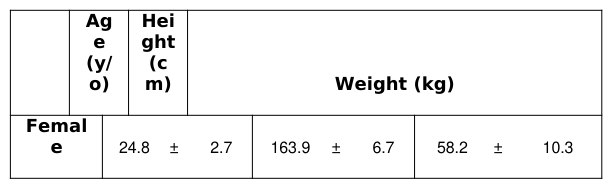
Subjects Eight female subjects from the university community volunteered to participate in this study. The inclusion criteria included no current or history of musculoskeletal pain or pathology and no known cardiovascular and neurological system disease. Each subject was informed about the purpose and procedure of the study prior to the experiment and was asked to sign an informed consent form approved by the Internal Review Board of a local hospital. The demographic data of the subjects are listed in Table 1.
Table 1. Demographic data of subjects Ag Hei ght e (y/ o)
Experimental design
The experiment was a two-factor factorial design. The independent variables included type of baby carrier (3 types) and weight of dummy baby (7kg and 10kg). The dependent variables included surface electromyography, skin temperature, heart rate and rating of perceived exertion.
Instrumentation Surface electromyography and Skin temperature
The electromyography and skin temperature were using a 8-channal wireless device (NeXus 10, Mind Media Inc., Netherlands) to collect data. The surface electromyography (SEMG) data from three muscles including: Upper trapezius, Rectus Abdominis and Erector Spinae were collected. Ag/AgCl adhesive disposable surface electrodes were used to record EMG data. The locations of electrodes for each muscle were placed according to the recommendation of Biomedical Health and Research Program (BIOMED II) of the European Union (www.seniam.org) as well as the maximum voluntary contraction (MVC) testing procedure. EMG signals are recorded at a sampling rate of 2048 Hz with low-pass filtering at 500 Hz and high-pass filtering at 20 Hz. The EMG activities during walking thus were calculated by using the following formula and were expressed in % standardized EA (sEA) (Seroussi and Pope, 1987):
Skin temperature of upper back and abdomen were collected using a thermistor, a small point probe attached on the skin. The sensor is reported to measure changes smaller than 1/1000th of a degree.
Heart rate Heart rate was recorded by a heart rate monitor (RS800CX, Polar Electro, Finland). It is a sensor (H3 heart rate sensor, Polar, USA) attached on a strap tied on subject’s chest and transmitting the data to the heart rate monitor. The measuring range of heart rate was 15-240 bpm.
Perceived exertion The Borg rating of perceived exertion scale (Borg CR-10)(Borg, 1998) was used to collect the subjective discomfort feeling of 7 different body parts, including: neck, right shoulder, left shoulder, upper back, mid-back, low back and abdomen.
Baby carriers Three commercially popular front baby carriers were selected for evaluation. Each baby carrier has it unique design and claimed to be comfortable to wear. For baby carrier A, it is a 2-part designed carrier using mesh fabric. For baby carrier B, it uses padded shoulder straps and padded waist-belt. For baby carrier C, it is a ring sling made of cotton fabric.
Experimental protocol
The experiment was conducted by two investigators, each with distinctive jobs during the experiment. Prior to the experiment, the two investigators discussed and agreed the wearing methods of the three baby carriers. For the protocol, after signing the consent form, each subject’s height and body weight were measured. A short sleeve t-shirt was provided for subject to wear during the experiment. Then EMG sensors, skin temperature sensors and heart rate sensor were attached. Resting EMG and heart rate were collected for 3 minutes followed by measuring the maximum voluntary contraction of the three target muscles. The 6 experimental combinations (3 baby carrier x 2 weighted dummy baby) were randomized. For each combination, subjects were asked to walk at their comfortable speed for 10 minutes. A 10 minutes rest was given between each combination. Immediately after walking, subjects were asked to fill out the Borg’s CR-10 scale to rate the level of discomfort for each body part.
Data analysis Two-way analysis of variance was performed to evaluate the effects of baby carriers and weight of dummy baby on the response measures. Duncan’s multiple range test (a < 0.05) was conducted as a post-hoc testing. Statistical analyses were performed using the statistical analysis software SPSS v.20.
RESULTS
Surface electromyography The effects of baby carrier and baby weight on EMG of the three muscles are summarized in table 2. The EMGs in all three muscles were found to have no significant differences in the three types of baby carrier. In baby weight condition, only the EMG of erector spinae was found to be significantly higher when carrying 10 kg dummy baby than carrying 7 kg dummy baby.
Table 2 The mean EMG of upper trapezius, erector spinae and rectus abdomines Sig.
* P< 0.05 Skin temperature and Heart Rate
Table 3 shows the effect of baby carrier and baby weight on skin temperature and heart rate. Both shoulder and Ergonomics In Design, Usability & Special Populations III abdomen skin temperatures were found to be significantly different in different type of baby carriers but no difference in baby weight factor. The Duncan grouping showed type B baby carrier had higher skin temperature in both areas. Heart rate did not have significant change in both baby carrier and baby weight conditions.
Table 3 The means and Duncan grouping of skin temperature and heart rate Sig.
* P< 0.05; **P< 0.01
Rating of perceived exertion (Borg’s CR-10) The effects of baby carrier and baby weight on Borg’s CR-10 score are presented in table 4. The perceived exertions were found to be significantly different in neck, left shoulder and right shoulder regions while using different type on baby carriers. The Duncan grouping results showed type A baby carrier had higher score in all three regions and type C baby carrier had higher score in the neck and right shoulder regions. The effect of baby weight was significant in right shoulder region.
Table 4 The means and Duncan grouping of Borg’s CR-10 scale Sig.
Abdomen 4.3 4.3 4.7 4.5 4.3
* P< 0.05; **P< 0.01
DISCUSSION
The results of this study showed that EMG of upper trapezius and rectus abdomines did not appear to be different in both baby carrier and baby weight conditions. The upper trapezius was chosen because when carrying the baby the weight of the baby was transmitted through the shoulder strap and resulted in increased muscle activity. Further different baby weight and different feature of the baby carriers (bilateral strap vs. single sling) would produce different results. The ring sling (baby carrier C) was manufactured with wide cotton fabric, when using properly the fabric covers the majority of carrier’s back. This might give a better pressure distribution over a wider contact area and resulted a similar muscle activity with the bilateral shoulder strap carrier (baby carrier A &B). The erector spinae muscle was found to be more activated in heavier baby weight (10kg) condition. Devroey and colleague (Devroey, Jonkers, De Becker, Lenaerts, & Spaepen, 2007) evaluated the effect of different back load (0%-5%- 10%-15% BW) on trunk muscle activities. They found reduced activity of erector spinae and increased activity of rectus abdominis with increased backpack load. The front baby carriage in this study revealed an opposite result comparing tothe backpack carriage. That is due to when load is carried in the front, the back muscle increased its activity to keep an upright position. The rectus abdominis did not show significant increase in heavier conditionwhich was assumed to be opposite to the backpack carriage result. A possible reason might be that the baby weight was rather heavy (approximately 17%BW) and caused a co-contraction effect (increased activity of both agonist and antagonist) of both rectus abdominis and erector spinae.
The skin temperatures of both upper back and abdomen were found to be significantly different among the three baby carriers. In our experimental setting, we asked the subjects to walk around within the laboratory area (5m x 5m), the environment temperature was controlled at 26oC via the air conditioner. The average skin temperature of upper back (above shoulder blade) and abdomen (7cm above umbilicus) was 33.6oC and 34.4oC respectively (Benedict, Miles, & Johnson, 1919). In our study, the average skin temperature during 10 minutes was about 1~2 oC higher comparing to the aforementioned study. We consider it was the heat evaporation effect resulting from walking and carrying a front weight to increase skin temperature. The fabrics of the three baby carriers were different. The mesh fabric used in Type A was claimed to be heat permeable. Type B carrier used padded shoulder straps and waist belt, and was less heat permeable. Thus, type A carrier produced a smaller increase in skin temperature in both upper back and abdomen and type B carrier produced a higher increase in skin temperature in both upper back and abdomen.
Heart rate was used as an indicator for assessing physical activity intensity. In this study, we did not find any differences in different baby carrier and baby weight conditions. According to American College of Sports Medicine, the exercise intensity can be calculated by the percentage of maximal target heart rate, and the exercise intensity of current study was around 47%. It is categorized in the non-active level (Medicine", 2011). This result can be interpreted that the three baby carriers caused the same effect on increasing carrier’s physical activity with the 7kg and10kg weight baby.
In Borg’s perceived exertion scale, neck, left shoulder and right shoulder were found to be significantly different while using the three baby carriers. The type B carrier was designed with padded shoulder straps and was rated as less exertion in neck and right shoulder regions compared to the other two carriers. The padded material could make people feel more comfortable and requiring less effort. The reason left shoulder scored least for type C carrier was due to that it is a ring sling and wearing on the right shoulder. And this might also be the reason that the right shoulder region was rated highest in perceived exertion. For baby weight condition, the Borg’s scale appears to be significantly higher in right shoulder area in the heavier weight condition but was not in the left shoulder area. One reason might be that all the subjects were right handed and the baby carriers might shift the weight to the right side while walking. The subjective data (Borg’s scale) and the objective data (EMG) showed a disagreement in which the subjects felt moderate exertion but no differences were found in muscle activities. One reason might be that the subjects had no previous experience of wearing a baby carrier, the unfamiliarity of baby carrying might increase the subjective feeling of exertion. Further, walking for a longer time or monitor more muscles around shoulder area might find some agreement in the subjective score and the objective data.
CONCLUSIONS
This study was to evaluate the caregiver’s responses in terms of EMG, skin temperature, heart rate and perceived exertion while using different front baby carrier under different baby weight. The results showed that the muscle activities were no different in bilateral shoulder strap or single sling designed baby carriers. And the padded shoulder straps and waist belt does increase skin temperature but with higher subjective comfortratings. When the subjective comfort and objective measures are equally important, there is somewhat a tradeoff when designing a product like baby carrier. This study was to evaluate the baby carrier design from mother’s point of view and might provide some useful information for future product design.
REFERENCES
Al-Khabbaz, Y. S. S. M., Shimada, T., & Hasegawa, M. (2008). “The effect of backpack heaviness on trunk-lower extremity muscle activities and trunk posture.” Gait & Posture, 28(2), 297-302. Bauer, D. H., & Freivalds, A. (2009). “Backpack load limit recommendation for middle school students based on physiological
and psychophysical measurements.” Work-a Journal of Prevention Assessment & Rehabilitation, 32(3), 339-350. doi: 10.3233/wor-2009-0832 Benedict, F. G., Miles, W. R., & Johnson, A. (1919). “The temperature of the human skin.” Proc Natl Acad Sci U S A, 5(6), 218-
222. Bettany-Saltikov, J., & Cole, L. (2012). “The effect of frontpacks, shoulder bags and handheld bags on 3D back shape and posture in young university students: an ISIS2 study.” Stud Health Technol Inform, 176, 117-121. Borg, G. (1998). Borg's perceived exertion and pain scales. Champaign: Human kinetics. Devroey, C., Jonkers, I., De Becker, A., Lenaerts, G., & Spaepen, A. (2007). “Evaluation of the effect of backpack load and
position during standing and walking using biomechanical, physiological and subjective measures.” Ergonomics, 50(5), 728-742. Fiolkowski, P., Horodyski, M., Bishop, M., Williams, M., & Stylianou, L. (2006). “Changes in gait kinematics and posture with the use of a front pack.” Ergonomics, 49(9), 885-894. Gathwala, G., Singh, B., & Balhara, B. (2008). “KMC facilitates mother baby attachment in low birth weight infants.” Indian J
Pediatr, 75(1), 43-47. Hunziker, U. A., & Barr, R. G. (1986). “Increased carrying reduces infant crying: a randomized controlled trial.” Pediatrics, 77(5), 641-648. Medicine", A. C. o. S. (2011). ACSM's Complete Guide to Fitness & Health (B. A. Bushman Ed. 1st ed.): Human Kinetics. Tessier, R., Cristo, M., Velez, S., Giron, M., de Calume, Z. F., Ruiz-Palaez, J. G., . . . Charpak, N. (1998). “Kangaroo mother
care and the bonding hypothesis.” Pediatrics, 102(2), e17. WHO. (2003). “Kangaroo mother care: A practical guide” World Health Organization.
LISTED IN THE AHFE DIGITAL BOOKSTORE CATALOGUE
Explore the complete digital volume
Advances in Ergonomics In Design, Usability & Special Populations: Part III
Read this individual research paper free through the original publisher, or explore the full digital proceedings book.
ISBN 978-1-4951-2108-1
Explore this ISBN in the AHFE Bookstore ↗Listed in the July 2026 bookstore catalogue; search by ISBN to confirm current availability · Digital book purchase optional