Anna Sirkka, Johan Fagerlönn, Stefan Lindberg, Katarina Delsing (2022). The Design of an Auditory Alarm Concept for a Paper Mill Control Room. In: Advances in Ergonomics In Design, Usability & Special Populations: Part III. AHFE Open Access, vol. 20. https://doi.org/10.54941/ahfe1001301
Auditory alarms are common in industrial control rooms. Sound has certain advantages over other alarm modes. Salient auditory stimuli effectively capture and guide attention, regardless of the operators’ visual focus. Sound can also convey detailed information. However, auditory alarms are often carelessly implemented, utilising sounds that are too loud, too numerous, and too confusing. The aim of this work was to develop a concept to enhance the auditory alarms in a control room. Before the concept was developed, a study involving 21 operators evaluated the state of the alarm sounds. The results indicated a poor design and confirmed certain well-known issues with alarm sounds. The concept included new alarm sounds, spatial presentation of the sounds, and alarm repetition intervals. The sounds are based on a new design principle in which each alarm sound composes two parts. One conveys urgency information, and the other contains information associated with the section in question. The design process involved 24 control-room operators and 13 design iterations, which were used to refine the concept. An evaluation involving 20 operators was conducted to examine the appropriateness of the concept. The results demonstrate that the developed concept increases operator effectiveness and acceptance as well as the overall sound environment.
The surveillance of industrial processes is traditionally performed through visual tasks. A constantly increasing level of complex information flows in industrial control rooms raises the risk that operators will become distracted, confused, and visually overloaded in demanding situations. New multimodal interfaces that consider human capabilities outside the visual domain may offer better solutions.
In this work, we focus on alarm sound design for industrial control rooms. Alarms alert operators to deviations from normal conditions and enable them to react appropriately to prevent physical and economic loss. The speed and accuracy with which operators can identify alarms are crucial to effectiveness. Additionally, sounds should not be too annoying or disturbing because they could negatively affect operator performance and acceptance, as well as the overall working environment. However, sounds are often carelessly implemented, using signals that are too loud, too numerous or too confusing (Edworthy, 1994). Poor alarm management and poorly designed alarm sounds are also common problems in industrial control rooms (Hollifield & Habibi, 2011). Auditory alarms are common elements in control room environments. Sound has certain advantages, especially in urgent situations that require immediate attention. Our hearing is omnidirectional, and salient auditory cues can effectively capture a person’s attention. It can be very difficult to ignore salient auditory cues, even if we know that they will occur (Shelton, Elliot, Eaves & Exner 2009).
However, sound offers more possibilities for assisting operators than simply capturing their attention. First, presenting sounds in correct spatial directions offer additional advantages. Directional cues can capture operators’ attention in the necessary direction and reduce detection and response times (Ho & Spence, 2005; Begault, 1993). Thus, employing a multi-channel audio system to spatially distribute signals in the control room could guide operators’ attention to the relevant visual display.
Secondly, sound can convey information that informs operators on a situation’s urgency. The perceived urgency of a sound may depend on learned associations (Burt, Bartolome, Burdette & Comstoc, 1995; Guillaume, Drake, Rivenez, Pellieux & Chastres, 2002). However, research has shown that fundamental auditory signal characteristics, including a range of temporal and spectral parameters, affect the urgency perceived (Edworthy, Loxley & Dennis, 1991; Hellier, Edworthy & Dennis, 1993; Marshall, Lee & Austria, 2007). By manipulating these parameters, a designer can systematically change the urgency level of the sound.
The Engineering Equipment and Materials Users’ Association (EEMUA, 2007) recommends that operators should be able to identify an alarm’s priority. Inappropriate urgency mapping has been described as a common issue in industrial control room environments (Hollifield & Habibi, 2011). Matching the priority or perceived urgency of a warning with the urgency of the threatening situation has been referred to as “urgency mapping” (Edworthy & Adams, 1996). Appropriate urgency mapping is important because it may aid operators in prioritising new information and minimising confusion. However, incorrect mapping may have the opposite effect and potentially increase the operator workload.
Third, sound can provide detailed information about a situation. Two main categories of sound have been proposed for conveying information, verbal and non-verbal sounds. Verbal signals can be beneficial due to the minimal learning time necessary. In addition, they can easily convey complex information. The potential downsides are that they may interfere with other verbal communication, and it may take a relatively long time to convey the information.
One promising way to convey information using non-verbal sounds is through auditory icons, a concept first introduced by Gaver (1986). He defined auditory icons as “everyday sounds mapped to computer events by analogy with everyday sound-producing events”. While conventional alarm sounds are arbitrarily mapped to their alarming function, auditory icons sound like what they represent; thus, they tend to be more meaningful in a particular user context. Auditory icons are easier to learn and interpret compared with other non-verbal signals (Leung, Smith, Parker & Martin, 1997; Dingler, Lindsay & Walker, 2008; Fagerlönn & Alm, 2010). However, one drawback with auditory icons is that it can be difficult to find sounds with strong mapping (associations) between the sound and event, which occurs when the event does not produce a sound or when the sound is not unique or otherwise recognisable. In such cases, the designer must rely on more indirect and potentially weaker sound-event mapping. Another challenge for designers is finding clearly recognisable sounds that are sufficiently brief to effectively convey information in an urgent situation. Finally, auditory icons bring design limitations that could affect audibility. Finding recognisable sounds with properties that make them clearly audible in the control room could be a challenge.
If operators can identify alarm sounds, they could more easily decide the operator that the alarm is directed to as well as the monitor and process that require attention. Another potential benefit from using sounds to convey information is that sounds do not require visual processing, which could be beneficial in visually demanding situations (e.g., when operators are monitoring several process parameters on a display).
A key challenge for designers is avoiding auditory alarms that are too annoying or disturbing. The negative effects of alarms may depend on system configurations unrelated to the sound design (e.g., alarm thresholds and false alarm frequency). However, designing more urgent auditory signals can easily render them more annoying (Marshall et al., 2007). Designers should strive to develop solutions that employ the appropriate urgency mapping while maintaining a low level of perceived annoyance.
It is likely that long or continuous sounds could negatively affect additional tasks (e.g., communication). Although alarms should capture operators’ attention and promote responses, this important feature should be considered in relation to a sound’s ability to distract operators from work-related tasks. For example, repeating a salient sound more frequently than necessary could render it unnecessarily distracting.
Finally, the extent to which a signal requires attention depends on the number of cognitive operations necessary to process the signal (Wickens & Hollands, 1999). Sounds designed to convey information that requires an operator to perform mentally demanding and time-consuming operations, such as conscious reasoning, can significantly increase the level of attention required. This “distraction potential” for sounds further supports use of auditory icons, which are often easy to learn and quickly interpreted.
Aim The underlying motivation for the present work was to examine how alarm sounds can be designed and implemented to assist operators in industrial control contexts. The aim was to develop a concept for a control room that would improve operator effectiveness and acceptance as well as the overall sound environment.
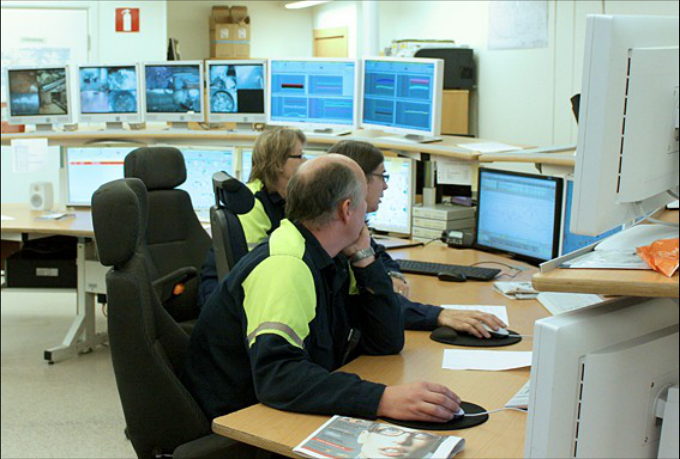
TARGET ENVIRONMENT A control room in a paper mill located in northern Sweden was identified as an appropriate target environment. The control room is situated in a building within the mill. Seven production sections are monitored from the control room, and three of these were selected to be part of the concept development. Control systems in the target environment are from different manufacturers and vary in age from approximately two to forty years old.
The control room is manned 24 hours a day, and the personnel consist of 24 operators (18 regular and 6 substitute). The operators are divided into six shift teams; each team has three operators.
Figure 1. The target environment
The operators work in a highly collaborative manner, and verbal communication composes an essential part of their working time. Mainly, they communicate with each other, but they also communicate with operators from other control rooms, working with other parts of the production process. In addition, they communicate with personnel on the factory floor, working with repairs and maintenance.
CONCEPT DEVELOPMENT Starting point
Before the concept was developed, a questionnaire pre-study that involved 21 operators evaluated the state of alarm sounds (see section Concept Evaluation). In addition, a workshop was conducted to further investigate the current state and set a basis for the future development. Six subjects participated in the workshop from a mixture of professions, including operators, system developers, and electricians. The results indicate a poor design and confirmed certain well-known issues with alarm sounds.
The operators thought the alarm sounds were annoying and stressful. In addition, they thought that the sounds were too similar and that many were unnecessary. Consequently, the operators primarily focused on silencing the alarms rather than solving the underlying problems. Often, they had to search for relevant information among several control room monitors. At worst, one shift team turned off the speakers and later forgot to inform the next shift team, which caused a situation with potentially severe consequences.
Design process The concept was developed through a user-driven design process involving 24 operators who worked in the previously described target environment. The process comprised the aforementioned workshop followed by approximately 13 design iterations. Each iteration comprised two steps: development of a design proposal and a user interaction.
During the user interaction, a sound design proposal was presented to three to six operators. The design was discussed, and feedback was provided from the operators, which was used to develop a refined design. In addition to the design discussions, the operators provided feedback on audibility, speaker positioning, and the manner in which the alarms were presented (e.g., the length of the repetition intervals). Each interaction occurred in the operators’ working environment (i.e., in the control room) and lasted for approximately half an hour.
The non-final concept was implemented in the control room for 8 weeks. During this period, the concept was developed and used in the real-world control-room environment. The final concept was implemented for 11 weeks.
THE CONCEPT Production sections
The following three production sections were selected by the operators as part of the concept development: (1) the washing section, (2) the wood chipping section, and (3) the cooking section. Together, these sections composed a significant portion of the controlled processes. Moreover, these sections were easily distinguished from the other processes monitored.
Spatial presentation
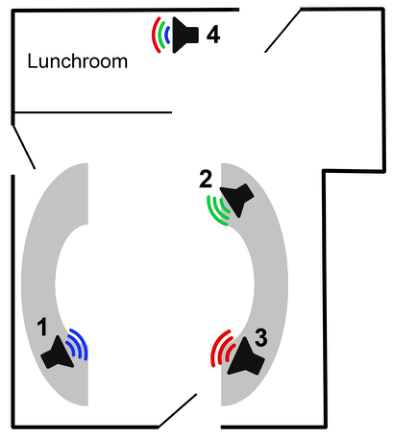
Figure 2 shows a principal sketch of the control room where the concept was implemented. The alarm sounds were reproduced using a multi-channel audio system with four speakers. The speakers were positioned such that the alarm sounds were reproduced in a direction that guided the operators to the alarming production section (the relevant visual display), i.e. the part of the control room wherein they could solve the problem causing the alarm.
For instance, an alarm from the washing section was reproduced by speaker no 1. Similarly, alarm sounds that corresponded to the wood chipping section were played through speaker no 2.
Figure 2. Principal sketch of the speaker positions
The operators are required to respond to alarms during coffee breaks or while eating. Speaker no. 4 was placed in the operators´ lunchroom. This speaker reproduced every alarm that was played in any of the other three speakers, and thereby allowed for a lower sound pressure level (SPL) for the alarms presented in speaker no. 1 to 3.
Alarm sound design A family of alarm sounds was designed for each of the three production sections. A family comprised four alarm sounds with the following urgency levels: very-low, low, medium, and high. The sounds were based on a design principle in which each alarm sound composes two parts. One conveys urgency information, and the other (an auditory icon) conveys information associated with the section in question.
Previous research has established that the number of repetitions and length of an auditory alarm each have individual effects on the perceived urgency (Hellier & Edworthy, 1989). The part that conveys urgency uses a combination of these parameters. The families essentially have the same temporal structure, where the low-urgency signals comprise one tonal sound. The medium-urgency signals comprise two tonal sounds, and the high-urgency signals comprise three tones. The very low urgency signals are not preceded by a tonal sound but solely comprise an auditory icon.
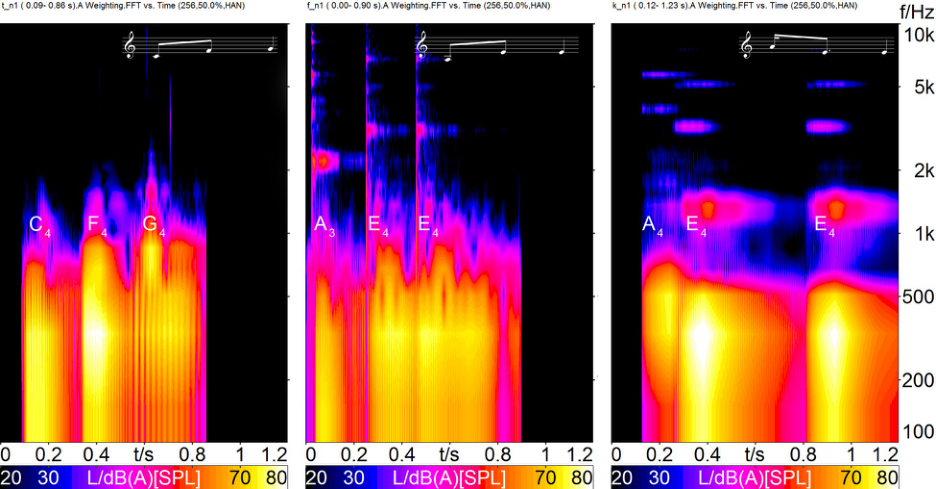
Figure 3 shows the temporal structure and frequency characteristics of the urgency part of the high-urgency signals. The upper right corners show the notes composing each signal. The low-urgency signals comprise the first tone of the high-urgency signals. The medium-urgency signals comprise the first and second tone of the high-urgency signals.
The character of the signals has its origins in acoustic musical instruments. Soft attacks, long decays, and natural harmonics were used to create signals designed to be pleasant to listen to. Each family has a unique sound character, timbre and melody, which makes it easier for the operators to distinguish the alarm sounds.
Figure 3. FFT vs time for the urgency parts of the high-level sound signals (left panel=washing section, middle panel=wood chipping section, and right panel=cooking section)
In collaboration with the operators, a variety of auditory icons were identified that could represent sections and events in the process and, thus, compose the second part of the alarm sounds.
An iconic water drop sound (auditory icon 1) was used to represent an alarm in the washing unit. A breaking twig sound (auditory icon 2) was used to alert the operator to an alarm in the wood chipping process, and a hissing steam kettle sound (auditory icon 3) informed the operators of an issue in the cooking section.
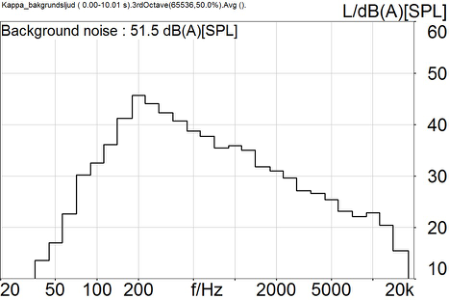
The control room was situated in a building within the mill. Consequently, the background noise in the control room had high levels of low-frequency sound. Figure 4 (left panel) shows the A-weighted SPL in 1/3-octave bands of the background noise. The auditory icons were carefully designed and continuously tested during the design process to ensure audibility and that they produced the intended associations. Figure 4 (right panel) shows the A-weighted relative sound pressure level in 1/3-octave bands of the auditory icons. The lengths of the auditory icons were approximately 1 s.
Figure 4. A-weighted SPL in 1/3-octave bands from the background noise (left panel) and auditory icons (right panel)
The entire family of alarm sounds was implemented in the wood chipping section. For the other two sections, only the high-urgency level was implemented due to limitations in the target environment.
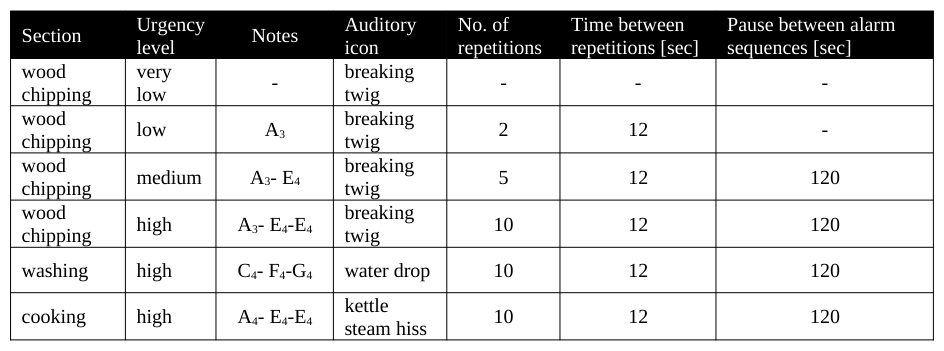
Repetition intervals The features of the alarm sounds presented in table 1 were based on the design process. Column 5 shows the number of repetitions that compose an alarm sequence, and the last column specifies the pause length between each alarm sequence. For instance, an alarm in the washing section will be repeated ten times with a 12-second pause between each repetition, which is defined as an alarm sequence. If the alarm is not confirmed during the alarm sequence, there will be a 120-second pause. Thereafter, a new sequence will begin.
Table 1: Features of the alarm sounds implemented
The sound level of the alarm sounds was lowered over time, beginning at a clearly audible level then gradually decreasing as the number of repetitions increased, also this resulted from operator input during the design process.
CONCEPT EVALUATION The same questionnaire was administered twice, once before the design process and implementation and then to evaluate the finalised concept (i.e. the result of the design process).
Twenty-one subjects, 2 females and 19 males, participated in the pre-study. Their mean age was 43 years (SD 11), and their mean experience as operators was 19 years (SD 11). Twenty subjects, 2 females and 18 males, participated in the follow-up study. Their mean age was 44 years (SD 10), and their mean experience as operators was 19 years (SD 11).
All subjects in both studies were arbitrarily selected from the group of 24 operators working in the target environment. Consequently, one may assume that many operators participated in both studies.
The questionnaire was written in Swedish and consisted of two parts. Initially, the participants were to assess the following statements on a 7-point Likert scale: (1) ”It’s easy to understand which section causing the alarm”, (2) “It’s easy to understand the urgency of the alarms coming from the wood chipping section”, and (3) ” I feel/think that the control room sound environment is good”. The participant responses ranged from (1) “Completely disagree” to (7) “Completely agree”.
In the second part of the questionnaire, operator acceptance was assessed using the Van der Laan scale (Van der Laan, Heino & de Waard, 1996). The participants were asked to rate the perceived usefulness of the sounds on 5- point scales ranging from useless to useful, bad to good, superfluous to effective, worthless to assisting, and sleep- inducing to alertness-raising. Similarly, the perceived satisfaction of the sounds was rated using scales ranging from unpleasant to pleasant, irritating to likeable, annoying to nice, and undesirable to desirable.
The questionnaire also had an open comment section where subjects could write freely about the sound environment.
RESULTS
Throughout the statistical analyses, the participating groups in the pre- and post-study were treated as independent samples.
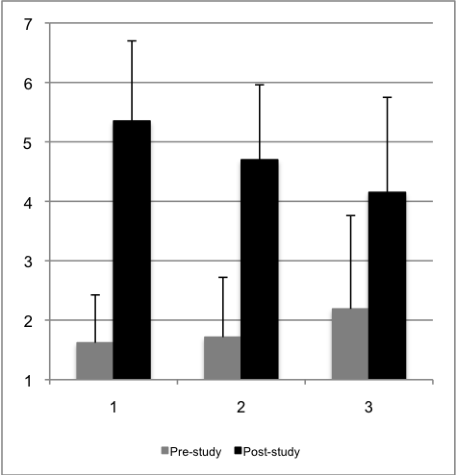
The mean values of the subjective Likert-scale ratings for question 1 to 3 are shown in figure 5. The error bars show the standard deviations from the mean. A normal distribution of data was not assumed. Both independent t-tests and Mann-Whitney U-tests showed that the difference between the pre- and post-study ratings were statistically significant (p<0.01) for all three questions.
Figure 5. Mean ratings for questions 1 to 3 (1=completely disagree, 7=completely agree)
The results support the notion that the concept developed made it easier for the operators to find the alarming section. Moreover, it improved urgency mapping for the alarms related to the wood chipping section, as well as the overall sound environment.
Table 2 shows the mean values, standard deviations, and results of the Cronbach’s alpha reliability test for the subjective acceptance ratings.
Table 2: Mean subjective ratings of usefulness and satisfaction ratings (standard deviations in parentheses)
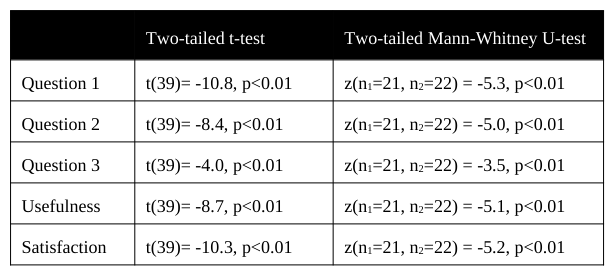
The ratings ranged between -2 and +2. As shown in table 2, the concept developed increased both the perceived usefulness (from -0.82 to +1.04) and satisfaction (from -1.05 to +1.21). Both unpaired t-tests and Mann-Whitney U- tests revealed significant differences for both dimensions (p<0.01). The reliability tests resulted in Cronbach’s alpha values above the 0.65 threshold (as recommended by Van der Laan et al. (1996)) for both the pre- and post-test. The results from the statistical analysis are presented in table 3.
Table 3: Results from the statistical analysis
In the open comment section, four subjects mentioned that the concept should be further developed by including more production sections. Moreover, two operators indicated that more dynamic regulation of the alarm sound levels would be useful. This could, for example, mean that, as the background noise level increased, the alarm sound level would increase as much. Furthermore, two operators stated that the noise from the plant negatively affected the overall sound environment.
DISCUSSION
The underlying motivation for the present work was to examine how to design and implement alarm sounds to assist industrial plant operators. A control room in a paper mill in northern Sweden was identified as an appropriate target environment. The aim was to develop a concept for the control room that would improve operator effectiveness and acceptance as well as the overall sound environment.
The results show a significant difference between the pre- and post-test results. The new concept received considerable more positive user ratings in both usefulness and satisfaction (as assessed using the method described in Van Der Laan et al. (1996)). Furthermore, the operator ratings indicated that it was considerably easier to identify the alarms using the new concept. In summary, the results show that both acceptance and perceived alarm efficiency improved. It should be noted that the participating operators evaluated the concept in their own working environment over a relatively long time period. Thus, the operators had proper time to experience the display solution in real settings and situations.
The results provide an example of how control room alarms could be improved. The design principle may also be utilised in other industrial plants and contexts. Although, the specific sounds designed for the present control room might not be directly applicable.
A body of research has shown that auditory icons can be effective and appropriate warnings (Fagerlönn & Alm, 2010; McKeown, 2005). The present evaluation supports the notion that auditory warnings based on auditory icons can be appropriate in an industrial operating room over a longer period of time (compared to typical controlled experiments). However, most sounds were not “pure” auditory icons but used as a combination of an urgency signal (an abstract tonal sound) and an auditory icon. This combination was demonstrated as appropriate in the design process, but we cannot draw a conclusion regarding the individual effect of the two signal types.
The design principle wherein urgency signals are provided prior to the auditory icons may offer certain advantages. The initial signal may aid operators in rapidly prioritising incoming information. Furthermore, the clearly audible and attention-grabbing urgency signals may prepare the operators to perceive more detailed information. The principle is similar to the typical auditory messages in various types of facilities, such as train stations and shops, where verbal messages are often preceded by an attention-grabbing tonal sound. Future studies may focus on the appropriateness of this and alternative principles (e.g., providing the auditory icon first).
Verbal sounds may be appropriate warnings. Fagerlönn and Alm (2010) showed that speech and auditory icons generated comparable response times, response accuracies, and annoyance ratings. However, speech could easily interfere with other verbal communication. Operators in the target control room work collaboratively and rely on verbal communication. A disturbance might be especially problematic in urgent and demanding situations that require rapid problem solving. Thus, speech was not used for the concept developed.
The results of the present study support the notion that the total sound environment improves after implementation of the new concept. The large differences in subjective scores might partly be an effect from the main focus of the questionnaire, which was on the auditory display, not the entire sound environment. However, the results indicate that alarm sounds in the control room considerably impact the total sound environment and, in turn, likely the whole working environment. Thus, the results support the notion that control room designers and system developers who seek to enhance operators’ working environments should seriously consider the design of the auditory alarms.
It should be noted that the present work focused only on the alarm sound design. Additional system-related factors, such as alarm thresholds and false alarm frequencies, can impact both acceptance and efficiency. However, these factors were not considered in the present work.
Furthermore, this study focused on a subjective judgement of the auditory alarms; no objective performance measures were assessed. However, it would be interesting to investigate performance aspects, such as the “time to confirm alarms” or “time to solve problems” between a pre- and post-test; these studies would contribute to an even more reliable understanding of individual alarm sound effectiveness and the entire alarm design concept.
The design process and evaluation were limited to three of the seven production sections in the targeted control room. One interesting idea for future development of the concept would be to extend the concept to more production sections (as suggested by four operators). A relevant and related research question is how many auditory warnings operators can reliably learn and recall in the control room context.
The new concept was designed in a process involving operators working in a targeted control room. The user involvement may have impacted the study results in at least two ways, contributing to more positive scores for the concept developed. First, the participation may have contributed to generating more appropriate sounds simply because the operators know what works well for them and what does not. Second, participation may have made the subjects rate the new concept more positively. The study was not designed to investigate the effect of participation on subjective ratings, but this complementary investigation would be interesting. For instance, certain operators may be in a control room and participating in the design process while other operators experience and judge the sounds.
Furthermore, the long design process generated friendly relations between the operators and designers, and the operators may have been particularly positive to the new concept simply to be kind. However, the designers and experimenters emphasised that they needed help and requested honest opinions.
ACKNOWLEDGEMENTS
The research presented in this paper was funded by the EU’s Structural Funds, the County Administrative Board of Norrbotten, Piteå Municipality, Skellefteå Municipality, and RISE.
REFERENCES
Begault, D. (1993). “Head-up Auditory Displays for Traffic Collision Avoidance System Advisories: A Preliminary Investigation”, Human Factors Volume 35 No. 4. Burt, J. L., Bartolome, D. S, Burdette, D. W., Comstoc, J. R. (1995). “A Psycho Physiological Evaluation of the Perceived
Urgency of Warning Signals”, Ergonomics Volume 38 No 11. Dingler. T., Lindsay. J., Walker. B. (2008). “Learnability of Sound Cues for Environmental Features: Auditory Icons, Earcons, Spearcons and Speech”. Paper presented at the 14th International Conference on Auditory Display, Paris, France. Engineering Equipment and Materials Users’ Association (EEMUA). (2007). “Alarm Systems – A Guide to Design, Management
and Procurement” (2th ed.). London: EEMUA. Edworthy, J. (1994). “The Design and Implementation of Non-verbal Auditory Warnings”, Applied Ergonomics Volume 25 No.
4. Edworthy, J., Adams, A. (1996). “Warning Design: A Research Perspective”, Taylor & Francis Ltd. Edworthy, J., Loxley, S., Dennis, I. (1991). “Improving Auditory Warning Design: Relationship Between Warning Sound Parameters and Perceived Urgency”, Human Factors Volume 33 No. 2. Fagerlönn, J., Alm, H. (2010). “Auditory Signs to Support Traffic Awareness”, IET Intelligent Transport Systems Volume 4 No.
4. Gaver, W.W. (1986). “Auditory Icons: Using Sound in Computer Interfaces”, Human-Computer Interaction Volume 2. Guillaume, A., Drake, C., Rivenez, M., Pellieux, L., Chastres, V. (2002). “Perception of Urgency and Alarm Design”. Paper presented at the 8th International Conference on Auditory Display, Kyoto, Japan. Hellier, E., Edworthy, J. (1989). “Quantifying the Perceived Urgency of Auditory Warnings”, Canadian Acoustics Volume 17
No. 4. Hellier, E. J., Edworthy, J., Dennis, I. (1993). “Improving Auditory Warning Design: Quantifying and Predicting the Effects of Different Warning Parameters on Perceived Urgency”, Human Factors Volume 35 No. 4. Ho, C., Spence, C. (2005). “Assessing the Effectiveness of Various Auditory Cues in Capturing a Driver’s Visual Attention”,
Journal of Experimental Psychology: Applied Volume 11 No. 3. Hollifield, B., Habibi, E. (2011). “Alarm Management - A Comprehensive Guide” (2nd ed.), International Society of Automation (ISA). Leung, Y. K., Smith. S., Parker. S., Martin. R. (1997). “Learning and Retention of Auditory Warnings”. Paper presented at the
4th International Conference on Auditory Display, Palo Alto, USA. McKeown, D. (2005). ”Candidates for within-vehicle Auditory Displays”. Paper presented at the 11th International Conference on Auditory Display, Limerick, Ireland. Marshall, D. C., Lee, J. D., Austria, P. A. (2007). “Alerts for In-vehicle Information Systems: Annoyance, Urgency and
Appropriateness”, Human Factors Volume 49 No. 1. Shelton, J. T., Elliot, E. M., Eaves, S. D., Exner, A. L. (2009). “The Distracting Effects of a Ringing Cell Phone: An Investigation of the Laboratory and Classroom Setting”, Journal of Environmental Psychology Volume 29 No. 4. Van der Laan. J.D., Heino. A., de Waard. D. (1996). “A simple procedure for the assessment of acceptance of advanced transport
telematics”, Transportation Research Part C Volume 5 No. 1. Wickens, C. D., Hollands, J. G. (1999). “Engineering Psychology and Human Performance” (3rd ed.), Prentice Hall.
LISTED IN THE AHFE DIGITAL BOOKSTORE CATALOGUE
Explore the complete digital volume
Advances in Ergonomics In Design, Usability & Special Populations: Part III
Read this individual research paper free through the original publisher, or explore the full digital proceedings book.
ISBN 978-1-4951-2108-1
Explore this ISBN in the AHFE Bookstore ↗Listed in the July 2026 bookstore catalogue; search by ISBN to confirm current availability · Digital book purchase optional