Thomas E F Witte, Torsten Gfesser, Jessica Schwarz, Stephanie Hochgeschurz (2025). Job Analysis of Gas and Electric Power Dispatchers for Control Room Design Decision Support. In: Human Factors in Software and Systems Engineering. AHFE Open Access, vol. 181, pp. 64–71. https://doi.org/10.54941/ahfe1006395
Power and gas dispatchers control crucial infrastructure of modern society. Key tasks include reacting quickly to problems such as gas leaks and short circuits. Phases of low performance needs, alternating with phases of high performance requirements, with time critical components, make the job challenging. To guide future optimizations in workplace design regarding support systems, ergonomic design of the control center’s hardware and software, and the selection of applicants and training, a job analysis survey was performed. A total of 27 dispatchers filled out the Fleishman Job Analysis System questionnaire (F-JAS). Scales with high scores in the categories cognition, sensory skills and social/interpersonal skills suggest potential to optimize the jobs and are discussed in more detail to guide future research to enhance efficiency, effectiveness, and safety of the workplace.
Managing infrastructure for gas and especially electricity is becoming an ever greater challenge. Technological advancements and complex grid topologies are increasing the demands on personnel (Henderson et al., 2017; Wang et al., 2022). Advancements in renewable energy and the electric car revolution are just some of the influencing factors that can push infrastructure and personnel to their limits. There are two primary strategies to address these challenges. First, by making the infrastructure more intelligent and autonomous, bottlenecks caused by humans can be alleviated. Second, by changing the work environment and enhancing training for personnel, humans can maintain meaningful control (Veluwenkamp, 2022). Each approach has its drawbacks. Due to the well-known ironies of automation, which have yet to be resolved, increased automation can lead to greater complexity and may result in major failures due to unforeseen events (Bainbridge, 1983). The second approach is constrained by human capabilities. If the number or complexity of tasks and information to be processed exceeds human capabilities, managing the situation becomes impossible. Therefore, a combination of both approaches could be employed to compensate for the shortcomings of each.
Job Analysis of Gas and Electric Power Dispatchers 65
Gas and electricity dispatchers are at the center of the responsibility for an efficient and effective operation of gas and power grids. Dispatchers are working in control centers to monitor the stability of the grids. Also, they have to respond to failures and emergencies. One example is a gas leak. When the fire department reports a gas leak, a dispatcher must close pipelines to prevent gas from further leaking. Sometimes even life-threatening situations can occur, and quick decisions, actions and communication are mandatory. As a first step, to adjust the workload of the dispatcher without compromising safety, efficiency and effectiveness, it is important to gain an in-depth understanding of the skills required of a dispatcher. These insights can improve the design of decision support systems of future control centers both from a technical as well as a human point of view. Therefore, a job analysis has been conducted to pave the way for the next steps in the process of optimizing the workload of dispatchers.
METHOD
There are numerous methods and techniques available for performing a job analysis, such as conducting observations, interviews, questionnaires or performing critical incident and log records analysis. In this study, the German version of the Fleishman Job Analysis System (F-JAS) was used, which is a standardized questionnaire consisting of 73 scales (items; Caughron, 2012).
The survey procedure was as follows. First, the participants voluntarily read and signed an informed consent, followed by reading the instruction booklet of the F-JAS. After that, the participants filled out the questionnaire digitally. Participants were asked to grade every item on a Likert scale, ranging from one to seven, where one is the lowest and seven is the highest level of skill needed for performing the analyzed job. To standardize every item as much as possible, a description of the item was given in a scale booklet. Participants had the opportunity to ask the experimenter questions about the items and received a debriefing after completing the questionnaire, if requested. There was no reward for the participants and the survey was approved by an ethical committee.
A total of 22 power dispatchers and five gas dispatchers (total n = 27) participated with an age ranging from 23 to 64 (M = 37; SD = 11.47) and a work experience ranging from 1.5 to 34 (M = 11.2; SD = 9,75) years. According to the instruction of the F-JAS a sample size of 22 or more is sufficient for validity. Nevertheless, the results of the five gas dispatchers are reported as well as they can give first insights on potential similarities and differences between gas and electricity dispatchers. The age of the power dispatchers ranged from 23 to 58 years (M = 34; SD = 8,14) and work experience ranged from 1.5 to 27 years (M = 8.9; SD = 5.95). Participating gas dispatchers were between the age of 29 to 64 years (M = 49.8; SD = 16,02) and had 0.7 to 34 years of working experience (M = 21.1; SD = 16,79).
Detailed results regarding the 73 scales in the categories cognition (21 scales), psychomotor skills (10 scales), physical characteristics
(9 scales), sensory skills/perception (12 scales), social/interpersonal skills and competences (21 scales) are reported and discussed in the following section. The analysis was performed with Microsoft Excel.
RESULTS
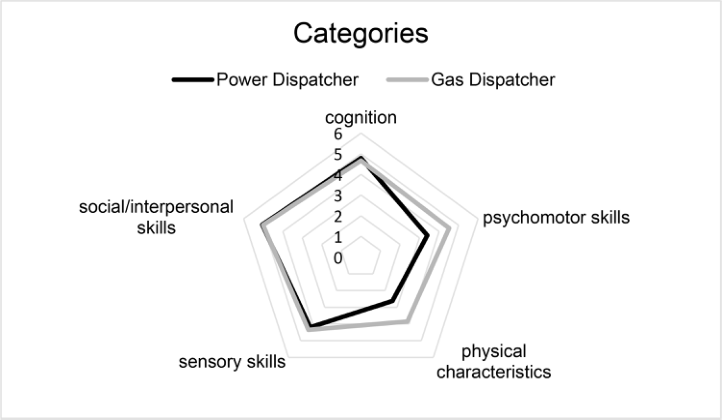
The following descriptive statistics show the results of the survey to analyze the needed skillset for dispatchers. No inference statistics were applied to compare power and gas dispatchers, due to the small number of gas dispatchers (n = 5). The manual of the F-JAS recommends that items with a mean score below four should be interpreted as irrelevant for the job. Table 1 gives an overview of the mean scores for each of the five categories of the F-JAS. Social and interpersonal skills scored the highest, followed by cognitive skills. Sensory skills came in third place, whereas psychomotor skills scored below four for power dispatchers, and above four for gas dispatchers. For power dispatchers, psychomotor skills were not relevant according to the data, and because of the small number of participating gas dispatchers, the category was not further analyzed in detail. As physical characteristics scored below four, they were not considered relevant for both jobs. However, viewed individually, there were two items (balance; M = 4.2; SD = 1,97 and condition; M = 4.2; SD = 2,43) that scored slightly above four for gas dispatchers.
Table 1: Mean (M) and standard deviation (SD) for the categories of job analysis.
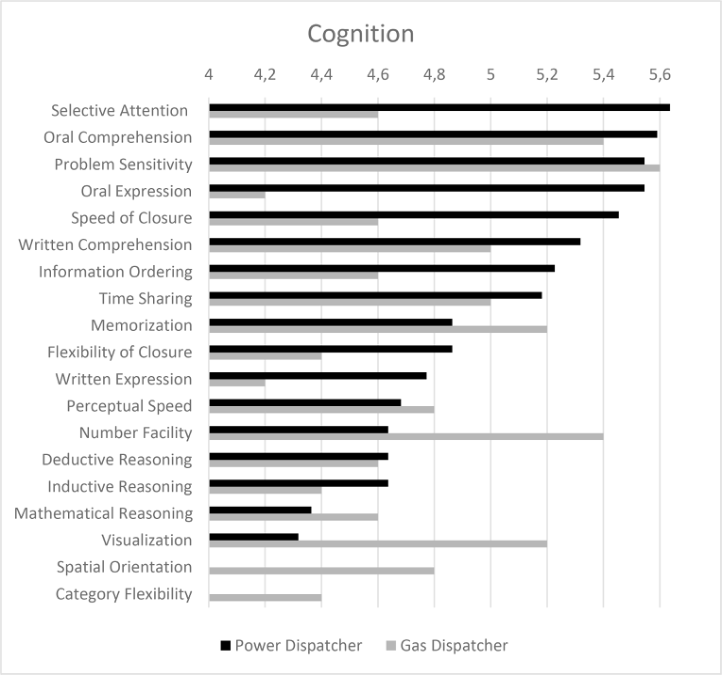
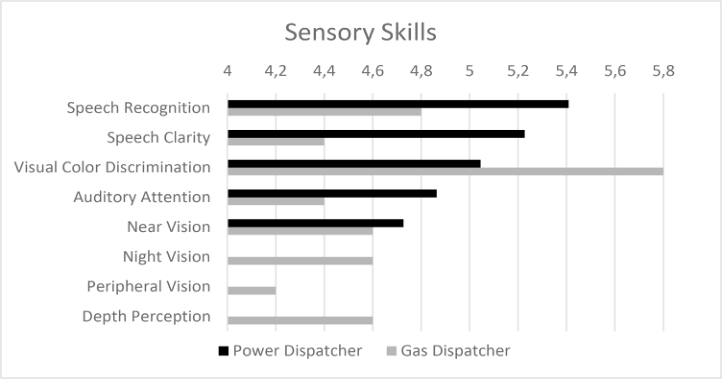
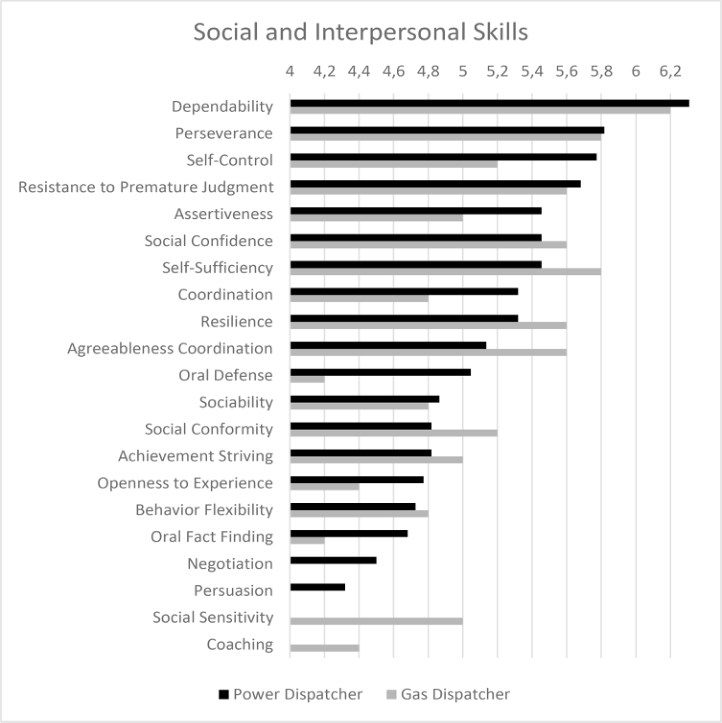
For the three most relevant categories social and interpersonal skills, cognition and sensory skills, descriptive statistics suggested similar overall scores (see Figure 1). However, the following descriptive statistics of individual items with scores above four suggest differences between the two jobs. Due to the small number of gas dispatchers that participated, the focus of the more detailed analysis lies on the power dispatcher data.
In the cognition category, the skills selective attention, speed of closure, problem sensitivity, oral expression and oral comprehension scored particularly high (see Figure 2). This indicates that a crucial task of power dispatchers is problem solving. Information must be filtered and prioritized in written, but especially in oral form, and communicated adequately.
The more detailed analysis of the category sensory skills further confirms that oral communication is crucial for power dispatchers (see Figure 3). Accordingly, speech clarity and speech recognition were the two highest scoring items in the category.
Job Analysis of Gas and Electric Power Dispatchers 67
Figure 1: Overall relevance of F-JAS categories for power and gas dispatchers.Figure 2: Overview of items in the category cognition, that have mean scores above four.Figure 3: Overview of items in the category sensory skills, that have mean scores above four.Figure 4: Overview of items in the category social and interpersonal skills, that have mean scores above four.
Job Analysis of Gas and Electric Power Dispatchers 69
In the category social and interpersonal skills, dependability had the highest score of all items in every category. This reflects the safety-critical nature of the job. Unreliability can lead to mistakes that can have serious consequences for humans, companies and the environment. Perseverance also received a high score. It is important for dispatchers to have strong perseverance, as they often work during periods where not much happens, yet they must remain vigilant to detect critical events. Self-control, another high scoring item, is needed to maintain this perseverance. Resistance to premature judgement also highlights the possible high impact of mistakes in a safety critical area.
Appendix A Table A1 to A3 include more detailed descriptive statistics for the relevant categories cognition, sensory skills and social and interpersonal skills. These results can inform the design of support systems, the control center’s hardware and software, aspirant selection and training.
CONCLUSION
The displayed results of the F-JAS can support the optimization of the work environment and the overall job design for power and gas dispatchers. For instance, due to the relevance of communication skills, improving these through training may increase job performance. Also, the workplace must have an effective, efficient, and safe design to facilitate information perception, reasoning support, and problem recognition. These aspects could be optimized through the control center’s hard- and software design and assistant systems, such as adaptive and context sensitive information presentation. High scores for perseverance, self-control, selective attention and problem sensitivity suggest, that the dispatcher’s cognitive user state has an impact on the overall performance and safety. Adaptive systems that detect and address these user states may increase the effectiveness, efficiency and safety of the human-machine-system. Furthermore, an analysis of innovative technologies could help identify solutions that optimally support skills deemed as highly relevant by dispatchers. For instance, depth perception is important for gas dispatchers and could be enhanced with the use of a stereoscopic display. However, it should be noted that these outcomes must be validated with a higher sample size. Whether such changes improve the effectiveness, efficiency and safety of the human-machine interaction for power and gas dispatchers remains an open question for future research.
APPENDIX A
Table 2: Mean (M) and standard deviation (SD) for the individual items of F-JAS category cognition for dispatchers.
Table available in the original PDF paper.
F-JAS Item Power Dispatcher Gas Dispatcher
M SD M SD Oral Comprehension 5,59 0,85 5,4 2,26 Written Comprehension 5,32 0,95 5 2,14 Oral Expression 5,55 1,06 4,2 1,87
Continued
Table 2: Continued F-JAS Item Power Dispatcher Gas Dispatcher
The authors would like to acknowledge Sunita Pevoubou Fobasso from Avacon AG for assistance with data acquisition and Avacon AG for supporting this study.
REFERENCES
Bainbridge, L. (1983). Ironies of automation. Automatica, 19. Caughron, J. J., & Mumford, M. D. (2012). The Fleishman job analysis survey. The handbook of work analysis: Methods, systems, applications and science of work measurement in organizations, 212–246. Henderson, M. I., Novosel, D., & Crow, M. L. (2017, November). Electric power
grid modernization trends, challenges, and opportunities. In IEEE Power Energy. Piscataway, NJ. Veluwenkamp, H. (2022). Reasons for meaningful human control. Ethics and Information Technology, 24(4), 51. Wang, G., Cheng, Q., Zhao, W., Liao, Q., & Zhang, H. (2022). Review on the
transport capacity management of oil and gas pipeline network: Challenges and opportunities of future pipeline transport. Energy Strategy Reviews, 43, 100933.
LISTED IN THE AHFE DIGITAL BOOKSTORE CATALOGUE
Explore the complete digital volume
Human Factors in Software and Systems Engineering
Read this individual research paper free through the original publisher, or explore the full digital proceedings book.
ISBN 978-1-964867-57-1
Explore this ISBN in the AHFE Bookstore ↗Listed in the July 2026 bookstore catalogue; search by ISBN to confirm current availability · Digital book purchase optional