Carlos Aceves-González, Sharon Cook, Andrew May (2022). Inclusive Service Design: In Search of Better Services. In: Advances in Ergonomics In Design, Usability & Special Populations: Part III. AHFE Open Access, vol. 20. https://doi.org/10.54941/ahfe1001289
Service Design focuses on designing services which are usable and desirable from the users’ perspective, and efficient and different from the organizations’ perspective. However, users are diverse and possess a variety of capabilities, needs, and desires, which presents specific challenges for Service Designers. Inclusive Design is an approach to designing products and services that addresses the needs of the widest possible audience, irrespective of age or ability. Draw upon these two approaches, this paper aims to present the concept of inclusive service design as an essential element in designing better services. The potential benefits of such an approach were explored through a series of qualitative studies of the bus service in Guadalajara, Mexico.Based upon the research, several advantages for service improvement were identified, drawn from the richness of data generated by younger and older customers, and the uniqueness of the information gained from them. Likewise, the value of the big picture data obtained from stakeholders. This information highlights areas where service designers can help reduce the gap between what service providers do and what a broad range of users expect or need.
The need for inclusive services It is well known that the world's population is ageing, starting first in the more developed countries, but then becoming more evident in much of the developing world (United Nations, 2002, 2010). This demographic trend has been recognised as one of humanity’s greatest triumphs, however, it is also one of its greatest challenges since global ageing will increase economic and social demands on all countries (WHO, 2002). This impact is expected to be higher in developing countries where the pace of ageing trend is faster and there will be less time to adjust to the consequences of this demographic change (United Nations, 2010). The World Health Organization (WHO, 2002) argues that conditions can improve if governments and society contribute to ‘active ageing’ of their populations, through policies and programs to maintain and improve the health, social participation and security for older people. Consequently, WHO claims that ‘in all countries, and in developing countries in particular, measures to help older people remain healthy and active are a necessity, not a luxury’ (WHO, 2002:6).
Although, great improvements have been made, especially in developed countries, through legislative imperatives - such as The Disability Discrimination Act (DDA, 1995) (now replaced by The Equality Act, 2010) and The
Americans with Disabilities Act (ADA, 1990) – access to outdoor spaces and buildings is not fully guaranteed for people with varying needs and capacities. According to The World Health Organization (WHO, 2007:15) ‘in both developed and developing countries, people think that their city was not designed for older people’ and they also report that the delivery of commercial and public services presents problems in meeting older people’s needs. Therefore, along with the need for an accessible built environment, there is a compelling need for inclusive services that can be used by a broader range of users. Services, in which providers are able to understand how they can better respond to users irrespective their age or capabilities (BS 18477, 2010; WHO, 2007) therefore need to be developed.
This paper aims to present the concept of inclusive service design as an essential element in designing better services, by capitalising on contributions resulting from integrating principles and techniques of Service and Inclusive Design approaches. The potential benefits were explored through a series of qualitative studies of the bus service in Guadalajara, Mexico.
Designing Inclusive Services Service Design is an emerging discipline that aims to innovate or improve services that are useful, usable and desirable from the user perspective, and efficient, effective and different from the organisations perspective (Mager and Sung, 2011; Moritz, 2005). Accordingly, it suggests that Service Design provides several benefits to the end users’ experience when applied to services sectors as retail, banking, transportation, and healthcare (Stickdorn, 2010a). But it has also been defined as a strategic approach that helps service providers to better position their service offerings (Mager and Sung, 2011). In the public services arena, it has been pointed out as an approach that is less about competition and contestability and more about reducing the gap between what organisations do and what users expect or need (Parker and Heapy, 2006).
Parker and Heapy (2006) point out that services need to be understood as a journey or a cycle, since they may be considered as a series of critical encounters that take place over time and across channels. These service encounters or touch points can take place in human-to-human or human-to-physical artefacts interactions. Still more, Service Design observes the full customer journey, containing the user’s experience before and after the service encounters (Mager and Sung, 2011). Therefore, from this perspective, elements such as: previous experience, making the decision to use the service, walking to the stop and waiting for the bus, getting on the bus, finding a seat, traveling, getting off the bus, and walking to destination, all contribute to the experience of bus service use. Similarly, principles of Service Design suggest that the entire environment of a service should be considered. Stickdorn (2010b:44) notes ‘the intention should always be to see the wider context in which a service process takes place’.
Meroni and Sangiorgi (2011) highlight that Service Design, since its origins, has considered the users as its main focus in the process of service delivery. These authors claim that this approach generally conceives users as a resource rather than a burden or a problem. Nevertheless, beyond being a user-centred approach, it is also considered as a human-centred approach that investigates or understands people’s experiences (as users, service staff, communities or humanity in a wider sense), interactions and practices ‘as a main source of inspiration for redesigning or imagining new services’ (Meroni and Sangiorgi, 2011:203).
However, it is really important to be aware that users are diverse and possess a variety of capabilities, needs, and desires, which present specific challenges to the design of products and services. With this in mind, Inclusive Design offers principles and tools for the delivery of better products and services for inclusion. Inclusive Design ‘is a general approach to designing in which designers ensure that their products and services address the needs of the widest possible audience, irrespective of age or ability’ (Design Council, 2008). One of the key objectives of this approach is avoiding design exclusion, which might be caused if the demands of the task exceed any of the corresponding user abilities (Clarkson, Waller, and Cardoso, 2013). Similarly, a central concern in Human Factors and Ergonomics is to evaluate the match between users' capabilities and the designed product (Persad, Langdon, and Clarkson, 2007).
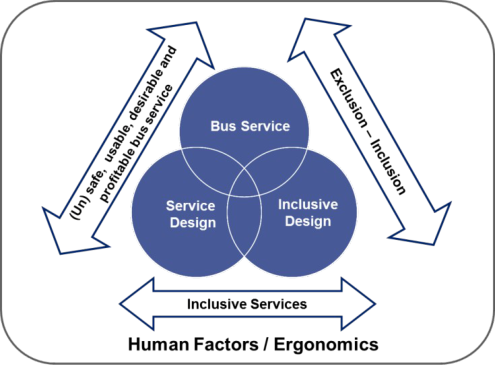
The use of philosophical principles, tools and techniques coming from Service Design and Inclusive Design, guided by a Human Factors perspective, can therefore be seen to contribute to designing inclusive services. Figure 1 shows a conceptual framework to design for inclusive bus services; however, this framework might be applied to design any other sort of service.
Figure 1. Conceptual frame to evaluating and designing inclusive bus services CASE STUDY: THE NEED FOR AN INCLUSIVE BUS SERVICE
Transport, particularly public transport, is one of those services that have been related to accessibility and usability problems for older and disabled people (Broome, McKenna, Fleming, and Worrall, 2009; Carlsson, 2004). The report of the World Health Organization (WHO, 2007) indicates that the cities in developed countries are more likely to have a well-developed or satisfactory public transport system. However, in cities at all stages of development, there are gaps that need to be addressed in order to offer an inclusive service, adds the report. This situation is highlighted by Nickpour, Jordan, and Dong (2012:14) who argue that an ‘accessible bus’ does not necessarily guarantee an ‘accessible bus service’.
This case study was based in Guadalajara, Mexico, where the lack of a strong regulatory and legislative regime means that there is little incentive for the transport operators to provide an inclusive bus service. Guadalajara has similar transport conditions to the City of Mexico, where the existence of "informal" systems of buses causes issues of security and accessibility for elderly and disabled passengers (Access Exchange International, 2009).
The research methodology comprised two complementary studies. The first study was designed to investigate the nature of the challenges facing younger and older users when using the bus service. The second study was designed to obtain from stakeholders a bigger understanding of the service operation, and to explore how this might relate to the challenges identified in the first study.
Study 1: Identifying Problematic Issues on the Bus Service from the Perspective of Younger and Older People In this study participants were asked to identify those issues in the whole journey that impose difficulties to their use of the service and which would need to be re-designed to increase its uptake. The study helped to ascertain whether younger and older users face similar challenges in the use of the bus service or if each group has unique views and needs when travelling. In addition, the study shows the potential for increased service use by designing the service to accommodate the needs of the older user.
Aim and objectives The overall aim of this study was to identify which elements of the transport system impose challenges to the successful use of the bus service. The specific study objectives were to:
Identify which elements of the transport system impose greater difficulty for younger and older people
Determine if older people report different reasons from those problematic elements than younger people. Ergonomics In Design, Usability & Special Populations III
Understand differences on the needs, if any, between younger and older people using public transport.
Method
In order to obtain information regarding to how users think and feel (Barrett and Kirk, 2000) about the bus service, this study used a series of focus groups to identify and understand problematic issues that impose greater difficulties to use the bus service to younger and older passengers. Discussions were aimed at ascertaining the true motivations and insights (Stickdorn and Schneider, 2010) behind the perception of each group of users.
The study recruited a convenience sample of older participants, via a general call in the Metropolitan Centre of the Elderly (CEMAM, according to its designation in Spanish), 26 older people were selected based on being aged 60 or over with appropriate language and cognitive abilities to participate in the group discussions and give informed consent. The study was particularly interested in those who had a desire to use public transport, but perceived that there were barriers to doing so. Therefore, a combination of frequent and non-frequent travellers took part in the study.
A similar strategy was used to recruit 17 students in their first year at the University of Guadalajara. These younger participants were aged between 18 and 21 years, and they were all frequent users of the bus service. Appropriate language and cognitive abilities to participate in the group discussions and give informed consent were also required of these participants.
Data Analysis For this study, the data analysis involved analyzing the audio recordings from the focus groups. These files were imported into the QSR International NVivo software, and a thematic analysis was undertaken to explore this qualitative data. Based on previous concepts about the bus service system, a theoretical analysis was undertaken. The analysis was also at a semantic and realistic level (Braun and Clarke, 2006; Robson, 2011). The analysis was carried out following the procedure described by Robson (2011). Since this study aimed to get a better understanding of the whole picture of the bus service use, and there was no previous research and knowledge related to the use of the bus service in the studied context, it was aimed to produce a rich description of the data rather than a detailed account of a particular aspect.
Results
A total of seven focus groups were conducted, four with older people and three with younger people. The majority of participants were female (65.2%) and frequent passengers (83.8%). Eleven (42.3%) older participants reported having problems going out and about; by contrast only one younger participant had a temporal physical impairment.
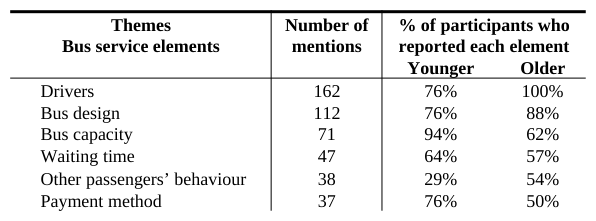
Table 1 shows the bus service elements that were most cited by younger and older participants in the group discussions. It is noted that the bus drivers, bus design, and bus capacity were stated as problematic elements by a higher number of participants from both age groups. However, it also highlights some differences between the percentages by theme in relation to the age group. For instance, at least one concern or complaint was raised by the total of older participants related to drivers in comparison with 76% of the younger participants. Conversely, bus capacity was stated as a problem by 94% of younger participants compared to 62% of older people.
Table 1: Elements that impose difficulty to use the service according to younger and older people
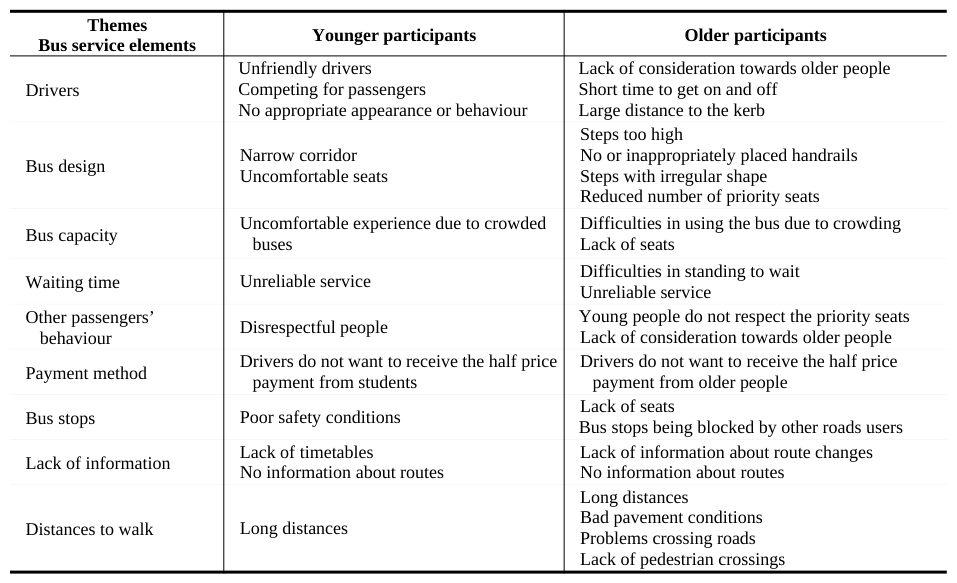
Although, in this study younger and older participants reported concerns about similar bus service elements, some differences were also found in the manner in which the problems were described. In table 2 some of those differences can be observed. For example, even though both groups reported problems with the bus design, younger users referred to narrow corridor and uncomfortable seats, while older participants stated concerns about the height of steps, lack of handrails and number of priority seats.
Table 2: Reasons behind of the problematic elements by age group Themes Bus service elements Younger participants Older participants
These results suggest the existence of several elements that impose difficulties in using the service. These elements are not only physical objects; rather there are many intangible elements that need to be considered to improving the service such as driver attitude, information provision and waiting time. Furthermore, results indicate that each user group faces different barriers to using the bus service, but it seems that older people experience additional and more serious limitations.
Study 2: Understanding the Bus Service System To better understand the broader service operation, the research needed to extend beyond the users by considering the contributions made by other stakeholders. Two methods were used to develop the team’s understanding in this area. The first related to consultations with a range of stakeholder groups in the form of personal interviews and group meetings whilst the second related to a document analysis of relevant items in the public domain. In this way the design and operation of the service could be better understood from the context of legal requirements through to in-practice considerations.
Aims and objectives The aims of this study were to gain a sense of the context in which the bus service is operating and, explore the presence of constraints in the service provision and why they are occurring. Particular objectives of the study were:
To identify the main stakeholders that are part of or are affected by the service
To describe the main characteristics of the bus service
To investigate the main issues that prevent delivery of an inclusive service
Methods
Semi-Structured Interviews This was a qualitative, exploratory study, which included a series of group and individual semi-structured interviews with stakeholders. Data were analysed to give an overview of the bus service characteristics: main actors, routes, bus design, and regulation, among others. It also aimed to explore the presence of constraints in the service provision and why they were occurring. The results were interpreted in terms of how those characteristics and constraints might prevent the service being perceived as safe, usable and desirable from the point of view of the users.
At the beginning of this study and based on previous knowledge of the bus system, the following key stakeholders were defined:
Users – (whom took part in the previous study)
Local authorities – those related to public transport and/or older people
Service operators – bus companies, bus organizations and/or bus owners
Bus drivers
Bus manufacturing companies – designers and managers
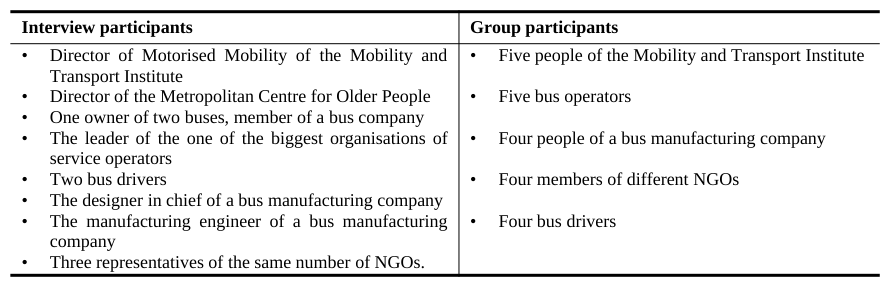
Non-Governmental Organisations – working in favour of public transport improvements In total, 33 participants took part in the study either individually or as part of a group session; this is detailed in Table 3 below. Initially, 11 interviews were conducted to gain an understanding of the service operation. After those interviews five group meetings were held with people from the same organisations to clarify or deepen in specific subjects.
Table 3: Individual and group participants in the study Interview participants Group participants
Document Analysis To gain a better understanding of the bus system and as a supplementary method (Robson, 2011) some documents such as laws, regulations, programs and plans, and newspapers, among others were integrated into the analysis. As suggested by Bowen (2009) the procedure involved finding, selecting, assessing and synthesizing the data contained in documents. The following list shows some documents that were included in the analysis:
Law on the Rights of the Elderly (INAPAM, 2011))
General Law for the Inclusion of People with Disabilities (Sedesol, 2011)
Federal Law to Prevent and Eliminate Discrimination (Gobierno de Mexico, 2007)
Law of Mobility and Transport of the State of Jalisco (Gobierno de Jalisco, 2013a)
State Development Plan – Jalisco 2013-2033 (Gobierno de Jalisco, 2013b)
Some news reports from the digital version of the local newspapers were included in the analysis. El Informador (http://www.informador.com.mx/), Mural (http://www.mural.com/), and La Jornada Jalisco (http://www.lajornadajalisco.com.mx/).
Data Analysis and Results This study comprised two different data sets which required different methods of analysis. In the first part, data analysis method, similar to that of the first study, was used for interviews and meetings. But in this case, based on the themes identified from the data, an inductive analysis was used. It was also at a semantic and realistic level (Braun and Clarke, 2006; Robson, 2011).
The second part of the data analysis included the examination, reading and interpretation of the documents. This process involved the combination of elements from content analysis and thematic analysis. The procedure excluded the quantification typical of conventional mass media content analysis and followed a first-pass document review to extract meaningful and relevant passages of text as suggested by Bowen (2009). Later, as part of the thematic analysis, a more focused re-reading and reviewing of data was undertaken. Codes and the themes previously defined for the interviews were used for the document analysis. However, the theme related to the current mobility situation in the city emerged mainly from the document analysis.
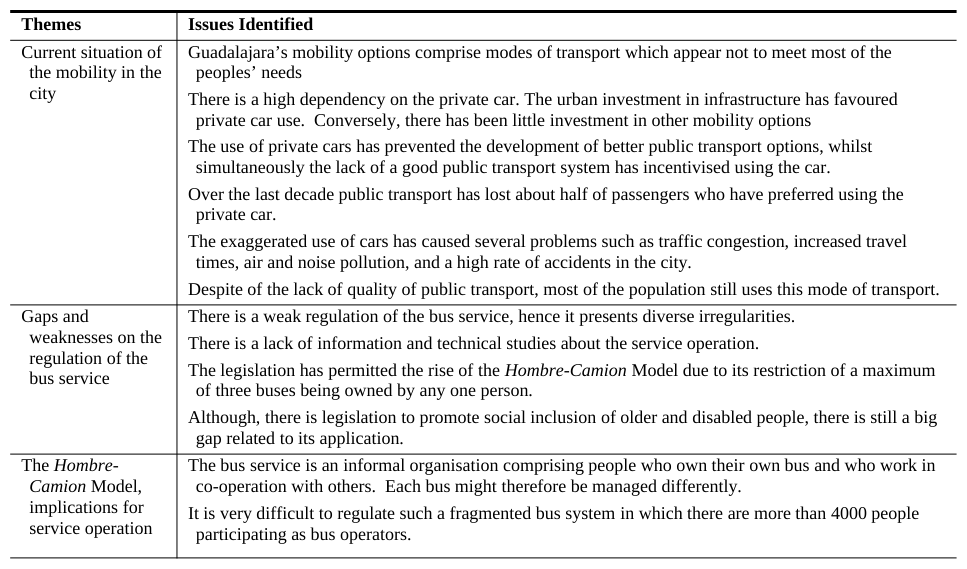
A large volume of data was obtained from this study, from which the results were classified and summarised into a total of four themes and a number of codes. Table 4 shows the main issues that affect the bus service operation and prevent the delivery of an inclusive service.
Table 4: Themes and issues identified related to the bus service operation Themes Issues Identified
The table above illustrates the wide diversity of data that can be obtained from stakeholder consultations and document review, which can help in understanding the elements of the bus service system that negatively impact the users’ experience. By extension, this data provides insights into the factors that may be encouraging a modal shift away from public transport to private car use and therefore provides guidance for improvements to bus service design and uptake.
DISCUSSION
The approach of the studies enabled the identification of problems across the whole of the users’ journey – from home to destination –and even the user’s perception before and after the service encounters. The identification of the problematic elements within all of the service is very relevant because a problem in just one part of the service might exclude users from the service as a whole.
Overall the results from these studies confirm the compelling necessity of a better bus service in the city. These results indicate that the current service is not characterised by being safe, usable and desirable from the users’ perspective, and since less and less people are willing to use the bus, it is becoming less profitable to service operators. More detailed results indicate the presence of several components of the bus system that impose difficulties for using the service and, as such, provide focus as to where improvements can be made.
It is important to note that although younger and older users’ expressed concerns about the same bus service elements, each age group stated different reasons for those problematic elements with older people experiencing additional and more serious limitations when using the bus service. This difference might be attributed to the declining functionality of the ageing process (e.g. motor, visual, auditory, cognitive, or health limitations), therefore, the gap between personal abilities and environmental demands becomes wider (Rogers, Meyer, Walker, & Fisk, 1998; Seidel et al., 2009). Moreover, it should be noted that the use of the bus service implies a series of tasks, such as climbing up and down stairs or moving towards a seat when bus is moving, which are among the most challenging and hazardous types of locomotion in the daily living of older people (Redfern et al., 2001; Startzell & Owens, 2000).
The use of this inclusive service framework permitted ascertaining the presence of tangible and intangible barriers for younger and older users. Thus, physical barriers were identified (e.g. the bus design or bad pavements conditions), but also psychological (e.g. discomfort and safety concerns), social and cultural (e.g. other passengers’ behaviour) and service operation barriers (driving style, driver behaviour and, reliability, among others). Likewise, the use of this approach, along with the application of both studies, allowed recognition that some of the problems experienced by the users – reported in the first study - can be in part attributed to a wider range of factors identified in the second study. For instance, results from the study 1 show issues with bus design (step height and shape; narrow aisle width) which relates to study 2 where due to affordability by owner-bus operators only truck-based vehicles are purchased for use. Equally, study 1 shows issues with long distances to walk and problems with paving and crossings which relates to study 2 where infrastructure investment has favoured private car use not public transport.
A further benefit from the use of this human-centred approach is the understanding that the bus service is Ergonomics In Design, Usability & Special Populations III problematic for both users and drivers. Results from the first study suggest the presence of several issues related to drivers’ attitude and behaviour. Drivers are blamed for unfriendly behaviour and lack of consideration towards passengers’ needs, but results of the second study show that they are ‘forced’ to work under poor working conditions. According to Polaine, Løvlie, and Reason (2013:36) ‘when frontline staff are let down by internal systems and procedures, they become disempowered and inflexible. This is passed down the line and leads to poor customer experiences and service failures’.
CONCLUSIONS AND FURTHER RESEARCH Having applied an inclusive service design framework for assessing and understanding the bus service, a number of benefits for service improvement can be identified, drawn from the richness of data generated by younger and older customers, and the uniqueness of the information gained from them. Likewise, the value of the big picture data obtained stakeholders. Taken together, this information highlights areas where service designers can help reduce the gap between what service organisations do and what a broad range of users expect or need. Equally, the use of this approach permitted the identification and understanding of factors that cause the failure of the service elements, e.g. establishing the reasons behind staff behaviour, and what the implications are for service improvement. Findings at this level can result in an improved service for both end users and the service providers themselves.
Further research is being undertaken concerning users’ experience using the bus service. This research includes methods that elicit data not only from the self-reporting of users and stakeholders, but from the assessment of the service performance and the observation of users’ capabilities when using the bus service. More research however is needed to evaluate the usefulness Inclusive Service Design as a conceptual framework in the context of the bus services.
ACKNOWLEGMENTS This research project was supported by the Ministry of Public Education of Mexico through the Program of Improvement of the Professors (PROMEP, according to its designation in Spanish), PROMEP/1 03.5/1 0/5397.
REFERENCES
Access Exchange International. (2009). Accessible Transportation Around the World. Access Exchange International. Retrieved from http://globalride-sf.org/newsletters/0901.pdf ADA. (1990). Americans with Disabilities Act. U.S.: Department of Justice, Civil Rights Division. Barrett, J., & Kirk, S. (2000). Running focus groups with elderly and disabled elderly participants. Applied ergonomics, 31(6),
621–9. Retrieved from http://www.ncbi.nlm.nih.gov/pubmed/11132046 Bowen, G. (2009). Document analysis as a qualitative research method. Qualitative research journal, 9(2), 27–40. Retrieved from http://www.emeraldinsight.com/journals.htm?articleid=17021410&show=abstract Braun, V., & Clarke, V. (2006). Using thematic analysis in psychology. Qualitative Research in Psychology, 3(2), 77–101.
doi:10.1191/1478088706qp063oa Broome, K., McKenna, K., Fleming, J., & Worrall, L. (2009). Bus use and older people: a literature review applying the Person- Environment-Occupation model in macro practice. Scandinavian journal of occupational therapy, 16(1), 3–12. doi:10.1080/11038120802326222 BS 18477. (2010). BS 18477:2010. Inclusive service provision – Requirements for identifying and responding to consumer
vulnerability. BSI. Carlsson, G. (2004). Travelling by urban public transport: exploration of usability problems in a travel chain perspective.
Scandinavian Journal of Occupational Therapy, 11(2), 78–89. doi:10.1080/11038120410020548 Clarkson, J., Waller, S., & Cardoso, C. (2013). Approaches to estimating user exclusion. Applied ergonomics, 1–7.
doi:10.1016/j.apergo.2013.03.001 DDA. (1995). Disability Discrimination Act. London: The Stationery Office. Design Council. (2008). Inclusive Design Education Resource. London: Design Council. Retrieved from http://www.designcouncil.info/inclusivedesignresource/index.html Mager, B., & Sung, T. (2011). Special issue editorial: Designing for services. International Journal of Design, 5(2), 2–4.
Retrieved from http://www.ijdesign.org/ojs/index.php/IJDesign/article/view/994/341 Meroni, A., & Sangiorgi, D. (2011). Design for Services. Great Britain: Gower.
Moritz, S. (2005). Service Design. Practical Access to an Evolving Field (p. 244). London. Retrieved from http://stefanmoritz.com/Book.html Nickpour, F., Jordan, P. W., & Dong, H. (2012). Inclusive Bus Travel - A Psychosocial Approach. In P. Langdon, J. Clarkson, P.
Robinson, J. Lazar, & A. Heylighen (Eds.), Designing Inclusive Systems (pp. 13–23). London: Springer London. doi:10.1007/978-1-4471-2867-0 Parker, S., & Heapy, J. (2006). The Journey to the Interface. How Public Service Design can Connect Users to Reform. London: Demos. Retrieved from http://hm-treasury.gov.uk/d/cypreview2006_wiltshirecouncil2.pdf Persad, U., Langdon, P., & Clarkson, J. (2007). Characterising user capabilities to support inclusive design evaluation. Universal
Access in the Information Society, 6(2), 119–135. doi:10.1007/s10209-007-0083-y Polaine, A., Løvlie, L., & Reason, B. (2013). Service Design. From Insight to Implementation (p. 202). United States of America: Rosenfeld Media, LLC. Redfern, M., Cham, R., Gielo-Perczak, K., Grönqvist, R., Hirvonen, M., Lanshammar, H., … Powers, C. (2001). Biomechanics
of slips. Ergonomics, 44(13), 1138–66. doi:10.1080/00140130110085547 Robson, C. (2011). Real World Research (Third Edit.). Cornwall, UK: Wiley. Rogers, W. a., Meyer, B., Walker, N., & Fisk, A. D. (1998). Functional Limitations to Daily Living Tasks in the Aged: A Focus Group Analysis. Human Factors: The Journal of the Human Factors and Ergonomics Society, 40(1), 111–125. doi:10.1518/001872098779480613 Seidel, D., Crilly, N., Matthews, F. E., Jagger, C., Clarkson, P. J., & Brayne, C. (2009). Patterns of Functional Loss Among Older
People: A Prospective Analysis. Human Factors: The Journal of the Human Factors and Ergonomics Society, 51(5), 669– 680. doi:10.1177/0018720809353597 Startzell, J., & Owens, D. (2000). Stair negotiation in older people: a review. Journal of the American Geriatrics Society, 48, 567–580. Retrieved from http://cat.inist.fr/?aModele=afficheN&cpsidt=1428725 Stickdorn, M. (2010a). Definitions: Service Design as an Interdisciplinary Approach. In M. Stickdorn & J. Schneider (Eds.), This
is Service Design Thinking: Basics Tools Cases (p. 373). Amsterdam: The Netherlands: BIS Publishers. Stickdorn, M. (2010b). 5 Principles of Service Design Thinking. In M. Stickdorn & J. Schneider (Eds.), This is Service Design Thinking: Basics Tools Cases. Amsterdam: The Netherlands: BIS Publishers. Stickdorn, M., & Schneider, J. (2010). This Is Service Design Thinking: Basics Tools Cases (p. 373). Amsterdam: The
Netherlands: BIS Publishers. United Nations. (2002). Madrid International Plan of Action on Ageing. New York: United Nations. Retrieved from http://social.un.org/index/Portals/0/ageing/documents/Fulltext-E.pdf United Nations. (2010). World Population Ageing Report 2009. New York: United Nations. Retrieved from
http://www.un.org/en/development/desa/population/publications/pdf/ageing/WorldPopulationAgeingReport2009.pdf WHO. (2002). Active Ageing. A Policy Framework. Geneva: WHO. Retrieved from http://whqlibdoc.who.int/hq/2002/who_nmh_nph_02.8.pdf WHO. (2007). Global Age-friendly Cities: A Guide (p. 82). WHO. Retrieved from http://www.who.int/ageing/age_friendly_cities_guide/en/
LISTED IN THE AHFE DIGITAL BOOKSTORE CATALOGUE
Explore the complete digital volume
Advances in Ergonomics In Design, Usability & Special Populations: Part III
Read this individual research paper free through the original publisher, or explore the full digital proceedings book.
ISBN 978-1-4951-2108-1
Explore this ISBN in the AHFE Bookstore ↗Listed in the July 2026 bookstore catalogue; search by ISBN to confirm current availability · Digital book purchase optional