Chen Li, Nan Li, Xiaoyu Xiao (2025). Inclusive design strategies based on a human factors perspective: integrating urban color in the regional cultural diversity of multi-ethnic cities. In: Human Factors in Architecture, Sustainable Urban Planning and Infrastructure. AHFE Open Access, vol. 191, pp. 155–165. https://doi.org/10.54941/ahfe1006619
The national culture of a city is a symbol of its unique identity, which profoundly affects the residents' sense of identity and belonging. Colour, as a visual expression of urban cultural landscape, not only shapes the visual image of the city, but also guides the residents' emotional experience and behavioural patterns in an invisible way. With the rapid development of cities, the phenomenon of serious loss of urban characteristics and one-sidedness of a thousand cities has become more and more prominent. This poses a challenge to the psychological feelings of urban residents and the diversity of social culture. Through the collection and research of ethnic colours in Hohhot City, it is found that how to make the city colours can reflect the cultural characteristics of multi-ethnic integration, and at the same time meet the psychological needs and aesthetic preferences of the residents, is a problem that needs to be solved by the current urban colour planning. This thesis aims to study the development profile of Hohhot and extract the current status of urban colour through literature, questionnaire survey, field research, etc., and quantitatively analyse the colour information by using the NCS colour system and the self-developed Java NCS colour analysis data program to determine the overall positioning of urban colour in Hohhot. In the planning process, we fully consider the human factor, from the residents' emotional experience, cognitive habits and behavioural patterns, and combine the urban colour planning with the city's functional layout, architectural style, landscape design, etc., to form a colour planning system from macro to micro, and from general to specific. Through the research method and based on the research of multi-ethnic urban architectural planning, the regional urban colour characteristics of Hohhot are finally summarized. The results of the study analyzed the minority architectural colours in the main urban area of Hohhot and obtained the chromatogram of the ethnic city of Hohhot, which is composed of greenish grey, light grey, white and other colours, from the grey landscape area in the western part with low luminance and low purity to the light grey landscape area in the eastern part with high luminance and low purity, which forms the rhythmic change of the urban colours in luminance and purity, which not only conforms to the aesthetic preference of the residents, but also can be used psychologically and psychologically. These colours not only meet the residents' aesthetic preferences, but also give them a sense of tranquility, comfort and belonging psychologically. Urban colour planning from the perspective of human factors can not only shape the unique image of the city, but also improve the quality of life of the residents and social and cultural diversity. In the future urban development, we should pay more attention to the combination of national cultural characteristics and modernism elements, to achieve the organic integration of traditional national culture and modern urban culture and innovative development, to provide urban residents with a more colorful and culturally rich urban colour environment.
Color has cultural attributes, and minority color language is an important carrier for the transmission of national cultural characteristicss (Lu, & Zhenghong, 2023). Ethnic colors lead the way, with its unique aesthetic sense and rich in color different meanings (Wei-Jing & Yu-Cheng, 2022). Urban color is an important element in people’s perception of the city’s appearance (Gou, 2022). Inclusive design in urban color design is a human-centered design philosophy that seeks to create equitable, accessible and friendly urban environments, ensuring that all residents, regardless of age, ability, gender, cultural background or socio-economic status, have equal access to and enjoyment of urban spaces. The human factor plays a crucial role in urban color design in ethnic minority areas, and in recent years, many outstanding ethnic minority historical buildings suffer from a lack of vitality (Liu, 2024), which makes it difficult to give full play to their use value and explore the rich connotation of traditional ethnic colors.
Multi-ethnic state refers to the multi-ethnicity of a country in terms of its ethnic structure (Yang, 2020). China is a multi-ethnic country, and Hohhot City in Inner Mongolia is located at the border of China, one of the five minority autonomous regions, and is a city inhabited by 41 ethnic groups such as Mongols, Han Chinese, Hui, Manchus, Daur, Ewenki, and so on, with a rich color of minorities. Minority areas of the city color design of human factors intertwined with each other, each other’s influence, together constitute the uniqueness and complexity of minority areas of the city color design.
This paper chooses Hohhot city as the research object, which has many kinds of ethnic buildings, to discuss the color of ethnic buildings in its research area. We will carry out a questionnaire survey of the region, on the basis of which we will process JAVA color data on the current status of color in the six sub-districts of Hohhot, and finally, we will discuss the color choices of ethnic buildings in this area. This study is conducive to the integration of ethnic colors into urban color research, and provides theoretical references for color planning for architectural construction in multi-ethnic regions of the world.
METHODS
Data Sources This study mainly carried out two aspects of data collection and analysis.One is a questionnaire survey on color preference of residents, tourists and visitors in Hohhot, which is now inhabited by 41 ethnic groups such as Mongols, Han Chinese, Hui, Manchus, Daur and Ewenki. According to the results of the seventh national census, the number of ethnic minorities in Hohhot accounts for 14.58% of the total population (2021-05-27). Secondly, the field coloring of NCS and data analysis of JAVA program were carried out on ethnic historical buildings in Hohhot. The survey visited an area of 2.58 million square kilometers, focusing on the study of the color qualities of historical buildings in the neighborhoods, which is an important basis and content of urban color planning.
Inclusive Design Strategies Based on a Human Factors Perspective 157
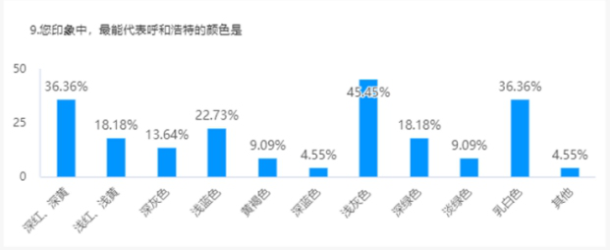
Survey on Public Awareness and Preference of National Colors in Hohhot City Color preference refers to the colors that people like or prefer (Mikellides, 2015). In order to deeply understand the aesthetic preferences and cultural connotations of various ethnic groups in architectural color, and to promote the understanding of and respect for ethnic color culture.The study of the ethnic area block color merchants, residents, tourists issued questionnaires (Figure 1) and questionnaire intervi ews, a total of 20 questions designed and 56 valid questionnaires, aimed at understanding the public’s experience, understanding of ethnic architecture color. The questionnaire is based on the following questions: Which do you think is the most representative building of ethnic architecture? What colors do you think represent the Mongolian, Hui and Manchu ethnic groups? What do you think are the types of buildings that represent ethnic architecture? The data of many questions such as organizing and summarizing were used to get the conclusions related to the ethnic color architecture.
Figure 1: Questionnaire.
In summary, several conclusions are obtained: First, the colors characteristic of urban architecture in Hohhot are blue, light gray and cream, with cream accounting for up to 50% and light gray accounting for 42.68%. Second, the colors that best represent the Mongolian ethnic group are blue and white, accounting for up to 68%, and the most representative ethnic building is the Dazhao Wulanji Temple, which accounts for up to 86.36%. Third, the most representative of the Hui color is yellow and white, accounting for 50% and 37.71% respectively. And the most representative characteristic ethnic building is the Mosque. Fourth, the most representative of the Manchu color is yellow and red, red accounted for 40.91% and 36.36%, and the most representative building for the Princess Palace.
Data Acquisition Processes and Applications As an important feature of the city image, national culture buildings play an irreplaceable role in urban planning and the construction of urban characteristics, and their colors reflect the historical heritage and national characteristics of the city (Deng & Chunfeng, 2011). Through the study
of the current situation of ethnic architecture, we can understand the unique preference of different ethnic groups for architectural colors and their characteristics, which will help us to better protect and inherit the characteristics of ethnic minorities.
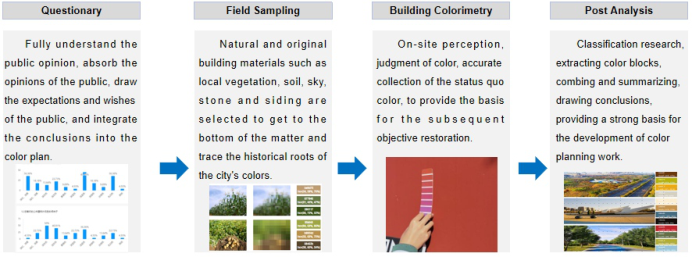
Following the order of investigation methods (Figure 2), on the basis of using the questionnaire survey method, fully understanding public opinion, absorbing people’s opinions, and arriving at people’s expectations and wishes, the architectural colorimetry method is used to perform on-site perception, judging the color, and accurately capturing the current status quo color, which provides a basis for the subsequent objective restoration of architectural color. Finally, we will carry out post analysis, and draw conclusions through classification research, extraction of color blocks, sorting and generalization, etc., which will provide a strong basis for the color planning of ethnic buildings.
Figure 2: Research methodology process.
A panoramic view of Passage Street was obtained through Baidu Maps and supplemented with 200 on-site photographs to document the neighbourhood architecture and environment and ensure data integrity. Field surveyed the road and summarised the data. To avoid weather affecting the colour data, a spectrophotometer was used to supplement the colour of important building facades to ensure accurate analysis.
The labeling method of the color sample parameters in the research and analysis of the current status of the study building color is based on the “Swedish NCS color card” (1950 colors) (Figure 3). NCS (nature color system) is a global color system, NCS color system is the most widely used color numbering system in Europe. The advantage of the NCS color system is that it can be visualized NCS. The advantage of NCS color system is that the visualized NCS system can be scientifically, rationally and permanently communicated, extracted, archived and produced more easily (Hård & Sivik, 1981). Using the NCS color system to measure the color of buildings and characteristic scenes with nationalities in Hohhot, and finally get the color spectrum of nationalities buildings in Hohhot.
By-Laws for Each Sector According to the color master plan of Hohhot City, combining the regional characteristics of the city, analysis of the current color situation, history and
Inclusive Design Strategies Based on a Human Factors Perspective 159
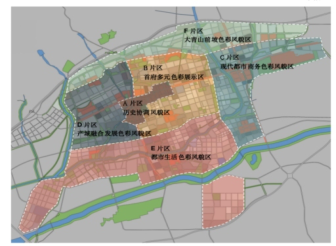
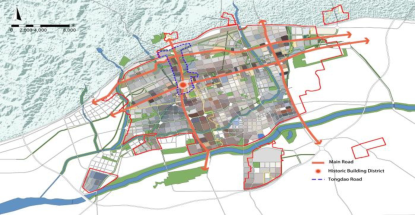
culture, as well as the functional characteristics of different districts, to carry out the city color zoning and provide the prerequisite for the subsequent color planning and guidance of the different zones (Figure 3).
Figure 3: Colour zoning plan.
1. Historical co-ordination style area: The specific scope of the east to the East Moat Street, south to Ordos Street, west to the western boundary of Ulanhu Park, north to Xinhua Street - Beiguan Street, including the city of naturalization, Suiyuan City and the construction area between the two cities. 2. Capital Multi-color Display Area: This area is located in the area east of the historical city of Hohhot. It is an important carrying place for the functions of the capital. 3. Modern urban business color style area: Located in the eastern part of Hohhot, the region is mainly administrative offices, business commercial functions, is the core business and governmental affairs in Hohhot. 4. Daqingshan front slope color landscape area: The region is located in the southern foot of Dazhongshan, the specific scope is located in the area north of Genghis Khan Street.The region has a good ecological background, outstanding landscape scenery and other characteristics. 5. Urban life color landscape area: The area is dominated by residential style, with the Big and Small Black Rivers running through the interior of the site, which is an important modern urban living area in Hohhot. 6. City integration and development of colour and style area: Located in the western part of Hohhot City, specifically located in the area west of the channel road, north of the South Second Ring Expressway, South of Genghis Khan Street.
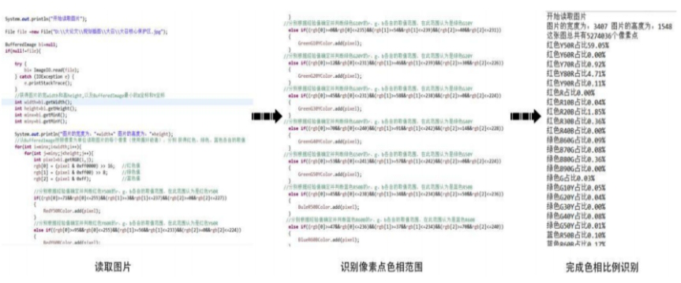
General Status of Colour Using JAVA data processing to process the current color data, the method is mainly for the field research of urban color information and research picture color in the self-built “JavaNCS color recognition software”. Figure 4 to read and quantify the information, transformed into the color card information in the NCS color system, and research picture, The color ratio is comprehensively analyzed. Two kinds of information can be obtained by
picking up the content of the information, one is all the colors contained in the picture (the names of the colors will be displayed in full); the other is the proportion of these colors (will be displayed in the form of a percentage), that is, the color tendency of the picture.
Figure 4: Java NCS color recognition program runtime interface.
The NCS color system is used to carry out information extraction of the color of the façade in the building image, and finally get the color map of the building color accounting for more than 90% of the color (Ji Xuejing, 2022) form the hue analysis chart and make the corresponding table according to the requirements.
RESULTS AND DISSCUSSION State of the City
Through the use of JAVA NCS color phase data analysis can be seen: historical coordination style area (Table 1): historical coordination style area base color to gray, light gray, red-yellow, etc. as the base color that is red- yellow (Y50R), red system (R20B) blue system (R80B) and colorless gray system (N), the gray system accounted for the largest proportion, reaching 60%. Diversified color display area of the capital: (Table 2) the basic color of architectural color is mainly light white, light gray, warm yellow, light yellow, light brown, etc.; auxiliary colors are mainly light white, dark blue, gray, orange, etc., i.e., yellow (Y20R), green (B80G) blue (R80B) and colorless gray (N), with the yellow color accounting for the largest proportion of 50.03%. Modern urban business color style area (Table 3) blue-based, white-gray auxiliary colors, namely, red-yellow (Y50R), gray system (R20B) blue system (R80B). Among them, the blue system accounted for a proportion of 70.25%, the Daqing Mountain front slope color landscape area (Table 4) to gray as the main color, green, yellow and blue as auxiliary colors. That is, gray system (5000N), yellow system (Y20R). Among them, the gray system accounts for the largest proportion, reaching 62.6%. The urban life color landscape area (Table 5) is dominated by red and yellow, with red, blue and grey as secondary tones, i.e., red and yellow (Y80R),red (R20B),blue (R80B),and colorless grey (N). Among them, red and yellow colors accounted for the largest proportion, amounting to 60.9%.
Inclusive Design Strategies Based on a Human Factors Perspective 161
Historic Co-Ordinated Landscape District Coloration Color value Blackness Java data
NCS 05 55
Table 2: Capital diversity colour showcase.
Table available in the original PDF paper.
Capital Multi-Color Exhibition Area Coloration Color Value Blackness Java Data
NCS
05, 10, 20, 25, 30, 42, 60
02, 20, 30, 40, 50, 60, 65
Table 3: Modern urban business colour zone.
Table available in the original PDF paper.
Modern urban business color landscape area Coloration Color Value Blackness Java Data
NCS
02, 05, 30, 40, 50, 60, 70 10–70
Table 4: Colourful landscape area on the front slope of Daqing mountain.
Table available in the original PDF paper.
Daqingshan Front Slope Color Landscape Area Coloration Color value Blackness Java data
NCS
10, 20, 30, 40, 50
20, 30, 40, 50, 60, 70
State of the City Based on the study of ethnic color traits in Hohhot, based on the questionnaire and the actual color measurement and hue analysis results, we summarize the ethnic color traits of the historic district and conclude that the public’s ethnic color preferences and the channel street color melody (Table 5).
Table 5: Predominant color.
Table available in the original PDF paper.
Public Ethnic Color Preferences Street Theme Dzhao Red Silver Gray Orange- Brown Light Yellow- Sky Blue White Cloud Color Scheme
White
Yellow- Gray Color
Earth Yellow
Scheme
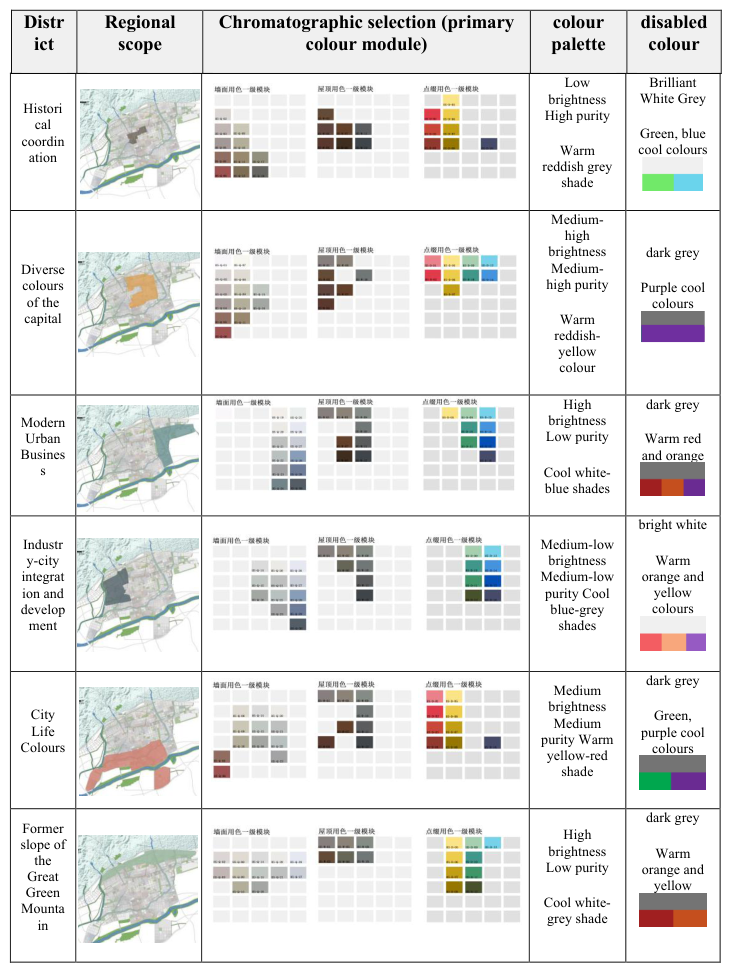
Thus summarized the ethnic historical district building color planning (Table 6), the integration of the above information pushed to get the first level of color chromatography, chromatography, including the main color (wall color), auxiliary color (roof color), embellishments, three parts of the color impression of each district is different, corresponding to the color tonality and disable the color is also different, in the respect for the premise of each ethnic view of the color and focus on the principle of the history of the corresponding proposedProhibited colors are proposed under the principle of respecting the color concept of each nation and paying attention to history.
The white color is the second most, Muyun White and Cangdao Green are the cultural color of the minority and the white color of the city’s current building color summary. The accent color is extracted from the cultural color preferences of the major ethnic minorities in Hohhot, and is summarized by the yellow and white colors favored by the Hui, the blue, white and red colors favored by the Mongols, and the yellow, white, red and blue colors favored by the Manchus. Finally, we get the color spectrum of Hohhot ethnic city (Fig. 5), the main color tone is composed of green-gray, light gray, white and other colors, from the west of the middle-low brightness, middle-low purity gray landscape area, to the east of the high brightness, low purity light gray landscape area, forming the rhythm of the city’s color changes in brightness and purity.
Figure 5: Hohhot city architectural chromatography.
Inclusive Design Strategies Based on a Human Factors Perspective 163
Table 6: Color chromatography of ethnic architecture in Hohhot.
CONCLUSION
The harmony and coordination of urban architectural color not only highlights the vitality of the city and the quality of the living environment, but also reflects the residents’ pursuit of urban values and national culture.In the context of the increasing loss of urban characteristics and the phenomenon of a thousand cities with one face, the importance
of urban architectural color planning as a kind of special planning is becoming more and more significant. However, in the process of regulating building colors and materials by city managers, the lack of systematic and effective technical management guidance, and the lack of inclusive design guidance make the urban building colors show a chaotic and disorderly phenomenon.
This paper analyzes the color of minority buildings in the main city of Hohhot. In the planning idea, comprehensive consideration of regional cultural characteristics, from the perspective of human factors, the national cultural qualities and modernist elements as the key point of planning and preparation, to achieve the organic fusion of traditional national culture and modern urban culture and innovative development, but also for other multi-ethnic areas of the city’s architectural color to provide new ideas and references.
ACKNOWLEDGMENT
This project is supported by Survey and Research on Productive Landscape Heritage of Beautiful Villages in Inner Mongolia (24YJA760062), Humanities and Social Science Research Project of Ministry of Education Fund.and supported by Research on Digital Protection and Real Scene Interaction Mode of Productive Landscape Heritage Information in Inner Mongolia Rural Areas (2024LHMS05030), Inner Mongolia Natural Science Foundation.
REFERENCES
(2021-05-27). Bulletin of the Seventh National Population Census of Hohhot ∼([1]) (No. 1). Hohhot Daily (in Chinese), 005. Deng, Chunfeng & Si, Wenjing. 2011 A new species of the genus Pterostilbene
(Coleoptera, Staphylinidae) from China. (2022). Study on the urban color control system of scenic historical and cultural cities: A case study of Guilin Historic District. Journal of Guilin University of Technology (03), 600–608. Gou, A., Shi, B., Wang, J., & Wang, H. (2022). Color preference and contributing factors of urban architecture based on the selection of color samples—Case study: Shanghai. Color Research & Application, 47(2), 454–474. Hård, A., & Sivik, L. (1981). NCS—Natural color system: A Swedish standard for
color notation. Color Research & Application, 6(3), 129–138. Ji Xuejing & Zhang JF. (2022). Analyzing the expression of color elements in intelligent architecture based on Java NCS color recognition tool. Art Appreciation (17), 96–99. Liu, C. H. & Li, Shunuo. (2024). Exploration on the value of residential architecture
of traditional Manchu villages based on the creative transformation of outstanding traditional culture of ethnic minorities–The example of “Kui House” in Wulajie Manchu Town, Jilin City. Central China Architecture (05), 165–169. doi: 10.13942/j.cnki.hzjz.2024.05.005. Lu, Z., & Zhenghong, P. (2023). Urban Color Readability of Ethnic Image: A Case Study on Nanning Central Urban Area. China City Planning Review, 32(1), 72–83.
Inclusive Design Strategies Based on a Human Factors Perspective 165
Mikellides B. Colour psychology: The emotional effects of colour perception. Colour Design. 2012;105–128. Wei-Jing & Pan Yu-Cheng. (2022). A study on the application of national colors in
the image design of cold-land architectural art–Taking Harbin as an example. Art Research (05), 166–169. doi: 10.13944/j.cnki.ysyj.2022.0250. Yang, L. F. (2020). On the double connotation of “multi-ethnic state”. Academia (08), 176–185.
LISTED IN THE AHFE DIGITAL BOOKSTORE CATALOGUE
Explore the complete digital volume
Human Factors in Architecture, Sustainable Urban Planning and Infrastructure
Read this individual research paper free through the original publisher, or explore the full digital proceedings book.
ISBN 978-1-964867-67-0
Explore this ISBN in the AHFE Bookstore ↗Listed in the July 2026 bookstore catalogue; search by ISBN to confirm current availability · Digital book purchase optional