Amon Onodera, Yohsuke Yoshioka (2025). The Influence of Geometric Properties of Spandrel Wall on the Perception of Spatial Depth. In: Human Factors in Architecture, Sustainable Urban Planning and Infrastructure. AHFE Open Access, vol. 191, pp. 134–143. https://doi.org/10.54941/ahfe1006617
This study investigates the influence of spandrel wall geometry on spatial depth perception. Partition walls contribute to spatial organization and perceptual experiences, yet the specific effects of spandrel walls remain understudied. Using immersive virtual environment technology, we conducted controlled experiments to examine how spandrel wall height and position affect depth perception.Participants memorized the depth of a reference virtual space before adjusting the depth of a test space containing spandrel walls. Depth perception accuracy was measured based on the discrepancy between the memorized and adjusted depths. The study consisted of a preliminary experiment and two main experiments: Experiment 1 analyzed the effect of wall position (central vs. peripheral), while Experiment 2 examined both position and height variations.Results indicated significant perceptual distortions based on wall placement and height. Centrally positioned walls induced greater errors, particularly at a height of 1.0 m, suggesting a critical threshold for perceptual impact. At lower heights, position played a stronger role in depth perception, whereas at greater heights, the wall itself became the dominant factor. These findings reveal an interaction between position and height in defining spatial perception and functional space division.This study provides insights for architectural design, optimizing partition wall configurations to balance spatial continuity and segmentation. Future research should further explore additional spatial factors to refine these findings.
Partition walls, including hanging and spandrel walls, are frequently used to divide large spaces into smaller functional areas. These partition walls, characterized by their incomplete vertical extension to the ceiling or floor, provide a balance between spatial division and connectivity, allowing spaces to be functionally partitioned while maintaining overall spatial connectivity, offering an alternative to full-height partitions that create complete spatial separation. This architectural strategy is commonly observed in contemporary interior design; however, the precise effect of spandrel wall geometry on human spatial perception, specifically depth perception, remains underexplored. Therefore, a quantitative investigation of the relationship between spandrel wall attributes and depth perception is warranted to inform evidence-based design practices.
The Influence of Geometric Properties of Spandrel Wall on the Perception of Spatial Depth 135
Spatial shape has a significant impact on human behavior and psychological responses. Prior research has examined the impact of spatial parameters, such as elongation, ceiling height, and volumetric proportion, on perceived spaciousness and depth.
Stamps et al. (2011) investigated the effects of horizontal area, elongation, and ceiling height on perceived spatial volume and reported an inverse relationship between elongation and perceived volume. Komiyama et al. (1997) and Hashimoto et al. (1998) conducted comparative evaluations of full-scale spaces and observed that a larger floor area tends to correlate with increased perceived spaciousness and that elevated ceiling heights can elicit comparable or even greater spatial impressions despite a smaller footprint. Hashimoto et al. (2001) further substantiated that spatial volume perception is influenced by absolute dimensions and, proportional relationships and ceiling height differentials. These findings suggest that spatial perception is a complex phenomenon that is modulated by the interplay of multiple geometric variables.
Previous studies have demonstrated that interior elements, such as furniture and partition walls, influence the perception of spatial shape. Research has also indicated that the configuration of partition walls plays a crucial role in the perception of interior-space volume. Takahashi et al. (2016) examined how the dimensions and arrangement of hanging walls affect the perception of the psychological center of a rectangular space and found that the perceived spatial center changes qualitatively depending on the dimensions and arrangement of the hanging walls. Similarly, Imamoglu et al. (1973) found that furniture can affect the perception of space volume, demonstrating that appropriate furniture placement can enhance perceived volume compared to unfurnished spaces. Furthermore, Uchida et al. (1979) examined the space deficit effect of furniture placement, highlighting its significance in understanding spatial shapes. These findings suggest that interior elements, including partition walls, systematically influence spatial perceptions.
Although the aforementioned research provides valuable insights into spatial perception, the specific contribution of spandrel wall geometry to depth perception remains unclear. Based on principles of cognitive spatial perception, it is plausible that partial visual obstructions, such as spandrel walls, function as boundary markers that influence spatial understanding (Gibson, 1979; Montello, 1997; Tversky & Lee, 1998; Sugiyama & Yoshioka, 2021). To address this knowledge gap, the present study aimed to investigate the effects of spandrel wall geometry on perceived depth. We hypothesized that systematic variations in the spandrel wall height and position within an enclosed virtual environment would induce measurable changes in perceived depth.
In this study, spandrel walls with different geometric characteristics were presented in a rectangular virtual space through controlled subject experiments using immersive virtual environment technology. Under each condition, we examined the influence of variations in the geometric characteristics of the spandrel walls on the perception of spatial depth. This research will provide valuable insights into the planning and design of
136 Onodera and Yoshioka
partition walls in interior space environments, contributing to the evidence- based optimization of spatial configurations. Furthermore, the findings of this study are expected to provide guidelines for designing perceptually optimized spaces that balance continuity and segmentation.
EXPERIMENT 1
Method
Experiment 1 investigated the influence of spandrel wall location on spatial depth perception. Participants wore a head-mounted display (HTC-VIVE, HTC) to experience a virtual environment developed using Vizard 7.0 software (WORLD VIZ, Inc.). The study included eight university students (seven males and one female) as participants.
The participants were first instructed to memorize the depth of the reference space for 10 s. They were then placed in a conditioned space featuring a partition wall, where they were allowed to adjust the position of the front wall using a trackpad controller. The participants then modified the position of the front wall to match their memorized depth perception. The difference between the actual reference depth and the adjusted depth was recorded.
The methodology employed in this study is based on the experimental approach introduced by Sugiyama et al. (2021). They examined height perception using ceiling height manipulation. This experiment provided a quantitative means of depth perception based on intuitive spatial adjustments by allowing the participants to adjust the wall position.
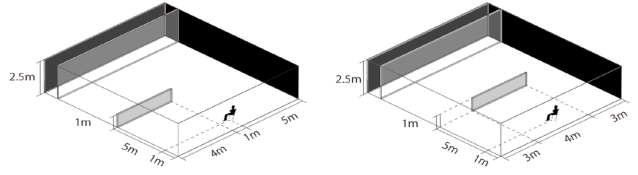
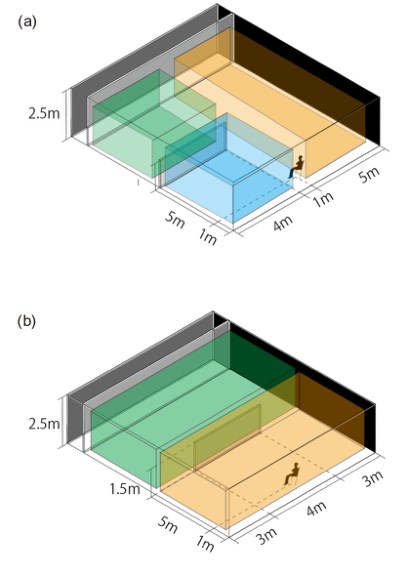
Conditions The virtual space was 10 m wide and 2.5 m high, with a reference space depth of 11 m (10 m extending in front of the participants and 1 m behind them). In the conditional space, a partition spandrel wall (4 m wide, 0.1 m thick, and 1 m high) was placed 5 m in front of the participants (Figure 1).
The experiment included two spandrel wall location conditions: “left” or “center,” based on the position of the spandrel wall relative to the space. The dependent variable (“measured value”) was calculated as the difference between the adjusted and actual wall positions. Each condition was evaluated twice per participant, and the average of the two measurements was used for analysis.
Figure 1: Dimensions of the experimental space and spandrel wall placement. (a) Left illustrating the “left” condition. (b) Right illustrating the dimensions of the “center” condition.
The Influence of Geometric Properties of Spandrel Wall on the Perception of Spatial Depth 137
Results
Data from participant 7 were excluded due to anomalous measurements in the “center” condition, which deviated significantly from the overall data trend. This extreme deviation suggests a potential lack of task comprehension, or an issue related to equipment malfunction, necessitating exclusion to maintain data integrity.
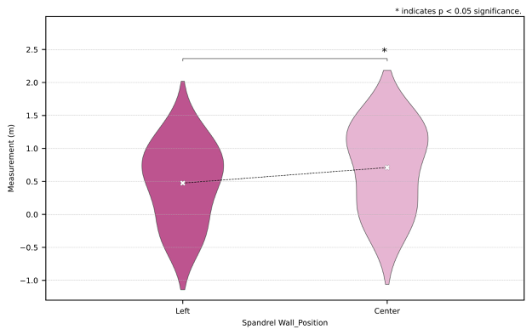
Figure 2 shows the changes in the measured values after excluding the data from participant 7. A paired-sample t-test (with a 5% significance level) revealed a significant difference between the “left” and “center” conditions [t(6) = 2.5, p = 0.045], indicating that the placement of the spandrel wall had a measurable impact on perceived spatial depth.
Specifically, in the “center” condition, participants exhibited a consistent underestimation of depth compared to the “left” condition. This suggests that a centrally positioned spandrel wall alters visual depth cues, possibly disrupting the perceived continuity of space and reducing the subjective sense of openness. The observed significant difference reinforces the notion that spatial segmentation induced by partition walls directly affects depth perception accuracy.
Figure 2: Violin plots illustrating the distribution of measured values (depth perception error) as a function of spandrel wall location (left, center), after excluding the data from participant 7. The plots depict the range and density of depth perception errors for each condition, providing a visual representation of the significant difference observed between the “left” and “center” conditions.
Discussion
This finding suggests that the placement of the spandrel wall influences spatial depth perception, with notable differences between the “left” and “center” positions. In particular, spandrel walls placed at the center led to an underestimation of the actual depth dimensions. Previous research has demonstrated that psychological evaluations of “openness” in a space are correlated with the space’s perceived volume. This suggests that placing a spandrel wall in the center may reduce the perceived openness of the space.
138 Onodera and Yoshioka
The statistically significant difference observed between the “left” and “center” conditions suggests that spandrel wall location influences spatial depth perception. Specifically, spandrel walls placed in the “center”condition led to an underestimation of the actual depth dimensions. This finding aligns with previous research demonstrating that psychological evaluations of “openness” in space are correlated with the perceived volume of the space.
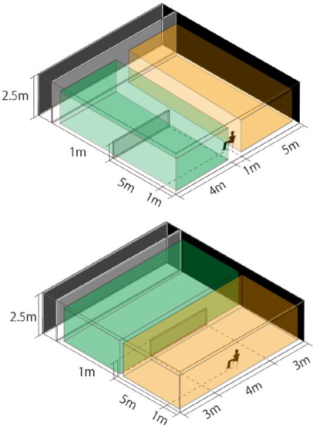
The difference between the “left” and “center” conditions may be attributed to variations in the visibility of the partition wall. The placement of the wall altered the view of the background wall, which may have influenced how participants interpreted the spatial layout. Hashimoto et al. (2001) and Takahashi et al. (2016) explored how the placement of spandrel walls affects the perception of spatial divisions. They investigated that the placement of the spandrel wall caused the space to be divided into two or more parts. In the “left” condition, participants may have perceived the rectangular space as divided into left and right sections, resulting in a more accurate perception of overall depth. Conversely, in the “center” condition, the partition wall may have created the impression of dividing the space front to back, potentially hindering ability of participants to perceive the depth of the rear section accurately (Figure 3). This could explain why participants tended to underestimate the actual depth dimensions when the partition was placed in the center.
Figure 3: Conceptual diagrams illustrating the perceived spatial division as a function of spandrel wall location. (a) Top: diagram depicting the perceived spatial division in the “left” condition, where the space is primarily divided into left and right sections. (b) Bottom: diagram depicting the perceived spatial division in the “center” condition, where the space is divided in a front-to-back manner, potentially hindering depth perception.
The Influence of Geometric Properties of Spandrel Wall on the Perception of Spatial Depth 139
EXPERIMENT 2
Method
Experiment 2 examined the effect of the position and height of the spandrel wall on the perception of spatial depth. The methodology followed the same approach as in Experiment 1, with the addition of height variation of the spandrel wall as a new factor.
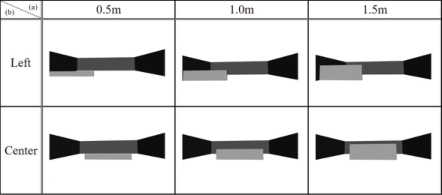
Condition The experiment included two location conditions (“left” and “center”) and three different spandrel height conditions (0.5 m, 1.0 m, and 1.5 m). The height of the spandrel wall was set at 0.5 m, 1.0 m, and 1.5 m, respectively (Figure 4). As in Experiment 1, the dependent variable (“measured value”) was calculated as the difference between the adjusted and correct wall positions. Each condition was measured twice for each participant, with the average value being used for analysis.
Figure 4: Geometric properties of the spandrel wall in the experimental space. (a) Illustration showing spandrel wall height varying along the Y-axis. (b) Illustration showing spandrel wall position (left vs. center) varying along the X-axis.
Results
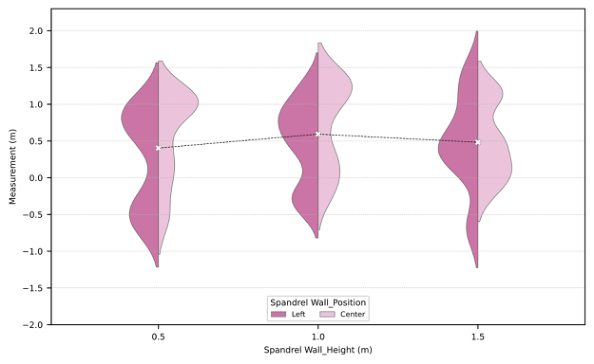
As in Experiment 1, the data from participant 7 were excluded due to anomalous measurements. Figure 5 presents the results for each experimental condition. For the “left” condition, the mean depth error was 0.25 m (standard deviation (SD) = 0.70) at a height of 0.5 m, 0.48 m (SD = 0.59) at a height of 1.0 m, and 0.49 m (SD = 0.68) at a height of 1.5 m. In the “center” condition, the mean depth error was 0.56 m (SD = 0.64) at a height of 0.5 m, 0.71 m (SD = 0.63) at a height of 1.0 m, and 0.48 m (SD = 0.52) at a height of 1.5 m.
A two-factor analysis of variance (5% significance level) was conducted to examine the effects of the location of the spandrel wall (left vs. center) and height (0.5 m, 1.0 m, and 1.5 m) on depth perception. The analysis revealed that spandrel wall location had an almost significant [F(1,6) = 5.57, p = 0.056] effect on perceived spatial depth. However, neither the main effect of height [F(2,12) = 1.93, p = 0.19] nor the position-height interaction [F(2,12) = 0.79, p = 0.48] reached statistical significance.
140 Onodera and Yoshioka
To further investigate the potential effects of the spandrel wall height on depth perception, post hoc Bonferroni-corrected pairwise comparisons were performed. These comparisons revealed a statistically significant difference between the 0.5 m and 1.0 m height conditions (p = 0.021), indicating that depth perception errors were significantly greater at the 1.0 m height than the 0.5 m height. Simple main effect tests, conducted to examine the effect of spandrel wall location at each height, confirmed statistically significant effects of spandrel wall position in both the 0.5 m and 1.0 m height conditions [F(1,6) = 11.29, p = 0.015 and F(1,6) = 6.42, p = 0.045, respectively]. These results suggest that the influence of the spandrel wall location on the perceived depth may be more pronounced at lower wall heights.
Figure 5: Violin plots showing the distribution of measured values (depth perception error) as a function of spandrel wall location and height. Each violin plot represents the data distribution for a specific combination of spandrel wall location (left, center) and height (0.5 m, 1.0 m, 1.5 m).
Discussion
These results indicate that spandrel wall location has a more substantial effect on the perceived spatial depth than wall height. While the wall height itself did not exhibit a significant main effect, the observed significant differences between the 0.5 m and 1.0 m height conditions suggest that height may contribute to depth perception distortions under specific conditions. Furthermore, the effect of wall location may be more pronounced at lower wall heights, suggesting that spatial segmentation cues from spandrel walls primarily influence depth estimation.
One possible explanation for the enhanced influence of position with lower wall heights is that shorter spandrel walls allow for greater visibility of the background, providing more depth cues and enhancing depth perception accuracy relative to higher spandrel walls.
The Influence of Geometric Properties of Spandrel Wall on the Perception of Spatial Depth 141
However, when the spandrel wall height was at a medium level (1.0 m), it functioned as a stronger visual partition, even when placed at the edge of the space (left placement). This may have caused participants to perceive the space as divided into multiple functional zones, altering their depth estimation. Specifically, when a medium-height spandrel wall is placed at the edge, the rectangular space is initially divided into two parts in the left- right direction, and the space on the side with the spandrel wall is further divided into two parts in the front-back direction. This creates the impression that the space on the spandrel wall side is divided into two parts, resulting in the overall impression that the entire rectangular space is divided into three parts (Figure 6). These findings are consistent with those of previous studies, which demonstrated that partition walls affect spatial segmentation and volumetric perception (Hashimoto et al., 2001; Takahashi et al., 2016). The results also reinforce that spandrel walls function as spatial markers that influence cognitive mapping and perceived spatial organization.
Figure 6: Conceptual diagrams illustrating the perceived spatial division as a function of spandrel wall location with a medium height spandrel wall (1.0 m). (a) When the spandrel wall is positioned at the “center,” the space is divided into two distinct sections: front and back. (b) When the spandrel wall is positioned at the “left,” the space is divided into three distinct sections: front, back, and left-right.
142 Onodera and Yoshioka
CONCLUSION
This study examines the influence of the position and size of spandrel walls on the perception of spatial depth dimensions. The results demonstrated that both the position and height of spandrel walls affect depth perception, with the positions having a particularly strong influence on lower wall heights. When a spandrel wall is centrally located and of medium height, its position and height significantly affect the perception of spatial depth, leading to an underestimation of the actual spatial dimensions. This effect may be linked to the influence of the spandrel wall height and position on the spatial use evaluation.
These findings have practical implications for interior design and spatial planning, particularly in spaces in which maintaining a sense of spaciousness is desired. Designers may consider positioning spandrel walls at the edges of the space to mitigate the underestimation of the depth associated with centrally located spandrel walls. By strategically determining the position and height of the spandrel walls, it may be possible to balance the need for spatial division with the desire to preserve a sense of spatial openness, ensuring that enclosed environments maintain both perceptual openness and structural functionality.
Future research should investigate the underlying mechanisms by which the spandrel wall geometry influences spatial perception. Furthermore, exploring the effects of other environmental factors, such as lighting, surface texture, and visual complexity, on depth perception in the presence of spandrel walls could provide valuable insights for optimizing interior spatial design. In addition, examining the generalizability of these findings across diverse populations and spatial contexts would enhance the robustness and applicability of this research, contributing to the development of evidence- based design strategies that optimize spatial perception and usability in architectural environments.
REFERENCES
Hashimoto, K., Komiyama, A., Hatsumi, M., & Takahashi, T. (1998). “Experimental study on evaluation of volume and spaciousness of interior-space fundamental study for spatial planning based on volume (Part2)”, J. Archit. Plan., AIJ, Volume 508. pp. 99–104. Hashimoto, M., Osaki, A., Nishide, K., & Nagasawa, Y. (2001). “The experimental
study on relation between a perception of volume, spatial impression and the ceiling height difference. J. Archit. Plan”, AIJ, Volume 540. pp. 167–173. Imamoglu, V. (1973). “The effect of furniture on the subjective evaluation of spaciousness and estimation of size of rooms”, In R. Küller (Ed.), Architectural psychology. pp. 314–352. Komiyama, A., Hashimoto, K., Hatsumi, M., & Takahashi, T. (1997). “Experimental
study on evaluation of volume and spaciousness of interior-space fundamental study for spatial planning based on volume (Part1)”, J. Archit. Plan., AIJ, Volume 496, pp. 119–124. Montello, D. R. (1997). “The perception and cognition of environmental distance: Direct sources of spatial information”, Spatial Information Theory, Lecture Notes in Computer Science, Volume 1329, pp. 316–331.
The Influence of Geometric Properties of Spandrel Wall on the Perception of Spatial Depth 143
Stamps III, E. (2011). “Effects of area, height, elongation, and color on perceived spaciousness”, Environment and Behavior, Volume 43 No. 2. pp. 252–273. Sugiyama, T., & Yoshioka, Y. (2021). “Relationship between bending pattern of
leading passages and feeling value of ceiling height in high ceiling room”, J. Archit. Plan., AIJ, Volume 86 No. 782. pp. 1224–1232. Takahashi, H., & Yoshioka, Y. (2016). “Influences of sizes and positions of hanging wall on perception of spatial center in virtual reality space”, J. Archit. Plan., AIJ, Volume 81 No. 727. pp. 1905–1915. Tversky, B., & Lee, P. (1998). “How space structures language”, Spatial Cognition
and Computation, Volume 2 No. 1. pp. 3–24. Uchida, S. (1979). “An experimental study on the sense of visually-closed spaces (Part1)”, J. Archit. Plan., AIJ, Volume 282. pp. 113–122.
LISTED IN THE AHFE DIGITAL BOOKSTORE CATALOGUE
Explore the complete digital volume
Human Factors in Architecture, Sustainable Urban Planning and Infrastructure
Read this individual research paper free through the original publisher, or explore the full digital proceedings book.
ISBN 978-1-964867-67-0
Explore this ISBN in the AHFE Bookstore ↗Listed in the July 2026 bookstore catalogue; search by ISBN to confirm current availability · Digital book purchase optional