Shinnosuke Takano, Yohsuke Yoshioka (2026). Effect of Cornice Lighting Distribution on Perceived Ceiling Height in an Immersive Virtual Environment. In: Human Factors and Ergonomics In Design. AHFE Open Access, vol. 210, pp. 211–219. https://doi.org/10.54941/ahfe1007442
Indirect lighting is a crucial element in determining the atmosphere of a space; however, its influence on dimension perception remains insufficiently researched. Therefore, this study investigated the effects of cornice lighting distribution characteristics on perceived ceiling height using virtual reality (VR) presented via a head-mounted display (HMD). In the experiment, perceived ceiling height was measured using the method of adjustment in two environments: a narrow space where side walls were visible, and a wide space where side walls were not visible. The main variables were the distance from the light source to the wall (150 mm vs. 300 mm) and brightness. Results indicated a statistically significant difference in the narrow space, where the perceived ceiling height was greater in the 150 mm condition compared to the 300 mm condition. This suggests that intense illumination on the upper part of the wall may have directed visual attention upward. thereby emphasizing verticality. In contrast, no significant difference was observed in the wide space where side walls were excluded from the field of view. This implies that side walls function as a "reference frame" for grasping spatial proportions. In the absence of this frame, the observer's attention shifted toward the horizontal expanse, attenuating the vertical effects of the lighting. These findings suggest that the impact of cornice lighting distribution on perceived ceiling height depends strongly on spatial composition. In architectural design, controlling light distribution on the upper wall is an effective strategy for enhancing the sense of openness in small-scale spaces; however, its efficacy may be limited in large spaces where overall proportion dominates perception.
In residential spaces, ceiling height is a critical architectural element that influences the psychological comfort of residents. Levy et al. (2007) reported that ceiling height affects the information processing of residents: high ceilings prime concepts related to freedom and openness, whereas low ceilings activate concepts associated with confinement and focus. Furthermore, based on the prospect-refuge theory proposed by Appleton (1975), low ceilings function as a “refuge,” providing residents with a sense of enclosure and security. Thus, although both high and low ceiling heights offer distinct
212 Takano and Yoshioka merits, dynamically altering the physical ceiling height to enjoy both benefits is challenging for general architectural structures.
To address these physical constraints, attempts have been made to adjust the “psychological ceiling height” by manipulating the lighting environment to alter spatial perception. For instance, Oberfeld et al. (2010) revealed that higher wall lightness leads to a higher perceived ceiling height, demonstrating that spatial brightness contributes to perceived ceiling height. Similarly, in a study on downlight arrangement patterns, Mizuno et al. (2023) reported that positioning lights near walls to illuminate wall surfaces (particularly the upper sections) increased the perceived ceiling height. Additionally, Lindh et al. (2021) reported that not only the quantity of brightness but also the pattern of light distribution itself influences the perception of spatial spaciousness and ceiling height.
These studies indicate that the illumination of wall surfaces and their distribution are crucial for the perception of ceiling height; however, the detailed effects of differences in light distribution characteristics caused by specific lighting techniques have not been sufficiently elucidated.
Although numerous lighting techniques exist, cornice lighting is a representative indirect lighting method that projects light from the upper part of a wall downward, possessing distinct light distribution characteristics. According to The Lighting Handbook by DiLaura et al. (2011), cornice lighting can create diverse luminance distributions on a wall surface—ranging from intensively emphasizing the uppermost part of the wall to grazing the entire wall surface—depending on the installation position and adjustment of the distribution angle.
If “wall brightness” (Oberfeld et al.) and “upper wall illumination” (Mizuno et al.) are factors that increase perceived ceiling height, it is inferred that cornice lighting, which strongly illuminates the uppermost part of the wall—physically the highest position—is an extremely effective method for manipulating perceived ceiling height by directing visual attention (VA) upward. Furthermore, as Lindh et al. highlighted, if the “distribution” itself determines spatial impression, the vertical light-dark gradation created by cornice lighting (bright at the top and darker at the bottom, or nearly uniform across the wall) may provide residents with a quality of openness and height perception different from that of homogeneous general lighting. However, to the best of our knowledge, no studies have directly examined the specific relationship between such distribution characteristics peculiar to indirect lighting—namely, the degree of light concentration on the upper wall and differences in light-dark gradation—and perceived ceiling height.
Therefore, this study focuses on indirect lighting, specifically cornice lighting, to clarify the relationship between light distribution characteristics and perceived ceiling height. The primary contribution of this research is providing empirical evidence on how targeted upper-wall illumination can manipulate spatial perception without altering physical dimensions. Furthermore, by investigating the relationship between these effects and spatial width, this study explores optimal lighting design guidelines suitable for various architectural spaces.
RESEARCH METHODS Experimental Environment and Procedure
In this experiment, the effects of the light distribution characteristics of cornice lighting (indirect lighting) on perceived ceiling height were investigated. The participants wore a head-mounted display (HTC VIVE Focus Vision) and experienced a virtual environment constructed using Vizard 8.0 (WorldViz). A total of 20 healthy university students (ten males and ten females) participated in the experiment.
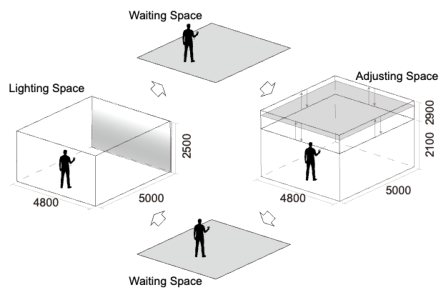
The procedure was as follows: First, the participants were presented with a space under specified lighting conditions and were instructed to memorize the ceiling height for 10 s. Subsequently, they moved to a waiting space comprising only a floor surface and waited for 10 s. Subsequently, they moved to an adjustment space where the ceiling height was adjustable. Using a handheld controller, the participants adjusted the ceiling height to match the height memorized in the lighting space. After the adjustment, they returned to the waiting space for 10 s and proceeded to the next trial.
Figure 1: Experimental procedure (Experiment I).
Experimental Conditions The lighting space was constructed using cornice lighting installed on the upper part of the front wall. The experimental conditions comprised three factors: “cross-sectional shape (distance between light and wall),” “brightness (luminous flux),” and “series (starting position for adjustment).”
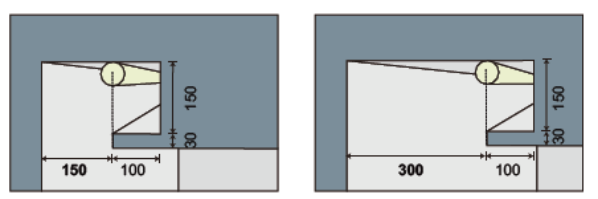
Cross-sectional shape: Two levels were set based on the distance from the light source to the wall: “150” and “300” mm.
Brightness (luminous flux): Two levels were set based on the luminous flux per lighting fixture: “1000” and “2000” lm.
Series: Based on the adjustment method, two levels were established based on the initial ceiling height. In the “descending series,” adjustment started from 2.9 m (high position), whereas in the “ascending series,” it started from 2.1 m (low position).
214 Takano and Yoshioka These specific values for the distance (150 and 300 mm) and luminous flux (1000 and 2000 lm) were determined exploratorily during the spatial modeling phase. Rather than relying on specific established standards, these parameters were carefully selected because preliminary observations indicated that they would produce distinct and perceptually salient differences in the vertical light distribution and overall spatial brightness, which are necessary for testing the experimental hypotheses.
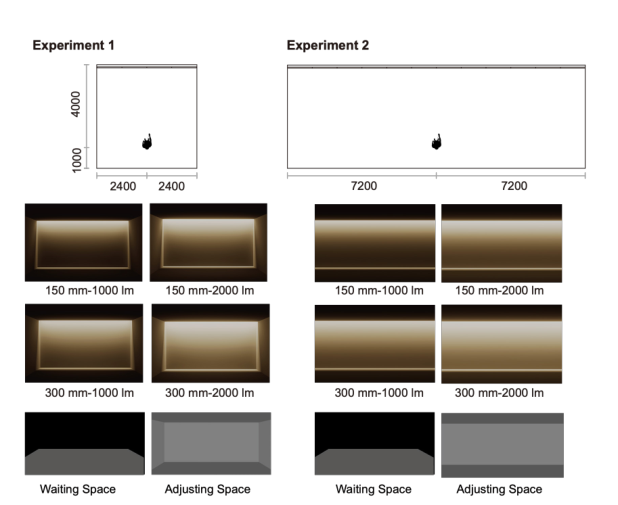
In addition, to verify the influence of spatial width on perception, two spatial types were employed: a narrow space where the sidewalls were visible (Experiment I: width 4.8 m) and a wide space where the sidewalls were not visible (Experiment II: width 14.4 m). Spatial dimensions other than the width were identical for both Experiments I and II, with a depth of 5 m and a height of 2.5 m. The participants stood 4 m from the front wall.
Figure 2: Cross-sectional dimensions of cornice lighting.Figure 3: Dimensions of the experimental space, examples of lighting space presentation, waiting and adjusting spaces.
Effect of Cornice Lighting Distribution on Perceived Ceiling Height 215 Measurement Metrics
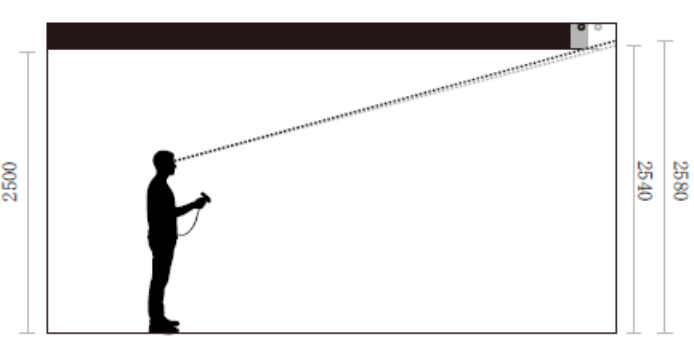
In this experiment, the perceived ceiling height reproduced in the adjustment space was used as the primary measure. Because of the structure of the cornice lighting, varying the distance between the wall and the light (cross-sectional shape) resulted in slight differences in the physically visible wall height (2.54 m under the 150 mm condition and 2.58 m under the 300 mm condition). Therefore, the difference between the visible wall and adjusted ceiling heights was calculated and used for analysis.
Furthermore, a three-way analysis of variance (ANOVA) was employed to analyze the experimental results, quantitatively verifying the main effects and interactions of the cross-sectional shape and series on the perceived height.
Figure 4: Physical height of the lighting space and visible wall height.
RESULTS
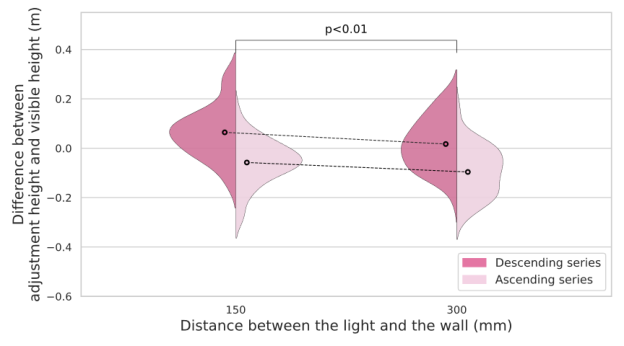
Experiment 1 A three-way analysis of variance (ANOVA) was performed to examine the effects of series (ascending and descending), cross-sectional shape (150 and 300 mm), and brightness (1000 and 2000 lm). The results of the analysis revealed a significant main effect of the series (F(1, 19) = 34.15, p < .001, η² = 0.26). In particular, the perceived ceiling height in the descending series was significantly greater than that in the ascending series. Additionally, the main effect of the cross-sectional shape was significant (F(1, 19) = 9.92, p < .01, η² = 0.03). Specifically, the perceived ceiling height under the 150 mm condition (distance between light and wall) was significantly greater than that under the 300 mm condition. However, the main effects of brightness and all interactions under the conditions did not reach statistical significance.
Figure 5: Distance between light and wall and perceived ceiling height (Experiment I).
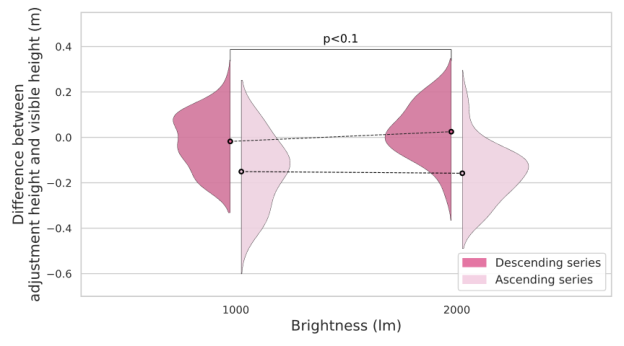
Experiment 2 A three-way analysis of variance (ANOVA) was performed to examine the effects of series (ascending and descending), cross-sectional shape (150 and 300 mm), and brightness (1000 and 2000 lm). The results of the analysis revealed a significant main effect of the series (F(1, 19) = 26.15, p < .001, η² = 0.27). Consistent with Experiment I, the adjusted perceived ceiling height in the descending series was greater than that in the ascending series. Additionally, a marginally significant interaction was observed between the presentation series and brightness (F(1, 19) = 3.51, p < .10, η² = 0.03), suggesting a tendency for the perceived ceiling height to be greater at 2000 lm in the descending series. Conversely, in the ascending series, the perceived ceiling height at 2000 lm was lower than that at 1000 lm. However, neither a main effect nor interactions involving the cross-sectional shape were observed.
Figure 6: Lighting brightness and perceived ceiling height (Experiment II).
Effect of Cornice Lighting Distribution on Perceived Ceiling Height 217 Comparison Between Experiment I and Experiment II
A comparative analysis of Experiments I (narrow space) and II (wide space) was performed to clarify whether the effect of cornice light distribution depends on spatial composition.
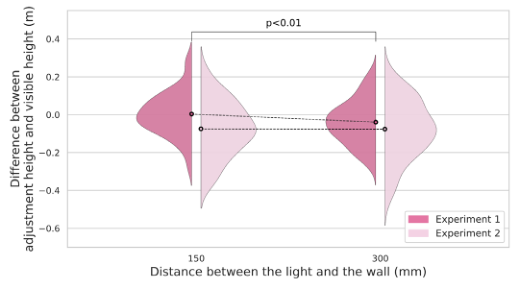
A significant interaction was observed between spatial type and cross- sectional shape (F(1,19) = 4.42, p < .05, η² = .02). Although the effect size was small, the pattern of the results differed under the two spatial conditions.
In Experiment I, cross-sectional shape significantly influenced perceived ceiling height (F(1,19) = 9.91, p < .01, η² = .14), whereas in Experiment II, this effect was not observed. This contrast suggests that the perceptual influence of the light distribution may depend on the availability of lateral spatial references.
One possible interpretation is that the visible sidewalls provide a visual framework within which vertical light gradients are processed as cues for height. When such lateral references are absent, attention may be distributed more broadly across the horizontal field, thereby reducing the relative weight of vertical illumination cues.
Taken together, these findings indicate that the effect of indirect lighting on the perceived ceiling height is moderated by spatial composition. However, given the relatively small size of the interaction effect, this interpretation should be treated as tentative and warrants further empirical verification.
Figure 7: Comparison of perceived ceiling height between Experiments I and II.
DISCUSSION
The results of this study confirmed that the perceived ceiling height under the 150 mm condition (short distance between light and wall) tended to be greater than that under the 300 mm condition. This phenomenon can be explained by focusing on the VA mechanism. Mizuno et al. reported that the perceived ceiling height increased when the upper part of a wall was strongly illuminated, inducing an upward gaze. Under the 150 mm condition, the light source created a high contrast in brightness on the upper wall. It is inferred that this uneven brightness distribution naturally directs the VA of the observer vertically toward the upper area, thereby increasing the perceived height. Conversely, under the 300 mm condition, the strong diffusion of light
218 Takano and Yoshioka reduced vertical unevenness, causing VA to be less focused on the upper area, which resulted in a smaller perceived ceiling height.
The degree to which this lighting distribution influences the perceived height depends heavily on the spatial enclosure, a difference clarified by the concept of a useful field of view (FoV). In the narrow space of Experiment I, the presence of side walls likely triggered a “tunnel vision” effect. As suggested by Mackworth (1965), when the information load in the peripheral visual field increases, the useful FoV constricts foveal processing. In this narrow setting, the sidewalls restrict the horizontal field, naturally directing the VA toward the front wall. Consequently, the participants processed the vertical light distribution on the front wall as the primary cue for judgment, amplifying the effects of lighting conditions.
By contrast, the results in the wide space of Experiment II can be interpreted by the isovist theory. Benedikt (1979) suggested that a state without physical restrictions leads to maximization of the visible area (isovist). In Experiment II, the sidewalls were located outside the useful FoV or were absent, expanding the horizontal visual field. This expansion caused VA to disperse horizontally rather than focusing on the vertical cues of the front wall. This attentional dispersion attenuated the influence of light distribution of the front wall on the perceived ceiling height, explaining the significant interaction observed between the two experiments.
Regarding the effect of luminous flux, although Oberfeld et al. suggested that brighter conditions (2000 lm) typically increase the perceived height, this experiment observed the opposite trend in the ascending series. This can be explained by the relationship between the horizontal VA and spatial proportion. As indicated by Miki et al. (1996), increased light intensity enhances the sense of spaciousness. Under the bright 2000 lm condition, intense light likely directed VA toward the horizontal expanse. However, because the participants could only adjust the ceiling height, they unconsciously lowered the ceiling to alter the spatial aspect ratio, creating a more horizontally elongated form to establish consistency with the perceived horizontal width.
Finally, the main effect of the presentation series, where the ascending series yielded significantly lower perceived heights than the descending series, is best explained by the adaptation level theory. As Dai (1976) highlighted, the adaptation level, which serves as a judgment standard, changes dynamically based on prior stimuli. In the ascending series, a low initial ceiling height shifted the adaptation of the participants level downward, causing them to deem the height to be sufficient before reaching a physical match. Conversely, a high initial height in the descending series increases the adaptation level, leading to a higher perceived height.
CONCLUSION
This study investigated the effects of the light distribution characteristics of cornice lighting on perceived ceiling height, focusing on its interaction with spatial width. Consequently, two key findings emerged.
Effect of Cornice Lighting Distribution on Perceived Ceiling Height 219 First, in narrow spaces where sidewalls are present within the FoV, concentrating light on the upper part of the wall can increase the perceived ceiling height. Second, in wide spaces where sidewalls do not fit within the FoV, the effect of lighting on the perceived ceiling height was attenuated. The absence of visible sidewalls shifted the attention of the observer toward the horizontal expansion. This suggests that in large spaces, spatial proportion dominates perception over lighting effects. In architectural planning, the strategy of “illuminating the upper wall to enhance openness” is likely most effective in small, enclosed spaces instead of in open plans where horizontal spread prevails.
This study has some limitations in terms of the ecological validity of the lighting environment. The experimental space was a completely dark environment illuminated solely with cornice lighting. However, in actual architectural spaces, lighting design involves complex practical issues, such as its combined use with other lighting systems, the need for illuminance uniformity, and securing sufficient brightness suited to the function of the room. Consequently, findings derived from this simplified setting may not be directly applicable to all practical scenarios. Future research requires further verification under lighting conditions that closely simulate real-world environments, incorporating ambient lighting and functional illuminance requirements.
Despite these limitations, this study contributes to understanding the complex relationship between “light distribution,” “spatial structure,” and “psychological scale” in architectural environments.
REFERENCES
Appleton, J. (1975). The experience of landscape. London: John Wiley & Sons. Benedikt, M. (1979). To take hold of space: Isovists and isovist fields. Environment and Planning B, 6(1), 47–65. Dai, K. (1976). Upon the effect of stimulus series on comparative judgments-a study in
terms of adaptation-level theory, The Japanese Journal of Ergonomics, 12 (1), 21–26. DiLaura, D. L., Houser, K. W., Mistrick, R. G., & Steffy, G. R. (2011). The lighting handbook: Reference and application (10th ed.). Illuminating Engineering Society. Mackworth, N. H. (1965). Visual noise causes tunnel vision. Psychonomic Science,
3, 67–68. Meyers-Levy, J., & Zhu, R. (2007). The influence of ceiling height: The effect of priming on the type of processing that people use. Journal of Consumer Research, 34(2), 174–186. Miki, Y., & Miyata, T. (1996). The effect of light source arrangement and interior
surface composition on atmosphere evaluation: A study on spatial distribution of light. Journal of Architecture and Planning (Transactions of AIJ), 61(488), 111–119. Mizuno, Y., & Yoshioka, Y. (2023). The effect of arrangement patterns of downlight on feeling value of ceiling height. AIJ Journal of Technology and Design, 29(71), 292–297. Oberfeld, D., Hecht, H., & Gamer, M. (2010). Surface lightness influences perceived
room height. The Quarterly Journal of Experimental Psychology, 63(10), 1999–2011. Wänström Lindh, U., & Billger, M. (2021). Light distribution and perceived spaciousness: Light patterns in scale models. Sustainability, 13(22), Article 12424.
LISTED IN THE AHFE DIGITAL BOOKSTORE CATALOGUE
Explore the complete digital volume
Human Factors and Ergonomics In Design
Read this individual research paper free through the original publisher, or explore the full digital proceedings book.
ISBN 978-1-964867-86-1
Explore this ISBN in the AHFE Bookstore ↗Listed in the July 2026 bookstore catalogue; search by ISBN to confirm current availability · Digital book purchase optional