Cai-Ling Wang, Yuan-Chi Tseng (2026). A Two-Phase Asynchronous–Synchronous Online Co-Design Method for Facilitating Multistakeholder Participation in Healthcare Technology. In: Human Factors and Ergonomics In Design. AHFE Open Access, vol. 210, pp. 1–11. https://doi.org/10.54941/ahfe1007420
Multistakeholder co-design is widely used in healthcare technology development to surface diverse viewpoints and support alignment across stakeholder groups. However, healthcare co-design faces persistent challenges: providers’ fragmented schedules limit sustained participation, provider-receiver authority asymmetries can shape whose input is taken up, and receivers from vulnerable or stigmatized groups may hesitate to engage in visible real-time discussion. We propose a low-cost, two-phase asynchronous-synchronous online co-design method designed to reduce these participation barriers. The method separates (1) asynchronous perspective articulation, which enables stakeholders to contribute at their own pace, from (2) synchronous perspective exchange, which relies on limited real-time interaction to clarify tensions and negotiate trade-offs. A researcher-mediated transition connects the phases by translating distributed inputs into de-attributed, negotiable discussion prompts. We illustrate the approach through a chatbot co-design case for pre-exposure prophylaxis (PrEP) care involving PrEP navigators and clients, using widely available tools (Google Sites, Sheets, and Meet). The case shows how asynchronous engagement surfaces divergent expectations about the chatbot’s scope and communication style, and structured prompts support focused negotiation in dyadic sessions. We conclude by discussing how the method mitigates authority effects when synchronous exchange remains essential, and how the structure can be iterated across cycles as new questions emerge.
Since healthcare technologies increasingly shape the work practices, responsibilities, and everyday experiences of both healthcare providers and receivers, their design must account for multiple stakeholder perspectives. Multistakeholder co-design is widely used in human-centered healthcare research to address system complexity, surface diverse needs and values, and support coordination across roles (Sanz et al., 2021; Cole et al., 2022; Malloy et al., 2023).
2 Wang and Tseng However, co-design workshops in healthcare settings face persistent practical challenges (Duffy et al., 2025). Because conventional co-design relies on synchronous sessions for idea generation, sensemaking, and negotiation, it can be difficult to sustain in healthcare contexts. Providers work under fragmented schedules, which limits continuity and reduces opportunities for reflection. In addition, healthcare design collaboration is frequently shaped by authority asymmetries (Lindblom et al., 2021), and such authority asymmetries can shape whose views are taken up, and receivers from vulnerable or stigmatized groups may hesitate to disclose sensitive experiences in visible real-time settings (Lee et al., 2022; Tseng et al., 2023). These factors complicate not only who can participate, but also how perspectives are articulated, represented, and negotiated within workshop settings. From an inclusive design lens, these are predictable participation barriers that systematically exclude stakeholders unless the process is deliberately structured around diverse constraints and disclosure conditions (Clarkson and Coleman, 2015; Keates and Clarkson, 2004).
To address these challenges, we propose a low-cost, two-phase asynchronous-synchronous online co-design method that broadens participation by reducing scheduling burden and lowering the visibility costs of disclosure. The following sections describe the method and illustrate its application through a healthcare chatbot co-design case.
TWO-PHASE ASYNCHRONOUS-SYNCHRONOUS ONLINE CO-DESIGN METHOD The proposed method consists of two phases, asynchronous perspective articulation and synchronous perspective exchange, connected by a researcher-mediated transition that translates individual inputs into negotiable tensions for collective discussion. The structure is designed to reduce common barriers in multistakeholder healthcare co-design, including limited stakeholder availability, authority asymmetries across roles, and sensitivity around identity disclosure. To address time constraints, the method separates articulation from negotiation: stakeholders contribute asynchronously at their own pace, while synchronous time is reserved for focused discussion of key tensions. To reduce authority effects, researchers convert individual contributions into role-neutral prompts before real-time interaction, allowing issues to be discussed without direct attribution. The online format further lowers visibility costs and social pressure for healthcare receivers who may hesitate to disclose sensitive experiences in face-to-face settings. The method is intentionally flexible in its choice of tools and can be implemented with widely available, low-learning-cost online platforms.
Phase 1: Asynchronous Perspective Articulation Phase 1 enables participants to reflect and respond at their own pace. Researchers define the design focus and usage scenarios, then develop prompts that invite participants to share concerns, expectations, and suggestions regarding the proposed intervention. This phase aligns with established asynchronous, participant-led elicitation approaches, such as diary studies
A Two-Phase Asynchronous-Synchronous Online Co-Design Method 3 and cultural probes, which support situated reflection over time and reduce dependence on real-time coordination (Rieman, 1993; Gaver et al., 1999). Outputs consist of stakeholder-specific input that maps the design space and surfaces points of divergence.
Transition: Structuring Negotiable Tensions The transition step converts distributed inputs into materials suitable for collective negotiation. Researchers review and organize contributions to identify recurring tensions, unresolved questions, and divergent assumptions. These are articulated as negotiable tensions, rather than attributed positions, and formulated into structured prompts that juxtapose competing considerations for the synchronous negotiation. This step functions as a methodological bridge between private articulation and public exchange, while reducing the likelihood that authority and identity cues dominate early interpretation.
Phase 2: Synchronous Perspective Exchange Phase 2 builds shared understanding through facilitated discussion around the structured prompts. Researchers introduce each prompt, guide participants to explain rationales and constraints, and encourage engagement with alternative viewpoints. The outcome is a set of negotiated design and decision rationales that can be carried forward into subsequent design and implementation work.
AN ILLUSTRATIVE CASE: CHATBOT CO-DESIGN WITH PrEP NAVIGATORS AND CLIENTS Contextual Background
Pre-exposure prophylaxis (PrEP) is a preventive medication strategy for individuals at high risk of HIV infection (Kelesidis and Landovitz, 2011; Thigpen et al., 2012). Due to its complex medication adherence requirements, PrEP case managers or navigators play a critical role in supporting clients’ medication adherence and addressing ongoing concerns related to PrEP use (Saberi et al., 2020; Yuan et al., 2023). As PrEP uptake and sustained adherence are shaped by both practical constraints and social dynamics, digital and mHealth strategies have been widely explored to support engagement over time (LaBelle et al., 2020).
Recent advances in chatbots have suggested their potential to support such care practices. Natural language interaction and continuous availability position chatbots as a promising means to assist navigators in managing caseloads while offering clients timely medication-related support (Braddock et al., 2023; van Heerden et al., 2023; Cheah et al., 2024; Massa et al., 2023). This framing aligns with user-centered efforts to design PrEP adherence support applications and evaluate adherence monitoring in practice (Strong et al., 2020; Wu et al., 2022). Nevertheless, designing such technologies remains challenging. Navigators often work under substantial time constraints, while clients, frequently belonging to populations at higher risk of stigma, may be reluctant to engage in visible forms of participation. More broadly, iterative
4 Wang and Tseng human-in-the-loop chatbot design has been applied in other team-based care settings (Tseng et al., 2025), motivating methods that combine stakeholder input with structured refinement cycles.
Accordingly, we adopted the proposed two-phase asynchronous- synchronous online co-design method to examine how it supports requirement elicitation in a sensitive healthcare context.
PARTICIPANTS PrEP navigators were recruited through online outreach and subsequently assisted in inviting clients to participate. In total, two PrEP clients (P1, P4) and two PrEP navigators (P2, P3) took part in the co-design process, representing distinct stakeholder roles.
Phase 1: Asynchronous Perspective Articulation Phase 1 was conducted using Google Sites and Google Sheets. Building on prior formative work, the research team defined six scenarios representing potential future chatbot use in PrEP-related care. For each scenario, simulated conversation screenshots were produced to illustrate plausible chatbot responses in context. These materials functioned as probes to elicit participants’ expectations regarding what the chatbot should say and how it should communicate under different conditions.
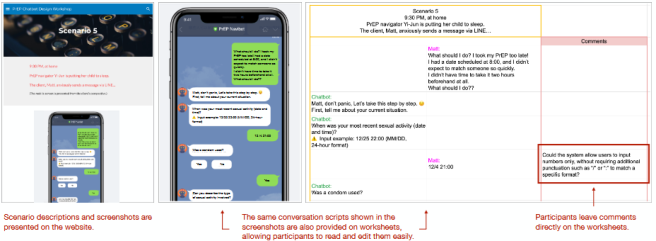
Scenario descriptions and screenshots were presented on Google Sites to support consistent access to text and images (Figure 1). The same dialogue content was also documented on Google Sheets as an editable artifact (Figure 1). Participants were invited to revise the chatbot responses directly or leave comments. They were instructed to first review each scenario on the website and then, as needed, edit or annotate the corresponding script on Google Sheets to reflect their preferred conversational trajectories.
Participants engaged with these materials over five days. Across one or two editing sessions, individuals contributed between 447 and 1347 words. Table 1 summarizes participation volume and engagement time, illustrating the feasibility of asynchronous contribution across stakeholder roles.
Figure 1: Example of materials used in Phase 1. Scenario descriptions and chatbot conversation screenshots were presented on a website (left). The same conversation scripts were provided on worksheets to support reading and editing (center & right). Participants edited and commented directly on the worksheets (right).Table 1: Summary of participant contributions in Phase 1.
Table available in the original PDF paper.
Participant Editing Sessions Editing Time Word Count P1 (client) 1 52 minutes 665 words
P2 (PrEP navigator) 2 115 minutes 1347 words P3 (PrEP navigator) 2 102 minutes 1090 words
P4 (client) 2 79 minutes 447 words
The artifacts captured divergent assumptions about the chatbot’s role and communication style. For example, in a scenario where the chatbot was imagined to provide emotional support to clients who had recently broken up with their partners late at night, participants expressed differing views. P4 emphasized boundary-setting, suggesting that “It might be better to state clearly at the beginning that emotional distress shouldn’t be directed to the chatbot or the case manager, and that this service is only meant for medication-related consultation.” In contrast, P2 revised the chatbot’s response to adopt a warmer and more explicitly empathetic tone, writing, “Thank yourself who once tried so hard. Let go of those ties and give yourself a moment to rest .” Together, these contributions make explicit a design tension between scope control and relational support, illustrating how asynchronous engagement can surface issues that require subsequent negotiation. This tension echoes adjacent HCI findings that chatbot-guided interaction can support emotionally difficult articulation in a self-paced, nonjudgmental format, while still requiring clear boundary-setting around the chatbot’s role in relation to professional care (Tseng and Liao, 2025).
TRANSITION: STRUCTURING NEGOTIABLE TENSIONS Between Phase 1 and Phase 2, two research assistants transformed the asynchronously generated inputs into materials suitable for collective negotiation. Researchers read and annotated all Phase 1 contributions, focusing on points of divergence, uncertainty, and conflicting expectations. These were formulated as negotiable tensions and translated into neutral discussion prompts without attribution, reducing the likelihood that professional perspectives would be treated as inherently more authoritative or legitimate than client perspectives.
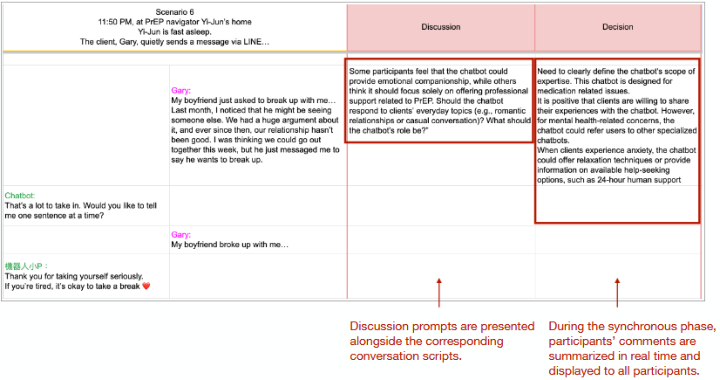
Prompts were phrased to foreground design trade-offs rather than stakeholder positions, typically using formulations such as “some participants expressed…”. For the scenario above, comments were synthesized into the following prompt: “Some participants feel that the chatbot could provide emotional companionship, while others think it should focus solely on offering professional support related to PrEP. Should the chatbot respond to clients’ everyday topics (e.g., romantic relationships or casual conversation)? What should the chatbot’s role be?” Through this process, researchers formulated seven discussion prompts. Other prompts addressed trade-offs in reminder timing and frequency, for example: “Some participants mentioned that being reminded 24 hours in advance feels too early, while others felt that
6 Wang and Tseng reminders every four hours are too frequent. What reminder frequency and format would best meet users’ needs?” These prompts served as structured inputs for the subsequent synchronous perspective exchange.
Phase 2: Synchronous Perspective Exchange Phase 2 was conducted using Google Meet and Google Sheets with the same participants from Phase 1. Two synchronous workshops were held, each involving one PrEP client and one PrEP navigator, with each session lasting approximately one hour. Dyadic workshops were adopted rather than a single group session due to scheduling constraints and to reduce participation barriers for clients who might be reluctant to disclose identities or personal experiences in the presence of other clients. Google Meet was selected for its accessibility and familiarity in the field setting, while Google Sheets were used to present prompts alongside relevant conversational contexts requiring further discussion (Figure 2).
Figure 2: Example of materials used in Phase 2. Conversation scripts and discussion prompts are presented side by side, while participants’ comments are summarized in real time and displayed to support discussion.
The workshops were supported by the research team, which included one design professor, one public health professor, and three research assistants. One research assistant facilitated discussion by introducing the structured prompts, inviting participants to articulate positions and rationales, and encouraging responses to alternative viewpoints. Discussion points were summarized by the other two research assistants in Google Sheets in real time, enabling participants to review and confirm emerging interpretations during the session. Additional team members were present to provide domain expertise when appropriate.
Across the two workshops, all seven discussion prompts were addressed within the allocated time. Participants clarified trade-offs and negotiated acceptable directions for the chatbot. At the conclusion of Phase 2, the
A Two-Phase Asynchronous-Synchronous Online Co-Design Method 7 workshops produced documented discussion outcomes, including shared understandings and negotiated directions that reflected how differing perspectives were reconciled.
For instance, when discussing whether the chatbot should engage in emotional support, the negotiated summary documented considerations such as defining the chatbot’s scope as primarily PrEP-related, specifying conditions under which redirection to specialized mental health resources would be appropriate, and allowing limited supportive responses (e.g., simple relaxation techniques or prompts to seek human assistance). This outcome illustrates how synchronous exchange supported the articulation of boundaries and conditional directions through facilitated perspective negotiation.
DISCUSSION
Addressing Challenges in Healthcare Co-Design Successful adoption of healthcare technology depends on alignment with the conditions of the deployment context, including technical infrastructure, clinical workflows, and user needs (Wang and Tseng, 2025). Multistakeholder co-design can surface and reconcile design directions across stakeholder roles (Andersen and Mosleh, 2021; Pirinen, 2016). Prior work has examined ways to scaffold deliberation, including design card toolkits for mutual understanding (Yu et al., 2025), chatbots that support group dynamics (Benke et al., 2020) and help address uneven participation (Kim et al., 2020; Kim et al., 2021), and visual interfaces that make consensus and disagreement more visible (Liu et al., 2018). Rather than attempting to address all challenges associated with group interaction, our method focuses on three constraints that are particularly salient in healthcare co-design: limited healthcare provider availability, authority asymmetries between healthcare providers and receivers, and participation sensitivity among healthcare receivers. Importantly, this sensitivity should not be treated as an individual “user characteristic.” It is often produced by sociotechnical conditions that shape what people feel safe to disclose, when, and to whom in health-related communication (Lee et al., 2022; Tseng et al., 2023). Related work in sensitive chatbot contexts similarly shows that participants may reject framings that feel pitying, underscoring the need for dignity- preserving elicitation and interpretation practices (Wang and Tseng, 2024). By combining asynchronous perspective articulation, researcher-mediated structuring, and focused synchronous exchange, the method prioritizes feasibility and inclusion under real-world healthcare constraints.
Paving the Way for Real-Time Interaction The method intentionally retains synchronous discussion because real- time interaction provides a shared space for clarification, grounding, and alignment across perspectives. This stance differs from approaches that rely on automated mediation, such as chatbots, to relay stakeholder input through fully asynchronous deliberation (Shin et al., 2022). While our
8 Wang and Tseng approach still requires stakeholders to allocate time for real-time interaction, asynchronous articulation and researcher-mediated prompt structuring concentrate synchronous discussion on well-defined tensions. This division of labour can make limited interaction time more efficient without reducing the opportunity for negotiation.
Retaining synchronous interaction also does not imply ignoring power asymmetries. Instead, the transition between phases is designed to mitigate such risks. Compared to conventional workshops that require facilitation and sensemaking in the moment, the proposed method shifts coordination and interpretation work into a preparatory stage. This enables researchers to engage more carefully with stakeholder input and to translate contributions into neutral, de-attributed discussion prompts, reducing the extent to which role-based authority shapes early interpretation and negotiation.
Beyond a Single Two-Phase Cycle Although presented as a two-phase method, the structure is not intended to be strictly linear. Asynchronous articulation and synchronous exchange can be revisited across multiple cycles as new questions, constraints, or design alternatives emerge. In this sense, synchronous negotiation does not necessarily signal closure. It can instead surface issues that warrant further reflection and re-articulation.
This flexibility aligns with views of co-design as “joint inquiry and imagination” (Steen, 2013). From this perspective, understanding the problem and envisioning alternatives unfold iteratively rather than in a single step. By supporting repeated individual articulation and collective discussion, the proposed method enables co-design outcomes to evolve through cycles of inquiry, tension structuring, and alignment.
LIMITATIONS AND FUTURE WORK Despite the use of familiar online tools, our method may still be challenging for populations with limited digital literacy, including older adults. Future work should examine adaptations and support mechanisms that improve accessibility, such as guided onboarding, alternative input modalities, or assisted participation formats. In addition, because researchers structure the discussion prompts, the transition step may introduce interpretive bias by shaping what becomes negotiable and what is set aside. Future studies could develop lightweight guidelines and reflexive practices, and explore tool support that documents how prompts are derived from inputs to improve transparency and consistency across research teams.
CONCLUSION
This paper presented a low-cost, two-phase asynchronous-synchronous online co-design method for healthcare contexts characterized by time constraints, power asymmetries, and participation sensitivity. An illustrative chatbot co-design case showed how the approach supports articulating diverse perspectives asynchronously and negotiating key tensions efficiently
A Two-Phase Asynchronous-Synchronous Online Co-Design Method 9 in focused synchronous sessions. Overall, the method offers a practical scaffold for conducting multistakeholder healthcare co-design in real-world settings where conventional workshop formats are difficult to sustain.
ACKNOWLEDGMENTS
The authors acknowledge support from the National Science and Technology Council, Taiwan (NSTC 112-2221-E-007-076-MY3). The authors also thank all the participants for their contributions.
REFERENCES
Andersen, P. V. K. & Mosleh, W. S. (2021). Conflicts in Co-design: Engaging with Tangible Artefacts in Multi-stakeholder Collaboration. CoDesign, 17, 473–492. Benke, I., Knierim, M. T. & Maedche, A. (2020). Chatbot-based Emotion Management
for Distributed Teams: A Participatory Design Study. Proc. ACM Hum.-Comput. Interact., 4, Article 118. Braddock, W. R. T., Ocasio, M. A., Comulada, W. S., Mandani, J. & Fernandez, M.
I. (2023). Increasing Participation in a TelePrEP Program for Sexual and Gender Minority Adolescents and Young Adults in Louisiana: Protocol for an SMS Text Messaging–Based Chatbot. JMIR Res Protoc, 12, e42983. Cheah, M. H., Gan, Y. N., Altice, F. L., Wickersham, J. A., Shrestha, R., Salleh, N.
a. M., Ng, K. S., Azwa, I., Balakrishnan, V., Kamarulzaman, A. & Ni, Z. (2024). Testing the Feasibility and Acceptability of Using an Artificial Intelligence Chatbot to Promote HIV Testing and Pre-Exposure Prophylaxis in Malaysia: Mixed Methods Study. JMIR Hum Factors, 11, e52055. Clarkson, P. J. & Coleman, R. (2015). History of inclusive design in the UK. Applied ergonomics, 46, 235–247. Cole, A. C., Adapa, K., Khasawneh, A., Richardson, D. R. & Mazur, L. (2022).
Codesign approaches involving older adults in the development of electronic healthcare tools: a systematic review. BMJ Open, 12, e058390. Duffy, A., Boroumandzad, N., Sherman, A. L., Christie, G., Riadi, I. & Moreno, S.
(2025). Examining Challenges to Co-Design Digital Health Interventions With End Users: Systematic Review. J Med Internet Res, 27, e50178. Gaver, B., Dunne, T. & Pacenti, E. (1999). Design: cultural probes. interactions, 6, 21–29. Keates, S. & Clarkson, J. (2004). Countering design exclusion. Countering design
exclusion: An introduction to inclusive design. Springer. Kelesidis, T. & Landovitz, R. J. (2011). Preexposure prophylaxis for HIV prevention.
Curr HIV/AIDS Rep, 8, 94–103. Kim, S., Eun, J., Oh, C., Suh, B. & Lee, J. (2020). Bot in the Bunch: Facilitating Group Chat Discussion by Improving Efficiency and Participation with a Chatbot. Proceedings of the 2020 CHI Conference on Human Factors in Computing Systems. Association for Computing Machinery, 1–13. Kim, S., Eun, J., Seering, J. & Lee, J. (2021). Moderator Chatbot for Deliberative
Discussion: Effects of Discussion Structure and Discussant Facilitation. Proc. ACM Hum.-Comput. Interact., 5, Article 87. Labelle, M., Strong, C. & Tseng, Y.-C. (2020). mHealth Strategies to Promote Uptake and Adherence to PrEP: A Systematic Review. International Conference on Human-Computer Interaction, Copenhagen, Denmark. Springer, Cham, 99–113.
migrant workers’ health information-seeking behavior during COVID-19 in Taiwan: A qualitative study. Digital Health, 8. Lindblom, S., Flink, M., Elf, M., Laska, A. C., Von Koch, L. & Ytterberg, C. (2021).
The manifestation of participation within a co-design process involving patients, significant others and health-care professionals. Health Expectations, 24, 905– 916. Liu, W., Xiao, S., Browne, J. T., Yang, M. & Dow, S. P. (2018). ConsensUs: Supporting Multi-Criteria Group Decisions by Visualizing Points of Disagreement. Trans. Soc. Comput., 1, Article 4. Malloy, J., Partridge, S. R., Kemper, J. A., Braakhuis, A. & Roy, R. (2023). Co-design
of digital health interventions with young people: A scoping review. DIGITAL HEALTH, 9, 20552076231219117. Massa, P., De Souza Ferraz, D. A., Magno, L., Silva, A. P., Greco, M., Dourado, I. & Grangeiro, A. (2023). A Transgender Chatbot (Amanda Selfie) to Create Pre-exposure Prophylaxis Demand Among Adolescents in Brazil: Assessment of Acceptability, Functionality, Usability, and Results. J Med Internet Res, 25, e41881. Pirinen, A. (2016). The Barriers and Enablers of Co-design for Services. International
Journal of Design, 10, 27–42. Rieman, J. (1993). The diary study: a workplace-oriented research tool to guide laboratory efforts. Proceedings of the INTERACT’93 and CHI’93 conference on Human factors in computing systems. 321–326. Saberi, P., Ming, K., Scott, H., Liu, A. & Steward, W. (2020). “You can’t have a
PrEP program without a PrEP Coordinator”: Implementation of a PrEP panel management intervention. PLoS One, 15, e0240745. Sanz, M. F., Acha, B. V. & García, M. F. (2021). Co-Design for People-Centred Care Digital Solutions: A Literature Review. Int J Integr Care, 21, 16. Shin, J., Hedderich, M. A., Lucero, A. & Oulasvirta, A. (2022). Chatbots Facilitating
Consensus-Building in Asynchronous Co-Design. Proceedings of the 35th Annual ACM Symposium on User Interface Software and Technology, Bend, OR, USA. Association for Computing Machinery, Article 78. Steen, M. (2013). Co-Design as a Process of Joint Inquiry and Imagination. Design Issues, 29, 16–28. Strong, C., Wu, H.-J., Tseng, Y.-C., Yuan, C.-W., Yu, Y.-F., Liao, C.-E., Chen, Y.-W.,
Hung, Y.-C., Li, C.-W. & Huang, P.-H. (2020). Mobile App (UPrEPU) to Monitor Adherence to Pre-exposure Prophylaxis in Men Who Have Sex With Men: Protocol for a User-Centered Approach to Mobile App Design and Development. JMIR Research Protocols, 9, e20360. Thigpen, M. C., Kebaabetswe, P. M., Paxton, L. A., Smith, D. K., Rose, C. E., Segolodi, T. M., Henderson, F. L., Pathak, S. R., Soud, F. A., Chillag, K. L., Mutanhaurwa, R., Chirwa, L. I., Kasonde, M., Abebe, D., Buliva, E., Gvetadze, R. J., Johnson, S., Sukalac, T., Thomas, V. T., Hart, C., Johnson, J. A., Malotte, C. K., Hendrix, C. W., Brooks, J. T. & Group, T. S. (2012). Antiretroviral preexposure prophylaxis for heterosexual HIV transmission in Botswana. N Engl J Med, 367, 423–34. Tseng, Y.-C., Chen, S., Mah, K.-H. & Chen, Y.-C. (2025). Designing an AI Chatbot
for Team-Based Diabetes Care: An Iterative Human-in-the-Loop Approach. International Conference on Human-Computer Interaction, Gothenburg, Sweden. Springer, Cham, 261–276. Tseng, Y.-C., Jarupreechachan, W. & Lee, T.-H. (2023). Understanding the Benefits and Design of Chatbots to Meet the Healthcare Needs of Migrant Workers. Proceedings of the ACM on Human-Computer Interaction, 7, 1–34.
A Two-Phase Asynchronous-Synchronous Online Co-Design Method 11 Tseng, Y.-C. & Liao, Y.-H. (2025). Enhancing Self-Awareness through Guided
Self-Talk: Designing a Chatbot to Support Mental Health and Counselor Communication. In: Chang, C.-Y., Chen, C.-H. & Hsu, Y., eds. IASDR 2025: Design Next, Taiwan. Design Research Society. Van Heerden, A., Bosman, S., Swendeman, D. & Comulada, W. S. (2023). Chatbots for HIV Prevention and Care: a Narrative Review. Curr HIV/AIDS Rep, 20, 481–486. Wang, C.-L. & Tseng, Y.-C. (2024). “I Don’t Want to be Pitied by a Bot”: Understand
How to Design Chatbots to Support People Being Ghosted on Dating Applications. Extended Abstracts of the CHI Conference on Human Factors in Computing Systems, Honolulu HI USA. 1–8. Wang, C.-L. & Tseng, Y.-C. (2025). When Clinics Meet Chatbots: Sociotechnical Reflections on AI Implementation in Primary Care. In: Chang, C.-Y., Chen, C.-H. & Hsu, Y., eds. IASDR 2025: Design Next, Taiwan. Design Research Society. Wu, H.-J., Yu, Y.-F., Ku, S. W.-W., Tseng, Y.-C., Yuan, C.-W., Li, C.-W., Huang, P.-H.,
Ko, N.-Y., Anderson, P. L. & Strong, C. (2022). Usability and effectiveness of adherence monitoring of a mobile app designed to monitor and improve adherence to event-driven and daily HIV pre-exposure prophylaxis among men who have sex with men in Taiwan. Digital Health, 8, 20552076221102770. Yu, T., Wang, X., Lu, Y., Yu, K., Yao, X., Deng, W., Li, Z., Li, X., Xue, X., Yang, Y., Guo, Y., Yao, Y., Liu, G. & Mi, H. (2025). A Card-based Co-Design Toolkit for Exploring Smart Material Applications with Multiple Stakeholders: A Case Study on Automotive Interior Design. Proceedings of the 2025 ACM Designing Interactive Systems Conference. Association for Computing Machinery, 1328– 1348. Yuan, C. W., Tseng, Y.-C. & Strong, C. (2023). Understanding and Designing Multi-
level Preventive Medication Support Against HIV for Men who Have Sex with Men in Taiwan. Proceedings of the ACM on Human-Computer Interaction, 7, 1–30.
LISTED IN THE AHFE DIGITAL BOOKSTORE CATALOGUE
Explore the complete digital volume
Human Factors and Ergonomics In Design
Read this individual research paper free through the original publisher, or explore the full digital proceedings book.
ISBN 978-1-964867-86-1
Explore this ISBN in the AHFE Bookstore ↗Listed in the July 2026 bookstore catalogue; search by ISBN to confirm current availability · Digital book purchase optional