Yizhen Shi, Meiyu Zhou (2026). A Product Redesign Approach Based on Negative Text Mining and Kansei Engineering. In: Human Factors and Ergonomics In Design. AHFE Open Access, vol. 210, pp. 103–114. https://doi.org/10.54941/ahfe1007430
As smart products continue to proliferate, the abundance of negative reviews on online platforms has become a critical source for uncovering product experience deficiencies. However, negative texts often contain implicit emotions, intertwined semantics, and mixed attribute expressions, making traditional analytical methods insufficient for transforming them into design-ready structured knowledge.This study proposes a product redesign framework that integrates negative text mining with Kansei engineering, establishing a complete process from negative affect extraction to visual product optimization. First, a semantic association graph is constructed from review corpora, and a Graph Convolutional Network is employed to identify key negative factors influencing user experience. These negative factors are then mapped to Kansei dimensions through Partial Least Squares Regression, further linked to adjustable design elements to form a quantitative translation pathway from user dissatisfaction to design language.Based on the derived target Kansei directions, a generative design module is introduced to perform guided visual refinement. The generation process is driven by the target affective features and explores multiple feasible visual improvement schemes. The resulting images provide intuitive references for designers, enabling negative user experiences to be directly translated into design decisions.Experimental results demonstrate that the proposed framework effectively identifies deep-seated negative experiences, provides interpretable connections between textual emotions and design characteristics, and supports product form optimization through generative artificial intelligence. This method highlights the value of negative reviews in experience-driven design and offers a systematic approach for emotion-informed improvement of smart products.
With the rapid proliferation of smart products, online review platforms have become important channels for users to express their experiences, expectations, and complaints (Hu and Liu, 2004). Compared with traditional surveys or laboratory studies, online reviews are characterized by large scale, spontaneous expression, and realistic contexts, making them valuable data
104 Shi and Zhou sources for user-centered product improvement research (Tirunillai and Tellis, 2014). Among various types of user feedback, negative reviews are particularly critical for identifying product defects. Previous studies have indicated that negative reviews often contain more specific functional issues, usability problems, and emotional complaints than positive reviews, thus providing higher information density and greater reference value in product improvement diagnostics (Liu, 2012). However, at the linguistic level, negative reviews often exhibit implicit emotions, intertwined semantics, and multi-attribute expressions, making it difficult for traditional sentiment analysis methods to directly convert them into structured knowledge usable for design decision-making.
Kansei Engineering (KE) provides an important theoretical basis for linking users’ emotional responses with product design elements. Since its introduction by Nagamachi, KE has been widely applied in the design of consumer electronics, automobiles, and household products, aiming to quantify subjective impressions and map them to specific design variables (Nagamachi, 1995). Nevertheless, traditional KE studies largely rely on small-scale questionnaires or semantic differential scales to establish the correspondence between subjective impressions and design variables (Yan et al., 2008). While these methods can provide high-quality affective data, they are limited in sample size, labor- intensive, and unable to capture real-time experiences from a large user base (Guo et al., 2016).
In recent years, advances in natural language processing and representation learning have offered new technical pathways for analyzing user-generated content. Pre-trained language models such as BERT have demonstrated significant advantages in capturing contextual semantics from review texts (Devlin et al., 2019). Meanwhile, Graph Convolutional Networks (GCNs) have shown good performance in modeling complex relationships among entities, concepts, and attributes (Kipf and Welling, 2017). These methods enable the automated extraction of design-relevant insights from unstructured negative reviews, providing valuable information for identifying product defects and improvement opportunities (Liu, 2012).
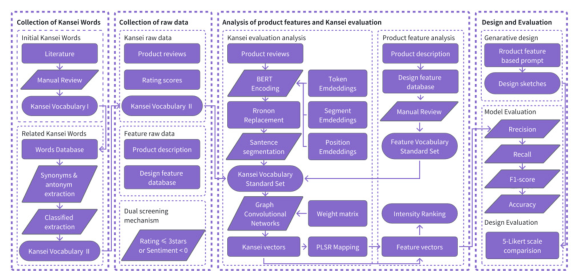
Despite these advances, existing studies mainly focus on sentiment classification, topic identification, or attribute importance analysis, and have yet to establish a quantitative, interpretable translation path from negative emotions to actionable design elements. To address this gap, this paper proposes a product improvement framework (Figure 1) that integrates negative text mining, Kansei engineering, and Partial Least Squares Regression (PLSR) Mapping Model. Taking smart household vacuum cleaners as an example, the framework guides generative design improvements based on insights extracted from negative reviews.
Figure 1: The framework of proposed approach.
METHODOLOGY
The initial Kansei vocabulary was constructed using a combination of literature-driven extraction and lexical expansion to ensure both theoretical consistency and comprehensive semantic coverage. First, relevant studies in Kansei engineering and product design were retrieved from the Web of Science database, and 10 representative SCI-indexed articles were selected. Kansei adjectives used in these studies were manually collected and filtered to retain words that reliably describe user perception and emotional responses, which obtained 327 Kansei words, and they were categorized according to their semantic characteristics to form the initial vocabulary set.
To enhance the coverage of affective expressions in real user reviews, the initial vocabulary was further expanded by incorporating synonyms and antonyms of the Kansei words, thereby enriching the affective expression space. WordNet is a large semantic thesaurus of English, which is often used in many text processing studies (Fellbaum, 1998), providing a structured resource to systematically identify semantically related words. For example, the Kansei word “fashionable” was expanded to include the semantically similar term “modern” as well as the opposite term “outdated”. The expanded vocabulary was subsequently reviewed and consolidated into the Kansei word set.
106 Shi and Zhou Feature extraction from product descriptions generally outperforms methods that extract noun phrases solely from reviews across multiple evaluation metrics (Wang et al., 2018). Therefore, this study combined literature analysis with product description features to construct a design vocabulary for smart vacuum cleaners. First, design-related terms used in existing studies were collected from the literature in Kansei engineering and product design, and then systematically organized. Subsequently, 10 smart vacuum cleaner products were selected from the Amazon platform (Figure 2), considering factors such as sales volume, number of reviews, and proportion of negative reviews, and their official product descriptions were crawled. Through manual annotation and inductive analysis, specific design attribute terms were extracted from the product descriptions, including items such as handle, product dimensions, color, and dustbin, and integrated with the literature-derived vocabulary. To ensure the professionalism and applicability of the vocabulary, a panel of five design experts reviewed and categorized the combined terms, ultimately defining five core design dimensions for the smart vacuum cleaner category: form and structure, material and craftsmanship, color and surface, size and proportion, and interaction and details. This process resulted in a complete and unified category-level design vocabulary (Table 1).
Table 1: Product feature vocabulary from literature and product description.
For the ten selected smart household vacuum cleaners on the Amazon platform, no fewer than 30 user reviews were collected for each product, resulting in over 300 raw reviews. Corresponding metadata including
A Product Redesign Approach Based on Negative Text Mining 107 product ID, review ID, review text, and rating score were also collected to support subsequent analysis and modeling.
Not all reviews pertain to product design attributes, and user reviews may express positive, neutral, or negative sentiment. Therefore, a three-channel filtering strategy was employed to automatically filter raw reviews and construct a high-relevance dataset of design-related negative reviews.
Rule 1: A review is classified as negative if its rating is less than or equal to three stars. Formally, this can be expressed as: ( ) ( ) = ≤ 1 3 score i i f r if score r (1)
Rule 2: To account for interactions between negation structures and negative emotion words, a sentiment polarity Boolean function ( ) sent i f r was defined. If negative emotion words appear, the review is classified as negative. If negation occurs, the expression is treated as negative. If double negation occurs, the expression is interpreted as neutral or positive. If no clear negative sentiment cues are detected, the expression is interpreted as neutral or positive.
Rule 3: Using the previously constructed category-level design vocabulary for smart vacuum cleaners, reviews are further evaluated for relevance to design attributes. Reviews that do not discuss any design-related aspect (e.g., price, logistics, or pure performance) are excluded.
The inclusion criterion for a review in the negative review training set can be formalized as: ( ) ( ) ( ) ∈ ⇔ = ∪ = ∩ = 1 0 1 i train score i sent i i feature r D f r f r f r (2)
After filtering, 366 design-related negative reviews were retained as the training dataset train D . From these filtered reviews, all sentiment adjectives were extracted and intersected with the initial Kansei vocabulary set. Manual verification was then conducted to remove ambiguous or weakly related terms, resulting in the final Kansei vocabulary set (Table 2). And through the review of five expert Theos, five pairs of the most representative Kansei word pairs were selected (Table 3).
Table 2: Kansei vocabulary based on sentiment adjectives.
uncomfortable rough ugly fragile useless To ensure the accuracy of textual analysis, all filtered negative reviews were subjected to a standardized preprocessing procedure. The preprocessing steps included completing sentences with omitted subjects, resolving pronoun references and replacing pronouns with their corresponding entities, and splitting complex sentences into individual simple clauses. After preprocessing, a total of 838 simple sentences or clauses were obtained. Each simple sentence was then processed using natural language processing tools to construct a dependency tree. As a crucial syntactic structure, the dependency tree clearly represents the relationships among words and effectively captures the dependencies within a sentence. By precisely encoding these syntactic relations, the dependency tree plays a critical role in assisting models to comprehend sentence semantics (Han et al., 2025).
Building on this, the pre-trained BERT model (Kenton et al., 2019) was employed to extract contextualized semantic representations from the text. BERT utilizes a bidirectional Transformer architecture to process input sequences, effectively capturing semantic features for each token. To prepare BERT input, WordPiece embeddings were applied (Wu et al., 2016). Contextualized representations were then generated through token embeddings, position embeddings, and segment embeddings.
Drawing inspiration from conventional convolutional neural networks (CNNs) and graph embedding, Graph Convolutional Networks (GCNs) are an efficient variant of CNNs that operate directly on graphs (Tang et al., 2025). To model the structured relationships between design attributes and Kansei perceptions expressed in user comments, this study adopts a Graph Convolutional Network (GCN) to construct the syntactic dependency graph ( ) = , G V E , where nodes V correspond to words and edges E represent dependency relations.
Each node is initialized with contextual embeddings generated by a pre-trained BERT model. For a sentence with n tokens, the initial node representations are defined as:
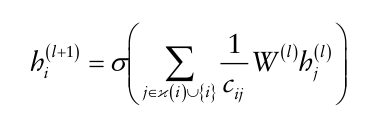
( ) ( ) ( ) ( ) ( ) = … ∈ 0 0 0 0 0 1 2 3 , , , , d i H h h h h [Equation or mathematical symbol available in the original paper PDF] (3) The GCN updates node representations by propagating information along the graph structure. At layer l, node embeddings are updated as:
( )
(4)
( ) ( ) σ + ∈ ∪ ( ) { }
Equation reproduced from the original PDF.
where ( )i [Equation or mathematical symbol available in the original paper PDF] denotes the neighbors of node i, ijc is a normalization coefficient, ( )l W is the trainable weight matrix, and σ is a nonlinear activation function. After L GCN layers, the final node embedding ( ) L ih encodes both contextual semantics and syntactic dependency information.
Let the design vocabulary set obtained above be K C , and let ( ) c K V be the node set belonging to the design category c C . To determine whether a certain comment involves this design category, this paper adopts the Max pooling strategy to calculate the activation intensity of this category: L K j (5)
( ) ( ) τ ( )
∈ =
j V s max W h
c K c
Among them, ∈ d K W [Equation or mathematical symbol available in the original paper PDF] is the learnable design projection vector. Based on the activation intensity sc, construct the design vector r K :
c K c
Equations and mathematical formulas are available in the original paper PDF.
s k otherwise (6)
1, 0,
[Equation or mathematical symbol available in the original paper PDF] where τ K is a predefined threshold.
Let E C denote the five Kansei dimensions defined by the refined Kansei word pairs (Table 2). For each Kansei dimension c E , the set of associated Kansei word nodes is denoted as ( ) c E V . To quantify the emotional perception intensity related to each design category, a Kansei polarity score is first computed as:
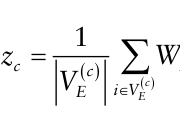
τ (7) c K i c ( ) ( )
Equation reproduced from the original PDF.
i V E z W h V
c E
where ∈ d E W [Equation or mathematical symbol available in the original paper PDF] is a learnable Kansei projection vector. The cz reflects the overall emotional tendency conveyed by the comment toward the corresponding Kansei dimension.
The normalized value of cz is discretized into an integer score ranging from 1 to 5, representing the perception spectrum from strongly negative to strongly positive (e.g., uncomfortable → comfortable). If no Kansei-related words associated with category c are detected in the review, the corresponding emotional dimension is assigned a value of 0.
Through the above mapping process, each user comment is finally represented as a pair of vectors ( r K , r E ).
RESULTS
After data cleaning, filtering, and structural processing, 376 valid review samples were retained. To establish a gold standard for performance assessment, reviews were manually inspected and annotated. For each review, a design category vector r K and a Kansei perception vector r E were assigned to represent the involved product design attributes and their corresponding emotional perceptions.
Based on the annotated dataset, the proposed approach was quantitatively evaluated and compared with Keywords-only methods using Precision, Recall, F-measure, and Accuracy as evaluation metrics(Table 4). The definitions of these metrics are given below.
Compared with the keywords-only approach commonly used in review mining, the proposed method shows a more pronounced advantage particularly in terms of precision, indicating that the incorporation of dependency structures and graph convolutional modeling effectively reduces false positives and improves the accuracy of identifying design-related affective opinions.
To quantitatively investigate the influence of design features (K) on users’ negative Kansei experiences (E), Partial Least Squares Regression (PLSR) was employed (Tobias et al., 1995). PLSR is widely applied in Kansei Engineering research to map the semantic space of product descriptions to the attribute space of design elements, effectively handling multicollinearity and high- dimensionality issues (Hsiao et al., 2017).
Nine products were used as the training set for the PLSR model and the remaining product was used as the test set (Table 5). The model performance was evaluated using Root Mean Square Error (RMSE) and coefficient of determination (R²). Its design vectors test K were input into the trained PLSR
A Product Redesign Approach Based on Negative Text Mining 111 model to predict Kansei vectors. The results indicate the model accurately predicts continuous Kansei values, with R² of 0.71 and RMSE of 0.38.
Table 5: Kansei attributes and design element matrix.
Table available in the original PDF paper.
NO. K1 K2 K3 K4 K5 E1 E2 E3 E4 E5
1 0 0 0 0 1 0 0 0 0 1
2 0 0 0 0 1 1 0 0 0 1
3 0 0 0 0 1 0 0 0 1 0
4 0 1 0 0 0 0 0 0 1 0
5 0 0 0 0 1 0 2 0 0 3
6 1 0 0 1 1 1 1 0 0 1
7 0 0 0 0 1 0 0 0 0 1
8 0 0 0 0 1 0 0 0 0 2
9 0 0 0 0 1 2 0 0 0 2
10 1 0 0 1 1 5 5 0 0 5
11 0 0 0 1 0 3 0 0 0 3
12 0 0 0 0 1 0 0 0 0 5
13 0 0 0 0 1 0 0 0 0 4
14 1 1 1 1 1 5 5 5 5 5
15 1 0 0 0 1 0 5 0 0 5
16 0 0 0 0 1 0 0 0 2 0
17 0 1 1 1 0 0 0 0 1 0
18 1 1 1 0 1 0 1 0 0 0
19 1 0 0 0 1 0 1 0 0 1
20 0 0 0 1 1 1 0 0 0 1
21 0 0 0 0 1 0 1 0 0 0
22 1 0 0 0 1 0 2 0 0 2
23 1 0 0 0 0 0 1 0 0 1
24 0 1 0 1 0 0 0 0 0 1
25 0 0 0 1 0 0 0 0 2 0
26 0 0 1 1 0 0 0 0 0 1
27 0 0 0 1 0 1 0 0 0 2
28 1 0 0 0 0 5 0 0 0 0
Kansei evaluation vectors were calculated across the 28 samples. The resulting mean Kansei values are [2.74 2.31 1.88 2.56 3.02]. The averaged Kansei vector was then input into the trained PLSR model to obtain the predicted design parameter vector as [0.42 0.51 0.33 0.47 0.68]. The predicted values were used as weighting factors for design modification.
The regression coefficient matrix produced by the PLSR model reflects the contribution strength of each design parameter to each Kansei dimension (Table 6). Analysis of the coefficient matrix indicates that K5 (Details and Interaction), K2 (Material and Craftsmanship) and K4 (Size and Proportion)
112 Shi and Zhou exhibit relatively large absolute coefficients on negative Kansei dimensions. Consequently, K5, K2 and K4 were identified as key modification elements, and their predicted values ik were used as design modification weights.
Table 6: Regression relationships between Kansei evaluation and design features.
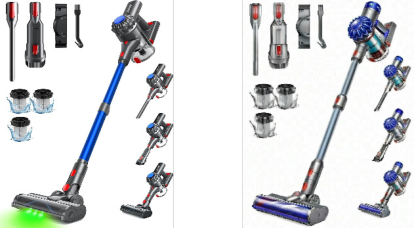
Based on the key design parameters and their corresponding weights obtained from the PLSR analysis, the experimental results were converted into structured design prompts to guide a generative image model for product appearance design. According to the model analysis results, the design elements of the original Amazon products were specifically adjusted to generate improved design schemes (Figure 3).
Figure 3: The original and the improved designs.
To evaluate the effectiveness of the design improvements, both the original and the improved designs were presented in a questionnaire, and users were invited to rate multiple Kansei dimensions using a 5-point Likert scale and 53 valid questionnaires were received. The average Kansei scores of the two schemes were then calculated and compared.
The results show that the average Kansei score of the original products was [3.22 2.95 3.05 3.10 3.38], while the average Kansei score of the improved products was [4.06 3.82 3.38 3.91 3.89], compared with the original designs, the improved designs achieved an overall Kansei score increase of 22.6%. Among the Kansei dimensions, the most significant improvement was observed in Fineness and Comfort, with an average increase of 29.5% and 26.1%. These findings are consistent with the predictions of the PLSR model, confirming the effectiveness of the proposed method in optimizing negative Kansei and improving product design.
CONCLUSION
This study proposes an integrated framework that combines negative text mining with Kansei engineering for the redesign of intelligent products. Taking smart vacuum cleaners as an example, key negative factors were extracted through semantic association graphs and Graph Convolutional Networks, and quantitative mappings between Kansei perceptions and design features were established using PLSR, ultimately guiding generative design optimization and yielding design solutions that align with users’ emotional needs.However, the current design feature extraction framework remains relatively coarse, with limited precision in feature representation, and the linear assumption of the PLSR model restricts its ability to capture complex relationships. Future research directions include developing more refined and computable design feature quantification systems and introducing high- precision prediction models, which are expected to achieve more accurate guidance from negative reviews to design improvements.
REFERENCES
Devlin, J., Chang, M.-W., Lee, K., Toutanova, K. (2019). BERT: Pre-training of Deep Bidirectional Transformers for Language Understanding. In: Proceedings of the 2019 Conference of the North American Chapter of the Association for Computational Linguistics: Human Language Technologies, Volume 1 (Long and Short Papers). Minneapolis, Minnesota: Association for Computational Linguistics, pp. 4171–4186. Du, Yuanjian., Liu, Xiaoxue., Cai, Mobing., Park, Kyungjin. (2024). A Product’s
Kansei Appearance Design Method Based on Conditional-Controlled AI Image Generation. Sustainability, 16(20), 8837. Fellbaum, C., ed. (1998). WordNet: An Electronic Lexical Database. Cambridge, MA: MIT Press. Guo, F., Liu, W., Cao, Y., Liu, F., Li, M. (2016). Optimization design of a webpage
based on kansei engineering. Human Factors and Ergonomics in Manufacturing & Service Industries, 26(1), pp. 110–126. Hongyu., Wang, Shengjie., Qiao, Baojun., Dang, Lanxue., Zou, Xiaomei., Xue, Hui., Wang, Yingqi. (2025). Aspect-Based Sentiment Analysis Through Graph Convolutional Networks and Joint Task Learning. Information, 16(3), 201. Hsiao, S.-W., Chiu, F.-Y., Chen, H.-Y. (2017). Product-form design model based
on Kansei engineering and grey system theory. Journal of Interdisciplinary Mathematics, 20(4), pp. 1043–1057. Hu, M., Liu, B. (2004). Mining and summarizing customer reviews, in: Proceedings of the tenth ACM SIGKDD international conference on Knowledge discovery and data mining (KDD ‘04), Seattle, WA, USA, 22–25 August, pp. 168–177. Kipf, T. N., Welling, M. (2017). Semi-supervised classification with graph
convolutional networks, in: International Conference on Learning Representations (ICLR). Toulon, France. Liu, B. (2012). Sentiment Analysis and Opinion Mining. San Rafael, CA: Morgan & Claypool Publishers. Nagamachi, M. (1995). Kansei Engineering: a new ergonomic consumer-oriented
technology for product development. International Journal of Industrial Ergonomics, 15(1), pp. 3–11.
GCN: Enhanced Multi-Feature Graph Convolutional Network for Aspect-Based Sentiment Analysis. Computing and Informatics, 44(3), 493. Tirunillai, S., Tellis, G.J. (2014). Mining marketing meaning from online chatter: strategic brand analysis of big data using latent Dirichlet allocation. Journal of Marketing Research, 51(4), pp. 463–479. Tobias, R. D. (1995). An introduction to partial least squares regression. In:
Proceedings of the Twentieth Annual SAS Users Group International Conference. Orlando, Florida: SAS Institute Inc., pp. 1250–1257. Wang, W. M., Li, Z., Tian, Z. G., Wang, J. W., Cheng, M. N. (2018). Extracting and summarizing affective features and responses from online product descriptions and reviews: A Kansei text mining approach. Engineering Applications of Artificial Intelligence, 73, pp. 149–162. Wu, Y., Schuster, M., Chen, Z., Le, Q. V., Norouzi, M., Macherey, W., Krikun, M.,
Cao, Y., Gao, Q., Macherey, K., Klingner, J., Shah, A., Johnson, M., Liu, X., Kaiser, Ł., Gouws, S., Kato, T., Mokhtar, T., Kazawa, H., Stevens, K., Shazeer, N., Prabhakaran, N., Dai, Z., Le, Q., Uszkoreit, J. (2016). Google’s Neural Machine Translation System: Bridging the Gap between Human and Machine Translation. arXiv:1609.08144. Yan, H.-B., Ma, T., Li, Y. (2008). A Kansei engineering system for product form design based on rough sets and grey system theory. International Journal of Product Development, 7(3/4), pp. 248–264.
LISTED IN THE AHFE DIGITAL BOOKSTORE CATALOGUE
Explore the complete digital volume
Human Factors and Ergonomics In Design
Read this individual research paper free through the original publisher, or explore the full digital proceedings book.
ISBN 978-1-964867-86-1
Explore this ISBN in the AHFE Bookstore ↗Listed in the July 2026 bookstore catalogue; search by ISBN to confirm current availability · Digital book purchase optional