Teru Kawakita (2026). Kansei Analysis of Spicy Noodle Packaging for Generative AI-Based Design Education. In: Human Factors and Ergonomics In Design. AHFE Open Access, vol. 210, pp. 122–129. https://doi.org/10.54941/ahfe1007432
This study examines the Kansei structure of Korean spicy noodle packaging as perceived by teenage female university students and explores its applicability to generative AI-supported design education. An impression evaluation experiment was conducted with 13 participants using seven commercially available packages found in Japanese supermarkets, and 16 Kansei word pairs were rated on a five-point semantic differential scale. Through principal component analysis and biplot visualization, individual packages were shown to occupy distinct positions within this affective space, corresponding to different design strategies such as emphasizing extreme spiciness, approachability, premium quality, or uniqueness. Furthermore, the visualized Kansei structure functioned as an effective reference framework for beginner designers using generative AI, suggesting its potential as both an analytical and educational tool.
Instant noodles, first developed in Japan, have spread worldwide and are now consumed at a scale exceeding 100 billion servings annually (World Instant Noodles Association, 2025). In Japan, the popularity of K-pop among younger generations has increased in recent years, accompanied by a growing presence of Korean food products in supermarkets and retail stores. Korean instant noodles are especially notable for their wide variety and strong popularity among consumers. Korean cuisine is widely characterized by spiciness and is commonly perceived as being strongly associated with spicy flavors, both domestically and internationally (Buldak, 2025). In Korea, the most common type of instant noodles features a spicy, red chili–based soup, with beef and seafood varieties also widely consumed (World Instant Noodles Association, 2025). Arifin et al. (2023) reported that consumers’ motivation to purchase and consume Korean spicy chicken cup noodles is strongly influenced by a preference for spicy flavors, convenience of preparation, reasonable pricing, and familiarity with well-known brands.
In the instant noodle market, it is difficult to directly convey taste and flavor experiences prior to consumption. As a result, the visual elements of packaging are assumed to play a crucial role in shaping consumers’ purchase
Kansei Analysis of Spicy Noodle Packaging for Generative AI-Based Design Education 123 decisions and product image formation. Food packaging design functions not only to protect and preserve products but also as a key communication medium that conveys value, attractiveness, and product identity to consumers (Marsh & Bugusu, 2007). In particular, packaging for Korean extremely spicy noodles is characterized by intense visual stimulation and distinctive world-building, attracting significant global attention.
Despite this prominence, limited research has examined how such packaging designs are perceived and evaluated in terms of their underlying Kansei (affective) structures. Previous studies on food and product packaging design have applied Kansei engineering methods to analyze emotional impressions and sensory evaluations (Schütte et al., 2024). In this study, principal component analysis and biplot visualization, which are widely used in Kansei engineering, are applied to examine the underlying affective structure of packaging impressions (Kawakita & Nishimura, 2023).
Furthermore, in the field of design education, the use of generative AI has rapidly expanded in recent years. However, beginners often face difficulties in articulating and structuring design intentions, particularly in defining the intended impressions or emotional qualities to be generated. Visualizing impression structures through Kansei engineering approaches may help address this challenge and provide effective guidelines for the educational use of generative AI in design practice (Kawakita, 2025).
Accordingly, this study aims to examine the Kansei structure of Korean spicy noodle packaging perceived by teenage female university students and to explore the potential of generative AI-supported design education.
METHOD
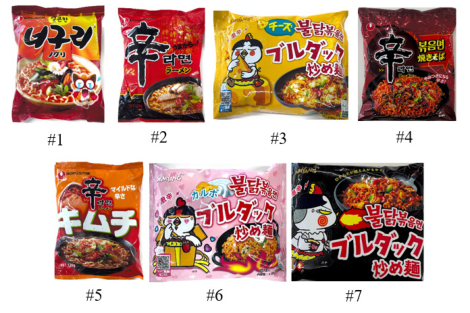
In this study, an impression evaluation experiment was conducted with 13 female teenage university students as participants. Participants reported no diagnosed color vision deficiencies. As visual stimuli, seven types of Koreans spicy instant noodle packages commercially available in Japanese supermarkets were selected. Sample images of the packages are shown in Figure 1.
Figure 1: Sample images of the packages.
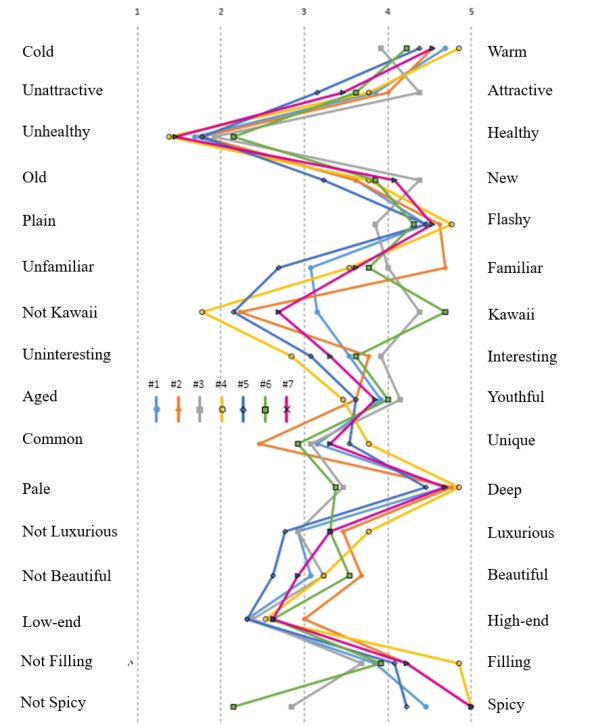
124 Kawakita For the evaluation, 16 Kansei words were selected based on a preliminary survey and relevant prior studies. Each package was evaluated using a five-point semantic differential (SD) scale. The Kansei words used for the evaluation are shown in Figure 2. The packages were printed on paper and presented to participants in a randomized sequence. The Kansei words were presented in a random order via Google Forms.
Subsequently, five students who did not participate in the evaluation experiment created new package design proposals using Canva (https://www.canva.com/), incorporating generative AI tools and royalty-free images. All five participants were beginners in design. During the design process, the extracted Kansei structure and its visualized results were provided as references to support their design decision-making.
RESULTS
Figure 2 shows the semantic profiles of the Kansei words for each package.
Figure 2: Semantic profiles of the Kansei words for each package.
Kansei Analysis of Spicy Noodle Packaging for Generative AI-Based Design Education 125 Kawaii is a Japanese Aesthetic Concept Referring to Cuteness
A principal component analysis (PCA) was conducted on the data shown in Figure 2. As a result, two principal components were extracted. The contribution rate of the first principal component was 51.85%, and that of the second principal component was 25.8%, yielding a cumulative contribution rate of 77.6%. The results of the PCA are summarized in Table 1. These findings indicate that the impressions of the spicy noodle packages examined in this study can be explained by a small number of perceptual dimensions.
Table 1: Results of PCA.
Table available in the original PDF paper.
SD scales Principal Components
I II Kawaii - Not Kawaii −0.93 Flashy - Plain 0.91
Youthful - Aged −0.9 Deep - Pale 0.89 Warm - Cold 0.89
Interesting - Uninteresting −0.85 0.36 Spicy - Not spicy 0.85 Filling - Not Filling 0.85 0.31
Healthy - Unhealthy −0.83 New - Old −0.56 Attractive - Unattractive −0.53 0.5
Luxurious - Not Luxurious 0.45 0.73 Unique - Common 0.54 −0.64
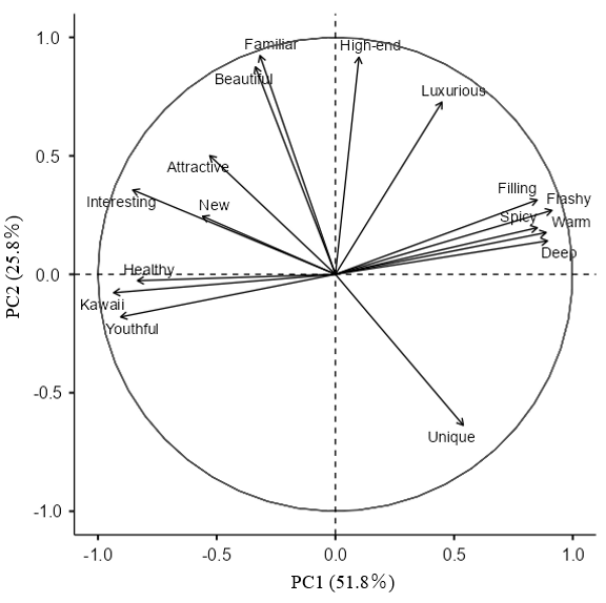
The first principal component comprised items related to approachable and light impressions (e.g., “Kawaii,” “Youthful,” and “Healthy”), contrasted with items indicating strong sensory stimulation and experiential intensity (e.g., “Flashy,” “Spicy,” and “Filling”).
The second principal component comprised items representing socially recognized aesthetic refinement and perceived product quality (e.g., “Familiar,” “Beautiful,” and “Luxurious”).
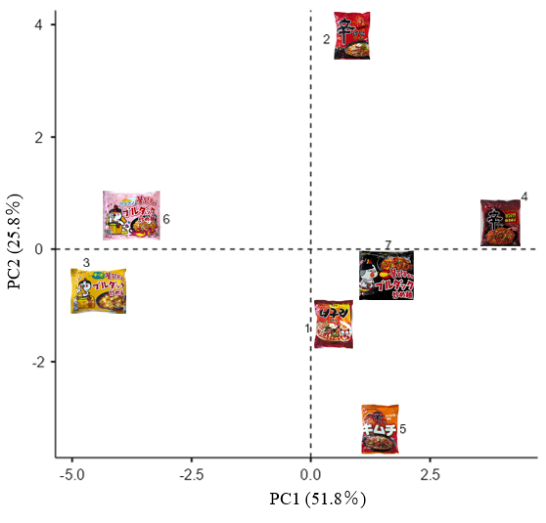
Based on these results, a principal component loading plot (Figure 3) and a principal component score plot of the packages (Figure 4) were created. Visualization using a biplot enabled an intuitive understanding of how each package was positioned along the perceptual dimensions, making it easier to grasp the relationship between specific design features and the underlying affective structure.
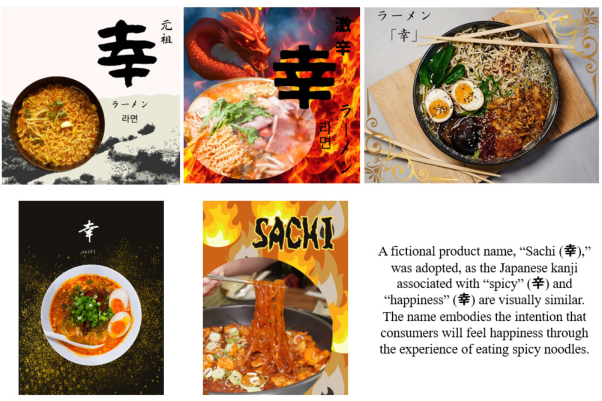
Using these findings as a reference, five students created new package design proposals using Canva, incorporating generative AI tools and royalty-free images. Figure 5 presents examples of design proposals created by beginners based on affective cues derived from the analysis.
Figure 3: Principal component loading plot.Figure 4: Principal component score of the packages.Figure 5: Examples of design proposals created by beginners.
In interviews with the students who designed the packages, the following comments were reported:
Because it was visually clear which packages corresponded to which Kansei impressions, it was easy to understand what kind of package design should be created.
When entering prompts for generative AI, including Kansei-related words associated with specific packages made it easier to generate images that could be directly used for design purposes.
DISCUSSION
This study aimed to examine the Kansei structure of Korean spicy noodle packaging perceived by teenage female university students and to explore the potential of generative AI-supported design education. For the analysis, seven Korean spicy noodle packages that are readily available in Japanese supermarkets were selected as samples (Figure 1). The results shown in Figure 2 indicate that all packages shared impressions of being unhealthy and flashy, as well as being perceived as relatively low-priced. Such strong visual catchiness is considered to play an important role in attracting the attention of teenage female consumers.
In the biplots (Figure 3 and Figure 4), Sample 4 was located in the positive direction of the first principal component and positioned close to the vectors of Kansei words such as “Spicy,” “Flashy,” “Filling,” “Warm,” and “Deep.” This suggests that the package was perceived as a typical design that strongly emphasizes spiciness and richness. In contrast, Samples 3 and 6 were located in the negative direction of the first principal component and showed proximity to “Kawaii,” “Youthful,” and “Healthy,” indicating that these packages were evaluated as designs that emphasize approachability and lightness, despite belonging to the spicy noodle category. Sample 2
128 Kawakita was positioned in the positive direction of the second principal component and showed strong correspondence with “High-end” and “Luxurious,” suggesting that it was perceived as a design conveying a sense of premium quality, completeness, and reassuring familiarity. Sample 5 was located in the negative direction of the second principal component and close to the vector of “Unique,” indicating that it was perceived as emphasizing originality and a distinctive, edgy character.
These results suggest that, in spicy noodle packaging design, strategic choices—such as how strongly to visually emphasize the intense spicy flavor and whether to present the product as a refined standard item or as a challenging and distinctive one—have a substantial influence on consumers’ Kansei evaluations. Furthermore, even within the same category of spicy noodles, multiple Kansei positionings were identified, including designs that maximize sensory stimulation, designs that enhance approachability, designs that emphasize premium quality, and designs that foreground uniqueness. This finding demonstrates that Kansei engineering methods enable the systematic visualization of impression structures in packaging design, providing valuable insights for future design analysis and educational applications.
As shown in Figure 5, the biplot visualizing the Kansei structure functioned as an effective reference framework for beginner designers. By understanding the dimensional positioning of the impressions that they aimed to achieve, students were able to iteratively explore visual expressions using generative AI. This suggests that Kansei analysis can serve not only as an analytical method but also as a practical design cue and prompt framework in generative AI–based design education. In other words, it plays a bridging role by structuring otherwise ambiguous Kansei intentions and translating them into visual generation through generative AI. Overall, this study demonstrates the potential of a novel design education approach that integrates Kansei engineering with generative AI, and future research is expected to extend the investigation by expanding participant attributes and target design domains.
CONCLUSION
This study clarified the Kansei structure underlying Korean spicy noodle packaging as perceived by teenage female university students. Two principal components were identified: one contrasting approachable and light impressions with strong sensory stimulation, and another reflecting socially recognized aesthetic refinement and perceived product quality. Through biplot visualization, individual packages were shown to occupy distinct positions within this affective space, corresponding to different design strategies such as emphasizing extreme spiciness, approachability, premium quality, or uniqueness.
Furthermore, the results suggest that visualizing Kansei structures can support design education through the use of generative AI. By referring to the extracted affective dimensions and package positions, beginner designers were able to articulate their design intentions more clearly and explore visual expressions in a structured manner. These findings suggest that Kansei analysis can function not only as an analytical method for packaging design
Kansei Analysis of Spicy Noodle Packaging for Generative AI-Based Design Education 129 but also as an effective framework for integrating generative AI into design education. Future studies should expand participant groups and design domains to further validate this approach.
ACKNOWLEDGMENT
We gratefully acknowledge the cooperation of the second-year students of the Kawakita Seminar at Matsuyama Shinonome Junior College (2023 academic year).
REFERENCES
Arifin, S., Roosdhani, M.R., Komaryatin, N., Ali, A. and Huda, N. (2023). The purchase intention of Korean noodles in the millennial Moslem, in Proceedings of the International Conference of Business and Social Sciences, pp. 530–539. Buldak (2025). Korea’s spicy food history: From chili to Buldak ramen noodles.
Available at: https://buldak.com/us/blog/korea-fiery-history-buldak-ramen-noodles/ (Accessed: 6 February 2026). Kawakita, T. (2025). Enhancing design skills for beginners in packaging design education through Kansei engineering, Educational Point, 2 (2), e125. https://doi. org/10.71176/edup/16729 Kawakita, T. and Nishimura, T. (2023). Avatar design focusing on kawaii motions,
Human-centered design and user experience, 114, pp. 158–165. https://doi. org/10.54941/ahfe1004232 Marsh, K. and Bugusu, B. (2007). Food packaging—Roles, materials, and environmental issues, Journal of Food Science, 72 (3), pp. 39–55. https://doi. org/10.1111/j.1750-3841.2007.00301.x Schütte, S., Lokman, A.M., Marco-Almagro, L., Ishihara, S., Yanagisawa, H.,
Yamanaka, T. and Coleman, S. (2024). Kansei for the digital era, International Journal of Affective Engineering, 23 (1), pp. 1–18. https://doi.org/10.5057/ijae. IJAE-D-23-00003 World Instant Noodles Association (2025). Instant noodles worldwide. Available at: https://instantnoodles.org/en/ (Accessed: 6 February 2026).
LISTED IN THE AHFE DIGITAL BOOKSTORE CATALOGUE
Explore the complete digital volume
Human Factors and Ergonomics In Design
Read this individual research paper free through the original publisher, or explore the full digital proceedings book.
ISBN 978-1-964867-86-1
Explore this ISBN in the AHFE Bookstore ↗Listed in the July 2026 bookstore catalogue; search by ISBN to confirm current availability · Digital book purchase optional