Avatar-based communication in the metaverse offers a more extensive range of non-verbal information compared to traditional web-conferencing platforms. This study introduced a metaverse-based structured group encounter (M-SGE) and examined its effects on state anxiety, mood, and self-disclosure. The results indicated a significant reduction in state anxiety among participants following their involvement in M-SGE (p = .01, d = .90). Additionally, there was a marked increase in the participants’ willingness to self-disclose (p = .019, d = -.79). However, no significant differences in mood were observed before and after the M-SGE. The M-SGE offers the advantage of enabling communication through avatars for individuals perceiving face-to-face conversations as a challenge, regardless of time and place constraints. During the experiment, there were occasional instances of voice feedback and audio difficulties among participants, indicating the need for an improved communication environment.
Structured group encounters (SGEs) are group psychotherapies designed for healthy individuals, encompassing both generic and specific forms. Generic SGE focuses on fostering personal growth through intensive group experi- ences during multi-day camps. In contrast, specific SGE is conducted more briefly and is tailored for distinct educational objectives, catering to children, students, and corporate seminar participants (Kokubu and Kokubu, 2004). This study utilized a specific SGE. In Japan, SGEs have been implemented in diverse settings for several decades. For instance, Takikawa et al. (2010) facil- itated an SGE for teachers, focusing on the acquisition of accurate knowledge about sex, human papillomavirus, and preventive vaccines. SGE incorporates three critical elements: instructions, exercises, and sharing.
Instructions: This involves detailing the overview, objectives, and necessary precautions of SGE.
Exercises: The exercises in SGE are tailored to their objectives. They are designed to promote psychological development such as self-understanding, understanding others, self-acceptance, and self-assertion (Kokubu and Kokubu, 2004).
Assessing Self-Disclosure Willingness in Metaverse-Based Structured Group Encounter 79
Sharing: This stage involves participants discussing and sharing the insights they have gained from the exercises.
In SGE, effective group communication is essential, with non-verbal cues playing a significant role. Traditionally, this therapy is conducted in face-to- face settings. However, the period of the COVID-19 pandemic made such in-person gatherings unfeasible, necessitating the use of web-conferencing platforms. Nishino (2022) implemented SGE via web-conferencing platforms and identified unique online challenges, such as screen freezing and audio interruptions during conversations.
Furthermore, the limitation of non-verbal communication through online meetings remains a significant concern. To address this, we suggest conduct- ing SGE in the metaverse rather than relying on web-conferencing platforms. In this approach, users gather in a virtual room created within the metaverse and communicate through avatars. Full-tracking avatars effectively convey users’ non-verbal information. This approach is termed metaverse-based SGE (M-SGE) in our study.
Self-disclosure is a fundamental component of SGE. Harada (2006) cate- gorized university students into groups based on high and low self-disclosure exercises and observed a significant decrease in interpersonal anxiety in the high self-disclosure group. Hiramiya (2013) conducted SGE twice for edu- cation workers and noted an enhancement in self-disclosure, particularly in areas such as “personal life values,” “family and daily life,” “hetero- sexual interpersonal relationships,” and “small talk (social topics)”. In M-SGE, participants engage with others through avatars while maintain- ing anonymity, a factor believed to enhance self-disclosure. Anonymity in online settings often reduces social inhibition, leading to more frequent self- disclosure, an effect known as the online disinhibition effect (Suler, 2004). Research, including a meta-analysis by Clark-Gordon et al. (2019), indicates that increased anonymity tends to facilitate self-disclosure. Therefore, it is reasonable to infer that M-SGE is particularly effective in reducing the anx- iety of individuals who are uncomfortable with direct communication and self-disclosure.
This study focused on evaluating the effects of conducting M-SGE on state anxiety, mood, and self-disclosure.
METHOD
Participants Originally, the intention was to recruit 20 participants and organize M-SGE into five groups, each undergoing several sessions. Since the experiment was conducted remotely, all communications with participants were carried out through email. However, eight participants were unable to participate due to equipment or communication environment issues, fever, or last-minute cancellations. Therefore, the study proceeded with 12 graduate students (M = 27.5, SD = 6.86, 10 males, 2 females). During each session, partic- ipants were assigned an ID and instructed to communicate using these IDs instead of revealing their real names.
80 Kawakita and Kanai
Settings The study utilized “Cluster,” a metaverse platform with a predominantly Japanese user base. Cluster (2024) metaverse is accessible via various devices, such as computers, smartphones, and virtual reality (VR) equipment, allow- ing users to create avatars, generate content, and communicate with other individuals. Since all participants did not have access to VR equipment, the M-SGE sessions were conducted using computers only.
The relationship between self-disclosure and environmental factors is well- documented. Okken et al. (2012a) presented participants with four images of rooms varying in size and spacing of objects. The findings indicated that larger rooms are associated with an increased willingness for self-disclosure. Furthermore, empirical observations in actual rooms of different sizes con- firmed that a larger room size fosters greater openness in self-disclosure (Okken et al., 2012b). This phenomenon extends to VR environments as well. In VR settings, individuals in larger counseling rooms exhibit a higher willingness for self-disclosure when interacting with an avatar (agent) that is not operated by a real person, compared to those in smaller VR counseling rooms (Kawakita, Sasaki, and Ishihara, 2021).
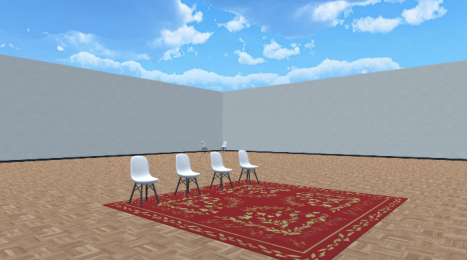
In traditional SGE conducted in a physical space, arranging for a larger room is essential, but making environmental adjustments can be challenging. In the metaverse, however, it was straightforward to create a comfortable room tailored to the participants’ needs. The VR room utilized in this study is depicted in Figure 1.
Figure 1: Image of VR room in cluster.
Avatars Participants engaged in the experiment through avatars within a virtual room (as shown in Figure 1). The design elements of an avatar can be manipulated to convey specific impressions, such as appearing weak or strong (Kawakita and Kanai, 2023). The willingness to communicate can also be influenced by the appearance of these avatars (Kawakita et al., 2022). Therefore, avatars can be strategically designed to enhance communication among individuals. The appearance of avatars and associated stereotypes can influence the psy- chological and behavioural responses of users, an effect known as the Proteus
Assessing Self-Disclosure Willingness in Metaverse-Based Structured Group Encounter 81
effect (Yee and Bailenson, 2007; Yee, Bailenson, and Duchenealt, 2009), with this effect being supported by a previous meta-analysis (Ratan et al., 2020).
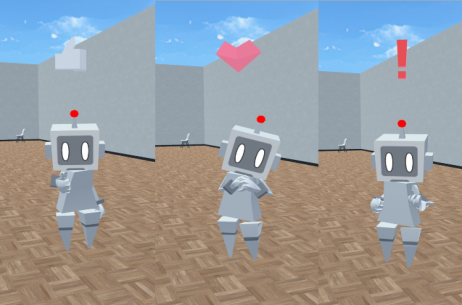
In this study’s platform, Cluster, there is a diverse range of avatar types, including humanoid, robot, animal, plant, and monster. Using avatars of varying appearances for each participant could introduce extraneous vari- ables. Therefore, we limited the avatar selection to robot types. Given that these avatars had limited non-verbal communication capabilities, such as facial expressions, participants actively utilized Cluster’s emotional icons to convey their emotions. These icons included sending hearts, giving a thumbs up, applauding, expressing surprise with exclamation marks, and bowing (as illustrated in Figure 2).
Figure 2: Robot avatar with emotional icons.
Materials
Data collection was conducted using Google Forms, which included demo- graphic information such as gender and age. For quantitative assessments, we employed the following measures: (1) State anxiety: This was assessed using 20 items from the state-trait anxiety inventory (STAI), measured on a 4-point Likert scale. (2) PANAS: In Japan, the profile of mood states (POMS) and POMS2 scales are often used to measure mood. However, due to concerns about their suitability for measuring the current psychological state (Oda et al., 2015), we used 16 items from the Japanese version of the positive and negative affect schedule (PANAS) to measure the positive and negative moods (Sato & Yasuda, 2001). This was measured on a 6-point Likert scale. (3) Willingness to disclose personal information: Drawing from the “will- ingness in self-disclosure to avatars” measures used in a prior study (Kawakita et al., 2022), we incorporated four items: “I feel difficulty to talk (R),” “I can talk freely,” “I hesitate to share personal information (R),” and “I feel difficulty to talk about myself (R)”. Here, R indicates reverse-coded items.
82 Kawakita and Kanai
Procedure Participants received a manual for operating the Cluster platform, including instructions on how to move avatars, send friend requests to enter the room (depicted in Figure 1), and coordinate schedules to gather in the room at the specified times.
Once participants gathered in the room depicted in Figure 1, they were guided on how to operate their avatar from a first-person perspective, reminded to unmute when speaking, sit in virtual chairs for discussions, address each other by ID, listen attentively, avoid causing harm, keep the discussions confidential, and feel no obligation to discuss topics they were uncomfortable sharing. After obtaining informed consent, participants were asked to respond to evaluation items (refer to Materials) using Google Forms.
The M-SGE proceeded in the following sequence: introductory exercises to reduce tension, followed by instructions, exercises, sharing, and a conclu- sion. To combat facilitator-related variables, such as experimenter effects, we standardized the facilitator role and adhered to a basic manual for conducting M-SGE.
An introductory self-introduction game was conducted. Participants pre- pared a one-minute self-introduction, including their hobbies, interests, and recent positive events. Each participant then introduced themselves, with listeners providing feedback, impressions, or questions.
The M-SGE instructions provided explanations and guidance for the exercise. Exercises focused on self-disclosure and active listening, are termed unforgettable experiences (Kokubu and Kokubu, 2004). The exer- cise involved reflecting on a significant, unforgettable personal experience, sharing it, and deepening understanding of the topic. The facilitator began by sharing one such personal experience, after which participants had three min- utes to reflect on and share their insights. Listeners then provided feedback and questions.
Following the completion of M-SGE, participants were once again asked to respond to the items using Google Forms.
RESULTS
The means and standard deviations (SD) for each item, both before and after the M-SGE, are presented in Table 1.
Table 1. Mean and SD for each item before and after M-SGE.
Table available in the original PDF paper.
Mean (SD) Items Before After
State anxiety 41.67 (7.05) 35.83 (8.16) PANAS-positive 23 (6.98) 26.83 (8.26) PANAS-negative 16.83 (7.18) 15.33 (7.05) Willingness to disclose personal information 15.92 (5.14) 20.5 (5.37)
Following the confirmation of data normality using the Shapiro-Wilk test, paired t-tests were conducted. The results of these t-tests for each item
Assessing Self-Disclosure Willingness in Metaverse-Based Structured Group Encounter 83
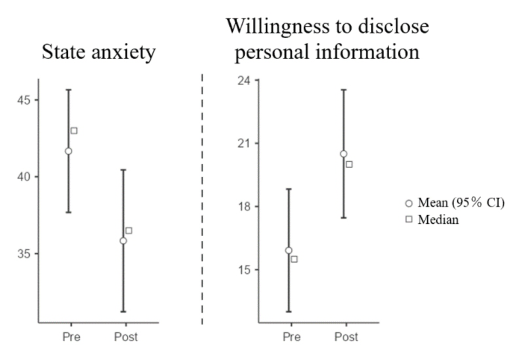
are presented in Table 2. Figure 3 illustrated the changes in state anxiety and willingness to self-disclosure, with significant differences highlighted in Table 2.
Table 2. Results of the paired t-test for each item.
Table available in the original PDF paper.
95% Confidence interval df Lower Upper t p Effect size
11 −1.43 −0.13 −2.75 .019 −0.79
State anxiety 11 0.21 1.56 3.11 .01 0.90 PANAS-positive 11 −1.05 0.14 −1.61 .136 −0.46 PANAS-negative 11 −0.31 0.84 0.93 .372 0.27 Willingness to disclose personal information
Figure 3: Changes in scores for items before and after M-SGE.
DISCUSSION
This study explored the effect of M-SGE on state anxiety, mood, and self-disclosure. The paired t-test results indicated that M-SGE significantly decreased state anxiety and increased willingness to self-disclosure. However, no notable changes in mood were observed before and after the M-SGE.
The unforgettable experiences, focusing on self-disclosure and active lis- tening, were integral to the sessions and were also applied in educational settings. Conducting these experiences in the metaverse appears to enhance self-disclosure willingness. The use of avatars may benefit individuals uncom- fortable with face-to-face interactions by reducing their anxiety thereby prompting them to engage in self-disclosure. However, during the experi- ment, occasional issues with voice feedback and audio quality were noted,
84 Kawakita and Kanai
potentially affecting participants’ moods. As demonstrated, enhancing the communication environment is vital for the success of M-SGE.
Self-disclosure, while a central aspect of M-SGE, is not merely sharing extensively about oneself. Excessive sharing can sometimes lead to regrets, prompting thoughts such as, “Why did I say all that?” Future research should delve into the qualitative aspects of self-disclosure.
The avatars employed need not be controlled by humans. Utilizing avatars operated by non-player characters (NPCs) or artificial intelligence (AI) may offer a more tailored experience for educational purposes, free from constraints of time, location, or human resource availability.
CONCLUSION
In traditional SGE, participants convene at a predetermined location and time. Individuals with interpersonal anxiety may find face-to-face inter- actions psychologically daunting. In addition, tailoring the environmental aspects of a physical room poses challenges. Therefore, this study pro- posed the M-SGE and examined its effects on state anxiety, mood, and self-disclosure. The findings demonstrated that M-SGE significantly boosted self-disclosure and reduced anxiety. Consequently, M-SGE presents a viable option for skill enhancement, unbound by the constraints of time, location, or human resource availability.
LIMITATIONS In this study, participants’ avatars were standardized to be robots, as depicted in Figure 2. As M-SGE gains popularity, a wider variety of avatars is likely to be employed. Therefore, examining the impact of avatar appearance on M-SGE outcomes is essential. Additionally, with the increasing ownership of head-mounted displays, a more immersive M-SGE experience becomes a viable option. This development necessitates research into the comparative effectiveness of traditional SGE and a more immersive M-SGE approach.
RESEARCH ETHICS This study received approval from the Life Science Committee of the Japan Advanced Institute of Science and Technology.
ACKNOWLEDGMENT
This work was supported by the Sasakawa Scientific Research Grant from the Japan Science Society.
We would like to thank Editage (www.editage.jp) for English language editing.
REFERENCES
Clark-Gordon, C. V., Bowman, N. D., Goodboy, A. K., & Wright, A (2019).
Anonymity and online self-disclosure: A meta-analysis. Communication Reports, 32 (2), 98–111.
Assessing Self-Disclosure Willingness in Metaverse-Based Structured Group Encounter 85
Cluster (2024). https://corp.cluster.mu/ Harada, E. (2006). A study on the effects of self-disclosure in continual structured encounter group. Kyushu University Psychological Research, 7, 159–167. Hiramiya, M. (2013). Study on Self-disclosure among the Members of Structured
Group Encounter. Japanese journal of educational counseling, 5(1), 11–20. Kawakita, T., & Kanai, H. (2023). Avatar Design for Bullying Prevention in the Metaverse: Avatar Appearances and the Presumption of Bullying. Kansei Engi- neering, AHFE (2023) International Conference, AFHE Open Access, 101, 52–58. https://doi.org/10.54941/ahfe1002991 Kawakita, T., Onishi, G., Ishihara, S., Hashimoto, K., & Kanai, H. (2022). A
Study on the Effects of Different Counselor Avatar Appearances and Seriousness of Client Problems. Transactions of Japan Society of Kansei Engineering, 21 (3), 267–274. (in Japanese). https://doi.org/10.5057/jjske.tjske-d-22-00001 Kawakita, T., Sasaki, T., & Ishihara, S. (2021). Remote virtual counseling and effects of embodied cues: Toward casual on-line counseling under COVID-19 situ- ation. Proceedings of the AHFE 2021 Virtual Conferences on Design for Inclusion, Affective and Pleasurable Design, Interdisciplinary Practice in Industrial Design, Kansei Engineering, and Human Factors for Apparel and Textile Engineering, 260, 952–960. https://doi.org/10.1007/978-3-030-80829-7_116. Kokubu, Y., & Kokubu, H. (2004). Structured Grouped Encounter encyclopedia.
Tosyobunka. Nishino, S. (2022). Online Continuous Semi-structured Encounter Group during COVID-19 —Examining the impact on members and the facilitator experience— Atomi Gakuen Joshi Daigaku Fuzoku Shinri Kyoiku Sodansho Kiyo, 18, 123–137. Oda, Y., Takano, R., Abe, T., & Kikuchi, K. (2015). Development of the Emotion and
Arousal Checklist (EACL). The Japanese Journal of Psychology, 85 (6), 579–589. https://doi.org/10.4992/jjpsy.85.13231 Okken, V., van Rompay, T., & Pruyn, A. (2012a) Exploring space in the consultation room: environmental influences during patient–physician interaction. Journal of Health Communication, 17, 397–412. Okken, V., van Rompay, T., & Pruyn, A. (2012b) Room to move: on spatial
constraints and self-disclosure during intimate conversations. Environment and Behavior, 45(6), 737–760. Ratan, R., Beyea, D., Li, B. J., & Graciano. (2020). Avatar characteristics induce users’ behavioral conformity with small-to-medium effect sizes: A meta-analysis of the proteus effect. Media Psychology, 23 (5), 651–675. https://doi.org/10.1080/ 15213269.2019.1623698 Sato, A., & Yasuda, A. (2001). Development of the Japanese version of Positive and
Negative Affect Schedule (PANAS) scales. Japan Society of Personality Psychology, 9 (2), 138–139. https://doi.org/10.2132/jjpjspp.9.2_138 Suler, J. (2004). The online disinhibitation effect. CyberPsychology & Behavior, 7, 321–326, 2004. Takikawa, M., Nakamura, T., Tamura, T., Kokubu, Y., & Kanayama, K. (2010).
Awareness survey of teachers after the introduction of the cervical cancer vaccine onto the market. Japanese Journal of Health, Fitness and Nutrition, 15 (1), 9–13. Yee, N., & Bailenson, J. N. (2007). The proteus effect: The effect of transformed self representation on behavior. Human communication Research, 33, 271–290. Yee, N., Bailenson, J. N., & Duchenealt, N. (2009). The proteus effect. Communica-
tion Research, 36 (2), 285–312.
LISTED IN THE AHFE DIGITAL BOOKSTORE CATALOGUE
Explore the complete digital volume
Kansei Engineering
Read this individual research paper free through the original publisher, or explore the full digital proceedings book.
ISBN 978-1-964867-21-2
Explore this ISBN in the AHFE Bookstore ↗Listed in the July 2026 bookstore catalogue; search by ISBN to confirm current availability · Digital book purchase optional