With the rise of new energy vehicles and increased consumer demand for personalization, understanding consumer behavior and emotional experience has become critical. This study analyzes the perceptual dimensions and influencing factors of automotive interior materials that affect consumers' car purchase decisions. The study analyzes consumers' preference for interior materials of new energy vehicles by examining the subjective perception differences between visual and visual-tactile dimensions. The study adopts the "material perception" theory to investigate people's perceptual evaluation of automotive interior fabric materials. Through perception experiments and multidimensional scaling analysis, we establish a space of perception dimensions and a structural model of material perception factors affecting car purchasing decisions. Regarding material roughness, there were significant differences across conditions, with visuotactile sensation rougher than visual sensation, and the interaction of material properties and sensory conditions had a substantial effect on emotionally assessed words. The study's results reveal the critical factors in consumers' car-buying choices and the advantages of automotive interior materials in the emotional perception dimension.
The design differentiation of automobile interiors largely determines an auto- mobile brand’s personality and market competitiveness. In addition to design, choosing materials that express texture and sensual elements also plays a vital role in automotive interior design. The selection of high-quality inte- rior materials can give automotive interiors a special visual effect and tactile texture. This study focuses on automotive interior seating and uses common textile materials, mainly organic, knitted, nonwoven, and fiber composites, as research objects. Functional properties of materials and manufacturing pro- cess selection of materials with objective measurability; It also depends on the production of various psychological emotions. Some studies have pro- posed that the description of material texture can be summarized in four dimensions: geometric, physicochemical, emotional, and associative dimen- sions (Zuo, 2004). Describing these dimensions allows people to convey the
Mechanism of Multidimensional Subjective Perception 37
sensory properties of materials more comprehensively. To help people better understand the combined properties of materials and the subjective feelings associated with them.
The subjective perceptual approach to assessing materials is a complex and multidimensional area of research (Chunhong, 2018). A physiological perspective quantifies emotional perceptual needs, and an eye-tracker is used to observe whether consumers’ subconscious behaviors align with consumer psychology (Jialin, 2022). Research on multisensory experience and selection of multiple packaging materials employed fuzzy theory and DEA methodol- ogy for sensory evaluation of experimental items to measure physiological signals with neural networks (Yong, 2022). There are also studies for the user’s perception of automobile interiors is based on multisensory percep- tion and feedback, and studying the user’s thinking, psychological needs, and cognitive processes can reveal the intrinsic factors and laws that affect prod- uct design and innovation (Yanqing, 2019). There is a connection between consumers’ physiological stimulation and psychological subjective percep- tion induced through the physical characteristics of materials. To study such relationships, Sahli et al. (2022) focused on how humans perceive haptic char- acteristics of irregular, rough surfaces. The role of tactile perception in terms of roughness, texture, and friction is discussed in detail, and the effect of fric- tion on tactile perception is explored. Kim et al. (2021) developed a structural model of affective responses elicited by tactile satisfaction with leather with tactile perception as the independent variable, the physical parameters of the material (e.g., softness, roughness, slipperiness, and elasticity) as the latent variables, and the participant’s perceived satisfaction as the dependent vari- able. Sousa et al. (2022) discussed whether there are differences in tactile and visual characteristics, such as roughness, gloss, etc., of different plastic textures.The impact of these plastic textures on the affective dimension, i.e., how they elicit emotional responses and experiences, was also explored. Cao et al. (2020) addressed the problem of measuring subjective tactile feelings using a non-metric multidimensional scaling (NMDS) analysis to determine the dimensionality of personal perceptual feature parameters and the quanti- tative coordinates from the subjects’ discrepancy ranking experiment. Liang et al. (2020) first conducted a sensory experience assessment experiment on an automobile sample, using quantitative theory to calculate the participant’s perceptual perceptions and interior weight relationship between design ele- ments; secondly, four dimensions of quality, emotion, price, and society were introduced, and factor analysis method was used to measure the influencing factors related to the degree of influence.
In this study, we first collect data about personal perceptions by exploring and analyzing the collected perceptual descriptive adjectives on a multidi- mensional scale. These data are used to build a perceptual model to examine the relationship between affective variables that affect perceived satisfaction.
Perceptual Assessment Experiments and Analytical Methods Perceptual engineering often employs semantic difference scales to explore the relationship between perceptual keywords, design elements, and user perception assessment. Thirty participants were summoned to conduct rat- ing experiments by rating 10 material samples made of different materials
38 Siqi and Yongyan
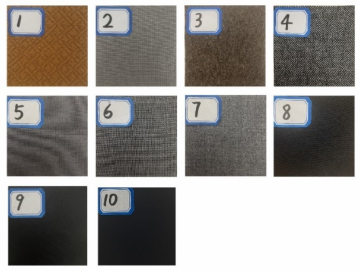
and textures and organizing, classifying, cutting, and numbering the material samples according to different textures and material categories, as shown in Figure 1. As rating indicators, we used three surface characteristics that identify the material category and texture: elasticity, softness, and rough- ness. Meanwhile, according to the participants’ own emotional needs and preferences, the material samples were subjectively rated in terms of their impressions, with three perceptual keywords, such as “aesthetically pleasing,” “comfortable,” and “favorite satisfactory, “as the rating index of the emo- tional dimension. According to the visual and visual-tactile, two perception modes under the production of our questionnaire are shown in Table 1.
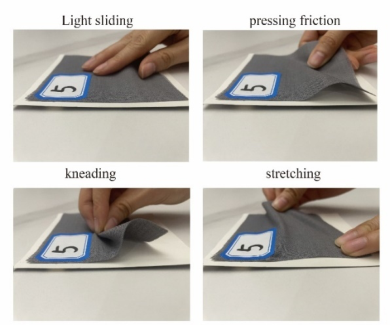
The experiment will be conducted under two conditions: Condition 1: Visual perception experiment, where participants are asked to observe the experimental material samples only through their eyes. Condition 2: In the visual-tactile perception experiment, participants can use their hands to touch the experimental material samples and observe them with their eyes, and hand movements such as pinching can be performed to recognize the sample materials according to the participant’s tactile perception habits. The specific experimental steps are as follows (see Figure 2).
Figure 1: Sample plates for perception experiments.Table 1. Questionnaire and semantic differential scale design.
Table available in the original PDF paper.
NO. Gender Age Drive Age
7-point SD Scale
7 6 5 4 3 2 1
Rough
Smooth Stiff
Soft Stretchy
Non-stretchable Cozy
Discomfort Sleek
Ugly Favorite
Nasty
Mechanism of Multidimensional Subjective Perception 39
Step 1: Arrange for the participants to experiment on a clean and tidy table and chair. Step 2: Participants were asked to truthfully fill in their personal information on paper, including age, gender, driving age, etc. This exper- iment was conducted for academic research only and would not disclose personal privacy. Step 3: Participants in the case ensuring a good physical and mental state, presented to the participant 10 items of material samples of the picture, according to the scoring index for the sample material 1–7 points. Step 4: Conduct a visual-tactile perception experiment where partici- pants were provided with physical samples of the materials and given enough time to perceive the interaction and complete the scoring task. Finally, the experimental data were collected, and all used materials and equipment were cleaned up to ensure the safety and tidiness of the practical site. In addition, Experimental personnel should to set a one-day interval between the two per- ception experiments allowed for a more accurate assessment of participants’ perceptual abilities in each experiment.
Figure 2: Experimental case demonstration procedure for perception in visual-tactile mode.
In the next step of the study, to better analyze the data affected by multi- dimensionality. We adopted Multidimensional Scaling (MDS) to downscale and visualize the multidimensional data and then used Structural Equation Modeling (SEM) to examine the interrelationship of the multifaceted influ- ences and the causal relationship between the influences and consumers’ satisfaction with car purchases.
In this study, SPSS/AMOS 18.0 software was used to integrate the dis- tance between samples into a distance matrix by using Euclidean distance calculations with subjective dimensions adjectives of emotional perception of materials: comfort, aesthetics, and fondness as a triad, and then projected onto the two-dimensional space by the MDS method to recalculate the new coordinates.
To further explore and validate the potential relationships and theoret- ical assumptions between the variables, a theoretical model is constructed to study consumers’ perceptual dimensions of fabric seating materials and
40 Siqi and Yongyan
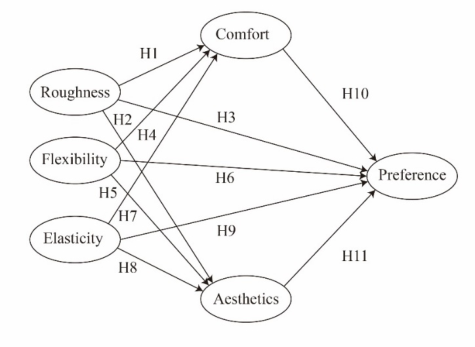
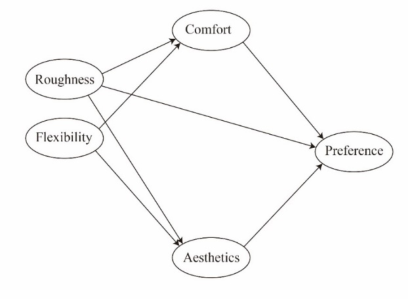
the factors influencing experience satisfaction. According to the academic studies in the previous literature review, the seat material perceived by partici- pants is affected by physical and psychological factors in multiple dimensions. The material’s surface characteristics and physical properties, such as tex- ture grain, roughness, hardness, and elasticity, affect the consumer’s visual or tactile perceptions of the material and the seat’s perceived comfort [15] . The theoretical modeling research framework shown in Fig. 3. The research hypotheses are as follows: H1: Perceived roughness will have a positive effect on the perceived comfort.
H2: Perceived roughness will have a positive effect on the perceived aesthetics.
H3: Perceived roughness will have a positive effect on the perceived preference.
H4: Perceived flexibility will have a positive effect on the perceived comfort.
H5: Perceived flexibility will have a positive effect on the perceived aesthetics.
H6: Perceived flexibility will have a positive effect on the perceived preference.
H7: Perceived elasticity will have a positive effect on the perceived comfort. H8: Perceived elasticity will have a positive effect on the perceived aesthetics.
H9: Perceived elasticity will have a positive effect on the perceived prefeernce.
H10: Perceived comfort will have a positive effect on the perceived preference.
H11: Perceived aesthetics will have a positive effect on the perceived preference.
Figure 3: A research framework for perceived dimensions of fabric seating materials and factors influencing experience satisfaction.
Mechanism of Multidimensional Subjective Perception 41
RESULT
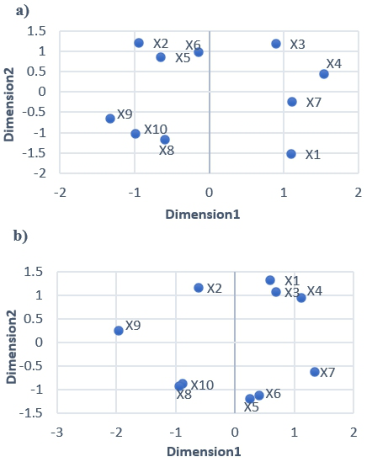
The descriptive statistics of the scores are shown in Table 2, and the average of the 30 models yielded Stress values and RSQ coefficients of determination of 0.259 and 0.548, respectively, which proved that the models had a reason- able degree of explanation. Fig. 4, shows the distribution of the perceptual space in the visual mode and visual-tactile mode.
The experimental assessment data were divided into two groups, visual perception assessment, and tactile perception assessment, and the structural equation modeling required that the data conform to a normal distribution as well as considering the correlation between the variables in the research model and the variables affecting the perceived fondness of the material. See Table 2 for a description of the statistical results, where the skewness coeffi- cient, Skewness, and the kurtosis coefficient, Kurtosis, both coefficients, are less than 1, which can be considered to approximate a normal distribution. The goodness-of-fit statistics used to describe the SEM model are shown in Table 3, and GFI, CFI, NFI, and TLI are used as assessment indicators in this paper.
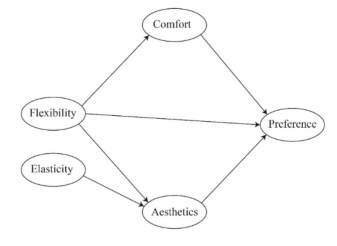
In this study, two structural equation models are proposed for the visual and tactile modes, as shown in Figure 5 and 6; the standardized path coeffi- cients are analyzed, as shown in Table 4 and 5, and significant correlations between the variables are found, and in the visual perception research model, the perceived softness has a significant positive effect on comfort, with a standardized path coefficient of r = 0.693, and the perceived softness has a significant positive effect on the aesthetics, with a Standardized path coeffi- cient r = 0.591; also perceived elasticity has a significant effect on aesthetics, but the path coefficient is negative, contrary to the hypothesis.
Figure 4: a) Perceptual spatial distribution in visual mode (stress = 0.25947, RSQ = 0.54775); b) perceptual spatial distribution in visual-tactile mode (stress = 0.25374, RSQ = 0.61656).
42 Siqi and Yongyan
Table 2. a) Descriptive statistics of assessment data in visual mode.
Among the variables influencing perceived liking, only softness, comfort, and aesthetics were significant, especially aesthetics, with a path coefficient of r = 0.697, indicating that perceived aesthetics strongly correlates with perceived liking in the visual mode. Among them, perceived softness is also related to perceived likability, and the path coefficient r = −0.2 shows a negative correlation with a relatively weak relationship. Therefore, we can summarize that H4, H5, H6, H7, H10, and H11 hold. Unfortunately, per- ceived roughness does not directly affect the subjective sensations of comfort, aesthetics, and liking in the visual mode.
Figure 5: Research modeling in the visual mode.
Mechanism of Multidimensional Subjective Perception 43
In the haptic perception research model, perceived roughness and soft- ness had significant effects on comfort, with standardized path coefficients of −0.248 and 0.585, respectively. It was found that more than the percep- tion of roughness, perception of It was found that the perception of softness influenced the subjective dimensions of comfort and aesthetics more than the perception of roughness. Perceived elasticity also had no significant effect on aesthetics. The hypothesis is not valid. In the visuo-tactile perception research model, a strong relationship exists between perceived aesthetics and perceived liking, with a standardized path coefficient of 0.816, greater than 0.8. The path coefficients between perceived softness and perceived liking are 0.266, and the path coefficients between perceived roughness and perceived liking are −0.087, which is a relatively weak relationship. However, the variable roughness plays a role in material perception compared to the visual model. The variable has a role in material perception. Therefore, we can summarize that H1, H2, H3, H4, H5, H10, and H11 hold.
Table 4. Model fit indicator data results (GFI, CFI, NFI, TLI required to be greater than 0.9).
DISCUSS From the perceptual spatial distribution in the visual mode observed that X3, X4, and X7 were in one category, and X2, X5, and X6 were in another cat- egory; the plushness of the material may be an essential perceptual factor in providing participants with emotional perceptions, which may be one of the reasons for this discrepancy. The visual presentation may stimulate partic- ipants’ imagination and association of emotions such as comfort, warmth, and closeness brought by the plush feeling. In addition, regarding the distri- bution of the second-dimensional orientation of the subjective dimensional perceptual space, one cluster consisted of samples 2, 3, 4, 5, and 6. In con- trast, the other cluster included samples 1, 7, 8, 9, and 10, and it could be found that the fabric material of the first cluster was made of thicker braided threads, thus making the surface texture appear more noticeable and based on the more apparent visual information elicited emotions from the partici- pants. Kodžoman et al. (2023) study also found that knitted texture was the most attractive visual texture, and the canvas was rated as unattractive. In the perceptual spatial distribution in the visuo-tactile mode, it is evident that sample 9 produces a significant difference from samples 8 and 10, a differ- ence that is difficult to obtain by going into the visual senses. Sample 1’s soft texture was more similar to samples 3 and 4 after touching, sample 2 caused a bumpy tactile sensation to distinguish it from samples 3 and 4, and sam- ple 7’s unique tactile sensation to distinguish it from samples 5 and 6, which were initially still more similar in the visual mode, and we can infer that those textural features, roughness, softness, and elasticity that can be sensed only by touching have a more significant impact on the participants’ affective per- ceptions. Pan-Zagorski et al. (2022) studied that participants may prefer soft seats. The material’s mechanical properties affected not only participants’ perceptions of overall comfort and firmness but also their perceptions of seat size through potential differences in contact areas.
After deriving objective and subjective perception variables that may affect perceived material likeability, the proposed theoretical model was verified through structural equation modeling and combined with previous studies.
Mechanism of Multidimensional Subjective Perception 45
It can be found that perceived aesthetics has the most significant correlation with perceived liking in the research model, i.e., the standardized path coef- ficient is 0.816. aesthetics refers to the attractiveness and coordination of the appearance of an item. Min et al. (2015) found that various embossings and textures that can create a volumetric effect and reflect light can be added to the surface of fabrics. It satisfies consumers in terms of visual and psycho- logical impact and renders a variety of interior spatial atmospheres. In this study, softness, an objective perceptual variable, directly affects perceived favoritism during visual interaction and indirectly affects favoritism through comfort and aesthetics during visuo-tactile interaction Yanqing et al. found (2019). That softness and hardness have direct and indirect effects on haptic satisfaction. Perceived slipperiness was also found to affect softness, luxury, and tactile satisfaction positively. Perceived softness also mediates elasticity, comfort, and aesthetics when touching a material surface.
CONCLUSION
The contributions of this study are as follows: (1) Plushness is an essential factor influencing the emotional perception of materials, and it can stim- ulate participants’ emotional associations through visual presentation. (2) The material’s surface characteristics and texture pattern have a more sig- nificant influence on visual perception. However, the physical quality felt by touch also plays a vital role in emotional perception.In the visual-tactile interaction, softness indirectly affects favorability through comfort and aes- thetics. After touching the material surface, roughness affects the affective variables of the material. Although the effect of roughness may be overlooked when perceived only through vision, it is more easily detected in touch. (3) Finally, understanding the influencing factors of perceived material fondness is significant. It can help us provide high-quality visual presentations through online shopping platforms, adjust contrast and lighting effects, provide mul- tiple perspectives and different distances, and work with textual descriptions and annotations, which can help consumers better perceive the material’s properties in the visual mode.
ACKNOWLEDGMENT
The authors would like to express their gratitude to their fellow students in the subject group and supervisor Guo for their advice and guidance on the thesis.
REFERENCES
Cao Zhiyong, ed. (2020). A texture tactile sensing model based on perceptual experiments. Sensors and Microsystems. Volume 40(12). pp. 10–13. Deng Chunhong. (2018). Research on Emotional Design of Electric Vehicle Interior.
Southeast University. Emanuel Sousa, ed. (2022) Tactile and visual perception of plastic textures for car interiors: Psychophysical and affective dimensions, International Journal of Industrial Ergonomics, Volume 92, 103369.
46 Siqi and Yongyan
Jihye Min and Kyungyeon Jung. (2015). Material Research for Diversifying Automotive Interior Design -Focusing on Automotive Seat Fabrics. Journal of Basic Sculpture. Volume 16(2). pp. 151–161. Kodžoman, Duje, ed. (2023). Fabric Attractiveness Using Four Sensory Evaluators.
Fibres & Textiles in Eastern Europe. Volume 31. Liang, C., ed. (2020). Investigating vehicle interior designs using models that evaluate user sensory experience and perceived value. AI EDAM. Volume 34(3). pp. 401–420. Li Jialin. (2022). Research on the design and evaluation of automotive interior
CMF based on perceptual engineering and physiological measurement technology. Guangdong University of Technology. Naddeo, A, ed. (2020). New Trend Line of Research About Comfort Evaluation: Proposal of a Framework for Weighing and Evaluating Contributes Coming From Cognitive, Postural And Physiologic Comfort Perceptions. In: Advances in Social and Organizational Factors. AHFE (2020) International Conference, Peter Vink (eds). volume 9. Pan-Zagorski, ed. (2022). Automotive Seat Comfort and Vibration Performance
Evaluation in Dynamic Settings. Appl. Sci. Volume 12, p. 4033. Sahli R, ed. (2020). Tactile perception of randomly rough surfaces. Sci. Rep. 10 (1), p. 15800. Wonjoon Kim. (2021). A study on the subjective feeling affecting tactile satisfaction
of leather in automobile: A structural equation modeling approach, International Journal of Industrial Ergonomics, Volume 84, 103167. Yong X, ed. (2022). Methodology selecting packaging materials combined multisensory experience and fuzzy three-stage network DEA model. Packaging Tech- nology and Science, 36(2). Yin Yanqing. (2019). Research on automotive interior brand tonality based on
multimodal perception. Hunan University. Zuo H, Jones M and Hope T. (2004) A Matrix of Material Representation, Proceedings of the International Conference ‘Futureground’, Melbourne.
LISTED IN THE AHFE DIGITAL BOOKSTORE CATALOGUE
Explore the complete digital volume
Kansei Engineering
Read this individual research paper free through the original publisher, or explore the full digital proceedings book.
ISBN 978-1-964867-21-2
Explore this ISBN in the AHFE Bookstore ↗Listed in the July 2026 bookstore catalogue; search by ISBN to confirm current availability · Digital book purchase optional