Dehe Yao, Ruan Xiaoxue Bai (2026). Toward Pigment-Free Leather: A Structural Color Design Framework Based on Photonic Crystal Principles. In: Intelligent Human Systems Integration (IHSI 2026): Disruptive and Innovative Technologies. AHFE Open Access, vol. 200, pp. 501–511. https://doi.org/10.54941/ahfe1007109
The large scale use of synthetic dyes in leather finishing raises growing environmental concerns and constrains long term colour stability. This conceptual study explores pigment free structural colour for leather based on photonic crystal principles and natural examples of structural colour. By transferring these optical mechanisms to fibrous leather substrates, we propose a multilayer L0–L4 surface architecture and a set of integration routes that embed periodic or quasi ordered nanostructures onto prepared grain. The framework links optical design parameters (feature size, refractive index contrast and angular response) with human factors requirements such as visual naturalness, glare acceptability and perceived premium feel. Rather than reporting experiments, the paper offers a design first roadmap and evidence seeking strategy for developing structural colour leather as a more sustainable complement to dye based colouration.
The leather industry delivers a durable and versatile natural material, but its colouration chain is under increasing environmental scrutiny. Drum dyeing and finishing rely heavily on synthetic organic dyes and auxiliaries, generat ing large volumes of wastewater that may contain heavy metals, aromatic amines and other persistent pollutants, particularly in regions with limited effluent treatment (Al-Tohamy et al., 2022, Bhardwaj et al., 2023). At the same time, heavily pigmented or thickly coated finishes can erode the visual identity of leather by reducing grain clarity and producing a plastic-like feel.
Current responses include a shift to natural dyes and upgraded wastewa ter treatment, as well as “smart” leathers that integrate thermochromic or cholesteric liquid-crystal coatings to produce dynamic colour change (Alexe et al., 2025). Mechanoluminescent fibres and other responsive systems further extend the expressive range of leather and leather-like (Xuan et al., 2021). However, these approaches largely add functionality on top of conventional dye-based routes and do not address the root problem of pigment-driven effluent or its associated lifetime risks.
502 Yao and Bai In contrast, many biological surfaces achieve vivid, fade-resistant colours without pigments. Peacock feathers, butterfly wings and beetle shells generate hue through the interaction of light with ordered micro- and nanostructures that create photonic band gaps and selective reflection (Xuan et al., 2021). Artificial photonic crystals replicate these periodic dielectric structures: by tuning lattice spacing, effective refractive index and angle of incidence, designers can control hue, chroma and angle-dependent effects without add ing chromophores (Xuan et al., 2021).
Although photonic-crystal structural colours have been demonstrated in textiles and optical devices, their application on rough, porous and non- planar leather surfaces remains limited (Ma et al., 2022, Wang et al., 2021). Existing studies often optimise optical performance on ideal substrates and rarely connect nanoscale design choices to human perception, usage context or manufacturing constraints (Ma et al., 2022, Wang et al., 2021). To address this gap, we reframe pigment-free structural-colour leather as a human sys tems integration problem rather than a purely materials challenge. We inte grate insights from photonic-crystal optics, leather finishing and sustainable manufacturing into a multilayer L0–L4 surface architecture and a concise set of integration routes tailored to fibrous substrates. Building on this architec ture, we outline representative use scenarios and propose evaluation metrics that couple CIE-based colour measurements with human-factors indicators such as delight, naturalness, glare acceptability and perceived premium feel. The result is a design-first conceptual framework and evidence roadmap for the development and industrial adoption of pigment-free structural-colour leather.
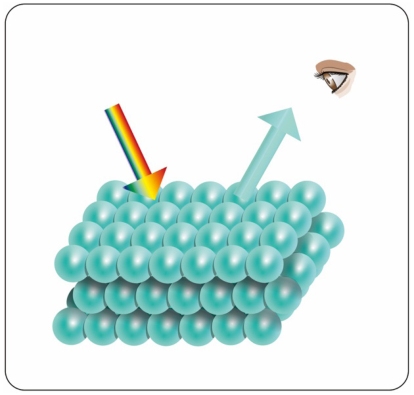
Figure 1: Working principle of structural colouration based on photonic crystals. (Authors’ illustration based on (Islam et al., 2025)).
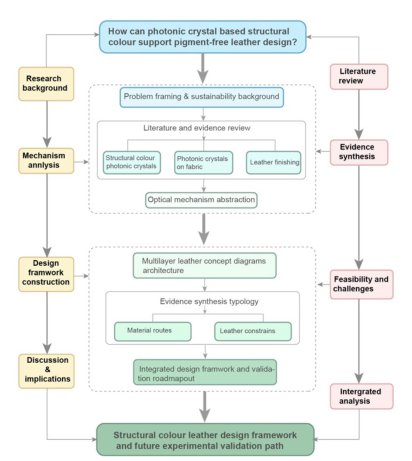
RESEARCH METHODOLOGY This study employs a conceptual research-through-design (RTD) approach to develop a structured framework for applying photonic-crystal structural colour to leather without building physical prototypes. The methodology consisted of three integrated stages.
First, a targeted literature synthesis was conducted. We reviewed research on photonic-crystal physics, structural-colour mechanisms, and leather sur face properties, contrasting these with conventional drum dyeing, aniline and pigmented finishes, and emerging smart leathers. This synthesis defined the problem space, highlighted key design levers such as feature size and refrac tive-index contrast, and identified constraints related to flexibility, grain preservation and process water use.
Secondly, we developed a conceptual L0-L4 surface structure and its asso ciated integration pathways through iterative modeling. This framework translates theoretical optical principles into multilayered stacked structures applicable to fibrous nonplanar substrates and visualizes where designers can control hue, chromaticity, angular response, and tactile feel. We also con sidered potential manufacturing pathways at the schematic level, including self-assembly, transfer lamination, and disordered “photonic glass” coatings.
Finally, we critically evaluated the framework from a human-machine sys tems perspective(2003). We mapped potential application scenarios, identi fied potential advantages in perceived quality and sustainability, and artic ulated key challenges such as durability, uniformity, and scalability. Based on this analysis, we developed a phased validation path, from benchtop col orimetry and durability testing to perception studies and small-scale field pilots. These steps collectively construct a design-led and testable framework for pigment-free structural color leather.
Figure 2: Research methodology and technical roadmap.
OPTICAL AND DESIGN PRINCIPLES Photonic-Crystal Structural Colour
Structural colour arises when micro and nanostructures modulate the prop agation of light rather than absorbing it. In photonic crystals, materials with different refractive indices are arranged in a periodic lattice. This peri odicity creates a photonic band gap that blocks specific wavelength bands and reflects them toward the viewer. The reflected wavelength, and thus the perceived hue, depends primarily on lattice spacing, the effective refractive index and the viewing geometry (Xuan et al., 2021; Zhang and Xue, 2025). Adjusting these parameters allows designers to tune hue and chroma, and to choose between pronounced angle-dependent “colour travel” and more muted, angle-stable appearance.
For flexible substrates such as leather, the structural-colour layer must accommodate bending and surface curvature while maintaining its opti cal periodicity. Thin, elastomer-supported photonic-crystal films or quasi- ordered “photonic-glass” structures are therefore of particular interest, as they can balance colour purity with mechanical robustness (Zhang and Xue; 2025, Ma et al., 2022; Wang et al., 2021).
Comparison With Conventional Leather Colouration Conventional leather colouration uses a combination of wet-end drum dyeing, aniline or semi-aniline finishes, pigmented coatings and, more recently, smart-ef fect layers. Wet-end dyeing and transparent finishes preserve grain depth and yield a soft hand, but are water-intensive and generate dye-containing effluent. Pigmented finishes increase uniformity and protection but can obscure texture and move the appearance toward that of coated synthetics. Smart coatings such as thermochromic or cholesteric layers add dynamic behaviour yet are typically stacked on top of dyed substrates and therefore inherit their environmental burden (Al-Tohamy et al., 2022; Bhardwaj et al., 2023; Alexe et al., 2025).
Table 1: Comparative summary of leather colouring processes, methods and design-relevant limitations (source: authors).
Table available in the original PDF paper.
Design Relevant Limitations
Method Visual & Haptic Process & Sustainability Wet-end drum dyeing Translucent depth; grain fully visible; natural hand Water intensive; dye effluent management needed
Colour depends on wet-end chemistry; limited angle control
Water-borne binders common
Aniline finish Transparent to semi-opaque; soft feel
Lower protection (aniline) or more coated look (semi-aniline)
Pigmented finish
Opaque, uniform; hides defects
High abrasion/stain resistance
Reduced grain-like clarity; risk of plastic-like feel
Dynamic colour; showpiece value
Usually stacked on dyed base; not addressing effluent
Smart effects (thermo/ cholesteric)
Increased complexity; depends on energy triggering Potential dry low-liquor routes
Uniformity on rough grain; durability; cost and scale
Photonic crystal structural colour
Pigment-free hues; tunable angle response
Table 1 summarises these routes in terms of visual and haptic outcomes, process and sustainability aspects, and design-relevant limitations, alongside a photonic-crystal structural-colour route. In this comparison, structural colour offers a path to pigment-free hues and potentially lower-liquor pro cesses, but raises new design challenges in achieving metre-scale uniformity on rough grain, ensuring long-term durability and controlling cost.
APPLICATION TO LEATHER SURFACE DESIGN Building on the optical parameters above, we define a four-to-five-layer stack (L0–L4) that lets designers control visible behaviours—hue, chroma, angle response, and feel while respecting leather’s tactile identity. Leather is porous, fibrous and non-planar; the design problem is not to perfect a lab-flat photonic crystal but to integrate a thin, behaviour-oriented layer that respects grain, hand and use. We translate constraints into three integration patterns:
1. Direct structural-colour coating on a levelled grain. Applications: small goods, fashion accents; controlled iridescence desired. Notes: add a thin levelling layer to reduce microroughness, then form the. structural layer in place; keep the topcoat lean to preserve chroma. 2. Transfer-laminated film. Applications: brand colours on large panels; ΔE uniformity is critical. Notes: pre-make and Quality Control (QC) the structural layer off-line, then laminate to leather; best for retail/furniture panels. 3. Disordered photonic glass coating. Applications: Angle-stable matte finish for automotive and interior use. Notes: Sacrificing some chroma for comfort and a non-distracting appearance.
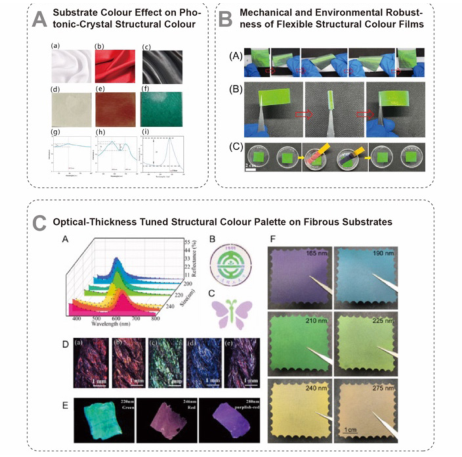
Figure 3: Representative evidence for photonic-crystal structural colour on flexible fibrous substrates. (Source: authors, synthesized from prior studies on photonic-crystal coatings on flexible fibers and fabrics (Ma et al., 2022, Wang et al., 2021, Li et al., 2023).)
Figure 3 shows how substrate tint, mechanical/environmental stress, and optical thickness shape structural colour on fibrous leather. In A, placing the same photonic-crystal film on different substrates changes the perceived saturation and brightness far more than the hue: light/neutral grounds yield cleaner, higher-contrast reflections, whereas dyed or dark grounds mute the band and can make the colour read dull or dirty. This indicates that a con trolled, near-neutral levelling layer is essential when uniformity is required. In B, peel, bending and wet-handling images suggest good film integrity on flexible supports: the colour patch remains continuous at high curvature and after contact with water, with no obvious edge cracking or lift-off, implying that a lean elastomeric topcoat and partial infiltration can protect appearance without plasticising the surface. In C, both spectra and swatches confirm a monotonic red-shift with increasing optical thickness/particle size, enabling a practical palette: the labelled samples map to blues-greens-golds on the same fibrous base. Taken together, the images support a design rule: tune colour by thickness, stabilise look by substrate neutralisation, and validate robustness by simple bend/peel/wet screens before moving to larger panels and scenar io-specific trials.
APPLICATION OF PHOTONIC-CRYSTAL STRUCTURAL COLOUR IN LEATHER SURFACE DESIGN Multilayer L0–L4 surface architecture
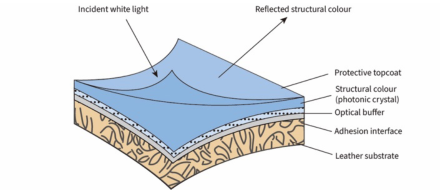
Building on these principles, we specify a four to five-layer stack (L0–L4) that balances visible behaviour, touch and feasibility on leather.
L0: Leather substrate: full or corrected-grain, selected according to the prod uct. line and defect tolerance. L1: Levelling and adhesion layer: an ultra-thin coating that reduces
micro-valleys and provides a controlled, near-neutral ground without erasing grain. L2: Wetting and flow-control layer: a micro-layer that ensures even self-assembly or film lay-down while remaining surfactant-lean to avoid orange-peel and excessive darkening. L3: Structural-colour layer: the optical core, implemented either as ordered
photonic crystals for high-chroma accents with visible travel or as qua si-ordered photonic glass for matte, angle-stable large fields. L4: Elastomeric topcoat: a thin protective layer tuned to maintain colour contrast while providing abrasion and cleaning resistance.
Designers first select the scenario, then specify L2–L4 thickness and chem istry to achieve the desired hue, angular response and feel, keeping the over all added build as thin as possible to preserve the leather hand.
Figure 4: Multilayer surface architecture for structural-colour leather and where designers can tune hue, chroma, and angle response.
Integration Routes for Different Product Types Three integration routes translate this stack into practice:
1. Direct structural-colour coating on levelled grain For small leather goods and fashion accents, a thin levelling layer on the grain is followed by in-place formation of an ordered photonic-crystal layer and a lean topcoat. Controlled angle-dependent travel is treated as an intentional design feature. 2. Transfer-laminated structural-colour film For large brand panels in retail or furniture applications, the structur al-colour layer is built and quality-controlled off-line, then laminated to prepared leather. This route prioritises tight ΔE00 uniformity and seam management at metre scale. 3. Disordered photonic-glass coatings For automotive and mobility interiors, a dispersion of narrowly sized par ticles in a clear matrix is applied to produce matte, low-glare, angle-sta ble colour. Some chroma is traded for visual calm and driving safety.
Evidence from flexible photonic-crystal films and colour-tunable coatings on polymer and textile substrates suggests that such routes are technically plau sible if mechanical and environmental stresses are properly managed.
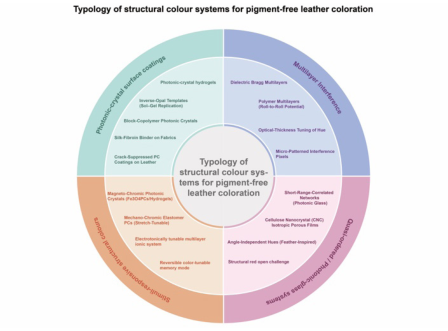
Figure 5: Evidence-based typology of structuralcolour systems for pigment-free leather.
508 Yao and Bai Four implementation routes are mapped: photonic-crystal surface coat ings, multilayer interference, quasi-ordered low-iridescence structures, and stimuli-responsive systems (Xuan et al., 2021; Zhang and Xue, 2025).
Scenarios and Evaluation Framework To link the framework to use contexts, we define four representative scenarios:
1. Fashion accents and small leather goods: hand-held or arm’s-length viewing under retail LEDs and daylight, with frequent touch. Ordered photonic crystals on levelled grain are used to create high-chroma, expressive accents, evaluated by ΔE00 before/after short use cycles and 7-point ratings for delight, naturalness and perceived premium feel. 2. Automotive and mobility interiors: surfaces in the driver and passenger field of view, cleaned with alcohol-based agents. Disordered photon ic-glass coatings target low glare and colour constancy across curva ture, assessed through angle-resolved reflectance and glare acceptability ratings. 3. Brand-colour large panels (retail/furniture): metre-scale panels viewed at 1–3 m under mixed lighting. Transfer-laminated films must match a brand master within a specified ΔE00 and minimise panel-to-panel varia tion and seam visibility. 4. Security and anti-counterfeit accents: small logos or badges inspected by quick tilt-check. Local modulation of feature size or orientation within L3 provides recognisable signatures without noticeable differences in hand relative to the surrounding leather.
Across all scenarios, common anchors include CIE colourimetry (illuminant D65), angle scans, short durability screens (rub/flex/clean) and compact per ception batteries for naturalness, glare and premium feel.
CHALLENGES AND LIMITATIONS Visual Perception and Adoption
Angle-dependent colour shift can be perceived as “coating-like” and reduce the apparent naturalness of leather. Strong iridescence in large fields may distract users, especially near displays or in the driver’s field of view. To mit igate these risks, we reserve ordered photonic crystals for small accent areas, keep levelling layers as thin as possible to preserve grain, and favour quasi- ordered photonic-glass structures for large panels. Early A/B perception tests under daylight and retail lighting can quantify acceptable travel and glare: ΔE00 ≤ 2.0 and gloss change ≤ 5 GU after short use-cycle (rub/flex/clean).
Durability, Uniformity and Scale-Up Bending, rubbing, temperature swings and cleaning agents can alter the microstructure, leading to colour drift or gloss changes. Metre-scale ΔE00 uni formity on rough grain is also challenging. We therefore emphasise flexible
Toward Pigment-Free Leather: A Structural Colour Design Framework 509 topcoats, partial infiltration of L3 to stabilise the lattice, and graded intro duction of scale: from bench coupons to A4 panels, then to pilot-line transfer films with in-line reflectance and angle scans for quality control.
Sustainability and Communication Pigment-free structural colour is not impact-free: additional coating layers add material and energy inputs. A directional life-cycle inventory is needed to compare water, chemical and energy savings against the added steps and materials, and to identify cases where structural colour is truly beneficial. Clear communication is also required to avoid implying medical or IoT func tions and to provide realistic care-and-cleaning guidance.
DISCUSSION
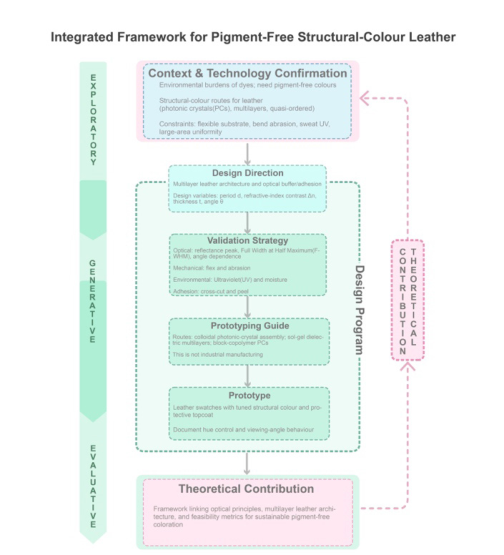
Figure 6 summarises the integrated framework, linking technology confirma tion, design direction, validation strategy and production workflow. From a design perspective, the L0–L4 architecture and three integration routes locate the main control points over hue, chroma, angle response and feel while protecting leather’s grain and hand. Scenario-specific routes highlight where ordered versus disordered structures are appropriate and how much colour travel is acceptable.
Figure 6: Schematic Integrated framework for pigment-free structural-colour leather.
510 Yao and Bai The validation strategy follows a bench–perception–pilot sequence. On bench coupons we measure CIE colourimetry and angle-resolved reflectance, run short durability screens and set simple ΔE00 and gloss gates. Perception sessions then compare delight, naturalness and glare acceptability across sce narios under realistic lighting. Finally, small in-context pilots—such as a seat trim, retail handle or brand panel—test comfort, cleaning tolerance and the practicality of quality-control hooks in real environments.
Although no factory runs are undertaken here, the framework out lines pilot-ready production routes. Direct coatings, transfer films and photonic-glass sprays can, in principle, be implemented with adapted exist ing coating and lamination equipment. Quality control focuses on colour at specification angles, uniformity within and between panels, and post-use drift, with care-and-cleaning scripts agreed early with brand stakeholders.
CONCLUSION
This paper reframes pigment-free structural colour for leather as a design- first, human-systems integration problem. We contribute a multilayer L0–L4 surface architecture that preserves leather’s grain and hand while locating designer control over hue, chroma and angular behaviour; a route library linking direct coatings, transfer-laminated films and disordered photonic-glass coatings to specific application scenarios; and a compact evaluation map that couples perception measures with optical and durability metrics. Read together, these elements define initial evidence gates and quality-control hooks that can de-risk subsequent pilots.
As a conceptual RTD study, the work is limited by the absence of material prototypes and experimental data. Next steps include mixed-methods verifi cation on bench coupons and A4 panels, tracking ΔE00 and glare acceptabil ity across angles, haptic naturalness under touch, and a directional sustain ability assessment comparing avoided dye liquor against added coating mass. Nonetheless, the framework provides a practical starting point for designers, engineers and manufacturers who wish to explore pigment-free, structurally coloured leather as a more sustainable complement to traditional dye-based colouration.
REFERENCES
<6ThedevelopmentoftheCIE2000colour-differenceformulaCIEDE2000_CRA_26_ 340_350_2001.pdf>. <Frayling.pdf>. <Making-Leather-Overview-Part-5.pdf>. <TAN_Published_def.pdf>. 2003. Front matter. Handbook of Human Systems Integration. Al-Tohamy, R., Ali, S. S., Li, F., Okasha, K. M., Mahmoud, Y. A. G., Elsamahy,
T., Jiao, H., Fu, Y. & Sun, J. 2022. A critical review on the treatment of dye- containing wastewater: Ecotoxicological and health concerns of textile dyes and possible remediation approaches for environmental safety. Ecotoxicology and Environmental Safety, 231, 113160.
Toward Pigment-Free Leather: A Structural Colour Design Framework 511 Alexe, C.-A., Gaidau, C., Stanculescu, I. R., Burducea, C. & Cîrcu, V. 2025. Smart
Leather Using Thermoresponsive Cholesteric Liquid Crystals in Surface Finishing. Journal of Natural Fibers, 22. Bhardwaj, A., Kumar, S. & Singh, D. 2023. Tannery effluent treatment and its environmental impact: a review of current practices and emerging technologies. Water Quality Research Journal, 58, 128–152. Islam, M. M., Aidid, A. R., Mohshin, J. N., Mondal, H., Ganguli, S. & Chakraborty,
A. K. 2025. A critical review on textile dye-containing wastewater: Ecotoxicity, health risks, and remediation strategies for environmental safety. Cleaner Chemical Engineering, 11. Li, S., Jia, L., Wang, L., Li, P. & Fan, X. 2023. Preparation of robust fully encapsulated structural color fabrics and their application to display. Dyes and Pigments, 212, 111150. Ma, W., Liu, H., He, W., Zhang, Y., Li, Y., Zhao, Y., Li, C., Zhou, L., Shao, J. & Liu,
G. 2022. Preparation of Acrylic Yarns with Durable Structural Colors Based on Stable Photonic Crystals. ACS Omega, 7, 39750–39759. Wang, X., Li, Y., Zhao, Q., Liu, G., Chai, L., Zhou, L., Fan, Q. & Shao, J.
2021. High Structural Stability of Photonic Crystals on Textile Substrates, Prepared via a Surface-Supported Curing Strategy. ACS Appl Mater Interfaces, 13, 19221–19229. Xuan, Z., Li, J., Liu, Q., Yi, F., Wang, S. & Lu, W. 2021. Artificial Structural Colors and Applications. Innovation (Camb), 2, 100081. Zhang, M. & Xue, R. 2025. Advances in structural color display of flexible materials
and their emerging applications. Nano Research, 18, 94907329.
LISTED IN THE AHFE DIGITAL BOOKSTORE CATALOGUE
Explore the complete digital volume
Intelligent Human Systems Integration (IHSI 2026): Disruptive and Innovative Technologies
Read this individual research paper free through the original publisher, or explore the full digital proceedings book.
ISBN 978-1-964867-76-2
Explore this ISBN in the AHFE Bookstore ↗Listed in the July 2026 bookstore catalogue; search by ISBN to confirm current availability · Digital book purchase optional