Amic G. Ho, P. W. Chau (2026). Designing with the Senses: Emotional Connections for Sustainable Consumption. In: Usability and User Experience. AHFE Open Access, vol. 232, pp. 9–21. https://doi.org/10.54941/ahfe1008031
The two major obstacles facing contemporary society include unsustainable consumption behaviours and a mismatch between consumer values and their actions relative to environmental concerns. Designers have the potential to bridge this gap using sensory design, with its focus on product sensory characteristics, which influence the decisions consumers make. This research aims to examine how different sensory attributes (such as colour, texture, etc.) can encourage consumers to adopt more sustainable behaviours, and therefore help to address the under-explored role of such attributes in determining consumption patterns. The research outlines three objectives: develop a model integrating sensory design with behavioural insights, evaluate the impact of material attributes on perceptions of environmental value, and study user interactions with sustainable materials. The anticipated outcome is a framework that empowers designers to leverage sensory qualities to enhance the emotional connection to sustainable products, ultimately fostering more sustainable consumption cultures.
In addition to unsustainable consumption behaviour, many societies are also struggling to connect their environmental values to those values. While increasing awareness of environmental issues (Hur & Sovacool, 2022) among consumers has resulted in an apparent disconnect between what consumers say (their values) and what they do (their consumption), designers play an important role in this connection process; design creates both physical artefacts and is a carrier of meaning and identity. A recent wave of breakthroughs in Behavioural science has identified how sensory properties of a product (colour, Received March 6, 2026; Revised April 1, 2026; Accepted April 19, 2026; Available online July 20, 2026
10 Ho and Chau texture) can influence a person’s decision-making (Ho & Chau, 2016), and thus potentially encourage more sustainable behaviours. While there are many examples of how design has influenced sustainable consumption behaviours using function and information, the sensory aspect of design is far less explored. This research is designed to help close this knowledge gap by combining the fields of sensory design (Trang, 2026), Behavioural science, and sustainability communications and exploring how the attributes of materials can be used to encourage sustainable behaviours (Karana, Pedgley & Rognoli, 2015).
One of the major concerns with the growing awareness of environmental issues and the subsequent ‘attitude-behaviour gap’ is that while many consumers claim to care about the environment and indicate this in surveys or focus groups, their purchasing decisions do not reflect this concern. Many previous eco-labelling initiatives were unable to overcome this challenge because they required consumers to actively engage in decision-making, whereas this research proposes that by incorporating sensory experiences (Cavallo, Vecchio & Del Giudice, 2024) into consumption, design may provide a means to reduce this attitude-behaviour gap. Currently available sustainable design frameworks frequently ignore the psychological factors involved in determining user experience, and therefore, this research aims to identify how the sensory aspects of materials (the way materials look, feel, etc.) can create an intuitive understanding of sustainability (Lofthouse & Prendeville, 2024) and compete with other products that appear more aesthetically pleasing.
The primary goals of this research are to develop a conceptual model that combines the principles of sensory design with Behavioural insights to facilitate sustainable consumption and to investigate how visual and tactile attributes (Bennett & Harper, 2025) of materials affect the perception of environmental value, to apply theoretical models of cognition to examine how engagement with sensory stimuli affects decision-making (Ho, 2014), and to perform studies of user interactions with sustainable materials. Ultimately, it is expected that the resulting framework enables designers to use sensory properties of materials to effectively convey sustainability, creating a greater emotional and experiential connection (Ho & Siu, 2012) for users to sustainable products and contributing to the development of more restorative consumption cultures.
THEORETICAL FRAMEWORK Sensory Design
Sensory Design refers to the intentional manipulation of the visual and tactile aspects (i.e., colour, texture, reflectivity, etc.) of a product to create a desired experience or meaning. This concept views Material Perception as a mediator of both a product’s physical characteristics and the user’s environmental interpretation of the product. Therefore, what is perceived visually and tactually is one of the primary channels through which ‘natural,’ ‘waste’ or ‘care’ concepts are defined and communicated. Thus, Sensory Design is not a secondary aesthetic aspect; it is a primary vehicle of communication, miscommunication, and/or avoidance of Sustainability at the point of purchase/decision.
Designing With the Senses: Emotional Connections for Sustainable Consumption 11 Behavioural Insights
The COM-B Model of Behavioural Change (Żemigala, 2025) provides the behavioural insight component of the study. The COM-B Model is based upon the principle that behaviour is the result of interaction among Capability, Opportunity, and Motivation. In the context of Sustainable Consumption, Sensory Cues represent part of the Opportunity Structure to make certain aspects of environmental quality more salient and accessible within the context of everyday consumer choices (Gunawardena & Perera, 2024). Sensory Cues can also enhance Psychological Capability to allow consumers to recognise and distinguish between Sustainable Options without reliance on Abstract Information. Sensory Attributes provide the Motivational Trigger that elicits Affective Responses such as Comfort, Authenticity, Perceived Prestige, etc. that can either support or diminish Pro-Environmental Intentions.
Embodied Cognition A further theoretical strand of the framework is embodied cognition, which states that cognition is based on sensorimotor engagement with materials and environments rather than being abstract or symbolic. From this perspective, sensory engagement (Fenko, Brancatisano & Pohlmeyer, 2024) and bodily experience provide critical pathways to implicit environmental meaning and attachment. For example, how a material resists touch, reflects light, or sits in one’s hand can serve as a basis for ideas of durability, care, and responsibility. Finally, the framework incorporates the theoretical foundations of affective forecasting in sustainable consumption, which investigates how anticipated emotions (particularly pride and guilt) guide green purchasing decisions. Sensory cues can facilitate affective forecasts by making the implications of a choice for the ‘future self’ more vivid, thus linking encounters with materials to anticipated moral emotions and subsequently to Behavioural outcomes (Bissing-Olson, Fielding & Iyer, 2017).
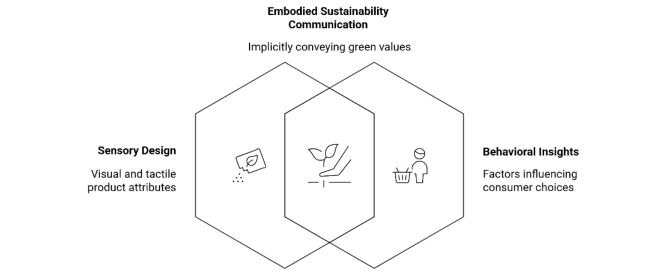
Figure 1: The synergy of sensory design and behavioural insights in sustainable consumption.
RESEARCH METHODS The investigation uses a combination of controlled material studies and user trials, combined with qualitative inquiry, to assess how characteristics of materials that are sensed create perceptions of value and desirability of environmental sustainability. The study’s methodology is based on the assumption that physical material qualities (e.g., colour, texture, reflectance and composition) do not simply convey functional information; they also serve as pre-cognitive cues that form users’ interpretations of sustainability, quality and emotional connection to a product. Through an experiment-based manipulation of sensory aspects of the materials, along with the in-depth assessment of participants’ experiences with the materials, the methodology is designed to demonstrate both empirically quantifiable patterns of judgments and the complex, embodied meanings that lie beneath them.
Experimental Setup Experimental Design The overall research design was divided into two sequential stages, which targeted to differing aspects of participants’ engagement with the material stimuli used as part of this study. Structured Material Evaluation (Phase 1): Participants individually viewed six different categories of the same six categories of material stimuli within controlled laboratory-like settings. Stimuli were selected from a systematically designed pool of stimuli that represented both sustainable and conventional materials; these are common in everyday products, with variations on the following sensory characteristics:
Colour of surface finish: muted/natural tones or bright/saturated and glossy finishes
Texture: fibre/rough textures or polished/smooth finishes
Finish: dull/shiny
Composition of material: composite made of recycled materials or virgin plastic To minimise the influence of the brand and the formal aesthetics of the materials, the materials were displayed in standardised, anonymous formats (i.e., uniform tiles or simplified product prototypes), allowing participants to focus primarily on the sensory characteristics of the materials rather than product category cues. The initial stimulus set was iteratively improved during pilot trials to confirm that all variations in the materials were perceptually distinguishable and could plausibly occur within commercially viable design contexts.
Participants evaluated each of the structural components from which their prototype consisted by completing a series of seven-point Likert scale rating tasks (environmental friendliness/quality/aesthetics/durability/desire for daily use/pride/guilt). The order in which the participants rated the different materials was randomly assigned to eliminate the effect of serial position.
Free Manipulation and Experiential Data Collection: In addition to collecting the above data, in the second phase of the study, participants were given free access to some of their preferred materials; they could use them
Designing With the Senses: Emotional Connections for Sustainable Consumption 13 in whatever way they wished and they articulated their thoughts as they went along through verbal reports (think aloud) and writing down what came into their minds. Participants’ views on how the materials felt, what they communicated regarding the environment, and how they envisioned themselves using/being associated with these materials for extended periods of time were explored during this phase.
Participants Participants were recruited from adult consumers who indicated that they have some degree of concern for environmental issues, consistent with the study’s focus on the attitudinal-Behavioural gap in sustainable consumption. Participant recruitment was stratified according to age, gender and reported environmental commitment to enable an understanding of how sensory cues operate in varying motivational contexts, rather than only among highly motivated ‘green’ consumers. Baseline screening questionnaires were administered to collect information regarding participants’ environmental attitudes, their usual purchasing behaviour and familiarity with sustainable products to enable later analysis of how participants’ pre-existing attitudes and behaviours interact with their sensory responses to the materials. Data collection occured in laboratory-like environments in which each participant engaged with the material stimuli independently. Participants initially completed structured evaluation tasks assessing each material sample’s perceived environmental friendliness, overall quality, aesthetic appeal, expected durability and desired use in daily life products. The evaluations were completed using Likert scales to enable the statistical comparison of the evaluations across material conditions. To control for any potential ordering effects due to the sequence of the material presentations, the presentation order of the materials was randomised.
In a second stage, participants were permitted to manipulate a subset of selected materials in any manner they desired and to describe their spontaneous thoughts and feelings regarding the materials using think-aloud protocols and short written associations. The primary focus was on how the materials feel, what they appear to communicate about the environment and how participants envision using or living with the materials over time.
PARTICIPANTS Across all thirty participants, materials made from recycled and bio-based materials that had matte finishes and slight texture were most commonly labelled as ‘natural’, ‘honest’ and ‘eco-friendly’ by the participants, and were generally associated with longer than average product life spans. Most of the participants described the materials as having a ‘solid’ or ‘dependable’ feel; additionally, many participants expressed a sense of pride in choosing these types of materials in a real purchasing situation. On the other hand, smooth and highly shiny virgin materials were generally associated with an image of being ‘high-end’ or ‘fashionable,’ but at the same time, the majority of participants stated that they believed these products were ‘less eco-friendly’
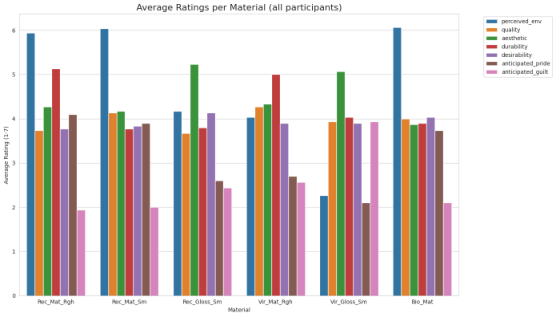
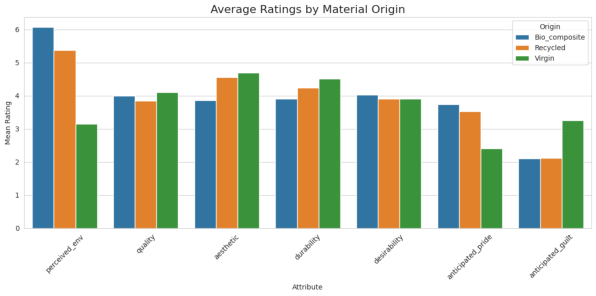
14 Ho and Chau or ‘wasteful’; a small number of participants even mentioned anticipating feeling somewhat guilty about buying them although they appeared visually pleasing. While a few participants characterised the rougher recycled materials as ‘unfinished’ or ‘low-end,’ this illustrates that, like the aesthetic, sensory cues may be interpreted by some consumers as indicating low-quality, especially when the imperfections are significant. The data presented here support the above-mentioned qualitative trends in the data set, in which recycled and bio-composite samples appear to have a greater perceived environmental benefit and anticipated pride than glossy virgin materials, and glossy virgin materials exhibit higher aesthetic ratings but also higher anticipated feelings of guilt for a subset of the participants.
RESEARCH DESIGN COM-B Mapping
Using the COM-B Model of Behaviour Change as a conceptual framework to study the role of sensory elements in enhancing sustainability related decisions making, this research examined whether sensory features increase people’s ability to recognize environmental indicators (psychological capability), make sustainable choices easier (opportunity), and create motivation for sustainable choice through the creation of positive associations. The researchers also studied how sensory-affective experiences influence participants’ affective forecasting about the emotions they expect will occur after selecting a product (satisfaction or guilt).
Statistical Methods Used to Analyse Quantitative Data To analyse quantitative data gathered using Likert scale ratings, the researcher used a two-step process. Step 1 involved conducting an ANOVA test to determine if there are differences in environmental-friendliness, quality, attractiveness, durability, desirability, anticipated pride, and anticipated guilt between different combinations of materials. This step identified which combination(s) of materials resulted in statistically significant differences in participant ratings. Step 2 involved using a multiple-regression model to calculate the degree to which individual sensory attributes (surface colour, texture, and reflectivity) contribute to sustainability based upon participant ratings. Additionally, interaction-terms between sensory attributes (i.e., matte finish x recycled content) were added to the model to assess possible synergy when evaluating the relationship between sustainability and sensory- based inferences. Before collecting all of the data required for this project, pilot-testing was completed to evaluate the reliability of survey instruments. Triangulating quantitative results with qualitative results was performed to further establish the validity of conclusions.
Thematic Coding for Qualitative Data Data from the Think-Aloud Protocols and Written Associations were analysed using a structured thematic coding method. Transcripts and written comments were initially reviewed separately, then coded using open-coding.
Designing With the Senses: Emotional Connections for Sustainable Consumption 15 Next, codes were sorted into themes that described the most common sensory (e.g., ‘naturally feeling,’ ‘looks high-quality’) and emotional (e.g., ‘pride,’ ‘guilty,’ ‘genuine’) responses and behavioural intentions (e.g., ‘likely to buy’, ‘perceived value’). Finally, higher-level themes were connected to the three COM-B components -- Capability, Opportunity, and Motivation (Folds et al. 2008), providing an empirical basis for understanding how sensory aspects of products can encourage behaviour consistent with sustainability values. All coding procedures followed established standards for rigor, including reviewing coding for consistency and selecting representative quotes to support each theme in the findings.
Ethically, the researcher has taken measures to ensure participant anonymity and has aligned the study design to meet the goal of sustainable consumption. As a result of this alignment, the design of the study is intended to promote design practices that support conscious consumption versus contributing to increased overall consumption.
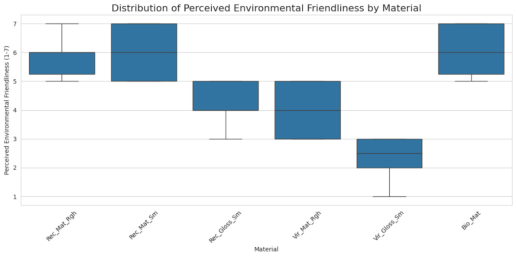
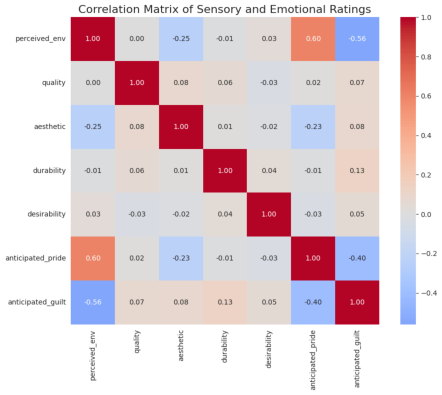
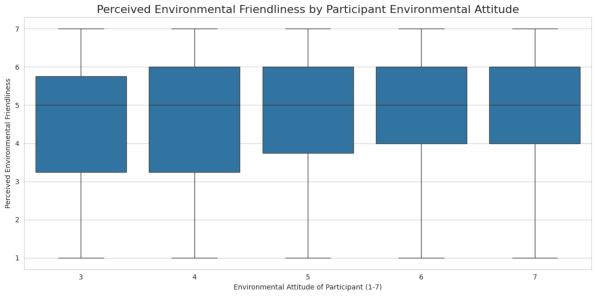
Figure 2: Average ratings per material.Figure 3: Distribution of perceived environmental friendliness by material.Figure 4: Correlation matrix of sensory and emotional ratings.Figure 5: Average ratings by material origin.Figure 6: Perceived environmental friendliness by participant environmental attitude.Table 1: Human systems integration test parameters.
mean 15.5 5.6 4.75 3.95 4.48 4.27 3.92 3.188889 2.49
std 8.67 1.38 1.60 1.41 1.47 1.51 1.41 1.23 1.21
min 1 3 1 2 2 2 2 1 1
25% 8 4 4 3 3 3 3 2 1
50% 15.5 6 5 4 5 4 4 3 2.5
75% 23 7 6 5 6 5.25 5 4 3
max 30 7 7 6 7 7 6 5 5
FINGINGS The analysis of the participant data indicated that the sensory properties of the materials affected how participants viewed the environmental value and quality and desirability of the materials. All six material conditions and thirty participant combinations showed that all recycled and bio-composite samples with matte finishes, regardless of surface roughness, obtained higher ratings of perceived environmental friendliness than virgin plastic samples with glossy surfaces. The results demonstrated that participants made strong inferences regarding sustainability based upon surface cues and labelling that referenced recycled or bio-based composition, without reference to branding or information. Furthermore, although perceived environmental value was not entirely congruent with other evaluative dimensions, it is clear that designers must navigate trade- offs between sustainability signalling and other material properties.
Quality and durability judgments had more complex relationships to sensory features. Although most of the recycled and bio-composite materials received moderate quality ratings, there were instances where specific combinations of rough texture and matte finish resulted in mixed responses from participants; specifically, some participants rated them as ‘robust’ and ‘solid’, whereas others interpreted similar cues as ‘unfinished,’ or ‘cheap’. Smooth, glossy surfaces received lower durability ratings than rough surfaces, suggesting that tactile attributes can be used as anchors for participants’ expectations for product longevity and resiliency. However, quality judgments were less strongly correlated to composition labels than to the felt and seen integrity of the surface, suggesting that sensory experience can partially mitigate, or otherwise complicate, abstract notions of what constitutes a ‘high-quality’ sustainable material.
Participants demonstrated a predictable yet behaviourally significant bias toward gloss and smoothness in aesthetic evaluations. Most of the virgin materials with glossy, smooth surfaces had higher aesthetic appeal ratings than matte, rough surfaces, despite having lower perceived environmental friendliness ratings. This aesthetic advantage translated into elevated desirability ratings for some of the glossy options, illustrating the role that hedonic consideration plays in influencing material preference. However, some recycled and bio-composite samples achieved comparable desirability ratings to virgin materials when their matte or slightly textured surfaces were perceived as ‘natural’ or ‘authentic.’ Therefore, it appears that well-crafted sensory profiles can balance both aesthetic pleasure and sustainability cues.
The affective measures of anticipated pride and guilt provide insight into how these sensory judgments may relate to Behavioural influences. Materials that were perceived to have greater environmental friendliness elicited higher anticipated pride ratings, suggesting that participants expect to feel positive self-worth if they select such options. Conversely, materials that had lower perceived environmental value elicited higher anticipated guilt ratings among a subset of participants, especially when these options were also perceived as being aesthetically appealing, representing an internal conflict between hedonic appeal and moral concerns. It is also
Designing With the Senses: Emotional Connections for Sustainable Consumption 19 worth noting that there were instances where high desirability ratings co-occurred with elevated anticipated guilt ratings, indicating that sensory design alone did not resolve all value conflicts but can highlight them in emotionally relevant ways.
Together, the findings suggest that sensory cues function at the nexus of cognitive, affective, and embodied processes, thus providing support for the theoretical proposition that material perception can facilitate bridging the attitude-behaviour gap in sustainable consumption. Additionally, the use of recycled and bio-based materials with intentionally designed matte and tactile features has the potential to convey environmental value while still enabling participants to perceive quality and desirability, ultimately increasing the likelihood of pride-based motivation for sustainable choices. In addition, the constant consumer preference for smooth, shiny virgin materials, along with the resulting patterns of expected guilt, demonstrates the need for design methods that not only communicate sustainability but also redefine what is considered attractive and desired in sustainable products.
DISCUSSION AND RESULTS Data collected from all participants demonstrated that physical properties significantly affect judgments relating to environmental friendliness, perceived quality, and aesthetic appeal. Compared to glossy virgin plastics, recycled and bio-based materials with dull finishes were rated higher for environmental friendliness, further indicating that dullness and visible authenticity of a surface are perceived as indicators of reduced environmental impact. Nevertheless, there existed some variability amongst participants as some felt that dull surfaces conveyed a “less expensive” or “cheap” experience, indicating that different participants have varied experiences and interpretations based upon their past experiences.
Judgments regarding perceived quality and durability were influenced by various aspects of the sensory experience. Several participants judged recycled and bio-based materials as both environmentally friendly and durable; however, rough texture led to varying results among participants, with some believing roughness indicates durability (strength), while others believed it indicated poor finishing. Participants who experienced materials with a balance of tactile mass and a non-flaking surface consistently rated these materials as having the highest levels of durability. Glossy virgin materials had minimal quality losses, and many participants viewed them as being well-finished; however, this does not mean that positive quality ratings directly correlate with high environmental ratings. This demonstrates that quality judgments can be separate from evaluations of sustainability and therefore designers must consider multiple sensory dimensions without assuming eco-friendliness is equivalent to quality.
Participants tended to prefer smooth, glossy materials, especially those made from virgin materials, due to cultural associations that link shine and smoothness with premium classification. Some recycled and bio-based samples received comparable or superior aesthetic ratings when participants perceived
20 Ho and Chau the sample as “natural, “ or “handmade, “ thereby re-interpreting dull finishes as stylistic choices that are intentionally related to sustainable design aesthetics. The strong desire for glossy virgin materials continued, even though they were evaluated as less environmentally-friendly than other alternatives, and several sustainable options achieved similar levels of desirability when they effectively combined environmental signalling with cohesive aesthetics.
Using affective measures, the study found that materials that were evaluated as environmentally friendly evoked greater anticipated pride among participants, specifically for recycled or bio-based materials that reflected an “eco-aesthetic” of muted colours and matte textures. Conversely, materials that were evaluated as less environmentally friendly resulted in greater anticipated guilt among environmentally conscious participants. Anticipated guilt in combination with high desirability indicated a conflict between the aesthetic appeal and moral accountability of consumers.
The overall findings indicate that sensory design can have an effect on the attitude-behaviour gap in sustainable consumption. First, specific material combinations can signal environmental value and preserve the perception of quality and aesthetic appeal, and as such generate anticipated pride and desirability at the time of purchase. Second, aesthetic benefits that exist with non-sustainable sensory profiles lead to feelings of guilt among consumers, demonstrating that sensory cues may not be sufficient to fully alter long- standing value hierarchies favouring traditional product appearances. Therefore, sustainable design practice should focus on establishing and refining sensory representations of matte, textured and visibly authentic materials as desirable in daily consumption.
CONCLUSION
The results from analysing what participants said show that people’s sense of environmental-friendliness is significantly affected by how a product feels when you touch it (the senses), in addition to whether they think a product is high-quality, visually appealing or if they experienced certain emotions when choosing a product. Participants who evaluated products with recycled or bio-based materials with specific matte and texture qualities perceived them as being ‘greener’, and tended to anticipate feeling a greater level of pride when using those products; yet these products still achieved comparable levels of desirability as virgin materials with glossy finishes. Conversely, virgin-glossy materials had the same aesthetic appeal; however, they elicited higher anticipated feelings of guilt in participants who identified themselves as being more environmentally conscious. This research suggests that through the use of design for the senses, designers can aid in narrowing the disconnect between an individual’s attitudes toward sustainable consumption and their actual behaviour; while also highlighting ongoing conflicts between hedonic (pleasurable) and moral (righteous) motivations.
ACKNOWLEDGMENT
The authors would like to acknowledge all those involved in this study.
REFERENCES
Bennett, J., & Harper, R. (2025). Designing sustainable materials: The role of material perception in consumer acceptance. New Design Ideas, 9(1), 15–32. Bissing-Olson, M. J., Fielding, K. S., & Iyer, A. (2017). The influence of anticipated pride
and guilt on pro-environmental decision making. Frontiers in Psychology, 8, 978. Cavallo, C., Vecchio, R., & Del Giudice, T. (2024). A systematic literature review of sensory-related sustainable product research. Journal of Cleaner Production, 458, 142123. https://doi.org/10.1016/j.jclepro.2024.142123 Fenko, A., Brancatisano, A., & Pohlmeyer, A. E. (2024). Sustainable materials: A
linking bridge between material perception and sustainable behaviour. Frontiers in Psychology, 15, 1307467. https://doi.org/10.3389/fpsyg.2023.1307467 Gunawardena, T., & Perera, N. (2024). Exploring sensory perception in sustainable building design. Journal of Green Building, 19(3), 85–104. https://doi.org/10.3992/ jgb.19.3.85 Ho, A. G. (2014). The new relationship between emotion and the design process for
designers. Archives of Design Research, 27(2), 45–55. Ho, A. G., & Chau, P. W. (2016). Understanding the capacity of emotion in decisionmaking for designers in design process management. The International Journal of Design Management and Professional Practice, 10(1), 1–15. Ho, A. G., & Siu, K. W. M. (2012). Emotion design, emotional design, emotionalize
design: A review on their relationships from a new perspective. The Design Journal, 15(1), 9–32. Hur, W. M., & Sovacool, B. K. (2022). How anticipated pride and guilt influence green consumption in the Middle East. Journal of Retailing and Consumer Services, 69, 103111. https://doi.org/10.1016/j.jretconser.2022.103111 Karana, E., Pedgley, O., & Rognoli, V. (2015). Material (and product) sensoriality:
Can perceptive qualities support sustainability? Temes de Disseny, 31, 24–39. Lofthouse, V. A., & Prendeville, S. (2024). Sustainability cues in users’ perception and consumption: A product design perspective. Design Science, 10, e22. https:// doi.org/10.1017/dsj.2024.22 Trang, T. T. N. (2026). Sustainability starts with the consumer: Applying the COM-B
model to green consumer behaviour. Sustainable Production and Consumption, 41, 18–30. https://doi.org/10.1016/j.spc.2025.12.004 Żemigala, M. (2025). A novel integrated structural model of green consumer purchasing behaviour: A systematic literature review with COM-B framework perspective. Equilibrium. Quarterly Journal of Economics and Economic Policy, 20(3), 557–590. https://doi.org/10.24136/eq.2025.024
LISTED IN THE AHFE DIGITAL BOOKSTORE CATALOGUE
Explore the complete digital volume
Usability and User Experience
Read this individual research paper free through the original publisher, or explore the full digital proceedings book.
ISBN 979-8-950676-08-6
Explore this ISBN in the AHFE Bookstore ↗Listed in the July 2026 bookstore catalogue; search by ISBN to confirm current availability · Digital book purchase optional