Xinchao Peng, Pengfei Zhao (2026). Design of an Intelligent Product–Service System for Last-Mile Express Delivery in the Chinese Context. In: Usability and User Experience. AHFE Open Access, vol. 232, pp. 112–120. https://doi.org/10.54941/ahfe1008040
The intelligent development of last-mile delivery holds enormous potential in China’s future market. However, the relationship between service quality and user experience in China’s current last-mile delivery market remains fragile, plagued by sporadic conflicts, highly diverse user demands and other pain points. The delivery process is marked by an imbalance: overall disorder coexists with partial orderliness. To improve user experience and satisfaction with last-mile express delivery, and to achieve the goal of cost reduction and efficiency enhancement, it is imperative to build a more intelligent and user-friendly delivery product service system based on a new operational model. Based on the current status of intelligent delivery in the domestic market, this study develops an user-centric design framework for an integrated product-service-environment delivery product service system from three core dimensions: service orientation, system planning and application development. This framework integrates the key elements of last-mile delivery with public facilities and architectural environments within a unified service ecosystem, and underscores the core thread of integrating delivery products with community development. In doing so, it achieves the research objective of shifting from inefficient manual operations to an efficient internet-enabled management model, and provides theoretical reference for the design of tailored solution systems for last-mile delivery product services that cater to personalized user needs.
As the final link connecting end-users, last-mile express delivery—an essential component of logistics services—directly determines the quality of consumer experience and the overall cost efficiency of the logistics system (Yang et al., 2023), and with the continuous deepening of global e-commerce and the full advent of the digital economy era, its efficiency and service experience have become a key benchmark for measuring the modernization level of the entire supply chain (Milioti et al., 2020); currently, community-based last- mile delivery in China has achieved sound development in terms of market scale, technological innovation, and the complexity of application scenarios, yet it still faces structural pain points including the difficulty in balancing
Design of an Intelligent Product–Service System for Last-Mile Express Delivery 113 costs and user experience as well as “last-mile congestion” in distribution networks, which has become a bottleneck restricting the high-quality development of the industry.
Against the backdrop of the in-depth integration of the smart development wave and the “Internet Plus” initiative, the intelligent transformation of last- mile delivery is not only a key expectation for social and people’s livelihood development but also a core topic of common concern to academia and industry, and optimizing delivery systems through collaborative decision- making, integrating multiple key elements including processes, technologies, business models, and user experience, and building a service experience- oriented last-mile delivery system have become pivotal directions for the industry’s innovative breakthroughs (Li et al., 2020); particularly against the backdrop of China’s current policies that encourage innovation and the in-depth integration of the digital economy with the real economy, further refinement is still required in both theoretical frameworks and implementation pathways to construct a community-based intelligent last- mile delivery service system that not only conforms to the characteristics of China’s ultra-large-scale market but also possesses international foresight.
For this reason, based on the differentiated scenarios and development stages of China’s express delivery market, this paper systematically sorts out the evolution path, policy orientation, academic research trends, and the similarities and differences between international and domestic development of domestic intelligent last-mile delivery, and by combining service design theory and system architecture methods, it proposes a community-based intelligent service system model for last-mile delivery that integrates the four dimensions of “technology-scenario-policy-business”, aiming to provide theoretical references and strategic suggestions for constructing an efficient, sustainable, and experience-oriented last-mile delivery system.
Global Vision and Chinese Market: The Differentiated Landscape of Intelligent Last-Mile Delivery The international express logistics industry is accelerating its development toward automation, greenization, and network collaboration, with developed countries in Europe, America, and some parts of Asia having achieved initial large-scale application in fields such as unmanned aerial vehicles (UAVs), autonomous delivery vehicles, and intelligent parcel locker networks, where their policy systems and standardization frameworks are relatively well- established, and emphasis is placed on full-chain data interconnection and low-carbon operations; by contrast, China’s express delivery market presents a unique ecosystem characterized by scale leadership, complex scenarios, and dynamic innovation, and although it holds distinct advantages in e-commerce express volume, mobile payment penetration, and end-point outlet density, it is still in a stage of diversified trials and partial promotion in terms of the integration of intelligent delivery systems in community scenarios, the support of standardized policies, and the exploration of sustainable business models. According to the latest deployment of the State Post Bureau of China, the industry has clearly defined the strategic core of “Two Promotions
114 Peng and Zhao and Three Enhancements” for the 15th Five-Year Plan period (2026-2030)— namely promoting high-quality development and high-efficiency governance, and striving to enhance the three core capabilities of rural postal and delivery services, international postal and delivery services, and industrial supporting services—and the innovations in “industrial collaboration” and “business model” proposed in this study are highly aligned with this connotation, as encouraging the express delivery industry to deeply integrate into the industrial chain and transform into an integrated logistics service provider is highly consistent with the key focus of enhancing industrial supporting service capabilities in the strategic core (Wei Liu and Chongjiu Zhao, 2026); meanwhile, the 2026 National Postal Work Conference has further identified accelerating the development of new productive forces in the industry as a core task and plans to issue the Policy Document on Accelerating the Popularization and Application of Unmanned Delivery Technologies within the year.
Given the relatively complex environment of China’s communities, which is characterized by high population density and intricate road and venue conditions, it will be necessary to explore more tailored approaches to realize intelligent last-mile delivery as urban modernization advances in an increasingly standardized manner, and we should seize the opportunity to drive the development of intelligent last-mile delivery service systems by leveraging new productive forces; this series of top-level designs for the Chinese market indicates that the development of intelligent express delivery is progressing under the dual constraints of an ultra-large domestic market and increasingly strengthened regulation of the platform economy. China’s path to intelligent development emphasizes not only the inherent technological sophistication of intelligent delivery itself but also the inclusiveness of supporting infrastructure, and by innovating and integrating traditional single products to achieve intelligent and real-time interaction with user groups and providing integrated intelligent services that integrate logistics delivery, community environments, and users, a new driving force for market and economic development has been formed (Yang et al., 2023), as we pursue the coordinated advancement of technological breakthroughs, network optimization, and people’s livelihood protection. This composite model featuring “technology-driven development, people’s livelihood-oriented approach, and collaborative governance” constitutes a China-characteristic intelligent framework for last-mile express delivery, which differs from the international development path focused on pure technological competition.
Academic Research Context: The Evolution of Delivery From Local Optimization to System Construction Academia has yielded abundant research outcomes on last-mile delivery, which mainly focus on the three core dimensions of efficiency, cost, and user experience: (1) Operational Optimization and Model Innovation: Early research mostly focused on the micro-level optimization of route planning and resource allocation, and for instance, scholars such as Jingshuai Yang established a joint decision-making model with distribution costs and user
Design of an Intelligent Product–Service System for Last-Mile Express Delivery 115 satisfaction as the objective functions and proposed expanding the flexible time window to improve system resilience (Yang et al., 2023), while Xiuli Meng et al. analyzed and compared the market acceptance and applicable boundaries of unmanned vehicle and manual delivery models from the perspective of consumer behavior, and these studies have laid a foundation for understanding the operational mechanism of last-mile delivery (Meng et al., 2023); (2) Technology Integration and Application Exploration: With the maturation of technologies such as artificial intelligence (AI) and the Internet of Things (IoT), the research focus has shifted toward the integrated application of these technologies, and Yunyan Duan systematically elaborated on the specific paths of AI and IoT technologies in addressing the challenges of community delivery in combination with the new regulations for the express delivery market in 2024 (Duan 2024), while international scholars proposed a more forward-looking collaborative delivery framework of “unmanned vehicles + unmanned aerial vehicles (UAVs)” and explored the feasibility of dynamic endurance and relay delivery (Kitjacharoenchai P et al., 2020); (3) Service Systems and Business Models: In recent years, the research perspective has been further elevated, with attention shifting to the design of the overall service system, and Suwatcharachaitiwong et al. constructed a variety of last-mile delivery service system models from the perspective of logistics enterprise strategy (Suwatcharachaitiwong et al., 2020), while domestic scholars have also increasingly emphasized the need to integrate distribution processes, technical systems, business models, and user experience to build a new service product-oriented system.
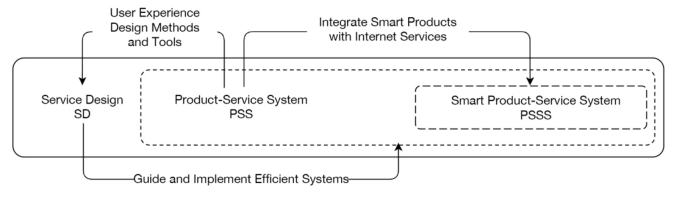
From Traditional to Intelligent: A Paradigm Shift in the Research on Last-Mile Delivery Product-Service Systems Smart Product-Service Systems (PSSS), a concept first proposed by Valencia (Valencia et al., 2015), differ essentially from traditional models in that the former drives value innovation through the Internet (see Figure 1): it enables connection and interaction between smart products and other facilities, conducts scientific analysis of multi-stakeholder demands, optimizes traditional operational models and production value creation, fulfills tasks allocated by cloud data centers, meets user demands through diverse approaches, and simultaneously enhances service standardization and adaptability to multiple environments—thereby transforming the operational and service models of traditional systems.
Figure 1: Relationship between service design, traditional PSS, and intelligent PSS.
116 Peng and Zhao The intelligent last-mile delivery service system constructs a collaborative smart logistics delivery platform centered on the development of the “Internet Plus” platform, integrating technologies and cross-boundary innovation concepts into the community-based last-mile delivery service system; it synchronizes real-time scheduling information through Internet-based intelligent algorithms, fully realizing the digitalization of logistics delivery business data and the optimization of the delivery management system, as well as the intelligent scheduling of all links in community logistics, including warehousing, storage and retrieval, outbound delivery, and docking distribution. Technological upgrading and AI empowerment facilitate the scientific understanding of user psychology, deliver better, more refined, and ultimate user experiences, promote the digital and intelligent innovation and transformation of the entire intelligent delivery process, and realize a new innovative sharing model (Zheng, 2020); additionally, it establishes an interconnected service system integrating products, services, users, and other relevant enterprises and institutions, thereby achieving the transformation from inefficient manual labor to an efficient Internet-based management model.
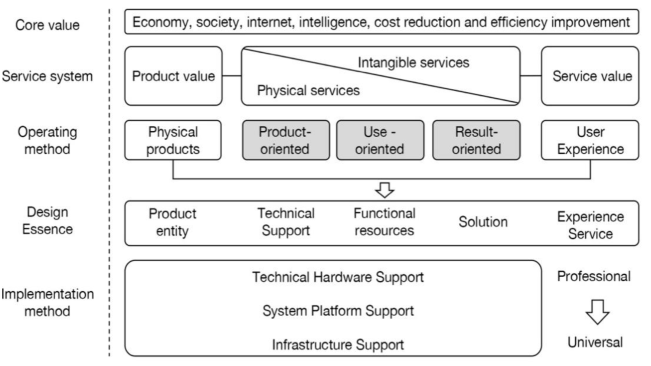
By leveraging the inherent integrative and holistic thinking of last- mile delivery, we re-examine the core elements—including the market, delivery facilities, enterprises, and users—within the traditional logistics distribution system; this approach guides the design of a user-centric last- mile delivery service system and further enables the innovation, integration, and reconstruction of a holistic integration model for the last-mile delivery service system (see Figure 2). This model refines the systematic thinking of last-mile delivery services from four dimensions, namely core value, service system, operation mode, and design essence, thereby achieving the research goal of transforming its implementation approaches: the first dimension takes “Internet Plus” and “intelligentization” as the core values, with the objective of reducing costs and improving efficiency in last-mile delivery; the second dimension regards the entire service system as three modules, including product value, tangible and intangible services embodied in products, and user experience provided by products; the third dimension defines product value as intelligent delivery products within the solution, which are divided into three categories—functions, applications, and delivery outcomes of delivery products—in the last-mile delivery process to achieve the expected goal of enhancing user experience services; the fourth dimension refines the aforementioned divided links, clarifies the system platforms, technical support, and intelligent product facilities required to complete community- based last-mile delivery, and transforms the solution from professional support into universal delivery products for users.
Transcending Local Optimality: Service System Design for Optimization Strategies of Intelligent Last-Mile Delivery Solutions Research data in China indicates that 64.5% of users choose express lockers as their top choice for parcel delivery, with third-party collection services and courier stations ranking as the subsequent preferences, accounting for 52.0% and 42.9% respectively; last-mile express delivery has gradually shifted from home delivery to a scenario where parcels are signed for in the recipient’s
Design of an Intelligent Product–Service System for Last-Mile Express Delivery 117 absence, primarily due to users’ unavailability to collect their parcels during the delivery window. At the current stage, on-behalf signing saves time for both users and delivery couriers while improving overall efficiency, and statistics show that with societal development, 71% of consumers in China expect higher levels of intelligence and network integration in logistics delivery systems. By leveraging the Internet of Everything (IoE), we integrate core elements including convenience, security, and timeliness into delivery service solutions, address the needs of community residents based on emerging market hotspots, and position intelligent last-mile delivery facilities as value carriers—thereby eliminating the inherent temporal and spatial constraints between enterprises and users in traditional delivery models (Xu et al., 2020).
Figure 2: Integrated model of terminal distribution service system.
Within the overarching delivery solution, we leverage a comprehensive online platform for community residents’ daily lives built on modern technologies, which integrates resident-centric daily living resources within the community and provides residents with convenient living and delivery services. Taking an Internet-based information platform as the foundation, we integrate real- time logistics delivery information of community households and further integrate various systems of the smart community—namely communication network systems, information network systems, environmental perception systems, and access control and security systems—to enable all-round dynamic supervision and management. Through smart home devices including smart home systems and Internet-connected home furnishings, users can achieve information sharing and real-time control, while community residents can book and choose self-pickup at smart warehouses or door-to-door delivery of intelligent distribution products, thereby resolving the inefficiencies caused by multi-platform and multi-stakeholder participation. This avoids scheduling conflicts between manual deliveries during working hours and residents’ availability, reduces unnecessary costs, and ultimately meets the demand of community households for intelligent services in last-mile express delivery.
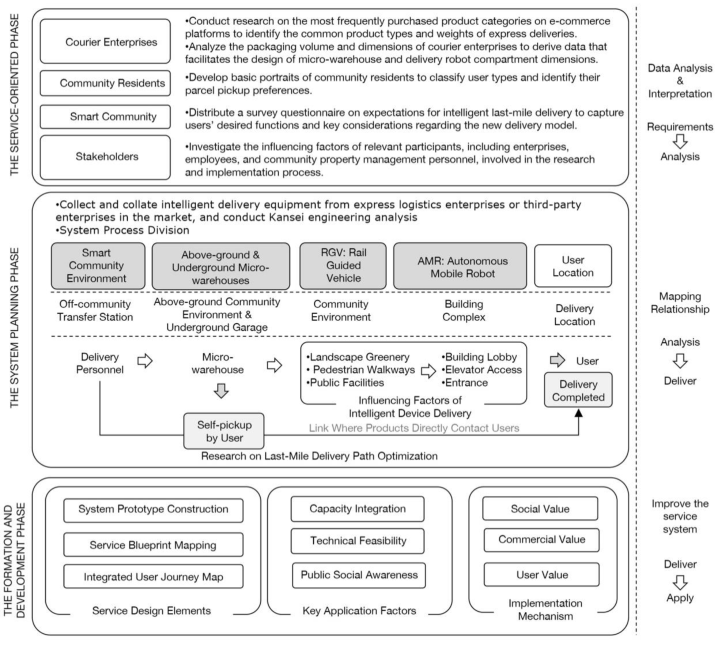
118 Peng and Zhao The intelligent delivery service solution designed in this study serves as a sophisticated omni-channel service system integrated into daily life, operating by leveraging resources from logistics and smart device enterprises, management entities, and frontline personnel and characterized by a relatively complex mix of stakeholder groups and operational processes—which results in numerous user touchpoints throughout its operational processes. In the innovation process of the product-service system, it is primarily divided into three phases (see Figure 3): the Service-oriented Phase, the System Planning Phase, and the Formation and Development Phase. Based on an analysis of the influencing factors and needs of relevant enterprises, users, and other stakeholders involved in last-mile delivery, this solution integrates design elements and emotional elements to construct a community delivery service system, and ultimately conducts improvement, output, application, and reflection on the service system. Therefore, in the context of service system design, during the process of promoting intelligent innovation in traditional last-mile delivery, it is particularly important to improve user experience satisfaction and logistics delivery efficiency, as well as to construct a design model for an intelligent last-mile delivery service system; furthermore, within the holistic delivery service solution, it is anticipated that the construction of three service system framework paths will provide references for last-mile delivery in terms of design diversity and intelligent universality.
Figure 3: Design model of the last-mile delivery service system.
CONCLUSION
As the world’s largest e-commerce and logistics delivery market, China is witnessing increasingly prominent status quo and pain points in its last- mile delivery sector. Innovation and exploration in this field are not only crucial to the transformation and upgrading of China’s domestic logistics industry, but also hold important demonstrative significance and reference value for the global development of smart logistics. The development of intelligent last-mile logistics delivery is an inevitable trend of the times. Against the backdrop of the “Internet Plus” initiative, this study integrates the behavioral processes of smart communities and intelligent last-mile delivery, and innovates existing service design methods. It extracts the parcel pickup needs of community residents by means of service system methodologies and tools, and analyzes user demands in last-mile delivery by combining system design methods with service design thinking. This approach is conducive to optimizing the overall service process of intelligent last-mile delivery. Finally, regarding the integration and development of smart logistics delivery and smart communities, it is expected that in future practical applications, the issues of social human resource allocation, disorder in the last-mile delivery environment, and residents’ personalized demands can be effectively addressed. By integrating public service facilities in smart communities, conducting scientific analysis on community residents’ demand information, and continuously improving the relevant intelligent modules of smart communities in China, we will promote the intelligent and modern development of last-mile delivery.
REFERENCES
Duan X Y. (2024) Research on Optimization Measures of Community Logistics Distribution Enabled by Digital Technology under the Background of New Regulations. China Shipping Weekly, (43). Kitjacharoenchai P., Min B C., & Lee S. (2020) Two Echelon Vehicle Routing
Problem with Drones in Last Mile Delivery. International Journal of Production Economics, (225). Li Y., Hu Y., & Du X. (2020) Product Design Innovation Strategy Integrating Service Design Concept[J]. Packaging Engineering, 41(4). Meng X L., An K., & Zhou L. (2023) Considering Service Quality and Short-
sighted Effect, Intelligent Logistics Platform Terminal Distribution Mode Decision—Take the Cainiao Platform as an Example. Journal of Systems Management, (10): 1–24. Milioti C., Pramatari K., & Zampou E. (2020). Choice of Prevailing Delivery Methods in E-grocery, a Stated Preference Ranking Experiment. International Journal of Retail and Distribution Management, 49(2). Suwatcharachaitiwong S., Lin C C., & Huang W., et al. (2020) On the Medication
Distribution System for Home Health Care through Convenience Stores, Lockers, and Home Delivery. Health Informatics Journal, 26(4) Valencia A., Mugge R., & Schoormans J P L., et al. (2015) The Design of Smart Product-Service Systems (PSSs): An Exploration of Design Characteristics. International Journal of Design, (9). Wei L., Chongjiu Z.,(Jan 8,2026),National Postal Work Conference in 2026.
Express Terminal Distribution System[J]. Packaging Engineering, 41(23). Yang J S., Yang Y E., & Li M M, et al. (2023) Joint Optimization of Terminal Distribution Service Mode and Path. Journal of Zhejiang University (Engineering), 57(5). Zheng Y J. (2020) Design and Evaluation of Terminal Distribution Scheme for
Smart Community. Business Information, (11).
LISTED IN THE AHFE DIGITAL BOOKSTORE CATALOGUE
Explore the complete digital volume
Usability and User Experience
Read this individual research paper free through the original publisher, or explore the full digital proceedings book.
ISBN 979-8-950676-08-6
Explore this ISBN in the AHFE Bookstore ↗Listed in the July 2026 bookstore catalogue; search by ISBN to confirm current availability · Digital book purchase optional