Francesco Burlando, Boyu Chen, Federica Maria Lorusso (2024). Inclusive smart navigation service design for the blind and visually impaired: a proposal for the city of Genoa. In: Human Interaction and Emerging Technologies (IHIET 2024). AHFE Open Access, vol. 157, pp. 126–135. https://doi.org/10.54941/ahfe1005471
The advancement of interactive technologies offers promising potentials for enhancing mobility and quality of life for visually impaired individuals in smart cities. Goal 11.7 of the 2030 Agenda emphasizes the importance of inclusive, safe, and sustainable urban spaces, specifically addressing the needs of elderly and disabled citizens. This paper examines the potential of interactive technologies, such as smart white canes, wearable aids, and smart devices, in transforming urban public spaces to support the daily activities of individuals with blindness or vision-related challenges in Genoa. By integrating these technologies effectively, this study proposes inclusive service solutions aimed at improving accessibility and promoting independent navigation within the city.
According to the World Health Organization (WHO), approximately 285 million people are visually impaired, with 39 million of them being blind (Pascolini & Mariotti, 2012). In Italy, there are currently about 2 million people living with visual disabilities, accounting for approximately 3% of the national population (ISTAT, 2017). Walking as a fundamental form of physical activity, is a primary mode of transportation in daily life. However, individuals with visual disabilities often lack crucial environmental information, making navigation, walking, and safety in urban areas significantly challenging, thereby impacting their autonomy and well-being.
Goal 11.7 of the 2030 Agenda (UN, 2015) emphasizes the importance of making cities’ green and public spaces more inclusive, safe, resilient, and sustainable, with a particular focus on meeting the needs of elderly and disabled citizens. The construction and advancement of smart cities offer an opportunity to address these challenges. The European Commission defines smart cities as using intelligent transportation networks and digital technologies to enhance urban management responsiveness and create safer
Inclusive Smart Navigation Service Design for the Blind and Visually Impaired 127
public spaces tailored to urban residents’ needs. Interactive technologies and devices within smart city transportation networks can effectively overcome existing deficiencies in facilities. This not only facilitates future accessibility enhancements but also significantly enhances safety and quality of life for visually impaired individuals.
This paper will explore the potential of interactive technologies in urban public spaces for people with visual impairments. We aim to not only enhance their travel accessibility through technologies and navigation systems but also consider the quality of their urban walking experience. Additionally, we will propose integrating these technologies and navigation systems into public spaces to enhance daily experiences for visually impaired individuals in Genoa.
WAY OF INTERACTION BETWEEN VISUALLY IMPAIRED PEOPLE AND URBAN ENVIRONMENT Visually impaired individuals are characterized by varying degrees of vision loss that hinder conventional problem-solving methods (e.g., eyeglasses). Blindness, on the other hand, refers to a complete inability to see due to injury, disease, or genetic conditions, with total blindness indicating a complete loss of vision (WHO, 2018). According to definitions, visual impairment encompasses moderate, severe, and complete categories (Cruciani, 2005). Partially impaired individuals with reduced visual sensitivity and limited visual fields often prefer designated routes that are trained and familiar. In most cases, the suitability of a route is determined not solely by its distance but by its navigational ease with minimal obstacles or conflicts (Parkin & Smithies, 2012). For those who are completely blind, environmental cues become crucial for gathering information that influences their mobility and activities (Marston & Golledge, 2004).
Human beings typically acquire approximately 80% of their total information through vision (Man & Olchawa, 2018). To compensate for this lack of visual input, the theory of sensory compensation suggests that when one sense is diminished or absent, others are heightened to capture environmental information for localization and navigation purposes (Pieniak et al., 2022). In addition, inclusive design considers individuals with temporary or short-term audiovisual impairments encountered daily in urban environments as a disability situation. Therefore, creating inclusive environments for people with sensory impairments, also can benefit all the citizen’s daily life. Simultaneously, the rapid advancement of digital technologies offers new opportunities for enhancing human-computer interaction and providing improved assistance for mobility and access to information for the visually impaired.
TECHNOLOGIES APPLIED FOR VISUALLY IMPAIRED’S WALKING TRAVEL Although individuals with vision impairments often enhance senses such as hearing and touch to navigate daily activities, they may also rely on optical
aids and techniques to compensate for their visual limitations. Specifically, in orientation and mobility, they utilize human guidance, guide dogs, echolocation techniques, or traditional white canes to detect and navigate around obstacles. However, the expanding array of emerging technologies is enriching the range of assistive aids available. Bouck (2015) defines assistive technology as a collection of devices and tools designed to enhance the functional capabilities of people with disabilities. Cities must increasingly incorporate smart street equipment and devices equipped with assistive technology to ensure users feel considered and safe. The combination of personal aids and urban technologies significantly enhances the experience of blind and visually impaired individuals in urban settings, promoting independence, safety, accessibility in daily activities and movements, and spatial awareness. Following a thorough review of the literature, we have identified and classified three main categories of personal technology devices based on their scenario, function, and technology.
Smart White Cane The first category concerns one of the most popular traditional aids. The white cane is the most common symbol that signals to people around that the user is visually impaired or blind.
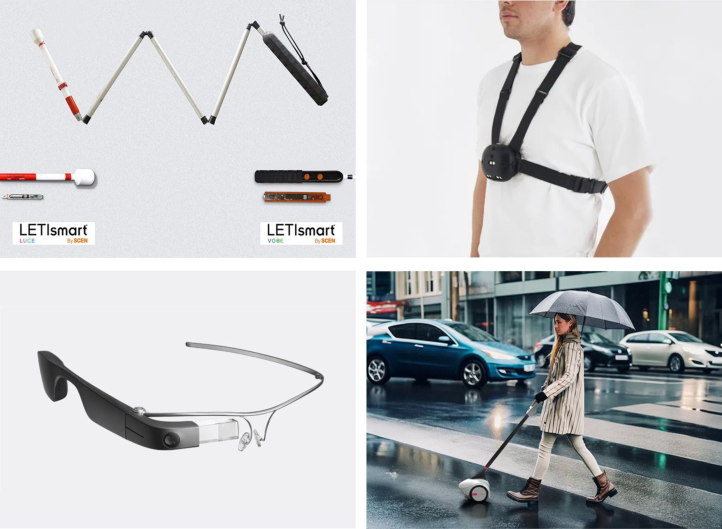
Its use requires intensive training and significant effort on the part of the user (Sobnath et al., 2020), however, it is particularly effective for exploring the surrounding space, orienting oneself, and detecting obstacles on the ground and unevenness independently. Unfortunately, the cane alone provides limited information; it cannot predict long-range obstacles or the ones that do not rest on the ground, such as overhanging branches or low- hanging structures. For these reasons, in recent years, canes for the blind have been implemented with microelectronics containing GPS navigation systems, proximity sensors, and LEDs to illuminate the tip of the cane and be recognized in dimly lit environments, all of which can provide the blind user with a more complete picture of the space around them. A technologically advanced project of particular interest in fostering urban autonomy for blind and visually impaired people is the LETIsmart system, developed by SCEN and co-designed with Marino Attini, a visually impaired user and National Advisor to the Italian Union of the Blind and Visually Impaired. The system is composed of two kits, LETIsmart LUCE and LETIsmart VOCE - which make one’s traditional white cane smart - and a sophisticated network of easy-to-install radio beacons placed at strategic points in the city and on public transportation, which can provide voice information to guide you to your destination through the LETIsmart VOCE kit and with the personal devices of citizens who need them, using LORA technology.
The first kit, LETIsmart LUCE, is a battery-powered lighting device that is installed on the lower end of the white cane. It consists of a translucent tube that, depending on ambient lighting conditions, allows a pulsating beam of light to shine through. Once mounted, it makes blind users more visible to other pedestrians or vehicle drivers thanks to the flashing light,
Inclusive Smart Navigation Service Design for the Blind and Visually Impaired 129
improving the safety of urban travel for both the blind person and others. The second, on the other hand, is a smart handle that can replace the traditional white cane handle or can be used as a pocket version to receive voice information pertaining to urban navigation or city events. In fact, LETIsmart VOICE contains microelectronic components that allow it to connect to beacons placed at useful orientation points, such as at traffic lights for crosswalks, public transportation stops and on bus doors, construction sites that impede movement, and entrances to public buildings and stores. The smart handle has multiple modes of use, including bus information, city information, and business information. Depending on the mode chosen by the user, beacons installed within a 50-meter radius will emit a radio voice message to be detected and reached, such as “Pedestrian crossing of Via Cesare Battisti.” From a technological point of view, the two kits to be integrated into one’s white cane are particularly advantageous, as they contain microelectronic components that do not affect the ergonomics and do not compromise the lightness of the white cane (only 11.5 grams). This allows the user to benefit from a lightweight, foldable product that does not fatigue the user during use and greatly enhances his or her experience in the city. On the other hand, the LETIsmart system only works if there is an adequate and widespread beacon infrastructure in the city. Each public or commercial entity can equip itself with beacons that play the name of its business as if it were a vocal sign (for the visibly able-bodied), or that announce news in the storefront. For the system to work properly, it is therefore essential that cities equip themselves with a massive amount of beacons that make every corner of the city inclusive and easily usable by the blind user.
Wearable Devices In recent decades, numerous wearable technological aids have been developed that assist visually impaired people in numerous daily activities without having to resort to large devices. They allow hands-free interaction or minimize the use of hands, as in most cases they are operated through voice commands and are directly worn on different parts of the body, such as on the head, wrists, chest and abdomen (Velázquez, 2010), with the purpose of providing real-time information. Among the many, the most popular are smart glasses and visors with AI technologies, followed next by chest harnesses, bone-conduction headphones, wristbands, and sensorised shoes. One emblematic device is Envision Glasses, developed by Envision based on the Google Glass Enterprise Edition 2. These are lightweight smart glasses that house traditional components, and are installed with AI- powered features and the use of advanced algorithms to identify objects, read text and recognize faces in real-time. As AI-powered smart devices such as Chat GPT, they need to be connected to the Internet at all times. They are configured through Envision App and also integrate navigation apps such as BlindSquare, to guide the user step by step by providing auditory cues and directions. Ultimately, smart glasses like Envision greatly support visually impaired or blind people in the city and can enrich their
experience through constant interaction with artificial intelligence. However, these devices are not designed to completely replace traditional mobility aids such as white canes or guide dogs, but rather act as a complementary support. According to users, they are an excellent substitute for the smartphone, as they allow for many hands-free activities, since the interaction is through voice. Unfortunately, they are not suitable for deaf-blind people, as they only provide audio output such as sounds and words to communicate information, and there is no way to set haptic feedback or vibration. As mentioned above, chest harnesses can also provide support. These are wearable devices designed specifically for walking, which through a series of sensors, such as Infrared Time of Flight sensors and ultrasonic sensors, accelerometer and gyroscope, capture real-time contextual data from the environment, alerting users to impending obstacles. This specific assistive technology makes it possible to improve walking speed and posture, as it allows for hands-free walking. Part of this type is the Ara project, designed by Strap Tech in 2022. Ara is a lightweight, rechargeable device that is worn on the chest that also identifies obstacles that cannot be detected with the classic white cane, i.e., those from chest height upward, and is therefore suitable for use alone. Ara does not overload the user with information, in fact it interacts with the user through sequential vibrations only when it detects obstacles, telling the user their location (high, medium or low). The advantage of such tactile language is that it can be universally understood, breaking down language and hearing barriers, thus making it suitable even for deaf-blind users.
Smart Aids Smart aids come in various sizes and technologies tailored to specific needs and preferences. Among the most widely adopted are smartphones, which have become indispensable assistive devices for people with visual impairments. Due to their compact size and lightweight nature, smartphones are convenient for navigation and interacting with the environment. Their operating systems include a range of accessibility features such as screen readers, magnifiers, high-contrast screens, and speech-to-text capabilities, which facilitate common daily tasks for visually impaired individuals (Muhsin et al., 2024). One noteworthy smart device is Glide, a self- guided mobility aid devised by Glidance, which is currently undergoing trials, but manifests great potential for facilitating the visually impaired. Ostensibly resembling a white cane, Glide employs advanced navigational robotics technologies, artificial intelligence, sensors and a camera to recognize and avoid obstacles, guiding users effectively. It features two 7-inch wheels that steer independently to avoid obstacles and guide the user along the correct path. Operating Glide is straightforward: the user pushes it via an ergonomic handle and follows its lead. Additionally, Glide adjusts to the user’s walking speed and provides voice feedback describing the surroundings, thereby enhancing the navigation experience.
Inclusive Smart Navigation Service Design for the Blind and Visually Impaired 131
Figure 1: Above, left, the two LETIsmart kits for the white cane; right, Ara chest harness. Bottom, left Envision Glasses; right, self-guided mobility aid Glide.
PROPOSAL IN THE CITY OF GENOA The Liguria region, including its capital Genoa, has a significant population affected by visual disabilities (ISTAT, 2017). Genoa, characterized by its complex and diverse terrain of narrow alleys, intricate streets, and stairways typical of Italian cities, poses daily navigation challenges for blind residents (Campisi et al., 2019). As a historic port city, Genoa not only possesses rich cultural heritage and natural beauty but also embraces advanced technologies like Digital Twin, a state-of-the-art simulation tool enabling real-time monitoring and management of city infrastructure. Moreover, Genoa has established a profound foundation in interactive technologies, actively participating in smart city initiatives such as RAISE (Robotics and AI for Socio-economic Empowerment). This three-year project, funded by the Ministry of University and Research (MUR) through the National Recovery and Resilience Plan (NRRP), is an innovation ecosystem coordinated by the Liguria Region which hosts the main robotic and AI research laboratories of Italy. Collaborating with leading research institutions like the National Research Council (NRC), the Italian Institute of Technology (IIT), and the University of Genoa (UNIGE), RAISE project aims to develop and commercialise technological solutions based on robotic systems and artificial intelligence to meet the productive and social needs of the Liguria region (Burlando et al., 2024). The project targets areas including health, environmental sustainability, smart ports, and urban technologies, aiming
to elevate the city’s technological landscape and enhance accessibility for visually impaired individuals.
Despite these advancements, Genoa still faces significant challenges in ensuring equitable access to public spaces such as streets and parks for visually impaired residents. However, adopting user-centric approaches and leveraging emerging technologies can offer innovative solutions to overcome these barriers. Enhancing the accessibility of public spaces through smart city concepts is crucial in improving the overall quality of life and inclusivity for visually impaired individuals in Genoa.
SMART NAVIGATION SERVICE PROPOSAL Due to its unique characteristics, Genoa presents an ideal spatial context for developing prototype solutions involving interactive technologies to support the blind and visually impaired community. Utilizing open data from the city’s Digital Twin and potential collaborations with institutions like the UNIGE and the David Chiossone Foundation, which specializes in the rehabilitation of visually impaired individuals, offer a promising starting point for enhancing existing smart devices available to this community.
Genoa has shown interest in projects like LETIsmart, highlighting an opportunity to expand its infrastructure with radio beacons. These beacons could be strategically placed at key locations such as theaters, meeting points, parks, and scenic viewpoints. Their role would be to convey information audibly to blind individuals, akin to reading a poster, or describing their surroundings in detail without requiring personal smart devices. This approach is crucial since many assistive devices are costly, posing a barrier to widespread adoption without governmental or municipal support in making cities more inclusive.
Additionally, implementing intelligent navigation systems and interactive information stations in parks can complement radio beacons. These systems offer voice-guided navigation and provide multi-sensory feedback, including tactile and auditory cues, tactile maps, and diverse flooring materials, all aimed at enhancing navigation and enjoyment of park environments for visually impaired individuals.
From an inclusive design perspective, urban infrastructures can further be optimized to specifically meet the needs of the visually impaired by integrating multi-sensory experiences. For instance, leveraging AI-powered information totems or radio beacons to highlight seasonal scents of surrounding plants can enrich the navigation experience. Real-time updates could inform users, “You’re smelling wisteria in bloom; it blooms in April with purple flowers”. Finally, we must not overlook the dictates of the New European Bauhaus (NEB), which posits not only inclusion but also sustainability and beauty as fundamental pillars for building the future of our society (Rosado-Garcıa et al., 2021). Ensuring that infrastructure designed to enhance city inclusivity does not compromise urban aesthetics is paramount. Equally important is cultivating an environment where visually impaired individuals can derive aesthetic pleasure from urban spaces. This challenge is complex, considering the diverse perceptions of beauty among individuals
Inclusive Smart Navigation Service Design for the Blind and Visually Impaired 133
with visual impairments, yet crucial for dignifying their urban experiences (Bolt, 2014). The challenge is therefore on two different levels: on the one hand, making sure that all the infrastructure useful for making cities more inclusive does not undermine the aesthetics of the urban environment. On the other, to pursue the achievement of good aesthetic perception even in the enjoyment of urban spaces by the visually impaired and blind. Only in this way, by recognizing that everyone has the ability and therefore the right to enjoy a beautiful and pleasant environment, is proper dignity given to these categories of users (Bolt, 2013).
As mentioned, this is not an easy challenge, especially considering that there are multiple categories of visual impairment and multiple levels of severity of the condition. The combination of these two factors produces huge differences in users’ needs and, therefore, in users’ perceptions of the solutions that could be identified (Zhao et al., 2018). If, as mentioned above, the ideal path from point A to point B for such users is not the shortest but the one with the fewest obstacles, the role that the presence of pleasantly satisfying multisensory elements plays in route identification must become equally important. It is important to note that, in full compliance with the dictates of Design for All (DfA), this does not prove to be an exclusive choice for users with disabilities. In fact, if one thinks of elements that normally enhance the urban experience of users, such as green areas, one can see how what for many is an improvement in terms of primarily visual and climatic, actually brings aesthetic benefits at the auditory and olfactory levels as well, going on to improve the aesthetic experience of hypo and visually impaired users.
CONCLUSION
The design of navigation assistive technologies for visually impaired people represents a promising yet challenging research area. Researchers and designers face the complex task of understanding how these technologies integrate into urban life and impact citizens, especially marginalized populations requiring heightened attention and understanding.
This paper conducts an analysis of existing aids and assistive technologies for blind and visually impaired individuals, including smart white canes, wearable aids, and smart devices, to assess their strengths and limitations, and identifying opportunities for design actions. Furthermore, we propose a conceptual solution aimed at enhancing inclusivity for visually impaired individuals in public spaces within the city of Genoa. This proposal serves as a foundational step towards future research endeavors in this field. In addition, we aim to optimize system functionalities and expand implementation to additional cities, ensuring that more blind and also vulnerable individuals can benefit from the convenience and welfare offered by smart city initiatives. Simultaneously, we advocate for increased attention across all sectors towards the needs of disadvantaged groups in the development of smart cities, fostering a more inclusive and supportive social environment.
ACKNOWLEDGMENT
The paper is the result of a joint reflection by the Authors carried out with the supervision of Francesco Burlando.
The “Introduction” and “Way of interaction between visually impaired people and urban environment” paragraphs have to be attributed to Boyu Chen, “Technologies applied for visually impaired’s walking travel” to Federica Maria Lorusso, “Proposal in the city of Genoa” and “Conclusion” to Francesco Burlando.
REFERENCES
Bolt, D. (2014). An advertising aesthetic: Real beauty and visual impairment. British Journal of Visual Impairment, 32(1), pp. 25–32. Bolt, D. (2013). Aesthetic Blindness: Symbolism, Realism, and Reality. Mosaic:
An Interdisciplinary Critical Journal, 46(3), 93–108. http://www.jstor.org/ stable/44030343 Bouck, E. C. (2015). Assistive technology. Sage Publications. Burlando, F., Lorusso, F. M., & Porfirione, C. (2024). RAISE ecosystem: urban design for accessible and inclusive Smart Cities, in Bisson, M., Environmental Design. 4th International Conference on Environmental Design, 9–11 May 2024, Palermo University Press. Campisi, T., Canale, A., & Tesoriere, G. (2019). The development of walkability
in the historic centre of Enna: The case of the Saint Tommaso neighbourhood. European transport: International journal of transport economics, engineering & law, (73), pp. e4–e4. Cruciani, F. (2005). A proposito della legge 138/01: “Classificazione e quantificazione delle minorazioni visive e norme in materia di accertamenti oculistici”. A che punto siamo. Oftalmologia sociale, pp. 4–9. European Commission. Smart cities, European Commission. Available at: https://commission.europa.eu/eu-regional-and-urban-development/topics/cities- and-urban-development/city-initiatives/smart-cities_en (Accessed: 15 June 2024). ISTAT. (2017). Italian National Institute of Statistics. Available at: https://www.istat.it/en/ (Accessed: 15 June 2024). Man, D., & Olchawa, R. (2018). The possibilities of using BCI technology in biomedical engineering. In Biomedical Engineering and Neuroscience: Proceedings of the 3rd International Scientific Conference on Brain-Computer Interfaces, BCI 2018, March 13–14, Opole, Poland (pp. 30–37). Springer International Publishing. Marston, J. R., & Golledge, R. G. (2004, May). Quantitative and qualitative analysis
of barriers to travel by persons with visual impairments and its mitigation through accessible signage. In Proceedings of the 10th international conference on mobility and transport for elderly and disabled people, Hamamatsu, Japan, pp. 23–26. Muhsin, Z. J., Qahwaji, R., Ghanchi, F., & Al-Taee, M. (2024). Review of substitutive assistive tools and technologies for people with visual impairments: recent advancements and prospects. Journal on Multimodal User Interfaces, 18(1), 135–156. Pascolini, D., & Mariotti, S. P. (2012). Global estimates of visual impairment: 2010.
British Journal of Ophthalmology, 96(5), 614–618. Parkin, J., and Smithies, N. (2012). Accounting for the needs of blind and visually impaired people in public realm design. Journal of urban design, 17(1), 135–149.
Inclusive Smart Navigation Service Design for the Blind and Visually Impaired 135
Pieniak, M., Lachowicz-Tabaczek, K., Karwowski, M., and Oleszkiewicz, A. (2022).
Sensory compensation beliefs among blind and sighted individuals. Scandinavian journal of psychology, 63(1), 72–82. Rosado-García, M. J., Kubus, R., Argüelles-Bustillo, R., and García-García, M. J.
(2021). A new European Bauhaus for a culture of transversality and sustainability. Sustainability, 13(21), 11844. Sobnath, D., Rehman, I. U., & Nasralla, M. M. (2020). Smart cities to improve mobility and quality of life of the visually impaired. Technological Trends in Improved Mobility of the Visually Impaired, 3–28. UN. (2015). Transforming our world: The 2030 agenda for sustainable development | department of economic and social affairs. Available at: https://sdgs.un.org/2030agenda (Accessed: 15 June 2024). Velázquez, R. (2010). Wearable assistive devices for the blind. Wearable and
Autonomous Biomedical Devices and Systems for Smart Environment: Issues and Characterization, 331–349. Zhao, Y., Kupferstein, E., Tal, D., & Azenkot, S. (2018, October). “It Looks Beautiful but Scary” How Low Vision People Navigate Stairs and Other Surface Level Changes. In Proceedings of the 20th International ACM SIGACCESS Conference on Computers and Accessibility (pp. 307–320).
LISTED IN THE AHFE DIGITAL BOOKSTORE CATALOGUE
Explore the complete digital volume
Human Interaction and Emerging Technologies (IHIET 2024)
Read this individual research paper free through the original publisher, or explore the full digital proceedings book.
ISBN 978-1-964867-33-5
Explore this ISBN in the AHFE Bookstore ↗Listed in the July 2026 bookstore catalogue; search by ISBN to confirm current availability · Digital book purchase optional