Ana Colim, Estela Bicho, André Cardoso, Carla Alves, Amin Salimi, Duarte Fernandes, Nuno Sousa, Nélson Costa, Paula Carneiro, Luís Louro, Sérgio Monteiro, João Gaspar Cunha, Pedro Arezes (2024). Ergonomics and Collaborative Robotics: The synergy to prevent workload in industrial assembly tasks. In: Human Interaction and Emerging Technologies (IHIET 2024). AHFE Open Access, vol. 157, pp. 11–19. https://doi.org/10.54941/ahfe1005459
1 DTx – Associação Laboratório Colaborativo em Transformação Digital, 4800–058 Guimarães, Portugal; Centro Algoritmi, School of Engineering, University of Minho, 4800–058 Guimarães Portugal ↗
2 Centro Algoritmi, School of Engineering, University of Minho, 4800–058 Guimarães, Portugal ↗
3 DTx – Associação Laboratório Colaborativo em Transformação Digital, 4800–058 Guimarães, Portugal ↗
4 Centro Algoritmi, School of Engineering, University of Minho, 4800–058 Guimarães Portugal ↗
The synergy between Ergonomics and Collaborative Robotics represents a crucial and emergent framework to achieve innovative and human-centered assembly workstations. Among the various I4.0 technologies, Human-Robot Collaboration (HRC) has emerged as a cutting-edge solution to address ergonomic challenges while enhancing manufacturing productivity. Despite this potential, there is a significant gap in empirical studies on the implementation of these technologies, particularly in the context of integrating ergonomic requirements. This study aims to present real-world applications of HRC in assembly tasks performed by workers with musculoskeletal complaints, as well as to indicate future research challenges in this field. Our previous work involved the digital transformation of two real-industry workstations, mitigating musculoskeletal risk factors by the HRC implementation according to a human-centered design. During this work, ergonomic assessments of the workstations before and after the introduction of HRC were performed (e.g. the application of Inertial Measurement Units to quantify the Rapid Upper Limb Assessment score). Key performance indicators, such as production rates, were measured through time studies and direct observation. To gather additional insights into workers' well-being, questionnaires were applied. This multi-method approach revealed that the workstations with HRC resulted in (i) reduced production costs, (ii) improved ergonomic conditions, and (iii) enhanced worker well-being. Based on these previous findings, our current research is focused on creating a flexible integrated robotic system capable of executing a shared human-robot task plan and reasoning about the working conditions. This system will integrate a real-time ergonomics assessment system to track and evaluate postures and other physical indicators and extrapolate corrective measures. In our research, we intend to highlight that this synergy between Ergonomics and Collaborative Robotics underscores the continuous improvement of industrial processes while ensuring sustainable productivity and worker well-being.
The current competition in the global labor market requires companies to implement flexible, efficient, and sustainable workstations. However, in the manufacturing industry, there are still several problems, exposing workers to cognitive and physical overload, awkward postures, monotonous and repetitive work (Beuß et al., 2019; Ding et al., 2023; Guimarães et al., 2015). These risk factors can negatively affect workers’ health and productivity, compromising their well-being and representing a barrier to the creation of sustainable jobs. For these reasons, there is a pressing need for further research focused on the digital transformation of workstations for adaptive production systems in the manufacturing industry, which promotes inclusion and well-being at work (Nahavandi, 2019; Xu et al., 2021). This strategy aligns with the Horizon Europe 2021–2027 agenda, focusing on the challenges listed by the European Commission: “Industry 5.0- Towards a sustainable, human-centric and resilient European industry” (Breque et al., 2021). In the manufacturing industry of the future, Human-Robot Collaboration (HRC) is identified as one of the main technologies to facilitate industrial evolution (John et al., 2020). Foreseeing the reduction of human workload, the Work-related Musculoskeletal Disorders (WMSD) risk mitigation, as well as enhancing safety, quality and productivity, collaborative solutions with human-robot interaction have been proposed (Gualtieri et al., 2021; Patil et al., 2023). In contrast to conventional and non-collaborative industrial robotics, in the HRC scenarios, robots are not confined to certain restricted areas, potentiating the opportunity to combine the benefits of automation with human cognitive flexibility, manipulation dexterity and other skills. However, safety and human well-being are the main challenges in this context, still requiring deep research, mainly in industrial environments, to test and validate the implementation of industrial HRC (Cardoso et al., 2021). Therefore, the inclusion of the ergonomics scientific area in the design of innovative workstations in the industry has assumed an emerging relevance. This area focuses on the design and assessment of tasks, workstations, machines, tools, and systems, aiming to achieve safe, effective, and productive human activities, considering human capabilities, limitations, and behaviors (IEA and ILO, 2021). One should note that attributing low importance to human factors is associated with decreased productivity, increased absenteeism, worsening occupational accidents, and WMSD rates, which negatively impact the economies of industrialized countries. Currently, WMSD is an important occupational health problem, and its occurrence is often associated with physical factors (such as awkward postures and repeated efforts) (Chen et al., 2018), but also with other factors (e.g., individual limitations and age) (Peruzzini and Pellicciari, 2017).
Motivated by this, the current article aims to present the work developed by our research team focused on the human-centered design of novel assembly workstations with HRC. Our research has been grounded in the synergy between ergonomics and collaborative robotics, and it could be exemplified in the three use cases presented in this article. We believe that
Ergonomics and Collaborative Robotics: The Synergy to Prevent Workload 13
this dissemination can significantly contribute to the body of knowledge for researchers and industry practitioners dedicated to integrating HRC into the workstations, to develop collaborative assembly tasks that prioritize ergonomics and human factors.
METHODOLOGY
Our research team is composed of researchers from DTx Colab (Associação Laboratório Colaborativo em Transformação Digital) and the University of Minho – Portugal, comprising the scientific areas of Ergonomics, Robotics and Computer Vision. The current article summarized the digital transformation of three real-industry assembly workstations (use cases posteriorly presented), mitigating musculoskeletal risk factors by the HRC implementation. During this work (over the last four years), ergonomic assessments of the workstations before and after the introduction of HRC were performed, applying Inertial Measurement Units (IMU) to quantify the Rapid Upper Limb Assessment score (Colim et al., 2021a; McAtamney and Corlett, 1993). Key performance indicators, such as production rates and spending on consumables (e.g. glue), were measured through time studies and direct observation. To gather additional insights into workers’ well- being, questionnaires were applied to estimate the physical and cognitive workload (Borg, 1990; Hart, 2006), as well as the human trust (Jian et al., 2000). This multi-method approach enabled us to achieve a human-centered design that also took into account the industry’s real needs. Moreover, all stakeholders involved in these use cases, including the assembly workers, were engaged from the early design phases through the adoption of a participatory ergonomics intervention (Guimarães et al., 2015). Throughout our research, all participants signed an Informed Consent Term in agreement with the Committee of Ethics for Research in Social and Human Sciences of the University of Minho (approval number CEICSH 038/2020), respecting the Declaration of Helsinki.
RESULTS AND ANALYSIS Use Case 1
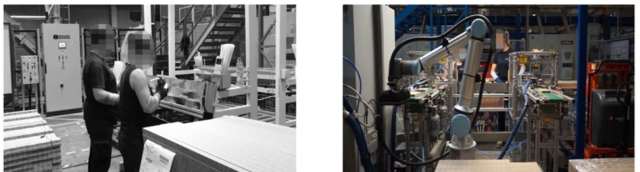
The first use case was focused on an assembly workstation (Figure 1), characterized by the performance of repetitive manual tasks, in which preforms are produced, which are elements that will compose, for example, table tops. As a result of the ergonomic assessment, it was identified that the task of applying glue was the most critical from the point of view of effort and repetitiveness, especially for the hand-wrist system. In addition to the existing musculoskeletal problems and complaints, accidental burns with hot glue were important factors to be corrected, motivating the transformation of this workstation.
Therefore, for the future work cycle, the requirements of work organization were defined, selecting the task of applying glue to be replaced by the robotic system. For the design of the new workstation, anthropometric data were considered and a complete review of standards and legal documents was carried out at this stage, to define a set of requirements
in terms of safety. This design phase and requirements definition are present in the paper Ana Colim et al. (2021). As we demonstrated in Colim et al. (2021b), compared to the previous manual workstation, the improvements are significant in terms of: improvement in working conditions and workers’ satisfaction; an increase of the workers’ trust and confidence to work with cobots; improvement in productivity (7% less cycle time) and the reduction of glue consumption (29% less glue); a significant reduction in musculoskeletal risk (24% to 39% reduction of RULA scores).
Figure 1: Assembly workstation before (on the left) and after (on the right) HRC implementation.
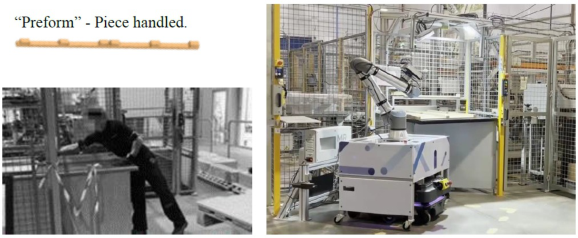
Use Case 2 The second use case was also developed and implemented in the same furniture manufacturing company as the first. The main goal of use case 2 was creating a robotic system to replace a repetitive, monotonous, and manual pick-and-place and palletization of “preforms” (pieces that incorporate the structure of tabletops or shelves, represented in Figure 2). This new system performs three important roles, namely: autonomous palletization (by a UR10e); quality control (throughout a computer vision system); and human- aware navigation (including an autonomous mobile robot MiR 200 with a mobile cart to move the UR10e) between different workstations according to production needs.
Relatively to the human-aware navigation, previously to the shopfloor implementation, several courtesy cues (such as stopping, decelerating, retreating, and retreating and moving aside) were tested and the findings published (Alves et al., 2022). These robotic cues could affect human trust and behavior, being this understanding crucial for improving human-robot collaboration in shared workspaces. The robot used in the study was the MiR 200, equipped with various sensors and programmed to perform the specified courtesy cues at a controlled industrial intersection. Participants’ trust and perception of the robot’s cues were measured using an adapted Human Trust in Automation (HTA) questionnaire (Jian et al., 2000), and their hesitation behaviors were analyzed through video recordings.
Key findings revealed no significant difference in participants’ trust levels across different courtesy cues. However, the legibility of the robot’s actions varied significantly. The retreating cue was the most legible from the forward view, while the decelerate cue led to the least hesitation among participants. The study suggests that while trust in the robot remained stable, the clarity of
Ergonomics and Collaborative Robotics: The Synergy to Prevent Workload 15
the robot’s behaviors and the reduction of human hesitation were influenced by the specific courtesy cues. These insights underscore the importance of designing HRC scenarios with clear and predictable movement patterns to enhance human-robot interaction in industrial environments.
Figure 2: Representation of a “preform” and the workstation before (on the left) and after (on the right) CR implementation.
Use Case 3 Finally, the third use case consists in an ongoing research project, with the title: I-CATER – Intelligent Robotic Coworker Assistant for Industrial Tasks with Ergonomics Rationale. With the current research, we intend to achieve the following outcomes:
1) Real-time ergonomics assessment system to track and evaluate, postures as well as cognitive variables, and extrapolate corrective measures; 2) Reinforcement learning system to map the corrective measures to robotic system inputs; 3) A flexible integrated robotic system capable of executing a shared human-robot task plan and reasoning about the working conditions and human characteristics.
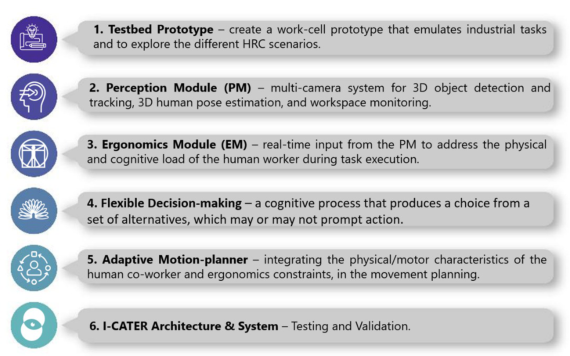
To achieve these goals, we have six main activities as represented in Figure 3.
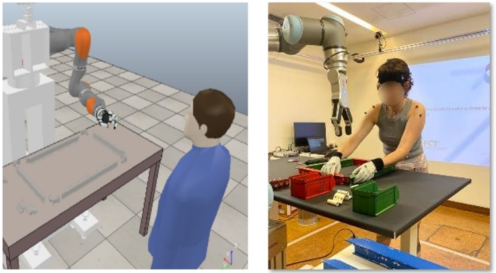
The testbed prototype was inspired by a real-industry scenario of assembly frames for windows, where an ergonomic assessment was performed, including the application of the NASA Task Load Index (NASA-TLX) (Hart, 2006) and RULA method (McAtamney and Corlett, 1993). The ergonomic assessment demonstrated that this assembly task involves teamwork (two workers), a high difficulty level in terms of work content, and a significant prevalence of WMSD risk factors (e.g. awkward postures and repetitive movements). Before the testbed prototype creation, in a virtual context, the future collaborative workstation was tested, and a set of safety and ergonomic requirements (including anthropometric data) were defined for the design. The simulation scenario includes a Kuka collaborative robotic arm attached to a humanoid torso, with anthropomorphic dimensions, to make collaborations more human-like and fluent. Then, in our laboratory, a real-world prototype was created (Figure 4). This is a key premise for the development and testing of the collaborative robotic system.
Figure 3: Research activities of the use case 3.Figure 4: Simulation in CoppeliaSim (on the left), and testbed prototype (on the right).
To evolve the state of the art of current collaborative robotics in the manufacturing industry, we propose to design and implement several modules/components, which, as a whole, will constitute a robotic system and platform for natural and efficient human-robot joint action. The high-level modules that compose the proposal and the robot system are:
1. Flexible and human-aware decision-making: to be a useful and efficient partner the robotic co-worker will be endowed with decision-making at different levels – task level, intention inference, and action selection. Because the robot will have to master various assembly tasks and interaction scenarios with different human partners, such decision- making processes will be intertwined with learning and adaptation processes supported by a knowledge base and a semantic environment. The innovations will be: the integration of ordinal and temporal information that will allow the robot to decide “what sub-task is to be done next” and “when to do it” in each given context; the integration of error communication and implementation of backup actions as
Ergonomics and Collaborative Robotics: The Synergy to Prevent Workload 17
corrective measures; learn how to adapt behavior to different human co-workers. These challenges are addressed in Activity 4 (previously identified in Figure 3). 2. Human-aware motion planning (Activity 5): in human-robot shared tasks, when observing the robot’s movement, the human should be able to understand the robot’s actions, infer the underlying motor intention, and predict its outcome, effortlessly. Hence, the robot’s decision to perform a specific complementary action will be translated into movements that are safe, fluent, smooth, and human-like/human- aware. Fundamental principles of human-motor control can be used to adopt human-like arm-hand motion planning strategies, that are meant to improve human comfort and enhance human-robot interaction and collaboration. The decisions at the motor level, and the generated movements are key elements to improve ergonomics. They should be tuned to the characteristics of the human partner and underlying ergonomics constraints. 3. Real-time assessment of human workload (Activity 3): to make decisions and actions that enhance human safety, well-being, and productivity during human-robot joint action, the robot needs to receive real-time measures of human activity. To this end, we will develop an ergonomics module for real-time assessment of the workload to which the human co-worker is exposed. New, will be: creating an assessment framework appropriate to the HRC tasks, that will integrate physical and cognitive ergonomic criteria; mapping of identified risk factors to ergonomic corrective measures; mapping of corrective actions to adequate robot behaviors or constraints, based on the ergonomic criteria and assessments. 4. General real-time perception module (Activity 2): HRC in shared tasks usually takes place in very dynamic and unconstrained scenarios. Thus, we will develop a perception module that allows, in real-time, 3D detection and tracking of task-related objects of interest, 3D human pose estimation, and workspace monitoring. The research focus will be on the generalization of the developed components, to add to the versatility and flexibility of the solution.
Summarily, our current research aims to create the first intelligent and human-aware ergonomic cobot. This next generation of robotic co-workers will enhance human capabilities, ergonomic criteria, and efficiency in assembly industrial tasks.
CONCLUSION
The synergy between Ergonomics and Collaborative Robotics presents a promising avenue for the development of human-centered assembly workstations. This article highlights the transformative potential of integrating HRC in industrial assembly tasks, according to human-centered design, significant improvements in ergonomic conditions and workers’ well-being were observed.
Our research underscored the importance of a multi-method approach that combines ergonomic assessments, real-time data collection, and workers’ engagement to create adaptive and safe work environments. The three use cases detailed in this study demonstrated the practical benefits of HRC in mitigating musculoskeletal risk factors and enhancing overall work conditions. Furthermore, the ongoing research project, I-CATER, aims to advance this field by developing an intelligent and flexible robotic coworker capable of real-time ergonomics assessment and adaptive task planning. This research seeks to create a next-generation ergonomic cobot that enhances human capabilities and ensures sustainable productivity.
ACKNOWLEDGMENT
This work was supported by FCT within Project I-CATER: Intelligent Robotic Coworker Assistant for industrial Tasks with an Ergonomics Rationale, reference PTDC/EEI-ROB/3488/2021.
REFERENCES
Alves, C., Cardoso, A., Colim, A., Bicho, E., Braga, A. C., Cunha, J., Faria, C., Rocha, L. A., 2022. Human–Robot Interaction in Industrial Settings: Perception of Multiple Participants at a Crossroad Intersection Scenario with Different Courtesy Cues. Robotics 11. https://doi.org/10.3390/robotics11030059 Beuß, F., Sender, J., Flügge, W., 2019. Ergonomics simulation in aircraft manufacturing – Methods and potentials. Procedia CIRP 81, 742–746. https://doi.org/10.1016/j.procir.2019.03.187 Borg, G., 1990. Psychophysical scaling with applications in physical work and the
perception of exertion. Scand J Work Environ Health 16, 55–58. https://doi.org/ 10.5271/sjweh.1815 Breque, M., De Nul, L., Petridis, A., 2021. Industry 5.0: Towards a sustainable, human-centric and resilient European industry. https://doi.org/10.2777/308407 Cardoso, A., Colim, A., Bicho, E., Braga, A. C., Menozzi, M., Arezes, P., 2021.
Ergonomics and human factors as a requirement to implement safer collaborative robotic workstations: A literature review. Safety 7. https://doi.org/10.3390/safety 7040071 Chen, D., Cai, Y., Cui, J., Chen, J., Jiang, H., Huang, M., 2018. Risk factors identification and visualization for work-related musculoskeletal disorders with wearable and connected gait analytics system and kinect skeleton models. Smart Health 7–8, 60–77. https://doi.org/10.1016/j.smhl.2018.05.003 Colim, A., Cardoso, A., Arezes, P., Braga, A. C., Peixoto, A. C., Peixoto,
V., Wolbert, F., Carneiro, P., Costa, N., Sousa, N., 2021a. Digitalization of musculoskeletal risk assessment in a robotic-assisted assembly workstation. Safety 7. https://doi.org/10.3390/safety7040074 Colim, Ana, Faria, C., Cunha, J., Oliveira, J., Sousa, N., Rocha, A., 2021. Physical Ergonomic Improvement and Safe Design of an Assembly Workstation through Collaborative Robotics. Safety 7, 2–18. https://doi.org/10.3390/safety/7010014 Colim, A., Morgado, R., Carneiro, P., Costa, N., Faria, C., Sousa, N., Rocha, L. A.,
Arezes, P., 2021b. Lean Manufacturing and Ergonomics Integration : Defining Productivity and Wellbeing Indicators in a Human – Robot Workstation 13, 1931. https://doi.org/https://doi.org/10.3390/su13041931
Ergonomics and Collaborative Robotics: The Synergy to Prevent Workload 19
Ding, X., Guan, Z., Liu, N., Bi, M., Ji, F., Wang, H., Zhang, X., Liu, B., Niu, D., Lan, T., Xie, T., Li, J., Yan, T., 2023. Prevalence and risk factors of work-related musculoskeletal disorders among emerging manufacturing workers in Beijing, China. Front Med (Lausanne) 10. https://doi.org/10.3389/fmed.2023.1289046 Gualtieri, L., Rauch, E., Vidoni, R., 2021. Emerging research fields in safety and
ergonomics in industrial collaborative robotics: A systematic literature review. Robot Comput Integr Manuf 67, 101998. https://doi.org/10.1016/j.rcim.2020. 101998 Guimarães, L., Anzanello, M. J., Ribeiro, J. L. D., Saurin, T. A., 2015. Participatory ergonomics intervention for improving human and production outcomes of a Brazilian furniture company. Int J Ind Ergon 49, 97–107. https://doi.org/10.1016/ j.ergon.2015.02.002 Hart, S. G., 2006. NASA-task load index (NASA-TLX); 20 years later. Proceedings
of the Human Factors and Ergonomics Society 904–908. https://doi.org/10.1177/ 154193120605000909 IEA, ILO, 2021. Principles and guidelines for human factors/ergonomics (HFE) design and management of work systems. International Labour Organization publications, Geneva, Switzerland. Jian, J.-Y., Bisantz, A. M., Drury, C. G., 2000. Foundations for an Empirically
Determined Scale of Trust in Automated Systems. Int J Cogn Ergon 4, 53–71. https://doi.org/10.1207/s15327566ijce0401_04 John, K. K., Adarsh, S. N., Pattali, V., 2020. Workers to super workers: A brief discussion on important technologies for industry 5.0 manufacturing systems. AIP Conf Proc 2311, 0–6. https://doi.org/10.1063/5.0034521 McAtamney, L., Corlett, N., 1993. RULA: A survey method for the investigation of
work-related upper limb disorders. Appl Ergon 24, 91–99. Nahavandi, S., 2019. Industry 5.0 — A Human-Centric Solution. Sustainability 11,
4371. https://doi.org/https://doi.org/10.3390/su11164371 Patil, S., Vasu, V., Srinadh, K. V. S., 2023. Advances and perspectives in collaborative robotics: A review of key technologies and emerging trends. Discover Mechanical Engineering 2. https://doi.org/10.1007/s44245-023-00021-8 Peruzzini, M., Pellicciari, M., 2017. Advanced Engineering Informatics A framework
to design a human-centred adaptive manufacturing system for aging workers. Advanced Engineering Informatics 33, 330–349. https://doi.org/10.1016/j.aei. 2017.02.003 Xu, X., Lu, Y., Vogel-Heuser, B., Wang, L., 2021. Industry 4.0 and Industry 5.0— Inception, conception and perception. J Manuf Syst 61, 530–535. https://doi.org/ 10.1016/j.jmsy.2021.10.006
LISTED IN THE AHFE DIGITAL BOOKSTORE CATALOGUE
Explore the complete digital volume
Human Interaction and Emerging Technologies (IHIET 2024)
Read this individual research paper free through the original publisher, or explore the full digital proceedings book.
ISBN 978-1-964867-33-5
Explore this ISBN in the AHFE Bookstore ↗Listed in the July 2026 bookstore catalogue; search by ISBN to confirm current availability · Digital book purchase optional