Ana Colim, André Cardoso, Estela Bicho, Luís Louro, Carla Alves, Pedro Ribeiro, Débora Pereira, Sérgio Monteiro, Nélson Costa, Paula Carneiro, Sacha Mould, João Oliveira, Duarte Fernandes, Pedro Arezes (2023). On the development of an ergonomic approach for the design of an industrial robotic coworker. In: Human Interaction & Emerging Technologies (IHIET 2023): Artificial Intelligence & Future Applications. AHFE Open Access, vol. 111, pp. 9–18. https://doi.org/10.54941/ahfe1004004
1 DTx – Digital Transformation Colab, Azurém Campus of University of Minho 4800–058 Guimarães, Portugal; Algoritmi Centre, Azurém Campus of University of Minho 4800–058 Guimarães Portugal ↗
2 Algoritmi Centre, Azurém Campus of University of Minho 4800–058 Guimarães, Portugal ↗
3 DTx – Digital Transformation Colab, Azurém Campus of University of Minho 4800–058, Guimarães, Portugal ↗
As industries push for continuous technological innovation to boost their competitiveness, the need to balance techno-economical goals with emerging societal needs is now more pressing than ever. Inspired by the novel paradigm of Industry 5.0, we aim to place human physical and cognitive needs at the center of the production process, introducing proactive and human-aware robots capable of collaboration as co-workers. Although Human-Robot Collaboration (HRC) has successfully permeated different industrial sectors, they still have a relatively limited role as agents that share the human workspace mostly executing pre-programmed actions. Based on this gap a research project is ongoing, including researchers in Ergonomics and Robotics. The current article presents the first stage related to the design of a workstation prototype that emulates industrial tasks and will allow us to explore the different HRC scenarios. The selection of the assembly task was supported by ergonomic assessment (Rapid Upper Limb Assessment), and questionnaires focused on the workers' psychophysical and cognitive overload perceived. Then, the CoppeliaSim simulation software was used to allow us to accurately reproduce both the visual and the physical aspects of the prototype, including the model of a humanoid abstract avatar. In addition, a set of ergonomic and safety requirements were defined to support the human-centered design of the prototype. The results of this research phase will be important for the next steps of our project and for other researchers/industrial practitioners focused on the human-centered design of HRC scenarios.
The role of Ergonomics & Human Factors (E&HF) on HRC systems design is an emergent research topic and a fundamental parameter in industrial engi- neering, to improve the efficiency and effectiveness of industrial processes (Cotta et al., 2021; Kadir and Broberg, 2021). The risk of Work-related
Musculoskeletal Disorders (WMSD) is often associated with physical risks present at the workstations (e.g. repetitive handling tasks, and awkward postures) (Chen et al., 2018). Recent studies (Colim et al., 2020; Colim, Morgado, et al., 2021) presented ergonomic interventions based on robotic solutions to support manual assembly/packing tasks and to mitigate WMSD risk. However, in these, as in many other industrial applications of HRC (Vil- lani et al., 2018), the robots are programmed to repetitively perform a specific complementary action, in strict and limited coordination with the human par- tner. Ergonomic improvement needs to be planned, and any modifications to the workstation, workflow, or personnel are neglected until a new ergonomic assessment, workstation adjustment, and robot reprogramming.
The link between COBOTs and the improvement of work conditions is not new, and yet, ergonomics criteria have seldom been factored into robotic controllers (Gualtieri, Rauch and Vidoni, 2021). This statement is supported by the scarce number of scientific papers that address the synergy between collaborative robotics and ergonomics, resulting in an open research chal- lenge. Improving working conditions using an adaptive robot coworker is a multi-faced problem. Two key aspects of the acceptance of this technology concern the workers’ psychological and physical well-being.
On the topic of psychological well-being, El Makrini et al. proposed a robotic system architecture capable of perceiving faces and gestures and gene- rating human-like behavior. The concept, tested in the laboratory with the collaborative assembly and inspection of a box, was successfully transpo- sed to an automotive assembly line (El Makrini et al., 2018). Even though the system was able to increase productivity and perceive faces and gestu- res, it lacks consideration for ergonomic indicators, namely the position and velocity at which objects are passed. Being able to adapt to the human co- worker entails the perception of the task, of the robot’s limits, and the sense of opportunity to proactively interfere with the task plan. Roncone, Mangin and Scassellati (2017) proposed a robotics framework to do just that and to query and be transparent with the coworker in case of uncertainty. This idea was tested in two HRC assembly scenarios, one where the robot is explicitly told what to do, and another where the robot autonomously and interactively partakes in the task. The last concluded the task 10% faster.
Regarding physical well-being, Peternel et al. (2017) proposed a method to adapt the robot’s behavior according to the worker’s fatigue – measured by Surface Electromyography (EMG). The robot imitates or learns its role from the worker in a co-manipulation wood-cutting task and then assumes the lead if human fatigue is detected. Cherubini et al. (2016) presented a human- centered robotic solution for a joint assembly line with a higher incidence of WMSD. The robot adjusts workpieces as the human coworker executes the task, resulting in lower cycle times and lower WMSD risk. Maurice et al. (2017) present a tool to optimize the design of collaborative robot workstati- ons for co-manipulation tasks. They propose multiple ergonomic indicators to assess the biomechanical demands throughout a task activity that is ite- ratively simulated. The robot parameters, its fixation position, and its role a readjusted by an optimization algorithm to minimize the biomechanical demand.
On the Development of an Ergonomic Approach for the Design 11
Although these previous approaches are sensitive to ergonomic indicators, they are not substantiated by a comprehensive ergonomic assessment integra- ting physical and cognitive factors. The high-level robot reasoning is based on instantaneous measurements and fails to account for intrinsic variables, i.e. task repeatability, human co-worker limitations, preferences, or techno- logical acquaintance. A comprehensive analysis of the design requirements is needed for the acceptance and success of these novel HRC workstations that can adapt to the human worker.
One of the challenges of the current research is the definition of a conce- ptual framework that can be applied to design the next generation of HRC workstations, comprehending a wide range of risk factors to provide a detailed and comprehensive assessment of the work cell for different tasks. However, to develop this research, a first phase related to the HRC prototype design is essential and the current paper is focused on this. Therefore, the main goal of this article is to summarize the human-centered design metho- dology for the creation of a workstation prototype that emulates industrial tasks and allows the exploration of different HRC scenarios.
METHODOLOGY
In the current study, the idea is to design a prototype inspired by real-industry production lines and workstations with potential for HRC (as defended by Teiwes et al., 2016). Considering a real-industry scenario, a windows frame assembly workstation was selected, but having in mind a replication effect. This selection was based on the following criteria: the need for teamwork (two workers cooperate), the task difficulty in terms of work content, and the prevalence of WMSD risk factors (e.g. awkward postures, manual and repeti- tive work). The participants signed an Informed Consent Term in agreement with the Committee of Ethics for Research in Social and Humans Sciences of the University of Minho (approval number CEICSH 038/2020), respecting the Declaration of Helsinki.
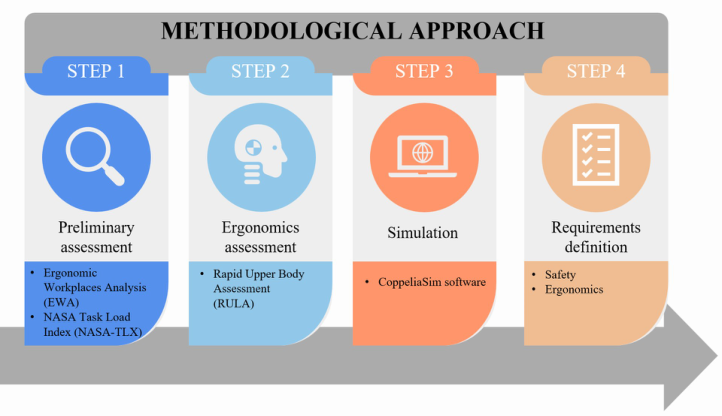
To support the prototype workstation design, the following methodo- logical approach was adopted: (i) preliminary ergonomic analysis of the real-world industry workstation through a screening method and question- naires applied to workers; (ii) ergonomic assessment considering the different tasks performed on the selected workstation; (iii) virtual of the prototype workstation; (iv) definition of safety and ergonomic requirements for the prototype (Figure 1).
Concerning the preliminary analysis, the Ergonomic Workplace Analy- sis (EWA) (Ahonen, Launis and Kuorinka, 1989) was applied, considering the topics: workspace, general physical activity, lifting tasks, work postures and movements, risk of an accident, work content, restrictiveness, workers’ communication, decision-making, work repetitiveness, and level of requi- red attention. This method incorporates assessments from both workers and analysts. The workers express their opinion about these topics by a scale with a four-level rating scale: “very bad” (- -); “bad” (-); “good” (+); “very good” (+ +). On the other hand, the analysts use a scale of four- or five-level (depending on the topic), in which the higher scores (four or five) indicate
Figure 1: Methodological approach for the human-centered design of the HRC pro- totype workstation.
the worst condition. In this phase, the NASA Task Load Index (NASA-TLX) (Hart, 2006) was used to collect the cognitive workload perceived by the wor- kers, including the categories of mental demand, physical demand, temporal demand, own performance, effort, and frustration level (Evans and Fendley, 2017). Each category is assessed using a scale ranging from 5 to 100 points (Rossato et al., 2021). Scores higher than 50 indicate higher levels in each category.
After several work cycles observation, a list of tasks necessary to assemble a window was listed. Then, for each task, three postures (the most frequently adopted by the workers) were assessed by the Rapid Upper Limb Assessment (RULA) (McAtamney and Corlett, 1993). The RULA application includes the postures assessment, as well as the forces exerted, the repetitiveness of move- ments, external loads (such as handling heavy materials), the occurrence of static/repetitive muscle work, and force exertion. For each posture, different joint angles were associated with a joint score according to a predefined range of angles (higher scores indicate inadequate postures). These joint scores lead to a final RULA score and respective risk level. A descriptive analysis of the data was conducted to calculate the mean values of quantitative variables (e.g. age and RULA scores).
Then, the CoppeliaSim software (version 4.4.0) was used to allow us to accurately reproduce both the visual and the physical aspects of the pro- totype, including the model of a humanoid abstract avatar. This simulation accelerated the prototyping phase by facilitating the test and validation of different cell layouts and task workflows. As the scenario is validated in simulation, a real-world prototype of the actual workstation was constructed, integrating ergonomic requirements. The physical dimensions and configura- tion were defined according to the anthropometric data for the Portuguese
On the Development of an Ergonomic Approach for the Design 13
population (Barroso et al., 2005). Finally, a risk assessment procedure to address the relevant essential health and safety requirements was conducted, respecting the Machine Directive (2006/42/EC) and the Use of Work Equi- pment Directive (2009/104/EC), as well as guidelines of relevant international safety standards, namely – EN ISO 10218–2 and ISO/TS 15066.
RESULTS AND DISCUSSION
In the current study, as previously mentioned, an assembly workstation of frames for windows production was considered, including the two workers allocated (with a mean age of 44.0 ± 12.7 years old and seniority at work of 3.5 ± 3.53 years), all of them right-handed and with no previous musculo- skeletal disorders. The EWA results, including the workers’ perceptions and the analysts’ assessment, are summarized in Table 1.
According to the EWA results, the most critical topics are “Work postu- res and movements”, “Decision-making” and “Level of required attention”. In these topics, the analysts’ and workers’ assessments are in accordance, and these demonstrate that the workstation reveals physical and cognitive
Table 1. EWA results.
Table available in the original PDF paper.
Justification
Topic Workers’ score
Analysts’ Assessment
1. Workspace ++ 3 Workbench height and length are inadequate and do not respect anthropometric data. 2. General physical activity
++ 3 The activity depends on work organization. The risk of overload due to work peaks is present in some situations. 3. Lifting tasks ++ 2 Heavier load weights 6 kg. 4. Work postures and movements
-- 4 Rotation or flexion of the neck and/or raising the arms above the shoulders. Trunk rotation and inclination without support. 5. Risk of accident - 2 There are conditions for incorrect postures (serious severity, low probability). 6. Work content -- 3 The worker only performs a part of the work entity. 7. Restrictiveness ++ 2 Tasks or work methods are sometimes constrained by process requirements or production methods. 8. Workers’ communication
++ 2 Cycle duration between 20–30 minutes.
++ 1 Special care is taken to ensure that communication and contacts between workers and other people are possible. 9. Decision-making - 5 A wrong decision can lead to material damage. 10. Work repetitiveness
11. Level of required attention
-- 4 High level of attention in more than 80% of the cycle.
Table 2. NASA TLX results.
Table available in the original PDF paper.
Effort Performance Frustration
Category Mental demand
Physical demand
Temporal demand
Score (0 to 100) 65 30 35 70 20 50
ergonomic concerns. Moreover, NASA TLX results (Table 2) corroborate this assumption, indicating that the main contributors to the cognitive wor- kload experienced by the workers are the effort (70 points) to achieve a high level of performance and the cognitive demand (65 points). These results may be due to the varied number of window references to be assembled on this workstation and, consequently, due to the differences in the working procedures.
Relatively to the RULA results (Table 3), these indicate that the assembly tasks present WMSD risk, being T1, T6, and T8 as the tasks with higher risk, and an ergonomic intervention is required soon. Foreseeing the development of a future robotic coworker, this ergonomic assessment will play an impor- tant role in assembly task allocation and sharing between the human and the robot.
Globally, the ergonomic assessment points out that these assembly wor- kers are exposed to a significant physical workload. Repetitiveness, awkward postures adoption, and manual handling loads, among other risk factors, are
Table 3. Assembly tasks description and RULA results (bold denotes the higher RULA score).
Table available in the original PDF paper.
Task Task description Rating mean (SD) Risk level 5.5 (1.0) C T1 Reach components and tools for the assembly.
4.3 (0.6) B
T2 Apply the glue on the edge of the frame preforms.
4.0 (0.0) B
T3 Apply bicomponent (for adhesion and filling of voids in the metallic structures) inside the frame preforms.
2.7 (1.2) A
T4 Insert the squares (components needed for joint different preforms) inside of the preforms.
4.4 (1.1) B
T5 Assemble the window frame (jointing the preforms).
6.8 (0.4) C
T6 Place the metal pins to guarantee the window frame stability.
4.7 (1.2) B
T7 Apply again bicomponent for finishing the frame.
3.5 (1.0) B
T8 Clean the surplus bicomponent. 5.3 (1.3) C T9 Quality control of the frame handling it in different orientations.
Risk levels defined by the final scores RULA (McAtamney and Corlett, 1993): A – The posture is acce- ptable if it is not maintained or repeated for long periods; B – Further investigation is needed and changes may be required; C – Investigation and changes are required soon; D – Investigation and changes are required immediately.
On the Development of an Ergonomic Approach for the Design 15
present in the assessed tasks and consist of a problem transversal to a wide assembly job (Schaub et al., 2013; Cardoso, Colim and Sousa, 2020; Colim, Cardoso, et al., 2021). HRC manufacturing has been proposed as a poten- tial solution to improve workstation conditions, eliminating some of these risk factors. This theory was tested in several studies (Cherubini et al., 2016; Villani et al., 2018; Colim, Cardoso, et al., 2021) with promising results in the reduction of the physical and cognitive workload and the decrease of the WMSD risk, as intended on the current research.
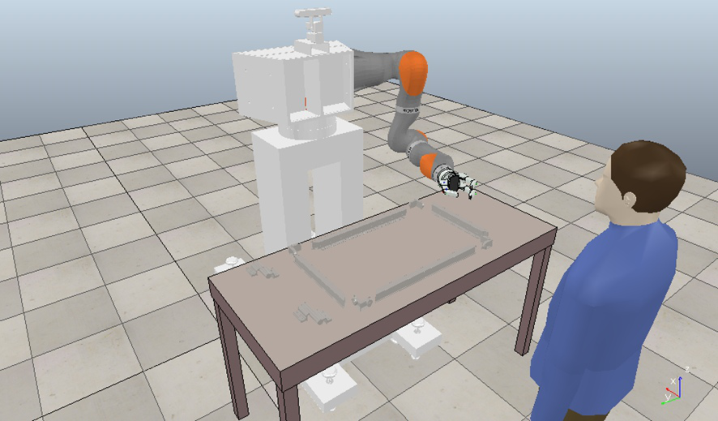
Considering this real-industry scenario and ergonomic concerns related to the manual assembly described, the simulation scenario (created in Coppelia- Sim includes a physics engine and a graphics engine, to make the simulations more realistic, reproducing both the visual and physical aspects of the HRC workstation. The simulation scenario (Figure 2) includes the Kuka LBR 14 R820 collaborative robotic arm and a Barrett Hand with 3 fingers attached to it. The robotic arm is attached to a humanoid torso, with anthropomor- phic dimensions, to make collaborations with the human more human-like and fluent. A human avatar is also added to simulate realistic interactions. Considering the window frames assembly task, CAD models were created for each of the components of the task and a workspace will be created.
Relatively to the safety requirements of the system, the selected robot presents a performance level d for safe HRC to EN ISO 13849-1. The end- effector chosen to be installed on the robotic arm respects the following normative compliances: ISO 9409-1-50-4-M6, EN ISO 8734, EN ISO 4762, EN ISO 10642.
It should be highlighted that since the initial phases of a human-centered design of HRC workstations, the ergonomics and safety requirements have to be considered (Villani et al., 2018; Faria et al., 2020). Therefore, concerning the ergonomic requirements and ensuring that the prototype workstation
Figure 2: Simulation of the HRC scenario.
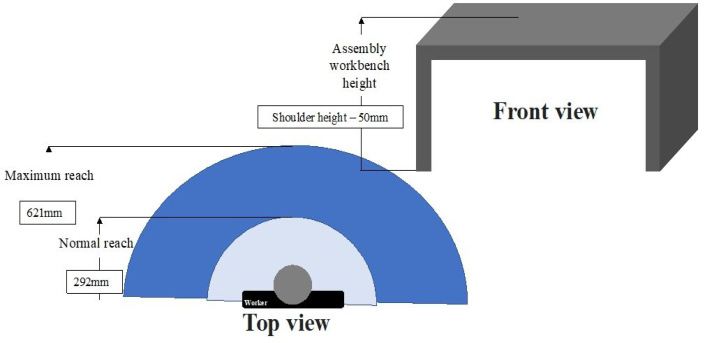
design potentiates WMSD prevention, the physical dimensions of the work- bench were defined according to the dimensions of the Portuguese population (Barroso et al., 2005). From an ergonomic point of view, the height of a workbench for manual labor should be close to the neutral elbow position (Pheasant, 2003). To respect this requirement the workbench selected for the prototype is adjustable in height, allowing its adjustment for each par- ticipant – below 50 mm to the elbow height as recommended by Konz and Steven (2016).
Additionally, considering the Portuguese database (Barroso et al., 2005), the normal reach dimension (for frequent manual tasks) was defined accor- ding to wrist elbow distance of the 5th female percentile. The maximum reach dimension was defined according to the anterior functional reach of the 5th female percentile. The clearance was defined according to the shoulder width of the 95th male percentile. These dimensions are represented in Figure 3.
As the scenario is validated in simulation, a real-world prototype of the assembly workstation will be constructed, including the safety and ergonomic requirements, previously described. This is a key premise for the development and testing of the future collaborative robotic system.
As mentioned above, this article presents the first phase of a research pro- ject focused on natural and efficient industrial HRC on a true peer-to-peer level, that will explore dynamic interactions and unstructured collaboration plans for the future industrial robotic co-worker. In this domain, ergonomic and occupational safety requirements are of crucial importance (Gualtieri, Rauch and Vidoni, 2021) to guarantee the human-centered design of the pro- totype that will support the experiments with HRC. Moreover, it is intended to demonstrate that this design approach, including a comprehensive asses- sment of the industrial tasks and risk factors, is necessary to develop research significant and aligned with real industry needs.
The results show that the methodology adopted sets an adequate founda- tion to accelerate the design and development of novel human-centered HRC
Figure 3: Relevant dimensions of the workbench for the workstation prototype.
On the Development of an Ergonomic Approach for the Design 17
workstations. Therefore, these results will be important for the next steps of our project, supporting the creation of the HRC workstation prototype focu- sed on an industrial assembly task. In addition, the methodological approach adopted could be also relevant for other researchers/industrial practitioners focused on the human-centered design of HRC scenarios.
ACKNOWLEDGMENT
This work has been supported by FCT within Project I-CATER: Intelligent robotic Coworker Assistant for industrial Tasks with an Ergonomics Rati- onale, reference PTDC/EEI-ROB/3488/2021. This work was also supported under the base funding project of the DTx CoLAB - Collaborative Labora- tory, under the Missão Interface of the Recovery and Resilience Plan (PRR), integrated in the notice 01/C05-i02/2022, which aims to deepen the effort to expand and consolidate the network of interface institutions between the academic, scientific and technological system and the Portuguese business fabric. In addition, this work was supported by R&D Unit Project Scope UIDB/00319/2020 and by the Ph.D. Grants: SFRH/BD/151365/2021 (fina- nced by the Portuguese FCT, and with funds from state budgets, under MIT Portugal Program); and 2022.13737.BDANA (financed by the Portuguese FCT).
REFERENCES
Ahonen, M., Launis, M. and Kuorinka, T. (1989) Ergonomic workplace analysis.
Edited by F. I. of O. H. Ergonomics Section. Institute of Occupational Health. Barroso, M. P. et al. (2005) ‘Anthropometric study of Portuguese workers’, International Journal of Industrial Ergonomics, 35(5), pp. 401–410. doi: 10.1016/j.ergon.2004.10.005. Cardoso, A., Colim, A. and Sousa, N. (2020) ‘The Effects of a Passive Exoskeleton on
Muscle Activity and Discomfort in Industrial Tasks’, Studies in Systems, Decision and Control, 277, pp. 237–245. doi: 10.1007/978-3-030-41486-3_26. Chen, D. et al. (2018) ‘Risk factors identification and visualization for workrelated musculoskeletal disorders with wearable and connected gait analy- tics system and kinect skeleton models’, Smart Health, 7–8, pp. 60–77. doi: 10.1016/j.smhl.2018.05.003. Cherubini, A. et al. (2016) ‘Collaborative manufacturing with physical human-
robot interaction’, Robotics and Computer-Integrated Manufacturing, 40. doi: 10.1016/j.rcim.2015.12.007. Colim, A. et al. (2020) ‘Ergonomic Intervention on a Packing Workstation with Robotic Aid – Case Study at a Furniture Manufacturing Industry’, WORK: A Journal of Prevention, Assessment, and Rehabilitation, 66(1), pp. 229–237. doi: https://doi.org/10.3233/WOR-203144. Colim, A., Cardoso, A., et al. (2021) ‘Digitalization of musculoskeletal risk asses-
sment in a robotic-assisted assembly workstation’, Safety, 7(4). doi: 10.3390/sa- fety7040074. Colim, A., Morgado, R., et al. (2021) ‘Lean Manufacturing and Ergonomics Integration : Defining Productivity and Wellbeing Indicators in a Human – Robot Workstation’, 13, p. 1931. doi: https://doi.org/10.3390/su13041931. Cotta, J. et al. (2021) Industry 5.0 - Towards a sustainable, human-centric and
resilient European industry. Brussels: European Comission. doi: 10.2777/308407.
Evans, D. C. and Fendley, M. (2017) ‘A multi-measure approach for connecting cognitive workload and automation’, International Journal of Human Computer Studies. Elsevier, 97, pp. 182–189. doi: 10.1016/j.ijhcs.2016.05.008. Faria, C. et al. (2020) ‘Safety Requirements for the Design of Collaborative Robo-
tic Workstations in Europe – A Review’, in Advances in Intelligent Systems and Computing, pp. 225–232. doi: 10.1007/978-3-030-50946-0_31. Gualtieri, L., Rauch, E. and Vidoni, R. (2021) ‘Emerging research fields in safety and ergonomics in industrial collaborative robotics: A systematic literature review’, Robotics and Computer-Integrated Manufacturing. Elsevier Ltd, 67(April 2020), p. 101998. doi: 10.1016/j.rcim.2020.101998. Hart, S. G. (2006) ‘NASA-task load index (NASA-TLX); 20 years later’, Pro-
ceedings of the Human Factors and Ergonomics Society, pp. 904–908. doi: 10.1177/154193120605000909. Kadir, B. A. and Broberg, O. (2021) ‘Human-centered design of work systems in the transition to Industry 4.0’, Applied Ergonomics. Elsevier Ltd, 92, p. (In revision). doi: https://doi.org/10.1016/j.apergo.2020.103334. Konz, S. and Steven, J. (2016) Work design: occupational ergonomics. 7th edn. Boca
Raton, Flórida, USA: CRC Press Taylor and Francis Group. El Makrini, I. et al. (2018) ‘Working with Walt: How a Cobot Was Developed and Inserted on an Auto Assembly Line’, IEEE Robotics and Automation Magazine, 25(2), pp. 51–58. doi: 10.1109/MRA.2018.2815947. Maurice, P. et al. (2017) ‘Human-oriented design of collaborative robots’, Inter-
national Journal of Industrial Ergonomics. Elsevier Ltd, 57, pp. 88–102. doi: 10.1016/j.ergon.2016.11.011. McAtamney, L. and Corlett, N. (1993) ‘RULA: A survey method for the investigation of work-related upper limb disorders’, Applied Ergonomics, 24(2), pp. 91–99. Peternel, L. et al. (2017) ‘Towards Ergonomic Control of Human-Robot Co-
Manipulation and Handover’, in IEEE RAS International Conference on Humanoid Robots. Birmingham, UK: IEEE, pp. 55–60. doi: 10.1109/HUMA- NOIDS.2017.8239537. Pheasant, S. (2003) Bodyspace: Anthropometry, Ergonomics and the Design of Work. Second Edi, Paraplegia. Second Edi. Roncone, A., Mangin, O. and Scassellati, B. (2017) ‘Transparent role assi-
gnment and task allocation in human robot collaboration’, IEEE Inter- national Conference on Robotics and Automation (ICRA), pp. 1014–1021. doi: 10.1109/ICRA.2017.7989122. Rossato, C. et al. (2021) ‘Facing with Collaborative Robots : The Subjective Experience in Senior and Younger Workers’, Cyberpsychology, Behavior, and Social Networking, 24(5), pp. 349–356. doi: 10.1089/cyber.2020.0180. Schaub, K. et al. (2013) ‘The European Assembly Worksheet’, Theoretical Issues in
Ergonomics Science, 14(6), pp. 616–639. doi: 10.1080/1463922X.2012.678283. Teiwes, J. et al. (2016) ‘Identifying the potential of human-robot collaboration in automotive assembly lines using a standardised work description’, in 2016 22nd International Conference on Automation and Computing (ICAC). IEEE, pp. 78–83. doi: 10.1109/IConAC.2016.7604898. Villani, V. et al. (2018) ‘Survey on human–robot collaboration in industrial settings:
Safety, intuitive interfaces and applications’, Mechatronics. Elsevier, 55(March), pp. 248–266. doi: 10.1016/j.mechatronics.2018.02.009.
Read this individual research paper free through the original publisher, or explore the full digital proceedings book.
ISBN 978-1-958651-87-2
Explore this ISBN in the AHFE Bookstore ↗Listed in the July 2026 bookstore catalogue; search by ISBN to confirm current availability · Digital book purchase optional