Barry Kirwan, Roberto Venditti, Simone Pozzi (2023). Human Risk-Informed Design Framework (HURID) for integrating human factors in the design of systems and operations. In: Human Interaction & Emerging Technologies (IHIET 2023): Artificial Intelligence & Future Applications. AHFE Open Access, vol. 111, pp. 1–8. https://doi.org/10.54941/ahfe1004003
This paper presents the Human Risk-Informed Design framework (HURID). HURID facilitates the integration of human factors into the design of systems and operations, safety assessment, and regulation. The scarcity of human factors data obtained from the investigation of domain accidents/incidents and the lack of effective feedback loops from operations back to designers create challenges to making human risk-informed decisions. HURID aims to fill these gaps by providing a standardised approach for data collection and analysis, supporting operators in making the right design decisions. The framework was developed to be scalable, proportionate to the risks involved, and customisable. HURID consists of five main steps to ensure the inclusion of Human Factors in risk-informed design: 1. Understanding the Design Intent, 2. Analysis of relevant past experience, 3. Application of Human Assurance Tools and Methods, 4. Risk Modelling, and 5. Consolidation of Design Requirements. During these phases, the framework entails the use of tools such as an incident taxonomy - named SHIELD - which allows to systematically identify the Human positive and negative contributions, precursors, organisational aspects; the Human Assurance Toolkit, which includes the state-of-the-art of HF methods and tools in the context of designing/redesigning safety-critical systems or operations; and Risk Models, which are tools that represent the major accident categories and provide information about human actions and influences that affect human performance. HURID is also supported by a web-based tool, the Human Factors Compass, whose purpose is to guide the user in the application of one or more of the HURID components. The Human Factors Compass was the result of a user-centred design process that aimed to identify user requirements and then solve the main pain points for operators that are unsure as to how to integrate human factors in their day-to-day work. The paper presents an aviation case study detailing how the HURID framework supported the design team in the different design phases, to collect human data and derive design decisions.
Although human error is often cited as a major cause in many accidents in high-risk industries (e.g. energy, transport), Human Factors – which aims to get the design right in the first place and avoid such errors – is often missing
in the crucial design phases. This can be for several reasons: a lack of Human Factors expertise inside high-risk organisations; a lack of understanding and awareness of Human Factors and how and where it fits into design proces- ses; cost considerations, etc. These obstacles to Human Factors inclusion in design processes are not so easily dismissed; it can be hard to find Human Factors expertise for new domains, Human Factors itself is not always that easy to understand (e.g. there are so many methods and techniques to choose from), and sometimes the cost of Human Factors can seem disproportionate to the system being considered.
There are areas where the design generally gets it right, such as comme- rcial cockpit design, nuclear power plants, and defence, all of which have strong Human Factors traditions and Human Factors integration through- out the entire design, manufacturing and operational phases. The first two also have strong regulation on Human Factors, although in aviation this pri- marily concerns the cockpit. The question is, therefore, one of how to spread such good practices to other industry sectors, in a way that is digestible and scalable to their requirements and resources.
THE SAFEMODE PROJECT: CHARTING PATHS TO NAVIGATE THROUGH HUMAN FACTORS IN AVIATION & MARITIME DOMAINS An EU-funded Horizon 2020 project (2019-2022) known as SAFEMODE (https://safemodeproject.eu/) was given the objective of helping maritime organisations learn Human Factors integration from aviation. The starting point was a review of all the information and guidance / standards on cock- pit Human Factors, as well as reviewing the SESAR Human Performance Assessment Process (HPAP) applied to new European air traffic management solutions. However, the former tends to require significant Human Factors expertise in interpreting the guidance and standards, and the latter was seen by stakeholders as too ‘resource-heavy’ a process for maritime design, and was generally only applicable for mature design concepts, whereas someti- mes what was wanted were ‘quick look’ approaches for exploratory designs. While carrying out six use cases during SAFEMODE (three aviation and three maritime) the design teams (comprising designers, safety and Human Factors people, system operators, etc.) working on them were all convinced of the added value of Human Factors (Moreno-Alarcon et al., 2022). However, there were two recurring ‘pain points’ regarding the concrete application of Human Factors in design processes: knowing which techniques to apply out of the selection available, and in what sequence. In general, the underlying problem for design teams was understanding the Human Factors landscape, which was perceived as akin to an intricate forest full of useful information, yet one which is hard to navigate.
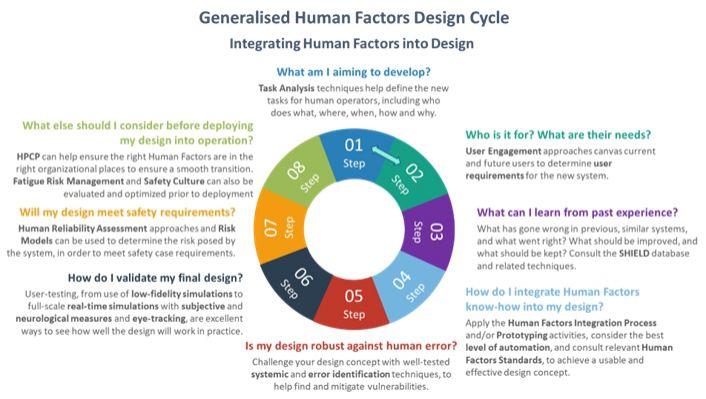
A COMMON HUMAN FACTORS FRAMEWORK Early on in SAFEMODE a range of useful techniques and a harmonised cycle of activities was developed, as shown in Figure 1. This cycle of activities was
Human Risk-Informed Design Framework (HURID) for Integrating Human Factors 3
applied to each of the six case studies, and each one could decide what tech- niques to apply and whether to skip any elements. For example, for early design concepts no risk models were used (none were available for future concepts), and each design team chose techniques to match its level of Human Factors expertise, which was sometimes very basic, and occasionally expert. The Cycle was found to work, and the approach led to certain techniques being dropped from the original Toolkit as no one used them. Others were seen as key, but requiring some guidance, and so a series of video tutorials was developed, called SAFEFLIX.
Figure 1: SAFEMODE generalised human factors design cycle.
It should be noted that this cycle principally concerns design, and therefore has less focus on aspects such as selection, training and procedures, occupati- onal health and wellbeing, etc., as these are often matured in the deployment phase prior to operation (though the techniques used in the cycle will often give rise to Human Factors requirements concerning these aspects).
Towards User-Friendly Human Factors – HURID & the Human Factors Compass During the SAFEMODE project there were many discussions and intervi- ews with the 30+ partners in the project concerning the usability of Human Factors itself, and its place in the design process. All wanted a flexible appro- ach wherein the system being developed or used could be ‘de-risked’/made more resilient from a human performance perspective. This led to the notion of Human Risk-Informed Design (HURID). HURID was established with six functional elements:
SHIELD (Stroeve et al., 2023): a living database of aviation and maritime incidents and accidents analysed via a Human Factors taxonomy.
Human Assurance Toolkit – a set of 25 well-heeled Human Factors tools that have shown their value in multiple domains.
Risk Models – available for certain aviation and maritime top-level risks (e.g. runway collision; collision in congested waters).
SEABRARY – a maritime correlate of the Skybrary ‘one-stop-database on safety in aviation’ ( https://www.skybrary.aero/).
Digital Tools including SHIELD, a system for reviewing an organisation’s Human Factors capabilities, and a rapid safety culture assessment tool – named SafetyEye.
SAFEFLIX – a series of video tutorials on key HF tools and applications.
HURID to a large extent satisfied the stakeholders’ functional needs, in terms of what was available, but did not satisfy them in terms of flexible and scalable processes – when and where to use the different techniques. An early concept to address this issue was the idea of different ‘doors’ or entry points to Human Factors, depending on who you are (designer, investigator, regulator, safety assessor, HF professional, etc.) and what you want to do (e.g. evaluate a new design, carry out an incident investigation, perform a safety case, carry out regulatory activities related to human performance, etc.). This matured into a set of Guided Paths for users, according to their needs, HF expertise, and resources. The Guided Paths are expressed very simply, e.g.
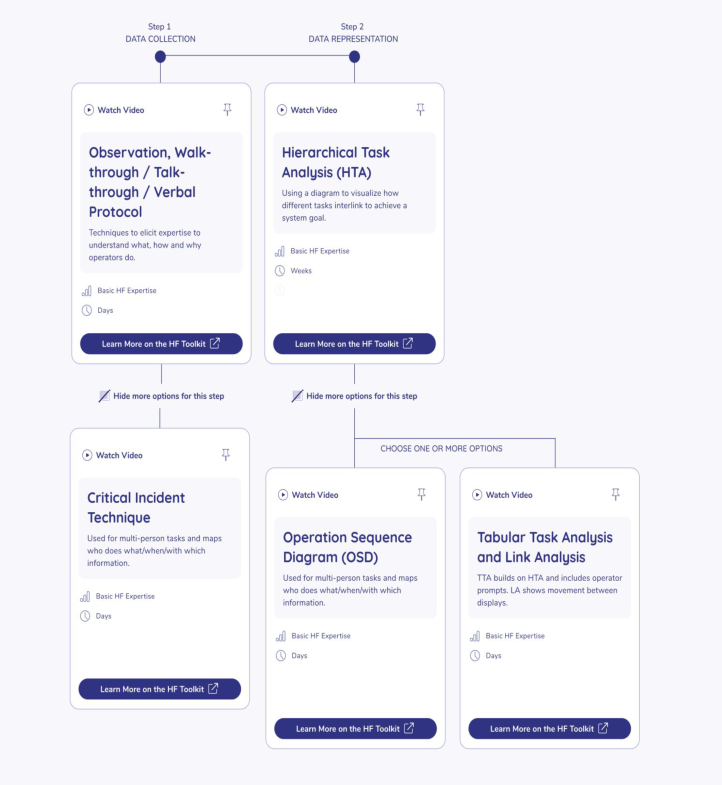
1. I want to apply Human Factors to a future design project 2. I want to apply Human Factors in a detailed design project 3. I want to apply Human Factors in a retrofit study 4. I want to look at Human Factors in incidents and accidents 5. I want to apply Human Factors for policies and regulations 6. I want to apply Human Factors in a risk assessment 7. I want to enhance the way we do safety in safety and operations A web tool was developed to enable users to visualise the Guided Paths and effectively integrate the HURID framework into their workflows. The resultant tool, the Human Factors Compass, is the product of a user-centred design cycle that involved a round of interviews with professionals from the maritime and aviation industries with varying degrees of Human Factors expertise. The interviews confirmed the users’ specific needs of guidance in the application of HF techniques and models. A design phase ensued in which the Guided Paths were developed as interactive visualisations sho- wing the relationships between HF methods and the sequences in which they should be used to solve specific problems. A screenshot example from the HF Compass is shown in Figure 2. This concerns one of the first sta- ges of a design-related study and shows five Task Analysis approaches that can be used. Guidance is given on each one, helping the user decide whe- ther to use one or several techniques. Each technique entity card also notes the expertise level required and likely resources. Clicking ‘Learn more on the HF Toolkit’ takes the user directly to the technique description in the Human Factors Toolkit, and to the video tutorial if one exists for the technique.
Human Risk-Informed Design Framework (HURID) for Integrating Human Factors 5
Figure 2: Extract from human factors compass
HURID in Practice – A Wake Vortex Alert Case Study
Behind every jet aircraft is a wake, and today there are rules concerning how closely an aircraft can follow behind, and how close aircraft can be, which affects when they might encounter a wake from a leading or cros- sing aircraft. These separation criteria are based on our understanding of wake phenomena. Generally, the separation criteria work well. However, a
number of wake encounters do occur in En Route (‘cruise’) airspace, some- times resulting in significant destabilisation of the aircraft encountering a wake, and occasionally resulting in injuries in the cabin.
Recent research into wake phenomena has led to the possibility to pre- dict wake events that can still happen even within current separation rules. The study aimed to develop and validate an ‘alert’ that would be presented to air traffic controllers on their radar screen, so that they could then warn the relevant flight crew and allow the time either to prepare for the wake, or at least to secure the cabin so as to avoid injuries. The prediction time is up to three minutes ahead of the wake vortex encounter (WVE). In this case study (see Rooseleer et al., 2022), HURID was applied by customising the generalised HF Design Cycle (see Figure 1) in two ways. First, by focusing on selected steps while neglecting others. Second, by selecting the most appro- priate HF technique among the ones available in the SAFEMODE Human Factors Toolkit: [STEP 1] What Am I Aiming to Develop? Critical Incident Technique (a task analysis technique) was used to interview pilots who had experienced such wake events. They noted it could be quite startling, with severe ‘roll’, and said they would welcome prior warning if reliable.
Hierarchical Task Analysis (HTA) and Operations Sequence Diagrams (OSD) were used to clarify ‘who does what when and why’. HTA was good for the overall structure of the tasks, and OSD was good for charting the timings and teamwork required between the flight crew and air traffic control.
[STEP 2] Who Is it for? What Are Their Needs? Operations Sequence Diagrams (OSD) were the basis for this step, comple- mented by Focus Groups, to establish that: pilots were more interested in the alert function than controllers, the optimum timings of the alert, the ‘phrase- ology’ to be used between controllers and pilots.
[STEP 3] What Can I Learn From Past Experience? SHIELD was used to consider 50 wake events and their corresponding Human Factors contributors (almost none, as these events are sudden, and generally either the autopilot handles it, or the flight crew take control and stabilises the aircraft). In some events, however, there were injuries to cabin crew and startled passengers.
[STEP 4] How do I Integrate Human Factors Know-How Into My Design? Prototyping and user-review led to a more mature concept of what would be shown on the controller’s radar display, and how the wake vortex event would be signalled to the controller. Human Factors Guidance and Standards were used at this stage to design alerting characteristics, etc.
Human Risk-Informed Design Framework (HURID) for Integrating Human Factors 7
[STEP 5] Is My Design Robust Against Human Error? Human HAZOP found various errors that could occur, and how to prevent them, which led to some final touches to the prototype design and phraseo- logy.
[STEP 6] How Do I Validate My Final Design? Two real-time simulations were run in an air traffic control simulator with seasoned controllers and in a state-of-the-art cockpit flight simulator with pilots from two airlines. The first showed that the controllers could detect the alert in time even if busy (this finding was aided by eye-tracking analy- sis), and the second showed that any warning was beneficial to pilots (this finding was supported by subjective and objective [neurological] measures of workload, stress and situation awareness), with the best timing for an alert between one and two minutes. Pilots unanimously stated they found the alert useful and desirable.
[STEP 7 and 8] The last two HURID steps were not applied in this case, considering the current level of maturity.
CONCLUSION
The HURID system including the Human Factors Compass is intended to support more integration of Human Factors into design projects, as well as helping investigators learn safety lessons from incidents and accidents, aiding risk assessors in integrating human elements into their quantified risk models, supporting regulatory authorities in knowing what is the state of the art in managing safe human performance, and supporting Human Factors profes- sionals themselves when dealing with new domains. The HURID system is free for use and its maintenance will be supported for several years, during which time more may be added to the platform. It is hoped that it will lead to more uptake of Human Factors in design, and better system performance and resilience in aviation, maritime, and other sectors of industry.
ACKNOWLEDGMENT
This research was carried out as part of the SAFEMODE project. This pro- ject received funding from the European Union’s Horizon 2020 Research and Innovation Programme under Grant Agreement N
814961, but this document does not necessarily reflect the views of the European Commission.
Read this individual research paper free through the original publisher, or explore the full digital proceedings book.
ISBN 978-1-958651-87-2
Explore this ISBN in the AHFE Bookstore ↗Listed in the July 2026 bookstore catalogue; search by ISBN to confirm current availability · Digital book purchase optional