Andrea Giorgi, Vincenzo Ronca, Francesca Dello Iacono, Marianna Cecchetti, Rossella Capotorto, Stefano Menicocci, Dario Rossi, Pietro Aricò, Gianluca Borghini, Federica Biassoni, Manuela Bina, Fabio Babiloni, Gianluca Di Flumeri (2026). A novel EEG-driven multidimensional modelling of the Driver Performance Envelope for a user-centred human-vehicle interaction. In: Advances in Human Factors of Transportation. AHFE Open Access, vol. 224, pp. 321–330. https://doi.org/10.54941/ahfe1007860
1 Department of Computer, Control, and Management Engineering “Antonio Ruberti”, Sapienza University of Rome, Piazzale Aldo Moro 5, 00185, Rome, Italy ↗
2 Department of Anatomical, Histological, Forensic & Orthopedic Sciences, Sapienza, University of Rome, Piazzale Aldo Moro 5, 00185, Rome, Italy ↗
3 Department of Molecular Medicine, Sapienza University of Rome, Viale Regina Elena, 291, 00161, Rome, Italy ↗
4 Unità di Ricerca in Psicologia del Traffico, Università Cattolica del Sacro Cuore, Largo A., Gemelli, 1, 20123, Milan, Italy ↗
The concept of Driver Performance Envelope (DPE), conceptualized from the theory of Human Performance Envelope developed in aviation, defines the boundary within which the driver can perform effectively. This study proposes a novel multidimensional formulation of the DPE based on EEG-derived neurometrics, aimed at providing a time-resolved estimation of the driver’s readiness to safely operate the vehicle. Fifteen participants completed five simulated manual driving scenarios designed to elicit different levels of difficulty, stress and thus overall performance, by manipulating context (highway vs. urban), traffic density, weather conditions (sun, rain, fog), time pressure, and the presence of a secondary task. EEG was continuously recorded to extract individual neurometrics of workload, vigilance, stress, and fatigue. These dimensions were integrated into a DPE index through a novel processing pipeline combining Principal Component Analysis and Mutual Information. Questionnaires were administered to validate the experimental design. Results showed that the proposed EEG-driven DPE successfully discriminated driving conditions characterised by different hypothesised performance envelopes. The DPE index significantly differentiated (p < .05) scenarios associated with high, intermediate, and—at least one comparison—low expected performance capacity. The robustness of the metric was supported by its comparison with an EEG baseline derived from a resting-state task, confirming its reliability and coherence across conditions. Beyond its methodological innovation, the proposed framework supports the development user-centred human–vehicle interaction strategies. Overall, this work demonstrates the feasibility and value of an EEG-driven multidimensional DPE as a key enabler for next-generation, human-centred mobility, contributing to safer and socially sustainable driving systems.
The development of human-centred driving systems increasingly requires models capable of accounting not only for task demands and environmental conditions, but also for the driver’s psychophysical state as a key determinant of safe and effective performance. Driver performance is not static; rather, it dynamically emerges from the interaction between cognitive resources, workload, environmental constraints, and internal mental states. For this reason, integrating human factors into performance modelling represents a crucial challenge for advanced driver-centred and adaptive systems. A valuable conceptual framework for monitoring optimal human functioning in operational contexts is provided by the Human Performance Envelope (HPE) model. Originally developed within the aviation domain for air traffic controllers and pilots (Graziani et al., 2016), the HPE integrates multiple task-related mental states that jointly determine human performance capability. The components of the model can be investigated using different types of measures, ranging from subjective and behavioural indicators to objective neurophysiological signals. In particular, the use of neurophysiological parameters allows the identification or prevention of undesired mental states associated with performance degradation, enabling timely interventions before the risk of error emerges (Silvagni et al., 2015; Graziani et al., 2016; Biella & Wies, 2017). From this perspective, the direct measurement of mental states can act as an interaction interface between humans and automated systems, supporting solutions aimed at reducing human error by continuously assessing operator conditions during task execution (Aricò et al., 2016). The concept of an envelope originates from geometry and refers to a curve defining the operational limits of a dynamic system. Within the boundaries of the envelope, human performance can be achieved under safe and optimal conditions, whereas outside these limits the probability of errors and performance failure increases. This notion explicitly recalls the aeronautical concept of the flight performance envelope, which defines the operational boundaries (e.g., speed, altitude, load) that allow safe flight. Despite its relevance, current applications of the HPE concept in the driving domain are still largely grounded in behavioural indicators, lacking a continuous and neurophysiologically informed estimation of driver capability. This limitation reduces the model’s ability to capture rapid fluctuations in mental states that are critical for driving safety. To address this gap, the present study proposes a novel implementation of the HPE tailored to the driving context: the Driver Performance Envelope (DPE). The DPE is conceived as a multidimensional model of driver mental states that are particularly relevant for driving, providing a synthetic yet informative representation of the driver’s performance capacity. The model incorporates several key mental states: mental effort, stress, vigilance, and fatigue. By considering both individual factors and their interactions, the DPE allows
A Novel EEG-Driven Multidimensional Modelling of the Driver Performance 323 the identification of threshold levels beyond which performance degradation exceeds acceptable safety limits. Depending on the configuration of these driver performance can fall within an acceptable zone—where adequate cognitive resources are available to safely perform the task—or within a non-acceptable zone, characterized by increased susceptibility to errors. The present study introduces a novel DPE model based on the continuous monitoring of drivers’ brain activity using electroencephalography (EEG). Different simulated driving tasks were designed to induce varying levels of DPE. The effectiveness of the experimental design was validated through subjective questionnaires, while drivers’ mental states were objectively assessed via EEG measures. Results demonstrated that the proposed DPE model successfully discriminated between different levels of performance. By embedding neurophysiological evidence into human factors modelling, this approach holds strong practical relevance and represents a promising method for assessing drivers’ readiness to face dynamic driving situations, ultimately contributing to improved road safety.
METHODS
Participants Fifteen participants (8M, 7F) took part in the study; none reported psychoactive medication use or neurological, psychiatric, or cardiovascular conditions affecting driving or measurements.
Experimental Procedures Participants gave informed consent, completed brief resting-state EEG recordings (eyes closed and eyes open), performed a baseline driving task (driving straight), and then completed five simulated driving tasks designed to induce different DPE levels:
- High DPE – Condition 1 (‘DPE HIGH 1’): Highway driving under clear weather conditions, with no surrounding traffic nor additional requests. - High DPE – Condition 2 (‘DPE HIGH 2’): Rural road driving under clear weather conditions, with no surrounding traffic. - Intermediate DPE (‘DPE INT’): Urban driving scenario including 90° turns, clear weather conditions, and no traffic. A time-pressure manipulation was introduced by instructing participants to drive “in a hurry,” simulating a condition of delay and the need to reach the destination quickly. - Low DPE – Condition 1 (‘DPE LOW 1’): Highway driving under foggy conditions, with by a marked reduction in visibility, high traffic density, and time pressure. Participants were instructed to drive rapidly. - Low DPE – Condition 2 (‘DPE LOW 2’): Urban driving under rainy conditions, with visibility reduction and increased environmental noise, with high traffic density. A secondary visuospatial n-back task was simultaneously administered on a tablet mounted to the right side of the driver.
Tasks order was pseudo-randomized to limit order effects, and questionnaires were completed after each session to assess subjective workload and mental states.
Subjective Assessment Subjective evaluations were collected to verify whether the developed driving tasks effectively induced the targeted mental states. At the end of each driving scenario, participants were asked to rate both the driving task and their own perceived state along several psychological dimensions. All ratings were provided using a 9-point Likert scale, ranging from 1 (“not at all”) to 9 (“very much”). Specifically, after completing each driving scenario, participants evaluated the following dimensions:
- Perceived difficulty of the driving task; - Driving task-induced Engagement; - Perceived stress; - Perceived fatigue.
These measures validated experimental manipulation and complemented the neurophysiological assessment.
Neurophysiological Assessment Drivers’ neurophysiological activity was assessed using a wearable EEG system (Mindtooth Touch; Mindtooth, Italy), equipped with eight Ag/AgCl electrodes positioned according to the international 10–10 system (AFz, AF3, AF4, AF7, AF8, Pz, P3, P4), with reference and ground electrodes placed on the mastoids. (Ronca et al., 2026). EEG signals were sampled at 125 Hz. A 50 Hz notch filter was applied, followed by band-pass filtering between 2 and 40 Hz. EEG data were then processed to identify and remove artifacts. Firstly, eye-blink artifacts were corrected by using O-CLEAN algorithm (Ronca et al., 2025a), while additional physiological and movement-related artifacts were identified and removed using EEGLAB routines implemented in MATLAB and already successfully used in other driving experimental trials (Giorgi et al., 2025). The cleaned EEG signal was segmented into 1-s epochs, and epochs exceeding an amplitude threshold of ±150 μV were rejected. Artifact-free EEG data were used to compute Global Field Power (GFP) in the frequency bands of interest for neurometric extraction. For each participant and driving scenario, neurometrics were organized into time × metric matrices with a temporal resolution of 1 Hz. Specifically, the following neurometrics, previously validated in driving settings, were computed: mental effort (Di Flumeri et al., 2018), vigilance (Di Flumeri et al., 2023), stress (Sciaraffa et al., 2022) and fatigue (Di Flumeri et al., 2022, Giorgi et al., 2023). To reduce inter-individual variability, all neurometrics were z-score normalized at the subject level, using each participant’s mean and standard deviation across all experimental conditions.
A Novel EEG-Driven Multidimensional Modelling of the Driver Performance 325 Driver Performance Enevelope (DPE) Index
To extract a composite index summarizing the neurophysiological dynamics observed during the different driving conditions, a combination of Principal Component Analysis (PCA) and Mutual Information (MI) was adopted. PCA is a widely used dimensionality reduction technique in neurophysiological signal processing (Jolliffe & Cadima, 2016) and has been successfully applied in automotive and neuroergonomic contexts (Lin et al., 2005).
For each participant and experimental condition, a data matrix 𝑋 ∈ 𝑅𝑇×𝑀 was constructed, where T is the number of temporal samples and M is the number of selected neurometrics. PCA was applied without automatic re-centering, preserving the participant-specific reference. The method identifies a linear combination of neurometrics that maximizes shared variance. Given the dataset 𝑋 ∈ 𝑅𝑇×𝑀, PCA searches for a series of orthogonal directions wk such that: The principal components (PCs) were:
𝑤1 = 𝑎𝑟𝑔 m𝑎𝑥∥𝑤∥=1 𝑉𝑎𝑟(𝑋𝑤)𝑤𝑘 =𝑎𝑟𝑔 𝑚𝑎𝑥∥𝑤∥=1,𝑤⊥𝑤1,…,𝑤𝑘−1 𝑉𝑎𝑟(𝑋𝑤) Zk = Xwk computed as the eigenvectors of the covariance matrix of X with the first component (PC1) representing the direction of maximum shared variance. PC1 was used as the primary DPE index. To improve robustness, a weighted combination of the first two components was used when PC1 explained less than 50% of the total variance:
𝑊12(𝑡)=𝛼1 𝑃𝐶1(𝑡)+𝛼2 𝑃𝐶2(𝑡),
where 𝛼1 and 𝛼2 are proportional to the variance explained by PC1 and PC2, respectively. This approach is consistent with neuroergonomic literature, where PC1 (or PC1+PC2) captures dominant EEG variations related to mental workload, stress, and vigilance (Makeig et al., 2004).
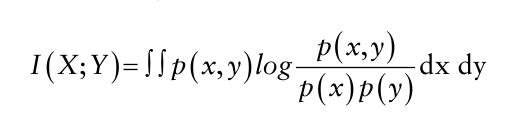
To verify the reliability of the PCA-based estimation of DPE as a phenomenon arising from the concomitant variations of the underlying neurometrics, MI was computed between each neurometric included in the PCA model. MI measures the shared information between signals in a potentially non-linear fashion (Cover & Thomas, 2006) and was estimated using a non-parametric k-nearest neighbors approach (Kraskov et al., 2004), widely adopted in computational neuroscience (Vicente et al., 2011) and recently applied to evaluate cognitive dynamics in real-world environments (Ronca et al., 2025b). Formally, for two variables X and Y, the MI is:
Equation reproduced from the original PDF.
High MI values indicate that the neurometrics were sensitive to a common effect (i.e. the driver’s mental performance), thus effectively characterizing driver performance. Low MI values suggest that the selected metrics do not share sufficient information to describe the phenomenon of interest.
RESULTS
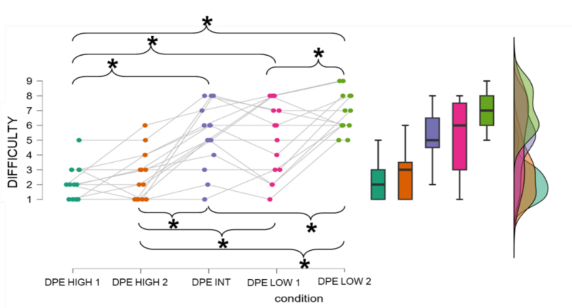
Subjective Assessment Analysis highlighted a significant difference between difficulty of the proposed driving tasks (Figure 1, ANOVA p < 0.01). High DPE tasks were perceived as less difficult compared to intermediate and low DPE tasks. Coherently, the intermediate DPE task was perceived as an intermediate difficulty between low and high DPE tasks.
Figure 1: Results of difficulty questionnaire. Asterisks indicate a significant difference (p < 0.05) among the paired comparisons.
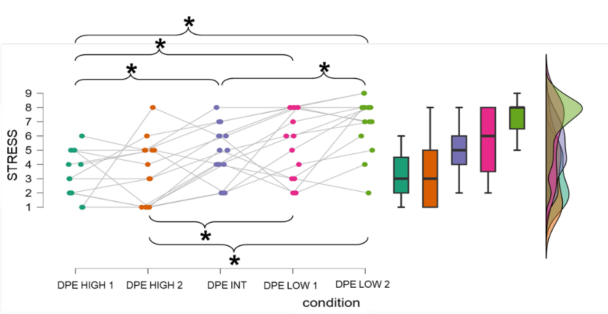
Regarding stress, the analysis highlighted a similar, statistically significant, trend (Figure 2, ANOVA p < 0.01). Participants perceived low DPE tasks as more stressful compared to intermediate and high DPE tasks. Again, intermediate DPE tasks was perceived as less stressful than low DPE tasks and more stressful than high DPE task.
Figure 2: Results of stress questionnaire. Asterisks indicate a significant difference (p < 0.05) among the paired comparisons.
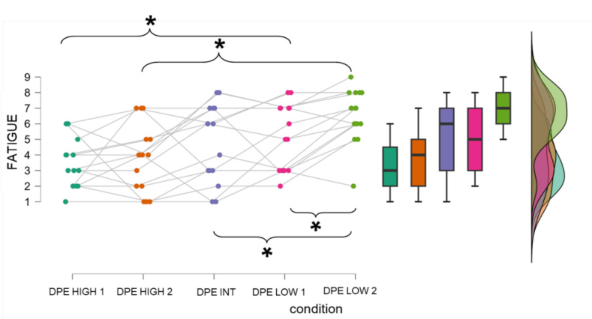
In terms of perceived fatigue, after the low DPE tasks participants reported higher levels of fatigue compared to intermediate and high DPE tasks (Figure 3, ANOVA p < 0.01).
Figure 3: Results of fatigue questionnaire. Asterisks indicate a significant difference (p < 0.05), among the paired comparisons.
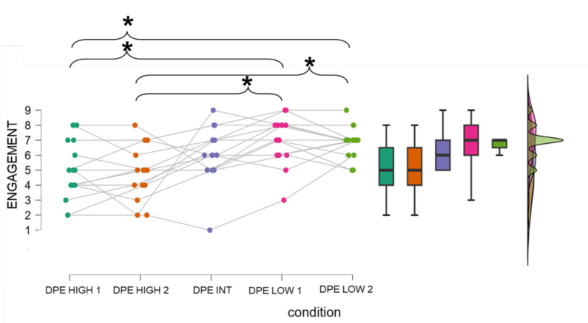
When asked about engagement in the driving tasks, participants reported a higher engagement after the low and intermediate DPE tasks compared to and high DPE tasks (Figure 4, ANOVA p < 0.01).
Figure 4: Results of engagement questionnaire. Asterisks indicate a significant difference (p < 0.05) among the paired comparisons.
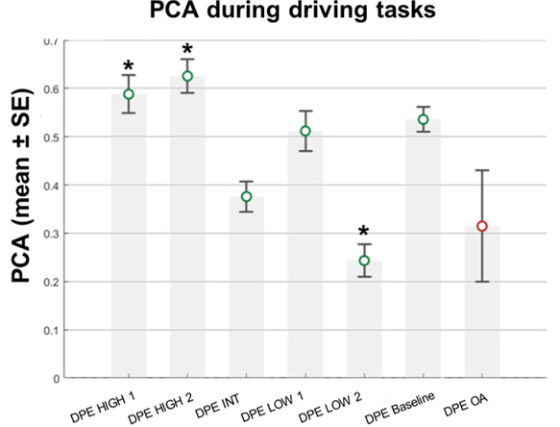
Neurophysiological Assessment Statistical analysis of the DPE parameter revealed a significant effect of driving conditions. The DPE, computed via PCA, was significantly higher (Figure 5, ANOVA p < 0.05) in the High DPE conditions (DPE High 1 and DPE High 2), consistent with the experimental hypotheses. Lower DPE values were observed in the Low DPE 2 and Intermediate DPE conditions. In parallel, reliability analysis of the DPE parameter, based on MI, showed that MI values associated with the input neurometrics were significantly lower only in the resting (eyes-open) condition, where actually the participant was not performing any task.
Figure 5: Composite DPE index calculated using PCA and MI. The circle colors represent the MI results, where ‘red’ means statistically lower Mutual Information coefficient than the ‘green’ ones.
DISCUSSION AND CONCLUSION Questionnaires were used to validate the effectiveness of the experimental manipulation. Results indicated that the targeted mental states were successfully modulated by the driving tasks, with changes generally aligning with the experimental hypotheses. Specifically, Low DPE tasks were associated with higher self-reported stress, fatigue, and perceived task difficulty compared to both High and Intermediate DPE tasks, with Intermediate DPE tasks showing intermediate values between the high- and low-demand conditions (Figure 1-3). Conversely from what hypothesized, participants reported a higher level of engagement during the Low DPE tasks (Figure 4). Following this validation, the various neurometrics extracted from the EEG signals were integrated into a multidimensional DPE index (Figure 5). The dynamic of this index appeared to reflect the mental state of the drivers, as they reported in the questionnaires. Indeed, during High DPE tasks DPE index showed higher values compared to Low DPE – Condition 2 task and to Intermediate DPE tasks (Figure 5). The value observed for Low DPE – Condition 1 appeared to be higher than Low DPE – Condition 2 and Intermediate DPE tasks, which goes against the experimental hypothesis. The driving task in Low DPE – Condition 1 was characterized by highway driving, fog, presence of traffic, and time pressure (participants were asked to speed in order to complete the task rapidly). Interestingly, some participants verbally reported that they were having fun during this driving session, since it was challenging mainly due to the high speed required to complete the task. This combination of factors may have rendered the task more manageable than initially anticipated, potentially explaining the unexpectedly high DPE values observed. Considering the MI value of DPE index of each scenario, it
A Novel EEG-Driven Multidimensional Modelling of the Driver Performance 329 is possible to note that only during resting state (eyes-open) condition, the MI displayed high values, suggesting that during resting state the selected metrics do not share sufficient information to describe the phenomenon of interest. This finding supports the experimental hypothesis that, in scenarios where the target phenomenon—namely driver performance—is absent, the PCA-derived index loses sensitivity and reliability.
The proposed Driver Performance Envelope (DPE) model proved effective in capturing drivers’ psychophysiological state across different driving conditions, supporting its validity as a neurophysiology-based indicator of performance capacity. By enabling a continuous and objective assessment of fitness to drive, this approach has the potential to enhance safety interventions aimed at reducing crashes related to human error or unsuitable psychophysiological states. Furthermore, in partially or fully automated vehicles, the DPE framework could support adaptive automation strategies by tailoring system behavior to the driver’s current capability envelope rather than relying solely on contextual information.
ACKNOWLEDGMENT
This work was supported by the Italian Ministry of University and Research through the following funded projects: AUGMENTO (CUP: B83C22002900007), funded to BrainSigns srl under the Spoke 9 of the MOST (Centro Nazionale per la mobilità sostenibile); and SIMU2DRIVE (CUP: B53C24009580001), funded to Prof. Gianluca Di Flumeri (Principal Investigator) through the Fondo Italiano per la Scienza (FIS 2023) Starting Grant.
REFERENCES
Aricò, P., Borghini, G., Di Flumeri, G., Colosimo, A., Bonelli, S., Golfetti, A., Pozzi, S., Imbert, J.-P., Granger, G., Benhacene, R., & Babiloni, F. (2016). Adaptive Automation Triggered by EEG-Based Mental Workload Index: A Passive Brain- Computer Interface Application in Realistic Air Traffic Control Environment. Frontiers in Human Neuroscience, 10. https://doi.org/10.3389/fnhum.2016.00539 Biella, M., & Wies, M. (2017): What the pilots see is what I get: how pilot’s gaze
can increase the Human Performance Envelope to improve safety. International Conference on Applied Human Factors and Ergonomics, Los Angeles, California, USA, https://elib.dlr.de/110069/ Cover, T. M. (1999). Elements of information theory. John Wiley & Sons. Di Flumeri G, Borghini G, Aricò P, Sciaraffa N, Lanzi P, Pozzi S, Vignali V, Lantieri C, Bichicchi A, Simone A, Babiloni F. (2018). EEG-Based Mental Workload Neurometric to Evaluate the Impact of Different Traffic and Road Conditions in Real Driving Settings. Front Hum Neurosci. Dec 18;12:509. doi: 10.3389/ fnhum.2018.00509. PMID: 30618686; PMCID: PMC6305466. Di Flumeri G, Giorgi A, Germano D, Ronca V, Vozzi A, Borghini G, Tamborra L,
Simonetti I, Capotorto R, Ferrara S, Sciaraffa N, Babiloni F, Aricò P. (2023). A Neuroergonomic Approach Fostered by Wearable EEG for the Multimodal Assessment of Drivers Trainees. Sensors (Basel). Oct 11;23(20):8389. doi: 10.3390/s23208389. PMID: 37896483; PMCID: PMC10610858.
Di Flumeri G, Ronca V, Giorgi A, Vozzi A, Aricò P, Sciaraffa N, Zeng H, Dai G, Kong W, Babiloni F, Borghini G., (2022). EEG-Based Index for Timely Detecting User’s Drowsiness Occurrence in Automotive Applications. Front Hum Neurosci. May 20;16:866118. doi: 10.3389/fnhum.2022.866118. PMID: 35669201; PMCID: PMC9164820. Giorgi A, Ronca V, Capotorto R, Vozzi A, Rossi D, Aricò P, Borghini G, Van
Gasteren M, Melus J, Petrelli M, Sportiello S, Polidori C, Picardi M, Babiloni F, Di Flumeri G. (2025). Beyond the time-on-task: an EEG-driven approach for effective physiological assessment of mental fatigue in simulated and real driving. Front Bioeng Biotechnol. Oct 28;13:1682103. doi: 10.3389/fbioe.2025.1682103. PMID: 41230198; PMCID: PMC12602447. Giorgi A, Ronca V, Vozzi A, Aricò P, Borghini G, Capotorto R, Tamborra L, Simonetti I, Sportiello S, Petrelli M, Polidori C, Varga R, van Gasteren M, Barua A, Ahmed MU, Babiloni F, Di Flumeri G., (2023). Neurophysiological mental fatigue assessment for developing user-centered Artificial Intelligence as a solution for autonomous driving. Front Neurorobot. Nov 30;17:1240933. doi: 10.3389/ fnbot.2023.1240933. PMID: 38107403; PMCID: PMC10721973. Graziani, I., Berberian, B., Kirwan, B., Le Blaye, P., Napoletano, L., Rognin, L., &
Silvagni, S. (2016, settembre). Development of the Human Performance Envelope Concept for Cockpit HMI Design. HCI-Aero 2016 International Conference on Human-Computer Interaction in Aerospace. https://hal.science/hal-01409075 Jolliffe, I. T., & Cadima, J. (2016). Principal component analysis: a review and recent developments. Philosophical transactions of the royal society A: Mathematical, Physical and Engineering Sciences, 374(2065), 20150202. Kraskov, A., Stögbauer, H., & Grassberger, P. (2004). Estimating mutual information.
Physical Review E—Statistical, Nonlinear, and Soft Matter Physics, 69(6), 066138. Makeig, S., Debener, S., Onton, J., & Delorme, A. (2004). Mining event-related brain dynamics. Trends in cognitive sciences, 8(5), 204–210. Ronca V, Flumeri GD, Giorgi A, Vozzi A, Capotorto R, Germano D, Sciaraffa N,
Borghini G, Babiloni F, Aricò P. (2025a) o-CLEAN: a novel multi-stage algorithm for the ocular artifacts’ correction from EEG data in out-of-the-lab applications. J Neural Eng. Sep 30;21(5). doi: 10.1088/1741-2552/ad7b78. PMID: 39284360. Ronca, V., Castagneto Gissey, L., Bellini, M. I., Iodice, A., Aricò, P., Di Flumeri, G., ...
& Borghini, G. (2025b). Mutual Information-based Teamwork Evaluation in Real Environment: Exploratory Investigation with Professional Surgeons. Frontiers in Network Physiology, 5, 1608824. Ronca, V., Cecchetti M., Capotorto, R., et al., (2026) Beyond the lab: real-world benchmarking of wearable EEGs for passive brain-computer interfaces. Brain Inf. 13, 3. https://doi.org/10.1186/s40708-025-00290-x Sciaraffa N, Di Flumeri G, Germano D, Giorgi A, Di Florio A, Borghini G, Vozzi
A, Ronca V, Babiloni F, Aricò P. (2022). Evaluation of a New Lightweight EEG Technology for Translational Applications of Passive Brain-Computer Interfaces. Front Hum Neurosci. Jul 14;16:901387. doi: 10.3389/fnhum.2022.901387. PMID: 35911603; PMCID: PMC9331459. Silvagni S., Napoletano L., Graziani I., Le Blaye P., & Rognin L. (2015): Concept for Human Performance Envelope. Available at: https://www.futuresky-safety.eu/ download/. Vicente, R., Wibral, M., Lindner, M., & Pipa, G. (2011). Transfer entropy—a
model-free measure of effective connectivity for the neurosciences. Journal of computational neuroscience, 30(1), 45–67.
LISTED IN THE AHFE DIGITAL BOOKSTORE CATALOGUE
Explore the complete digital volume
Advances in Human Factors of Transportation
Read this individual research paper free through the original publisher, or explore the full digital proceedings book.
ISBN 979-8-950676-00-0
Explore this ISBN in the AHFE Bookstore ↗Listed in the July 2026 bookstore catalogue; search by ISBN to confirm current availability · Digital book purchase optional