Hagar Baruch, Mary Still (2025). Cognitive Load and Memory for Wireless Emergency Alerts. In: Safety Management and Human Factors. AHFE Open Access, vol. 189, pp. 228–238. https://doi.org/10.54941/ahfe1006589
A Wireless Emergency Alert (WEA) is an emergency message sent directly to compatible phones through mobile carriers in the United States to inform the public of specific emergencies (natural disasters, severe weather, acts of terror, or child abduction) occurring in their vicinity. WEAs must convey relevant and comprehensive information to the public to be effective. Unfortunately, individuals are often already engaged in a task when they receive a WEA, which could lead to interference between the information contained in the WEA and information related to the ongoing task. This study examines how repetition of a WEA for a tornado warning can improve memory for message details and explores the cost associated with interruption and resource requirements of the ongoing task. For the primary task, participants engaged in a memory matching task that was interrupted by one tornado WEA or the same tornado WEA repeated three times (with a three-minute delay between each). Results indicate better memory for message information if it is repeated three times compared to once. The data also suggest that individuals may have more difficulty processing and retaining information related to the tornado warning if they are also engaged in a visual/spatial task. Given that it may not be possible to know what an individual will be doing when they receive a WEA, these results suggest that repetition could be used to reinforce emergency information comprehension. Future work will consider the effectiveness of multimodal messages on information recall and the potential cost associated with repetition. The current study can be used to advance current WEA communication techniques and increase public awareness during emergency events.
A Wireless Emergency Alert (WEA) is a message sent directly to compatible phones in the United States to inform the public of specific emergencies occurring in their vicinity, such as natural disasters, severe weather, acts of terror, or child abductions. To be effective, WEAs must convey relevant and comprehensive information for the public to make informed decisions. However, the interrupting nature of WEAs can threaten message effectiveness (Bailey and Konstan, 2006; Edwards and Gronlund, 1998). Individuals are often engaged in a task when the message is received; therefore, cognitive resources needed to interpret and remember the message may be split between processing message information and maintaining information about the ongoing task. This study examines the resource cost associated with
Cognitive Load and Memory for Wireless Emergency Alerts 229
WEAs and whether repetition of a WEA can improve memory for message information.
Since the implementation of WEAs in 2006, risk communication researchers have attempted to quantify their potential benefits and limitations, focusing on the message’s character limit effect on understanding (Carlson et al., 2024; Casteel and Downing, 2016; Harder and Bloomfield, 2008; Kumar et al., 2018), efficiency of information and instruction (Kuligowski and Doermann, 2018; Olson et al., 2023), visual improvements such as maps (Kumar et al., 2018; Miller and Clinkinbeard, 2006), and the decision-making process of people who have received WEAs (Kim et al., 2019). While research has shown the influences of these message characteristics on comprehension and decision-making (e.g., more characters and maps aid in message comprehension), it is unclear how those characteristics impact the ability to remember message information.
Memory for emergency information has been examined in other areas of risk communication. A few studies examined recall of AMBER alert information during driving scenarios and found that long strings of information (e.g., license plate numbers, phone numbers) could not be encoded while driving, especially when driving at speeds above 40 mph (Dudek, Schrock and Ullman, 2007; Harder and Bloomfield, 2008). Miller and Clinkinbeard (2006) note that repetition may be one way to improve memory for AMBER alert information but also caution against “fatigue” that may impact orienting to the message and motivation to act.
Decision Making in Risk Communication Comprehension of and response to emergency alerts has been examined in numerous studies in an attempt to systematically chart the process by which humans respond to emergency incidents (Kuligowski and Doermann, 2018; Lindell and Perry, 2012; Mileti and Sorensen, 1990). The Protective Action Decision Model (PADM) is commonly used to understand how people respond to emergency alerts and information (Lindell and Perry, 2012). The PADM model is split into pre-decisional and decisional processes. The present study investigates the three-phase pre-decision process: Pre-Decision 1: The individual must perceive or receive the cue(s), Pre-Decision 2: The individual must pay attention to the cue(s), and Pre-Decision 3: The individual must comprehend the cue(s) and the information that is being conveyed.
By perceiving and comprehending the cue, recipients have the information needed to make informed decisions regarding their safety. However, if recipients do not recall emergency information or protective action information from WEAs once the message is no longer visible, their ability to act in an informed manner is impaired. In this study, we investigated participant perception, comprehension, and recall of information provided to inform pre-decision.
Definition of Interruption In the real world, WEAs can appear spontaneously and interrupt numerous tasks. In this study, we define an interruption as an externally generated,
230 Baruch and Still
unplanned, and unscheduled task or event that causes discontinuity of cognitive focus and impairs performance of the primary task (Brixey et al., 2007; Coraggio, 1990). This definition was chosen for its focus on the disruption of cognitive attention and the emphasis on the message’s unexpected nature. Based on this definition, WEAs are almost always interruptions. Unlike interruptions often examined in the literature, WEAs are interruptions that contain the most important information in a given scenario. Even though the message, based on the critical nature of its contents, should be remembered, it is still a message that the individual may not be prepared to process. Finding a way to overcome this inherent challenge associated with interruptions is important.
Repetition has been found to improve recall and recognition of information (Hintzman, 1970; Hintzman and Block, 1971; McDermott and Chan, 2006; Musfeld, Souza and Oberauer, 2023) and could be a solution to the challenge of recalling interrupted information. Currently, it is unclear if repetition of interrupting information would have the same memory benefits as non-interrupting information. Most people do not intend to remember interrupting information, and when a task is interrupted more than three times, for instance, motivation decreases, and frustration increases (c.f., Lee et al., 2018; Miller and Clinkinbeard, 2006). In addition, under conditions of repeated interruption, initial interruptions (first and second) may be processed longer than subsequent interruptions; this suggests that individuals may become desensitized to later alerts and updates (Powers and Scerbo, 2023).
Cognitive Resources and Interruptions The information provided in WEAs is crucial for instigating protective action and requires an individual to comprehend and recall information, regardless of the current task. However, because the onset of WEAs is unpredictable, individuals may already be operating under mental load when they receive the message and may be actively maintaining task-related information in working memory while processing WEAs. Cognitive performance decreases in dual- task situations and is exacerbated when both tasks rely on the same cognitive resources (Chang, Sodnik and Boyle, 2016; Coraggio, 1990; Simoni et al., 2013). The Multiple Resource Theory (Wickens, 2008; Wickens et al., 1983) predicts that limited resources are available to process information at any given time, and interference can occur when simultaneous tasks require the same stage, code, or modality for processing. This interference can result in information being missed, misunderstood, or forgotten. WEAs rely on spatial (e.g., location of emergency concerning the recipient) and verbal (e.g., license plate numbers) resources to convey the information, and an individual engaging in a task requiring the same resources could miss critical information.
Present Study This study was designed to apply past findings and methods on the efficiency of WEA presentation, effects of dual tasks on information processing, and
Cognitive Load and Memory for Wireless Emergency Alerts 231
dual-task interference in memory to examine how WEA information is recalled when the message repeatedly interrupts a competing ongoing task.
Based on previous research suggesting the effectiveness of repetition on recall, we predict that those exposed to a WEA multiple times will have a larger rate of correct recall than those exposed to a WEA once (Hintzman, 1970; Hintzman and Block, 1971; McDermott and Chan, 2006; Musfeld, Souza and Oberauer, 2023). In addition, based on the multiple resource theory (Wickens, 2008; Wickens et al., 1983), we predict that working memory load will interfere with the recall of WEA information due to the limited capacity of visual/spatial and verbal resources, both of which are used in WEA processing.
This study is intended to investigate the effect of cognitive workload on the retention of valuable information in interruptions. From the perspective of risk communication, cognitive resources should be considered when designing emergency messages that need to be remembered. Memory for the information is needed to support better decision-making and protective action responses in at-risk populations.
METHOD
Participants The study took place at a public university in the United States. The nearly 16,000 undergraduate student population is composed of 54% women, with 73% of students being between the ages of 18–24; the racial make-up of the population is mixed with 45% White, 34% African American, 13% Hispanic, and 8% classified as being more than one race. All participants were recruited through a participation pool comprised of students of various majors taking psychology classes. The demographics of the study sample are similar to those of the university.
Forty-one students participated in the study in exchange for course credit. The study had a mixed design with alert frequency manipulated between subjects (one non-interrupting message, one interrupting message, three interrupting messages) and working memory load manipulated within subjects (low verbal, high verbal, low visual/spatial, high visual/spatial).
Materials and Procedure After providing informed consent, participants were randomly assigned to a message frequency group. They completed the study in an individual room using a computer; E-Prime 3.0 experimental software was used to run the study. To simulate a naturalistic response, participants were not provided with any details regarding the theoretical nature of the research in advance. Instead, they were told that the study would involve playing a memory card game, and any information provided on the screen was part of the study manipulation and not intended to reflect real-world information. Once the study ended, participants were debriefed. The study was conducted in two parts: Part 1 evaluated performance for the memory card game and WEA message(s), and Part 2 evaluated performance for the memory card game in
232 Baruch and Still
conjunction with visual/spatial and verbal working memory tasks at both low and high workload levels.
Memory Card Game All participants engaged in the memory card game as the primary task in Parts 1 and 2. The game consisted of 8 randomly generated cards from the diamond suite, totalling 4 pairs of cards. Face cards (e.g., King, Queen) were excluded from the study. Participants were tasked with finding all 4 pairs by using the mouse to select the cards to reveal the card face. Once a participant found all 4 pairs, a new randomized card trial would begin. In Part 1 of the study, participants played multiple trials of the memory card game for the duration of the 12-minute section and experienced a WEA based on their frequency group. In Part 2 of the study, participants were exposed to 80 trials of the memory card game corresponding to the 80 concurrent working memory trials. The memory card game was created utilizing a modified version of the E-Prime SlideButton Memory Game Template.
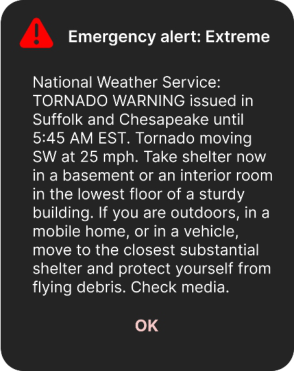
WEA Interruption All participants received the same 360-character tornado alert (see Figure 1). The alert was presented on a grey background in the center of the screen for 15 seconds and disappeared after the 15-second duration. The message covered approximately 4 inches in height and 2 inches in width on the display. The hazard type was selected to intentionally require the participants to experience verbal and visual/spatial mental workload while processing the WEA.The message content involved the geographical location of the tornado, the duration of the tornado, the tornado’s direction and speed, and protective action instructions. Location information was chosen to be familiar to participants. The message was designed based on the standard emergency message guidelines disseminated by FEMA for WEA and contained the maximum number of characters allowable in the current WEA designs.
Participants in the control group played a memory card game for 9 minutes and then were presented with the WEA. After 9 minutes, a blank screen with a fixation cross was presented for 200 ms, followed by the WEA for 15 seconds. After the message disappeared, participants typed in the number of the last card pair they had matched. They then played the memory card game for an additional 3 minutes.
Participants in the one-interruption group followed the same procedure as the control group with one exception. After 9 minutes of playing the memory card game, the 15-second WEA appeared abruptly with no fixation cross or 200 ms delay. To ensure the message functioned as an interruption, the message’s appearance left participants no time to prepare for the break in tasks.
Participants in the three-interruption group played the memory card game as well but received the interrupting WEA message three times: at 3 minutes, 6 minutes, and 9 minutes. Like the other groups, they completed Part 1 by playing the memory card game for 3 additional minutes.
Cognitive Load and Memory for Wireless Emergency Alerts 233
After completing the 12-minute memory card game task, all groups were assessed for their memory of the WEA information and provided a confidence rating for each memory response.
Figure 1: Wireless emergency alert.
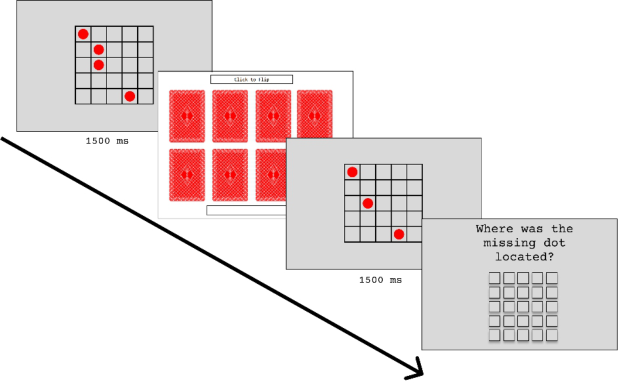
Working Memory Tasks In Part 2 of the study, all groups completed the memory card game in conjunction with working memory tasks. This provided a measure of cognitive workload associated with the memory card game. Tasks that examine visual/spatial resources and verbal resources were used. Each resource type was assessed at low workload and high workload, amounting to 80 trials (20 low visual/spatial, 20 high visual/spatial, 20 low verbal, and 20 high verbal). Participants were presented with a task for 1500ms, followed by a memory card game. Once the card game was complete, participants received the same task with one missing number or dot, then reported where the missing number or dot was located. See Figure 2 for the general procedure and a specific example of a high workload visual/spatial trial.
In the visual/spatial working memory task, participants were presented with a 5 × 5 grid with either 1 or 4 red circles randomly located within the grid for 1.5 seconds. After completing one cycle of a memory card game (on average 8 seconds in duration), a 1.5-second blank grid (low workload) or a grid with 3 of the previous 4 circles (high workload) was presented. Participants were then provided with a blank 5 × 5 button grid and asked to report where the missing circle was located. Low and high workload manipulates were blocked, and the order of the conditions was randomized across participants.
In the verbal working memory task, participants were presented with either 1 or 5 randomly selected single-digit numbers for 1.5 seconds. After completing one cycle of the memory card game, participants in the low workload task were asked to report the number they had seen before the
234 Baruch and Still
game. Participants in the high workload task were provided with 4 of the 5 numbers for 1.5 seconds, then asked to report the missing number. Low and high workload manipulations were blocked, and the order of the conditions was randomized across participants.
Figure 2: Trial procedure example.
Scoring and Measures Participant recall of the WEA information was measured using two questions: “What must you protect yourself from after finding a substantial shelter if you were outdoors, in a mobile home, or in a vehicle?” and “Is the tornado approaching Norfolk?”. Correct responses (debris; no) were coded as 1, all other responses were coded as 0. The recall score represents the average of those values.
After each recall question, the participant rated their confidence level using a five-point scale (5 = I am confident my answer is correct, 1 = I am not confident my answer is correct). The confidence score represents the average of the two ratings.
RESULTS AND DISCUSSION
Data were collected from 41 participants; 6 participants were excluded from the analyses due to missing data.
Message Interruption and Repetition Effects A one-way ANOVA revealed no significant difference between the recall accuracy for each group, F(1,35) = 2.72, p = .081. Even so, the results were in the predicted direction, with the repeated message leading to better recall. Because this frequency effect was the critical component being tested, the
Cognitive Load and Memory for Wireless Emergency Alerts 235
data were recoded to compare the three-message group to a combined one- message group. The ANOVA revealed a significant difference, F(1,35) = 4.15, p = .05, η2 = .112; higher recall accuracy was found in the three-message group (n = 12, M = 0.46, SE = 0.40) compared to the combined one-message group (n = 23, M = 0.22, SE = 0.30). These results suggest that repeated exposure to the same emergency message leads to better recall of emergency information.
Breaking down the recall questions, there was a significant difference between groups for performance on the Protective Action question (“What must you protect yourself from after finding a substantial shelter if you were outdoors, in a mobile home, or in a vehicle?”), F(1,34) = 4.17, p = .049. Participants who received the message three times were more likely to get the answer correct (M = 0.36, SE = 0.51) than participants who only received the message once (M = 0.09, SE = 0.39). There was no significant difference between the groups in accuracy for the direction question (“Is the tornado approaching Norfolk?”), F(1,30) = 1.06, p = .312, but the three-message group did demonstrate numerically higher recall accuracy (M = 0.58, SE = 0.52) than those who only received the message once (M = 0.39, SE = 0.50). These results indicate that message frequency aided in the recall of protective action behaviour, but it is unclear whether that benefit is equally applicable to general knowledge and spatial information.
A one-way ANOVA revealed no significant difference in confidence levels between the groups, F(2,34) = 0.18, p = .836, nor between the three-message group and the combined one-message group, F(1,34) = 0.47, p = .497. Therefore, subjective feelings of confidence were not sensitive to actual knowledge regarding WEA information.
Cognitive Workload Working memory tasks examined the resources needed to play the memory card game. A repeated measures ANOVA revealed a significant main effect of workload type, F(1,30) = 15.80, p <.001; participants demonstrated better performance on the verbal memory task (M = 0.80, SE = 0.02) compared to the visual/spatial task (M = 0.69, SE = 0.03). There was also a main effect of workload, F(1,30) = 56.89, p <.001; whereby performance was higher in the low-load condition (M = 0.84, SE = 0.02) than the high-load condition (M = 0.66, SE = 0.03). No interaction was found (F(1,30) = 1.34, p = .256). These results suggest that there was more interference between the memory card game and the visual/spatial task than there was between the memory card game and the verbal task. This was independent of load level.
CONCLUSION
This study focused on two factors that could impact information recall of WEA messages: 1) the number of times the message is encountered, and 2) potential interactions between resources needed to interpret and remember the message and resources needed for the ongoing task.
The results indicate that repeated exposure to the same information doubled the accuracy of recall, even with the 15-second limit to read a
236 Baruch and Still
360-character message. We can conclude that repeated exposure to the same information leads to greater information retention.
The working memory tasks in Part 2 of the study indexed the cognitive workload required to complete the memory card task. The results suggest that the game relies more on visual/spatial resources than verbal resources. While it might be argued that the visual/spatial task was simply more difficult than the verbal task, the fact that there was no interaction between load type and amount of load (low vs. high) speaks against that. Similarly, both the visual/spatial and verbal tasks low condition only required the maintenance of one piece of information, but differences in performance were still found. If the memory card task relies heavily on visual/spatial information, it follows that the deficits seen in recall performance of the WEA could be tied to that resource interference. This interference may also partially explain why participants struggled to understand the implications of the tornado trajectory.
These findings demonstrate clear differences between single exposure and multiple exposures to WEA information. There is also indirect evidence that both verbal and visual/spatial resources are needed to process and remember WEA information. While WEAs attempt to convey essential information in concise ways, limited availability of cognitive resources can lead to interference and low information retention. Conveying information in a way that manages cognitive load and reduces potential interference is vital. Future research should explore how multimodal messages could accomplish these goals.
REFERENCES
Bailey, B. P. and Konstan, J. A. (2006). On the need for attention-aware systems: Measuring effects of interruption on task performance, error rate, and affective state. Computers in Human Behavior, 22(4), pp. 685–708. https://doi.org/ 10.1016/j.chb.2005.12.009 Brixey, J. J., Robinson, D. J., Johnson, C. W., Johnson, T. R., Turley, J. P., and
Zhang, J. (2007). A concept analysis of the phenomenon interruption. Advances in Nursing Science, 30(1), pp. E26–42. https://doi.org/10.1097/00012272- 200701000-00012 Carlson, E. J., Bean, H., Ratcliff, C., Pokharel, M., and Barbour, J. (2024) Do 360-character Wireless Emergency Alert (WEA) messages work better than 90-character messages? Testing the risk communication consensus. Journal of Contingencies and Crisis Management, 32(2), p. e12587. https://doi.org/10.1111/ 1468-5973.12587 Casteel, M. A. and Downing, J. R. (2016). Assessing risk following a Wireless
Emergency Alert: Are 90 characters enough? Journal of Homeland Security and Emergency Management, 13(1), pp. 95–112. https://doi.org/10.1515/jhsem- 2015-0024 Chang, C.-C., Sodnik, J. and Boyle, L. N. (2016). Don’t speak and drive: Cognitive workload of in-vehicle speech interactions’, in Adjunct Proceedings of the 8th International Conference on Automotive User Interfaces and Interactive Vehicular Applications. New York, NY, USA: Association for Computing Machinery (AutomotiveUI ‘16 Adjunct), pp. 99–104. https://doi.org/10.1145/ 3004323.3004351
Cognitive Load and Memory for Wireless Emergency Alerts 237
Coraggio, L. (1990). Deleterious effects of intermittent interruptions on the task performance of knowledge workers: A laboratory investigation. Unpublished doctoral dissertation, University of Arizona. Available at: https:// repository.arizona.edu/handle/10150/185243 (Accessed: 18 February 2025). Dudek, C., Schrock, S. and Ullman, B. (2007) License plate and telephone numbers in changeable message sign Amber Alert messages. Transportation Research Record, 2012(1), pp. 64–71. https://doi.org/10.3141/2012-08 Edwards, M. B. and Gronlund, S. D. (1998). Task interruption and its effects on
memory, Memory, 6(6), pp. 665–687. https://doi.org/10.1080/741943375 Harder, K. A. and Bloomfield, J. R. (2008) The effectiveness and safety of traffic and non-traffic related messages presented on changeable message signs: Technical summary. MN/RC-2008-27. Available at: https://rosap.ntl.bts.gov/ view/dot/17876 (Accessed: 17 February 2025). Hintzman, D. L. (1970). Effects of repetition and exposure duration on memory,
Journal of Experimental Psychology, 83(3, Pt. 1), pp. 435–444. https://doi.org/ 10.1037/h0028865 Hintzman, D. L. and Block, R. A. (1971). Repetition and memory: Evidence for a multiple-trace hypothesis, Journal of Experimental Psychology, 88(3), pp. 297–306. https://doi.org/10.1037/h0030907 Kim, G., Martel, A., Eisenman, D., Prelip, M., Arevian, A., Johnson, K. L. and Glik,
D. (2019). Wireless Emergency Alert messages: Influences on protective action behaviour, Journal of Contingencies and Crisis Management, 27, pp. 374–386. https://doi.org/10.1111/1468-5973.12278 Kuligowski, E. D. and Doermann, J. (2018) A review of public response to short message alerts under imminent threat. (National Institute of Standards and Technology, Gaithersburg, MD), NIST Technical Note (TN) 1982. Available at: https://doi.org/10.6028/NIST. TN.1982. Kumar, S., Erdogmus, H., Iannucci, B., Griss, M., and Falcão, J. D. (2018).
Rethinking the future of Wireless Emergency Alerts: A comprehensive study of technical and conceptual improvements. Proceedings of the ACM on Interactive, Mobile, Wearable and Ubiquitous Technologies, 2(2), pp. 71:1–71:33. https:// doi.org/10.1145/3214274 Lee, B., Chung, K. and Kim, S.-H. (2018). Interruption cost evaluation by cognitive workload and task performance in interruption coordination modes for human– computer interaction tasks. Applied Sciences, 8, p. 1780. https://doi.org/10.3390/ app8101780 Lindell, M. K. and Perry, R. W. (2012). The protective action decision model:
Theoretical modifications and additional evidence. Risk Analysis, 32(4), pp. 616–632. https://doi.org/10.1111/j.1539–6924.2011.01647.x McDermott, K. B. and Chan, J. C. K. (2006). Effects of repetition on memory for pragmatic inferences. Memory & Cognition, 34(6), pp. 1273–1284. https:// doi.org/10.3758/BF03193271 Mileti, D. S. and Sorensen, J. H. (1990) Communication of emergency public
warnings: A social science perspective and state-of-the-art assessment. ORNL- 6609. Oak Ridge National Lab. (ORNL), Oak Ridge, TN (United States). https:// doi.org/10.2172/6137387 Miller, M. K., & Clinkinbeard, S. S. (2006). Improving the AMBER alert system: Psychology research and policy recommendations. Law & Psychology Review, 30, 1–21.
238 Baruch and Still
Musfeld, P., Souza, A. S. and Oberauer, K. (2023). Repetition learning is neither a continuous nor an implicit process. Proceedings of the National Academy of Sciences of the United States of America, 120(16), p. e2218042120. https:// doi.org/10.1073/pnas.2218042120 Olson, M., Sutton, J., Cain, L. B. and Waugh, N. (2023). A decade of wireless emergency alerts: A longitudinal assessment of message content and completeness. Journal of Contingencies and Crisis Management, 32, e12518. https://onlinelibrary.wiley.com/doi/10.1111/1468-5973.12518 Powers, S. A. and Scerbo, M. W. (2023). Examining the effect of interruptions
at different breakpoints and frequencies within a task. Human Factors, 65(1), pp. 22–36. https://doi.org/10.1177/00187208211009010 Simoni, D., Rubbieri, G., Baccini, M. Rinaldi, L., Becheri, D., Forconi, T., Mossello, E., Zanieri, S., Marchionni, N. and Di Bari, M. (2013). Different motor tasks impact differently on cognitive performance of older persons during dual task tests. Clinical Biomechanics, 28(6), pp. 692–696. https://doi.org/10.1016/ j.clinbiomech.2013.05.011 Wickens, C. D., Sandry, D. L., and Vidulich, M. (1983). Compatibility and resource
competition between modalities of input, central processing, and output. Human Factors, 25(2), pp. 227–248. https://doi.org/10.1177/001872088302500209 Wickens, C. D. (2008). Multiple resources and mental workload. Human Factors, 50(3), pp. 449–455. https://doi.org/10.1518/001872008X288394
LISTED IN THE AHFE DIGITAL BOOKSTORE CATALOGUE
Explore the complete digital volume
Safety Management and Human Factors
Read this individual research paper free through the original publisher, or explore the full digital proceedings book.
ISBN 978-1-964867-65-6
Explore this ISBN in the AHFE Bookstore ↗Listed in the July 2026 bookstore catalogue; search by ISBN to confirm current availability · Digital book purchase optional