Eliel Oliveira, Francisco Lima, Dalisson Vieira, Vitor Fernando Gomes, Francisco José De Castro Moura Duarte, Lucas Farah (2025). Health at Risk: How Organizational Culture Impacts the Health of Oil and Gas Workers in Brazil. In: Safety Management and Human Factors. AHFE Open Access, vol. 189, pp. 77–83. https://doi.org/10.54941/ahfe1006572
The importance of the oil and gas industry in the global context is widely recognized, both for fuel production and for other derivatives. In Brazil, the sector has shown strong potential for expansion, driven by the discovery of new, yet-to-be-explored reservoirs. With the market heating up, the number of offshore units has grown, and forecasts indicate even greater expansion ahead. The remote and hostile environment of offshore installations presents unique characteristics compared to other industries. The intense interaction among workers, the high level of control and procedural requirements, and the confined living and working conditions in high-risk units are elements that set this context apart.This article examines, through case studies, the factors that lead workers to avoid using onboard health services, such as infirmaries, even when experiencing symptoms of discomfort or minor accidents. This study was developed within the framework of the Human and Organizational Factors of Industrial Safety project, which aims to develop a quantitative and qualitative diagnostic methodology, grounded in Ergonomics and Human Factors, to support positive changes and foster the maturation of Safety Culture in the oil and gas industry in Brazil. Initiated in 2020 and scheduled to conclude in 2025, the project addresses topics such as blame culture (related to punishment systems and deviation management), safety bureaucracy (performance indicators), and experience feedback (lessons learned from incidents). These factors reveal a concerning relationship with the utilization of healthcare resources in offshore units.According to the workers themselves, seeking care at the infirmary entails risks associated with several factors: negative exposure, conflicts with the work team, bureaucratic procedures, and the possibility of disembarkation or even dismissal. The fear of exposure stems from an organizational culture that often, even indirectly, blames workers who have been injured. This blame culture discourages workers from seeking medical help due to fear of judgment and stigmatization. The fear of conflicts with the work team also discourages the use of infirmaries, as their absence can result in an increased workload for other team members. This is particularly problematic if their condition is not perceived as severe by everyone. The fear of punishment persists despite the significant changes the sector has undergone in recent years. Many believe that accidents attributed to errors can still lead to severe consequences, such as warnings, transfers to other units, dismissals, or even "exclusion," which refers to being blacklisted by companies in the sector.These fears foster a culture of self-medication and neglect of health, where workers exchange medications among themselves and only seek medical care in critical situations that have worsened or are difficult to hide. Mental health issues are even more frequently ignored or silenced due to the stigma associated with these conditions. To overcome these challenges, it is essential to transform the organizational culture, creating an environment that encourages seeking medical care without fear or negative consequences.
The global relevance of the oil and gas industry is widely recognized, not only for its role in fuel production but also for its contribution to various other derivatives. In Brazil, the sector has shown strong potential for expansion, driven by the discovery of new reservoirs. With the market heating up, the number of offshore units has been increasing, and forecasts indicate even greater growth. The remote and hostile environment of offshore installations presents unique characteristics when compared to other industries. The intense interaction among workers, the high level of procedural control, and the fact that they live and work in confined, high-risk environments are distinctive features of this setting (Conchie, 2006).
In such a complex and highly regulated environment, understanding how organizational factors influence safety becomes particularly relevant. Research on safety culture has increasingly highlighted the organizational dimension, shifting the focus from individual behaviors to the formal and informal contexts of work. In practical terms, Antonsen (2009) argues that while culture should not be the main target of organizational change, its analysis can still support improvements in internal practices. The author
also draws attention to the limited consideration of power dynamics within organizations. Acknowledging conflicts and resource disputes as structuring elements of organizational life—an argument also emphasized by Le Coze (2019)—enhances our understanding of safety-related decisions and practices, offering a more realistic and ethically grounded perspective that considers the tension between managerial control and worker autonomy.
Within this organizational and cultural context, the role of health professionals on offshore platforms becomes particularly significant. To ensure worker safety and promote adequate health and well-being conditions, these installations are equipped with nurses and onboard infirmaries. In addition to verifying workers’ health conditions for critical tasks—such as working at heights or in confined spaces—these professionals are responsible for providing first aid and responding to less urgent complaints, such as general discomfort. Considering the challenges posed by the offshore environment and the organizational dynamics discussed, this article analyzes, through case examples, some of the barriers that hinder workers’ access to onboard health services, even when experiencing symptoms or minor accidents.
METHOD
The intervention method presented in this study is based on Rocha et al. (2023) and employed a quantitative-qualitative approach to diagnose the maturity level of the safety culture and promote its development. The study focused on the workforce of a well-construction drillship that had been operating as a subcontractor in Brazilian territory for over two years. At the time of the study, the drillship was ranked among the best-performing vessels in terms of overall performance evaluation. Data collection was conducted through four onboard deployments between March and December 2023, totaling 18 days aboard. This study considers the different teams that make up the drillship’s workforce. In the quantitative phase, homogeneous groups were formed to apply a customized questionnaire, primarily distinguishing hierarchical levels. The questionnaire consisted of 84 questions and gathered responses from a total of 338 participants (Confidence level = 95%, Margin of error = 2%). The questionnaire aimed to assess the workforce’s perceptions across various themes. In the qualitative phase of the study, interviews and focus group discussions were conducted to explore the key issues identified in the previous phase and to understand different perspectives on safety, thereby valuing the diversity of viewpoints. To facilitate discussions, graphical representations of the findings from the quantitative phase were presented, and conversations were guided by workers’ lived experiences. A total of 72 workers participated in the focus groups. Although the questionnaire and focus group meetings allowed for the identification of various issues, this study presents findings specifically related to workers’ reluctance to report deviations and incidents, particularly those involving symptoms of discomfort and minor accidents, and their connection to the onboard healthcare services provided. The material in this article is primarily based on data from the Human and Organizational Factors of
Health at Risk: How Organizational Culture Impacts the Health of Oil and Gas Workers 79
Industrial Safety project, which aims to develop a quantitative-qualitative diagnostic methodology, grounded in Ergonomics and Human Factors, to support positive changes and promote the maturation of Safety Culture in the oil and gas industry in Brazil. Initiated in 2020 and scheduled for completion in 2025, the project addresses topics such as blame culture (related to punishment systems and the handling of deviations), safety bureaucracy (performance indicators), and lessons learned (insights gained from past incidents). These factors reveal a concerning relationship with the utilization of healthcare resources in offshore units
RESULTS AND DISCUSSION
We present: 1) a contextualization of the offshore drilling work organization; 2) a quantitative result as a basis for the discussion related to the omission of deviations; and 3) the selection of empirical material (cases) presented in the focus groups, which are related to the issue addressed in this article.
The Organization of Offshore Drilling Operations An offshore drilling ship is a vessel designed to operate in deep and ultra-deep waters. Essentially, using highly advanced equipment, workers traverse water depths of up to 2 km and drill through the pre-salt layer to reach the reservoir rock, approximately 4 km below the seabed. In Brazil, the workforce is predominantly composed of outsourced teams, including the ship operator, specialized crews, and hospitality professionals.
The interventions carried out by the offshore drilling ship include drilling (creating access to the reservoir rock), completion (installing equipment for connection to the production platform), evaluation (productivity testing), and workover (repairing subsea equipment or stimulating production).
Regarding work shifts, most of the professionals onboard the drilling ships work in 12-hour shifts for 14 days, followed by 14 days off. The issue of outsourcing plays a prominent role in these dynamics, along with the performance evaluation system related to health management indicators.
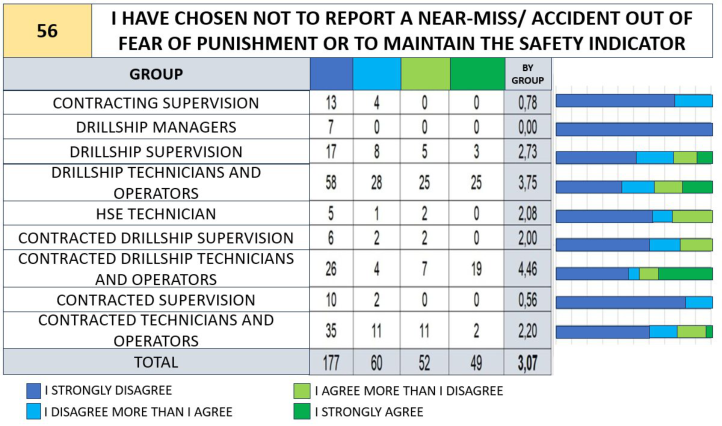
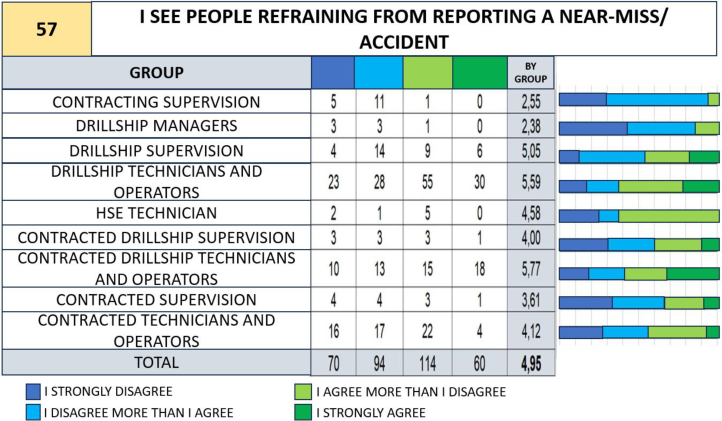
Quantitative Results From the initial interactions, it became evident that issues related to workers’ exposure in near-miss and accident contexts were key elements influencing the dynamics between the workforce and the infirmary. Figures 1 and 2 present the results of two questions directly related to these topics.
In the first question regarding phenomena that may inhibit workers from reporting, we observe that, in general, workers emphasize that they do not refrain from reporting the events in which they are involved. The overall score of 3.07 indicates a moderate disagreement with the statement. In contrast, the second question, which allows workers to adopt a more external perspective without committing to the statement in question, shows a considerable increase in the overall average (4.95), indicating a divergent scenario. The results reflect that the workforce struggles to acknowledge their own omissions but feels more comfortable when referring to others.
Figure 1: Item 56 of the customized questionnaire applied to the workforce.Figure 2: Item 57 of the customized questionnaire applied to the workforce.
Qualitative Results Responses to the questions were presented in the focus groups. The different groups were able to support their perspectives through verbalizations and cases that were subsequently explored in depth. Some of these cases were selected and are presented below:
Case 1: Small Cut on the Foot - The operator, after suffering a scratch on his foot while showering, sought medical attention to clean the minor wound. When he requested the application of antiseptic to the injury, the
Health at Risk: How Organizational Culture Impacts the Health of Oil and Gas Workers 81
nurse informed him that procedures required the incident to be reported to the onshore medical department. The worker did not object. However, he was subsequently asked to disembark and was later subjected to two X-ray procedures. According to the worker involved in the incident, the following day, his case became a topic of discussion at the managerial levels of the company, resulting in his exposure to the entire fleet through a safety alert: “I will never go back to the infirmary” (injured worker).
Case 2: Severe Knee Injury - A team leader injured his knee during the work shift by stepping on a poorly secured hatch while walking on the deck. This worker, an older gentleman and the most experienced person on board in his role, reported that he was in significant pain. Since he was scheduled to disembark in three days, he did not report the incident or seek medical attention in the infirmary. It was only after his disembarkation that he sought medical care. He emphasized that his 14 days of leave turned into a recovery period and that when he reboarded, he was still experiencing pain. The worker again did not inform the infirmary and remained on board using the prescribed medications. His work team was aware of his condition and organized their activities to ensure that the injured worker was, as much as possible, spared from heavy exertion.
Case 3: Worker Falls While Descending a Ladder - After falling from the ladder during an activity, the operator did not report the incident to the infirmary due to fear of repercussions. He was concerned about the embarrassment of being used as an example of negligence or being disembarked, which would create friction with his supervisor: “Why did you go there, man? Are you trying to get disembarked?”
Case 4: Worker Struck in the Chest - While performing his duties, the equipment he was handling rotated and struck the torso of a subcontracted worker. It was only after three days, when the bruises became concerning, that the worker sought medical attention in the infirmary. Even so, he distorted the facts, claiming that the incident occurred the previous day, which was contradicted upon reviewing the video system.
Case 5: Worker Hits His Head in the Cabin - While storing his belongings in the cabin shortly after boarding, the manager hit his head violently against the bathroom door. Despite experiencing a severe headache throughout the day, he did not seek medical attention.
The analysis of the collected material reveals, first and foremost, according to the workers themselves, that seeking medical attention in the infirmary is seen as assuming a risk, related to several factors: negative exposure, conflicts with the work team, bureaucratic procedures for care, and the possibility of disembarkation or even dismissal. The fear of exposure stems from the organizational culture that often holds workers responsible, even if indirectly, for the accidents that occur. This blame culture leads workers to avoid seeking medical help due to fears of judgment and stigmatization (Cases 1, 3, and 5). The fear of conflicts with the work team also discourages the use of infirmaries, as a worker’s absence may result in an increased workload for other team members, which is not well received, especially if their condition is not recognized as serious by everyone (Cases 1, 2, 3, and 5). The fear of punishment persists, despite the significant changes the sector has undergone
in recent years. Many believe that accidents attributed to mistakes can still lead to severe consequences, such as warnings, transfers to other units, dismissals, or even “exclusion,” which refers to the worker being blocked from working in other companies within the industry (Cases 2 and 4). These fears foster a culture of self-medication and neglect of health, where workers exchange medications among themselves and only seek medical attention in critical situations that have worsened or become difficult to conceal. Issues related to mental health are even more frequently ignored or silenced due to the stigma associated with these conditions. Another negative effect of this reality is its impact on reporting and organizational learning (Van der Schaaf and Kanse, 2004).
This scenario is aggravated when it comes to subcontracted workers, who are often “advised” by their own supervisors to bring medications on board and to avoid the infirmary. However, this fear of seeking medical care on board is present even at higher hierarchical levels (Cases 2 and 5). To overcome these challenges, it is essential to transform the organizational culture, fostering an environment that encourages seeking medical care without fear of negative consequences. This requires overcoming the blame culture, similar to what occurs in organizations that prioritize learning rather than responding to behavioral failures with blame (Bitar, 2018).
CONCLUSION
It is observed that the relationship between the workforce and medical resources on board is permeated by various fears, which, combined, result in a neglect of health care. This neglect is reinforced by the work collective, which becomes an informal support network for the worker. Although these may seem like minor events in the face of the risks of serious accidents on a drillship, these omissions are symptoms of a broader culture that may lead to the neglect of other risks or failures, including process-related issues. To overcome these challenges, it is essential to transform the organizational culture, fostering an environment that encourages seeking medical care while dissociating these services from indicators associated with financial incentives. Limitations of this study include difficulties in accessing the field and the scarcity of studies related to this context.
ACKNOWLEDGMENT
We would like to thank the Human Resources Program of the National Agency of Petroleum, Natural Gas, and Biofuels (PRH-ANP), which, through the R&D funding from ANP Resolution No. 50/2015, provided financial support for this research and enabled the development of this work.
Health at Risk: How Organizational Culture Impacts the Health of Oil and Gas Workers 83
REFERENCES
Antonsen, S. Safety Culture: Theory, Method and Improvement, Ashgate Publishing Limited, Inglaterra, 2009. Bitar, F.; Chadwick-Jones, D.; Lawrie, M.; Nazaruk, M.; Boodhai, C. Empirical
validation of operating discipline as a leading indicator of safety outputs and plant performance. Safety Science, v. 104, pp. 144–156, 2018. Conchie, S. M.; Donald, I. J. The Role of Distrust in Offshore Safety Performance.
Risk Analysis. v. 26, n. 5, pp. 1151–1159, 2006. Le Coze, J. Risques (socio) technologiques, ergonomie et culture sécurité: Nouvelles perspectives. Présenté au 56
Congrès de la SELF, Genève, Suisse, pp. 780–785, 2022. Rocha, R., Duarte, F., Lima, F., Mercado, M., Araujo, A., Garotti, L., Campos, M.:
Framework for the assessment of the safety culture in the oil and gas industry. International Journal of Occupational Safety and Ergonomics 30(1), 224–237 (2023). Van der Schaaf, T., Kanse, L. Biases in incident reporting databases. Saf. Sci., v. 42, pp. 57–67, 2004.
LISTED IN THE AHFE DIGITAL BOOKSTORE CATALOGUE
Explore the complete digital volume
Safety Management and Human Factors
Read this individual research paper free through the original publisher, or explore the full digital proceedings book.
ISBN 978-1-964867-65-6
Explore this ISBN in the AHFE Bookstore ↗Listed in the July 2026 bookstore catalogue; search by ISBN to confirm current availability · Digital book purchase optional