Sungkyung Kim, Jihye Ryu, Youngchan Kim, Jun-ho Choi, Seong-hwan Yoon, Wonhwa Hong (2025). Understanding sensory Perception and Cognitive Abilities Based on the Elderly's Capability for Independent Evacuation. In: Safety Management and Human Factors. AHFE Open Access, vol. 189, pp. 121–127. https://doi.org/10.54941/ahfe1006577
As societies age, ensuring elderly safety during evacuations is crucial. However, research on elderly-specific evacuation patterns, particularly sensory and cognitive factors, remains limited. Given age-related declines, tailored strategies are essential, especially in long-term care facilities. This study examines the impact of visual, auditory, and cognitive levels on independent evacuation capability among the elderly. Data were collected through an on-site survey, and the findings indicate that cognitive ability is the most critical factor, followed by visual and auditory perception. Those unable to evacuate independently had significantly poorer cognitive function, vision, and hearing, hindering route recognition and decision-making. This study highlights the need for elderly-friendly evacuation systems and calls for further research on cognitive-based evacuation methods to improve emergency preparedness.
South Korea is undergoing rapid population aging and is projected to become a super-aged society by 2025, with individuals aged 65 and older comprising over 20% of the total population. Due to age-related declines in physical and cognitive functions, older adults are more susceptible to evacuation challenges compared to the general population, classifying them as at-risk evacuees within disaster management frameworks. This underscores the necessity of developing targeted evacuation policies and support measures tailored to this demographic.
Older adults demonstrate slower walking speeds and reduced mobility compared to the general evacuation population (Rahouti, 2021; Li, 2020;
Lui, 2010). Furthermore, cognitive decline results in prolonged decision- making processes, exacerbating delays during pre-evacuation and wayfinding phases (Rahouti, 2021; Lui, 2010). While the significance of elderly-specific evacuation studies is well recognized, empirical research remains limited due to methodological constraints and practical implementation challenges (Gerges, 2018; Fu, 2019; Rendón Rozo, 2019; Qu, 2019).
Recent research has emphasized the role of sensory perception and cognitive processing in evacuation efficiency. The ability to identify obstacles and interpret structural elements within built environments is closely linked to human sensory integration. Additionally, factors such as the placement, color, size, and design of evacuation cues are extensively studied for their influence on cognitive processing and spatial awareness. Akizuki (2024) highlighted that enhancing visual clarity through size, color, and positioning of evacuation elements significantly improves cognitive comprehension and response efficiency. Similarly, Fu (2024) demonstrated that highly visible emergency exit colors enhance recognition accuracy and evacuation success rates in simulated environments.
However, most previous studies primarily focus on the general adult population, with limited research dedicated to the evacuation capabilities of older adults. Specifically, investigations into the relationship between evacuation performance, physical health status, sensory perception (visual and auditory), and cognitive function in aging populations remain insufficient.
This study aims to analyze the role of sensory perception and cognitive ability in elderly evacuation performance. A field survey was conducted to assess these factors, categorizing participants based on their evacuation capability to develop evidence-based strategies that enhance the safety and effectiveness of elderly evacuation protocols.
MATERIALS AND METHODS
This study conducted an analysis of the synesthesia that should be prioritized for the elderly, based on a review of previous research related to elderly evacuation. Prior studies on elderly synesthesia indicate that older adults exhibit the highest confidence in visual and auditory perception, with a stronger reliance on visual cues (Tancogne- Dejean, 2016). Among the different sensory modalities, visual perception played the most crucial role in cognitive performance (Kobes, 2010; Frantzich, 2001).
Humans can evacuate more efficiently when evacuation routes and destinations are visually accessible (Armedeo, 1983). In evacuation situations where cognitive functions are impaired, a decline in visual-cognitive processing negatively impacts decision-making for evacuation behavior (Lee, 2016), which is particularly critical for the elderly. Additionally, when visual guidance provides high visibility, it has been found to be more effective than auditory guidance for evacuation. As a result, this study focuses on visual perception, auditory perception, and cognitive levels. Previous studies on human behavior in the elderly population suggest that assessing cognitive
Understanding Sensory Perception and Cognitive Abilities Based on the Elderly’s Capability 123
ability in older adults should carefully consider health conditions, such as motion sickness and nausea.
Therefore, to prioritize the safety of elderly participants, this study conducted a field survey using 2D images as a presentation method. A field survey was conducted by visiting the designated research site. This method allows for the consideration of the real-life experiences, sensory perception, and situational awareness of actual users regarding evacuation behavior. Additionally, since this approach does not significantly impact participants’ health conditions, it is considered a suitable method for research involving the elderly population.
METHODOLOGY
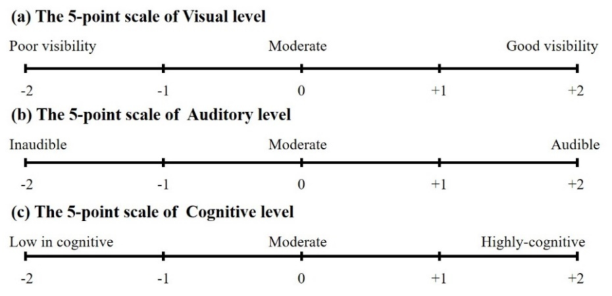
The field questionnaire used in this study is illustrated in Fig. 1. The personal variables included in the questionnaire were categorized into two main sections. The first category, “Basic Information,” collected demographic details such as gender, age, and personal physical attributes (height, weight). The second category, “Personal Level,” assessed sensory perception and cognitive levels. Based on previous research findings, the questionnaire specifically focused on visual and auditory perception, which play a crucial role in elderly evacuation. To ensure intuitive responses and ease of evaluation, both sensory perception levels and cognitive levels were measured using a five-point Likert scale, allowing participants to provide a straightforward and structured assessment of their abilities.
The survey was conducted as follows, with the process divided into a waiting area and an experiment area. All participants were first guided by staff to the waiting area, where they were provided with an overview of the study and given an informed consent form regarding the use of research data. After signing the consent form, the field questionnaire was distributed. Participants initially completed the first section (Basic Information), which included gender, age, and physical attributes, while in the waiting area. Upon completion, they were individually guided to the experiment area in the order
they finished. In the experiment area, participants completed the Personal Level assessment, which measured.
The survey was conducted with actual users of Long-Term Care Facilities (LTCFs) in South Korea, which were selected as the target sites. Among the facility users, only elderly individuals aged 65 and older, as defined by domestic standards, were selected as participants (Minegishi, 2021). The study was conducted at four LTCFs in South Korea, all of which agreed to both on-site visits and participant recruitment. All participants had no reported physical health or mental health conditions that could affect their ability to participate in the study. Additionally, all participants provided informed consent for the use of their personal data for research purposes.
RESULT
A total of 70 questionnaires were collected through the on-site survey. However, seven questionnaires were excluded due to duplicate participants, resulting in a final dataset of 63 valid responses for analysis. The participants in this study ranged in age from 65 to 84 years. Among them, those aged 65–69 accounted for the largest proportion at 43% (27 participants). In contrast, those aged 80–84 represented the smallest proportion at 16% (10 participants), though this was only 1% lower than the 75–79 age group (11 participants) (see Table 1). Consequently, the average age of the participants was 71.9 years (SD: 5.8). In terms of gender distribution, 57% (36 participants) were female, while 43% (27 participants) were male.
Table 1: Age distribution of participants.
Table available in the original PDF paper.
Percentage Category Parameter Number of participants Age (i) 65–69 27 43% (ii) 70–74 15 24% (iii) 75–79 11 17% (iv) 80–84 10 16%
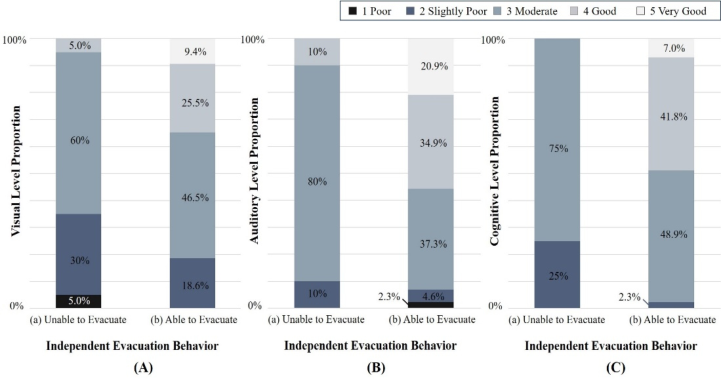
The analysis results of visual, auditory, and cognitive levels in relation to independent evacuation behavior are presented in Figures 2(A), (B), and (C), respectively. The data were measured using a five-point scale, where 1 represents “Poor” and 5 represents “Very Good.”
In Figure 2(A), among participants unable to evacuate independently, 30% reported their vision as “Slightly Poor” (2 scale), and 60% rated their vision as “Moderate”(3 scale). Notably, 5% of this group had “Very Poor”(1 scale) vision, which could significantly hinder their ability to perceive evacuation signs and routes. In contrast, among those able to evacuate independently, only 18.6% rated their vision as “Slightly Poor” (2 scale), while 46.5% assessed it as “Moderate” (3 scale), and a higher proportion (25.5%) rated it as “Good” (4 scale). These findings suggest that better visual ability is associated with a higher likelihood of independent evacuation.
In Figure 2(B), among participants unable to evacuate independently, 80% rated their hearing as “Slightly Poor” (2 scale), while 10% reported
Understanding Sensory Perception and Cognitive Abilities Based on the Elderly’s Capability 125
“Very Poor” (1 scale) hearing. This indicates that hearing impairments may contribute to evacuation difficulties. Among participants able to evacuate independently, the hearing level distribution was more balanced: 37.3% rated their hearing as “Slightly Poor” (2 scale), 34.9% rated it as “Moderate” (3 scale), and 20.9% rated it as “Good” (4 scale). These findings suggest that auditory perception influences evacuation behavior, though it may have a slightly lesser impact compared to vision.
In Figure 2(C), the most significant difference was observed in cognitive levels. Among participants unable to evacuate independently, a striking 75% had “Slightly Poor” (2 scale) cognitive function, and 25% had “Very Poor” (1 scale) cognitive ability. In contrast, among those able to evacuate independently, nearly half (48.9%) reported their cognitive function as “Good” (4 scale), while 41.8% rated it as “Moderate” (3 scale). Only 2.3% of this group had “Slightly Poor” (2 scale) cognitive ability. These results strongly suggest that cognitive ability is a crucial factor in independent evacuation behavior.
Cognitive ability is the key factor in independent evacuation, followed by visual and auditory perception. Poor cognition, vision, and hearing were more prevalent among those unable to evacuate, emphasizing the need for cognitive and visual support in elderly evacuation strategies.
These findings indicate that cognitive ability is the most critical factor in independent evacuation, followed by visual and auditory perception. Poor cognition, vision, and hearing were more prevalent among those unable to evacuate, emphasizing the need for cognitive and visual support in elderly evacuation strategies. Impaired vision and cognitive decline hinder
route recognition and decision-making, whereas better sensory and cognitive abilities improve evacuation success.
In conclusion, this study highlights the need for elderly-friendly evacuation systems that integrate visual, auditory, and cognitive support to improve safety and efficiency. Future research should explore tailored evacuation training for the elderly to optimize emergency preparedness. Additionally, further studies on evacuation methods that account for cognitive ability are essential to better support elderly individuals in emergency situations.
FUNDING This research was supported by Basic Science Research Program through the National Research Foundation of Korea (NRF) funded by the Ministry of Education (RS-2024-00460627) and This work was supported by the National Research Foundation of Korea (NRF) grant [grant number RS-2023-00278882 & RS-2024- 00460627], which was funded by the Korean government (Ministry of Science and ICT, MSIT).
ACKNOWLEDGMENT
This research was supported by Basic Science Research Program through the National Research Foundation of Korea (NRF) funded by the Ministry of Education (No. NRF-2022R1A6A3A01087255) and National Research Foundation of Korea grant funded by the Korea government (MSIT) (No. NRF-2022R1C1C2007215).
REFERENCES
A. Rahouti, R. Lovreglio, D. Nilsson, E. Kuligowski, P. Jackson, F. Rothas, Investigating evacuation behaviour in retirement facilities: Case studies from New Zealand. Fire Technol. 57(3) (2021) 1015–1039. D. Armedeo, J. Griffin, J. Potter, Wayfinding in Public Spaces: The Dallas-Fort Worth
Airport. (1983), 129–138. G. Lui, L. Tong, Survey on total fire safety in residential care homes for elderly persons in Hong Kong. Commun. Technol. (2010) 171–182. H. Frantzich, Occupant behaviour and response time – Results from evacuation
experiments. Human behaviour in fire: Understanding human behaviour for better fire safety design. (2001) 159–166. J. Li, J. Wang, B. Jin, Y. Wang, Y. Zhi, Z. Wang, Evacuation of nursing home based on massmotion: Effect of the distribution of dependent elderly. KSCE J. Civil Eng. 24 (2020) 1330–1337. M. Gerges, S. Penn, D. Moore, C. Boothman, C. Liyanage, Multi-storey residential
buildings and occupant’s behaviour during fire evacuation in the UK: Factors relevant to the development of evacuation strategies. Int. J. Build. Pathol. Adapt. 36(3) (2018) 234–253. K. Rendón Rozo, J. Arellana, A. Santander-Mercado, M. Jubiz-Diaz, Modelling building emergency evacuation plans considering the dynamic behaviour of pedestrians using agent-based simulation. Saf. Sci., vol. 113, pp. 276–284, 3 (2019). L. Fu, S. Cao, W. Song, J. Fang, The influence of emergency signage on building
evacuation behavior: An experimental study. Fire Mater 43(1) (2019) 22–33.
Understanding Sensory Perception and Cognitive Abilities Based on the Elderly’s Capability 127
L. Qu, Y. Wang, Y. Cao, Fire safety in high-rise buildings under elderly housing. IOP Conf. Ser. Earth Environ. Sci. 238(1) (2019) 012055. Lee, Ju Ho. Issues and Development Direction of Disaster Safety Education for
Disaster Vulnerable Groups: Focusing on Multicultural Family. Crisisonomy. 12(11) (2016) 37–50. Meiqing Fu, Why individuals do not use emergency exit doors during evacuations: A virtual reality and eye-tracking experimental study. Advanced Engineering Informatics 14 February (2024). M. Tancogne-Dejean, P. Laclémence, Fire risk perception and building evacuation by
vulnerable persons: Points of view of laypersons, fire victims and experts. Fire Saf. J. 80 (2016) 9–19. M. Kobes, I. Helsloot, B. de Vries, J. G. Post, Building safety and human behaviour in fire: A literature review. Fire Saf. J. 45(1) (2010) 1–11. Yoshikazu Minegishi, Experimental study of the walking behavior of crowds mixed
with slow-speed pedestrians as an introductory study of elderly-mixed evacuation crowds. Fire Safety, (2021) 120. Yuki Akizuki, Evacuation route design based on visibility for reducing evacuation delays. Fire Safety Journal 13 January (2024).
LISTED IN THE AHFE DIGITAL BOOKSTORE CATALOGUE
Explore the complete digital volume
Safety Management and Human Factors
Read this individual research paper free through the original publisher, or explore the full digital proceedings book.
ISBN 978-1-964867-65-6
Explore this ISBN in the AHFE Bookstore ↗Listed in the July 2026 bookstore catalogue; search by ISBN to confirm current availability · Digital book purchase optional